• About
  • Donate!
  • EVENTS
  • Ottawa’s “Energy Evolution”: wind turbines coming to rural communities
  • Thinking of signing a wind turbine lease?
  • Wind Concerns Ontario
  • Wind turbines: what you need to know

Ottawa Wind Concerns

~ A safe environment for everyone

Ottawa Wind Concerns

Category Archives: Health

Nation Rise wind power project likely to create noise, health problems: WCO president

07 Tuesday Aug 2018

Posted by Ottawa Wind Concerns in Health, Renewable energy, Wind power

≈ 1 Comment

Tags

adverse health effects, EDP Renewables, environmental noise, ERT, Health, Nation Rise, Ontario Ministry of Environment, Wind Concerns Ontario, wind farm, wind turbine noise

(C) ONTARIO FARMER

July 31, 2018

Report by Tom van Dusen

Finch, Ontario — Sitting demurely and speaking quietly, on July 24 the volunteer president of Wind Concerns Ontario blasted the provincial government approach to monitoring industrial wind turbines, accusing it of ignoring complaints about noise, health and other issues, or deferring them with no subsequent action.

Jane Wilson made  her comments while presenting as a witness during an Environmental Review Tribunal hearing into the Nation Rise wind power project planned for Stormont County. The hearing is scheduled to continue through August 2.

Currently engaged in the approval process, the project is sponsored by EDP Renewables Canada and calls for installation of some 33 turbines in North Stormont farm country delivering a total of 100 megawatts of power that, opponents observe, the province doesn’t need.

Headed by local resident Margaret Benke, opponents were hopeful the new Doug Ford government would cancel Nation Rise just as it did the White Pines wind project in Prince Edward County. But that didn’t happen and opponents’ legal fees and other expenses are up to $20,000. Benke noted that, with Ford in place, Nation Rise isn’t likely to proceed and yet opposing residents are still on the hook for costs.

Government not enforcing the law

A registered nurse, Wilson said Wind Concerns represents a coalition of more than 30 community groups across Ontario.

She emphasized that the Ministry of the Environment and Climate Change–renamed Environment, Conservation and Parks — has pledged to protect the environment and human health from any turbine side effects.

She cited former Environment Minister Glen Murray congratulating his officials for responding quickly to complaints and enforcing the law. However, Wilson’s review of incident reports obtained through Access to Information indicated the ministry doesn’t respond to all complaints and “does not, therefore, enforce the law.”

No answer to that

Total number of incident reports filed with the ministry between 2006 and 2016 was 4,574, Wilson told Maureen Cartier-Whitney, chair of the one-person panel. Records showed that in more than 50 per cent of formal complaints, there was no ministry response. Another 30 per cent were deferred. “In fact, only one percent received priority response.”

While he asked for some clarification, Paul McCulloch of the ministry’s Legal Services Branch, didn’t dispute Wilson’s basic facts. Representing EDP, lawyer . Grant Worden also offered no challenges to Wilson.

The repetitive nature of various complaints suggests, Wilson continue, that wind power developers are failing to live up to the terms of their approvals by allowing conditions triggering adverse effects including on health, to continue.

“Documented health effects include headache, sleep deprivation, annoyance, and ringing or pressure sensation in the head and ears. Most disturbing was the fact that these health effects were reported many times, and also among children.”

Wilson indicated that 39 per cent of 2006-2016 incident reports referred explicitly to sleep disturbance which is generally blamed for a myriad of diseases and disorders.

“Given the thousands of unresolved noise complaints in Ontario, and given Health Canada results of adverse health effects at distances of 550 metres to 1 km, it is reasonable to question whether the Nation Rise power project will not also engender community reports of excessive noise and adverse effects.”

contact@windconcernsontario.ca

To help support the appeal, which is bringing forward issues never presented to the ERT before, please send a cheque to Concerned Citizens of North Stormont, c/o Wind Concerns Ontario, PO Box 509, 250 Wellington main Street, Wellington ON  K0K 3L0


Nation Rise project: significant concerns over health, environmental damage


North Stormont community fight for environment begins Monday

22 Sunday Jul 2018

Posted by Ottawa Wind Concerns in Health, Ottawa, Renewable energy, Wind power

≈ 1 Comment

Tags

EDP Renewables, environment and energy, Environmental Review Tribunal, Eric K Gillespie, ERT, Ministry of Environment Conservation and Parks, renewable energy, William Palmer, Wind Concerns Ontario, wind farm, wind power

Citizens of North Stormont are preparing for their appeal of the 100-megawatt wind power project, which begins Monday in Finch before the Environmental Review Tribunal

Wind turbine near Brinston, south of Ottawa: citizen reports of noise from industrial wind turbines are unresolved in Ontario [Photo: Ray Pilon]

July 22, 2018

In a bizarre fight which sees ordinary citizens marshalling scarce after-tax dollars to fight the Ontario government’s environment ministry to try to protect the environment (and safety and health), the Concerned Citizens of North Stormont begins its appeal of the 100-megawatt “Nation Rise” wind power project tomorrow, July 23rd.

The appeal goes before the quasi-judicial Environmental Review Tribunal, a panel that is part of the Environment and Lands Tribunals (ELTO) of Ontario.

Almost every single wind power project in Ontario has been appealed, but there have been few victories in a system apparently set up to favour the power developers. Most successful appeals were won on blatant risks to wildlife and the environment, and one on aviation safety (the completely insane Fairview Wind project, planned between two airports near Collingwood).

Despite decisions that note the pain suffered by people forced to live inside wind power projects, the Tribunal has refused to consider any risk to health from the huge industrial-scale wind turbines, that do emit a range of noise.*

The power developer, Portugal-based EDP, is represented by John Terry of international law firm Torys LLP; Mr Terry has also represented the wind industry lobbyist and trade association, CanWEA, in the past. The new environment ministry, now the Ministry of the Environment, Conservation and Parks or MECP, will also be represented by a team of lawyers.

The citizens’ group will be represented by lawyers from the environmental law firm of Eric K. Gillespie.

Risks to environment, safety and health

The community concerns filed with the Notice of Appeal include the danger to the area water supply (most of the project is on a “highly vulnerable” aquifer), safety from turbine operations, and health impacts from the noise from the industrial-scale wind power generators/turbines.

Tomorrow’s appearance will consist of Opening Statements, and a series of presenters including mechanical engineer Vern Martin, who will discuss safety concerns posed by the wind turbines and blades.

Tuesday, the themes are noise and health, and public safety, with Wind Concerns Ontario president Jane Wilson presenting data on the thousands of noise complaints lodged with the Ontario government which have not been resolved. Engineer William Palmer will present information on turbine events in Ontario related to debris and ice throw from the turbine blades.

Thursday will see appellant presenters discussing the risk to the aquifer and local water wells, posed by the foundation construction and wind turbine vibration.

The proceedings will take place in the Finch Community Centre and Arena, beginning at 9 a.m., and are open to the public.

Fund-raising for the citizen effort to protect the community is ongoing, please see the Go Fund Me link, here.

contact@windconcernsontario.ca

  • From the report on wind turbine noise by the Council of Canadian Academies, 2015: “Wind turbines are a particularly complex and distinctive source of sound, which can span a wide range of frequencies including low-frequency tones. …The evidence shows a positive relationship between outdoor wind turbine noise levels and the proportion of people who report high levels of annoyance. (“Annoyance” is employed here as a medical term denoting stress or distress. Annoyance is listed by the World Health Organization as an adverse health effect.)

Ottawa area community ramps up wind farm fight

17 Tuesday Jul 2018

Posted by Ottawa Wind Concerns in Health, Renewable energy, Uncategorized, Wind power

≈ 1 Comment

Tags

Conservation and Parks, EDP Renewables, environment, ERT, MECP, North Stormont, Ontario Environmental Review Tribunal, Ontario Ministry of Environment, wind power, wind turbines

Last chance for justice

CAM01025

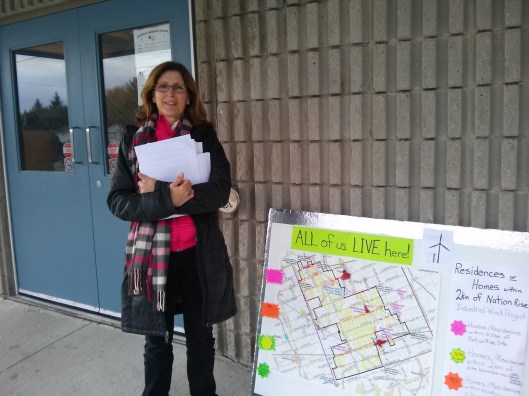
Concerned Citizens of North Stormont leader Margaret Benke : power not needed, plenty of environmental dangers ahead

July 17, 2018

Residents of Berwick, Finch and Crysler, just 40 minutes south of Ottawa, are working day and night to prepare for their appeal of the Nation Rise wind power project, scheduled to begin next Monday in Finch.

The power project, planned to have a capacity of 100 megawatts of power (though wind power is typically less than 30% efficient) and would see more than 30 huge industrial wind turbines throughout the project area.

If it goes ahead, that is.

And that’s something many in the community are determined to fight.

The project was one of five new wind power contracts awarded in 2016 under the Large Renewable Procurement program (LRP). The 20-year cost of the contract, which will be added to Ontario electricity customers’ bills, will be more than $436 million, or almost $22 million a year. The new Ontario government pledged to cancel all five of those contracts and so far, has dispatched three of them, with an announcement last Friday.

Without formal cancellation, however, the community through a citizens group Concerned Citizens of North Stormont, is forced to proceed with its expensive appeal of the project’s Renewable Energy Approval. That approval, or REA, was given just three days before the writ period began for the recent Ontario election—an act that runs counter to the accepted idea that governments go into “caretaker” mode immediately prior to the election.

That is costing North Stormont residents thousands, but it’s costing all Ontario taxpayers, too, says Margaret Benke, spokesperson for the community group. “They have to send all those lawyers up here from Toronto, they have to stay somewhere, they have to eat — it all costs money, as they defend a bad decision made by the previous government.”

Why a bad decision? The majority of the power project would be built on land that is designated as a “highly vulnerable aquifer” meaning it is at risk for contamination by pollutants, and that the hydrogeology is such that the aquifer could be disturbed and wells for farms, homes and businesses could fail. That’s already happened near a wind power project in North Kent, and the new government has promised a public health investigation.

There are other environmental concerns about the project, including the risk of injury from blade failures and ice throw from the huge blades.

And then there’s the noise. The industrial-scale wind power generators produce a range of noise emissions which affect a significant portion of the population. The turbine noise can cause disturbance of sleep which results in other health problems; the unique quality of the turbine noise also results in “annoyance,” a medical term for stress or distress.

Almost every wind power project in Ontario has been appealed by Ontario citizens, and a few have been successful, but none on human health. At present, according to Wind Concerns Ontario, there are thousands of official reports of excessive wind turbine noise, almost none of which have ever been resolved.

The power developer, Portugal-based EDP Renewables, operates the South Branch wind power project in nearby Brinston; there have been noise complaints for that project, but they are unavailable under Freedom of Information requests because the Environment ministry’s Cornwall office did not follow procedures and issue tracking numbers for the complaints.

Wind Concerns Ontario president Jane Wilson, a Registered Nurse, says that situation “is an outrage. If it were anything else, like a model of automobile that had a few engine fires, or a food product that was contaminated, it would be recalled. In Ontario, this terrible situation is allowed to go on and on, with the Environmental Review Tribunal and the former Ministry of the Environment just letting it happen.”

“This appeal is the community’s last chance for justice outside of the court system or the Legislature,” says Wilson. “I hope the Tribunal will finally recognize its responsibility to this community, and rescind the approval for this project.”

The appeal begins Monday morning in Finch, at the Finch Community Centre/North Stormont Arena.

Ottawa resident’s case goes to court with charges against government on environment

15 Tuesday May 2018

Posted by Ottawa Wind Concerns in Health, Ottawa, Renewable energy, Wind power

≈ 1 Comment

Tags

environment, MInistry of the Environment and Climate Change, MOECC, wind farm, wind turbine noise

A private citizen alleges the Minister of the Environment and Climate Change has violated terms of the Environmental Protection Act

Wind turbine near Brinston, south of Ottawa: citizen noise reports unresolved [Photo: Ray Pilon]

May 15, 2018

A resident of North Gower in the City of Ottawa is represented by lawyers in a Toronto court Thursday with a charge against Chris Ballard for violating a section of the Environmental Protection Act. Mr. Ballard is Ontario’s minister of Environment and Climate Change.

Using a little known legal option available to citizens known as a private prosecution, Jane Wilson has charged Mr. Ballard with “causing or permitting the discharge of a contaminant, namely noise, into the natural environment that has caused, or may cause an adverse effect.”

“I am not taking this step lightly,” Wilson says, “this is very serious. But with thousands of reports of excessive noise from wind turbines unresolved in Ontario, and more new power projects planned, I had no choice. He is responsible for allowing the noise to continue to be discharged into the environment.”

Wilson, a Registered Nurse, is president of Wind Concerns Ontario, a coalition of 30 community groups and individuals and families concerned about the negative impacts of utility-scale wind power generation projects. She is also the chair of local community group, Ottawa Wind Concerns, which battled a wind power project proposed for North Gower. That project would have exposed hundreds of families to noise from wind power generators or turbines placed close to the rural village.

People forced to live near wind power projects are going without sleep for days, weeks, even months because of wind turbine noise, Wilson says. Documents provided to Wind Concerns Ontario under Freedom of Information show that the government has received more than 4,500 formal reports of excessive noise from wind turbines since 2006, but responds to about 7 percent of the complaints.

“Sleep disturbance has been confirmed as a link to other health problems such as high blood pressure and diabetes,” says Wilson. “Staff notes in these reports contain reference to health impacts in about 35 percent of the complaints.”

“I am just trying to do whatever I can to get some help for these people.”

The MOECC just gave Renewable Energy Approval to a 100-megawatt project in North Stormont, south-east of Ottawa, despite environmental concerns about noise and impact on the “vulnerable aquifer” that serves 10,000 wells in the area.

The charge against Mr. Ballard was signed by a Justice of the Peace in Toronto and the first appearance in the matter is in Toronto, May 17 at 9 a.m. at the Toronto East provincial courthouse. Wilson will be represented by Andrew Chachula of environmental law firm Eric K. Gillespie, in Toronto.

Contact: president@windconcernsontario.ca

Wind Concerns Ontario report on MOECC response to noise reports: Second Report Noise Complaints February 2018-FINAL

References: Environmental Protection Act Section 14 (1) and (2)

Adverse effect definition EPA 1 (1)


Ottawa-area wind power project approved; community concerns over water ignored

07 Monday May 2018

Posted by Ottawa Wind Concerns in Health, Ottawa, Renewable energy, Wind power

≈ 1 Comment

Tags

environment, North Stormont, Ontario Ministry of the Environment, renewable energy, Water quality, wind farm

Concerns about damage to the environment, and exposure to industrial power generator noise continue as the community ponders options

Concerned Citizens of North Stormont leader Margaret Benke : power not needed, plenty of environmental risk ahead

May 7, 2017

As seems to be typical for the Ministry of the Environment and Climate Change, the announcement of a Renewable Energy Approval (REA) for the controversial “Nation Rise” wind power project came late in the day last Friday, May 4.

The project has a nameplate capacity of 100 megawatts of power. Ontario currently has a surplus of electric power for the foreseeable future, the Independent Electricity System Operator (IESO) has said, but approved five more contracts in 2016, regardless.

The community group, Concerned Citizens of North Stormont, is worried about the impact of turbine construction on the aquifer and local water wells, especially following the failure of 20 wells in the Chatham-Kent area during construction of the North Kent Wind power project. The geology there is fragile Kettle Point Black Shale; independent hydrogeologists have said the vibration from pile-driving disturbed the shale and now wells are clogged with shale particles. The shale is known to contain toxic heavy metals such as arsenic.

In the Nation Rise project area, the hydrogeology is not shale but there are concerns nonetheless; in fact, almost all of the turbines are planned in an area designated “highly vulnerable aquifer.” (See map, below)

And, in spite of just receiving approval late Friday, the company has already done pile-driving for the project, without a formal construction plan or indeed, a formal Notice To Proceed from the government.

The community group has 15 days from the approval announcement to decide whether to appeal.

To contact Concerned Citizens of North Stormont, go to: http://concernedcitizensofnorthstormont.ca/

MEDIA: to contact the community group leadership, email Wind Concerns Ontario at contact@windconcernsontario.ca

#MOECC


Ottawa area community groups petition Queen’s Park today

30 Monday Apr 2018

Posted by Ottawa Wind Concerns in Health, Renewable energy, Wind power

≈ 1 Comment

Tags

Dutton-Dunwich, environmental noise, North Stormont, Ottawa, renewables, The Nation, Wallaceburg, wind farm noise, wind power

Concerned Citizens of North Stormont leader Margaret Benke, Same rules for everybody.

April 30, 2018

The Ontario government realized there were inadequacies in their protocols for wind turbine noise and the assessment procedures needed in the approval process for new wind power projects, so they changed them.

And then gave the five newest wind power projects the option not to use the new rules.

As a result, the powerful power generators in projects that received contracts in 2016 but which are not yet built — in fact four don’t have Renewable Energy Approval yet — will be out of compliance with the new regulations the minute they start operating.

Four Ontario community groups think that’s not right.

They’re heading to Queen’s Park today as three MPPs present thousands of signatures on a Petition, asking the government to follow its own rules.

Representatives of Ottawa-area Concerned Citizens of North Stormont and Save The Nation will join their colleagues from Dutton Dunwich Opponents of Wind Turbines (DDOWT) and Wallaceburg Area Wind Concerns as the Petition is presented in the Legislature.

The Petition is related to the creation of “Transition Provisions” by the Ministry of the Environment and Climate Change (MOECC) in the Renewable Energy Approval process, which allows wind power developers to ignore new noise modelling guidelines, even for the newest unapproved power projects.

“The MOECC recognized that the previous requirements for turbine noise modelling were inadequate and they revised them,” says Bonnie Rowe, spokesperson for Dutton Dunwich Opponents of Wind Turbines (DDOWT), whose citizen group has applied for a Judicial Review of the Transition. “The noise modelling requirements are important to protect health and safety for people living near the turbines but now, the government has allowed the developers for the new projects to use the old ones — we think that’s wrong.

“If the government sets rules, especially for health, then everyone should have to follow them, no exceptions.”

Wind turbine noise has been linked to sleep disturbance, which in turn leads to other, serious health problems. According to Wind Concerns Ontario, documents received from the Ministry of the Environment and Climate Change #MOECC show that thousands of reports of excessive noise remain unresolved, and not responded to in Ontario.

MPPs presenting the petitions Monday are: Jeff Yurek, from Elgin-Middlesex-London where the Strong Breeze Wind Power Project is proposed for Dutton Dunwich; Monte McNaughton, from Lambton-Kent-Middlesex where the Otter Creek Wind Farm is proposed for the Wallaceburg area; and Jim McDonell, MPP for Stormont-Dundas-South Glengarry, who will be delivering petitions on behalf of the North Stormont area where the Nation Rise Wind Farm is proposed, and also the Municipality of The Nation, where the Eastern Fields Wind Power Project is proposed.

Concerned Citizens of North Stormont: Margaret Benke  macbenke@aol.com

Ottawa Wind Concerns: ottawawindconcerns@gmail.com

Ottawa area citizen groups to sue Ontario over wind turbine noise

28 Sunday Jan 2018

Posted by Ottawa Wind Concerns in Health, Ottawa, Renewable energy, Wind power

≈ 1 Comment

Tags

Concerned Citizens of North Stormont, Eric Gillespie, MOECC, Ontario Ministry of the Environment and Climate Change, Ottawa wind farms, wind energy, wind farm, wind farm noise, wind power, wind turbine noise

CBC.ca

Citizens sue province over proposed industrial wind turbine projects

Groups allege 5 wind power projects are allowed to defy safe noise limits

By Amanda Pfeffer, CBC News Posted: Jan 28, 2018 6:20 AM ETLast Updated: Jan 28, 2018 6:20 AM ET

Citizens living near five proposed wind turbine parks in Ontario have launched a lawsuit alleging the provincial government is allowing the companies behind the projects to defy safe noise limits.

The province approved the wind park projects in 2016. They are scattered around rural Ontario, and two are within an hour’s drive from Ottawa.

The projects are now going through a “technical review” as part of the final approval process by the Ontario Ministry of Environment and Climate Change.

  • Wind turbines approved for eastern Ontario despite objections

In 2016, the Ontario government also introduced new and more accurate standards for how companies model the noise impact of turbines before they’re built.

Map of wind turbine impact, Eastern Fields Wind Power Project

Map depicting range of impacts of wind turbines for Eastern Fields project near St Bernardin and St Isidore, east of Ottawa [Photo: Radio-Canada]

Suit alleges standards out of date

The lawsuit, however, alleges the proponents behind the five projects have been using old modelling standards.

“It appears that the majority of proposed turbine sites are out of compliance with the [new] requirements,” states the suit, which has been filed with the Ontario Divisional Court.

If the projects were forced to adhere to the new standards, three quarters of the more than 200 proposed turbines in the province would be breaking the rules, according to Eric Gillespie, the Toronto lawyer who filed the suit on behalf of concerned citizens.

If the companies used the new guidelines for modelling, Gillespie said, those rule-breaking turbines “will have to be relocated or removed.”

Citizens concerned about impact on health

The suit doesn’t ask for monetary damages, said Gillespie, but is about ensuring “that anyone living near an industrial wind turbine project is safe.”

“There’s well-documented research that you don’t want to go above the legislated level,” said Gillespie, adding that the noise associated with the loud, rhythmic drumbeat of the turbines can affect sleep, heart health, and general well-being.

“Unfortunately, it appears almost all these projects and most of the turbines in them are going to [break the guidelines] if they’re allowed to proceed.”

The lawsuit includes affidavits from experts on noise pollution, as well as from residents affected by the projects.

Gary Wheeler, a spokesperson with the Ontario Ministry of Environment and Climate Change, wrote in an email that the ministry is working with the companies behind the wind turbine projects to make sure they meet “our stringent noise standards.”

“We will be determining the appropriate next steps,” said Wheeler, who declined to comment on the lawsuit.

Margaret Benke

Margaret Benke, right, lives near the proposed Nation Rise Wind Farm located in the Township of North Stormont. She met Saturday with other residents to discuss the lawsuit. [Photo: Radio-Canada]

Residents plan strategy

The five proposed projects include two in eastern Ontario:

  • Eastern Fields Wind Power Project, in the Municipality of The Nation.
  • Nation Rise Wind Farm, in the Township of North Stormont,

Some of the residents living close to those projects met Saturday to discuss the suit and their next steps.

“We’re asking the government to consider the sentence they’re imposing on the people of rural Ontario,” said Margaret Benke, who lives near the proposed Nation Rise Wind Farm, about 60 kilometres southwest of Ottawa.

Benke said she’s concerned that almost three quarters of the turbines proposed in her community would break the current noise standard.

“I can move out,” she said, “but there are many people without that option. Even if their health is affected.”

The three other projects are all in southern Ontario:

  • Otter Creek Wind Farm, north of Wallaceburg, Ont., in the Municipality of Chatham-Kent.
  • Romney Wind Energy Centre, in Lakeshore, Ont.
  • Strong Breeze Wind Power Project in the Municipality of Dutton/Dunwich.

###

Wind Concerns Ontario obtained records of noise complaints and government response in two batches, 2006-2014 and 2015-2016, under Freedom of Information legislation. There are thousands of unresolved citizen complaints about wind turbine noise and vibration; yet, the government is in the process of approving more industrial wind power projects. Read the WCO report here. NoiseResponseReport-FINAL-May9

NOTE: these power projects are NOT “parks.”

Serious questions still unanswered as Nation wind power developer holds final Open House

28 Monday Aug 2017

Posted by Ottawa Wind Concerns in Health, Ottawa, Renewable energy, Wind power

≈ 1 Comment

Tags

Eastern Fields wind farm, Julie Leroux, Leda Clay, MOECC, Ontario Ministry of the Environment and Climate Change, Renewable Energy Approval, Save The Nation, The Nation municipality, wind farm, wind farm noise, wind turbine, wind turbine noise

Citizens have concerns about impact of noise, and about environmental effects on water and wildlife

Citizens have unanswered questions about a huge power project in Nation Municipality [Photo: Ontario Farmer/PostMedia]


August 28, 2017

Wind power developer RES Canada has scheduled the final Open House events for the Eastern Fields wind power project in The Nation, east of Ottawa. The Nation includes St Bernardin and Casselman.

The power project proposed would be 32-megawatt capacity, and cost Ontario almost $140 million over the 20-year contract. Ontario is currently in a situation of surplus power, and is regularly selling off surplus power as well as paying power producers to “constrain” or not to produce.

Community group Save The Nation/Sauvons La Nation has many unanswered questions about the project says spokesperson Julie Leroux.

For example, the corporate power developer has not actually confirmed the type of turbines it will use, but has provided a Noise Impact Assessment Report based on computer noise modeling for a type of Vestas wind turbines.

There are questions too about studies of waterways and groundwater, and how the wind turbine foundations will affect the ground. The Nation has Leda Clay which can be unstable.

The water issue is of special concern as property owners in Chatham-Kent are now experiencing contaminated water or Black Water as vibration from turbine construction and operation has been implicated in disturbing aquifers, and causing toxic heavy metals to contaminate wells.

Another concern is the company’s response to complaints of excessive noise and vibration. Wind Concerns Ontario received documents under Freedom of Information legislation showing that thousands of noise complaints have been filed since 2006, very few of which have had any response or resolution. RES Canada’s Talbot development was the source of hundreds of noise complaints. The Ministry of the Environment and Climate Change (MOECC) leaves response to noise complaints up to the power developers, in spite of the Ministry’s mandate to protect the environment and health.

There will be two Open Houses, the final events before the developer files documents for a Renewable Energy Approval.

Tuesday August 29, 2017 from 5:00 pm to 8:00 pm

Caledonia Community Centre

6900 County Road 22

St-Bernardin, ON


Wednesday August 30, 2017 from 5:00 pm to 8:00 pm

Vankleek Hill Curling Club

136 Bond Street

Vankleek Hill, ON

To contact Save The Nation and donate toward pre-operational environmental testing and legal fees

Website: www.sauvonslanation.ca

Email: Sauvonslanation@xplornet.com

Tel.: 613-678-6471


Honesty required for new Environment Minister

01 Tuesday Aug 2017

Posted by Ottawa Wind Concerns in Health, Renewable energy, Wind power

≈ 3 Comments

Tags

Chris Ballard, EDP Renewables, environmental damage wind farm, Jane Wilson, La Nation, MOECC, North Stormont, Ottawa wind farms, RES Canada, Wind Concerns Ontario, wind farm noise, wind farms, wind power, wind turbine noise, Wynne government

EDP wind turbine and home at South Branch project, Brinston, Ontario. Problems unresolved. [Photo by Ray Pilon, Ottawa]

With more wind power projects queued up for environmental approvals to produce intermittent electrical power Ontario doesn’t need, Ontario’s new Minister of the Environment and Climate Change needs a fresh approach.

The previous Minister left thousands of complaints about noise and vibration unresolved, and did not follow through on promises to help people affected by the huge wind turbine installations.

Right now, in the Ottawa area, two projects are planned: the “Eastern Fields” in The Nation and “Nation Rise” in North Stormont. Both are opposed by their communities, both projects will come with negative environmental and social impacts, and neither will produce power that’s needed.

Wind Concerns Ontario has sent a letter to the new Minister with a “To Do” list for his immediate attention.

Here it is:

To the Honourable Chris Ballard

Minister of the Environment and Climate Change

Queen’s Park, Toronto

Welcome to your new position as Minister of the Environment and Climate Change.

Unfortunately, Minister Glen Murray has left you an extensive list of action items requiring your immediate follow-up. We highlight the key issues for you in the following list, related to Ontario’s energy policy and wind power projects.

White Pines – Withdraw the Renewable Energy Approval for this project as developer wpd cannot meet the terms of their contract. There are significant environmental concerns with this project that remain, even after a successful appeal by citizens before the Environmental Review Tribunal.

Amherst Island – Rescind Renewable Energy Approval for this project which is planned for the tiny island heritage community. Significant environmental risks are present including the serious impact on migrating birds that congregate in this area; Ontario does not need the power from this project.

Saugeen Shores – The single wind turbine at the Unifor educational facility has been fraught with problems and engendered hundreds of complaints about excessive noise. This turbine would not be allowed under present regulations. You can immediately address the failure to meet a June 30 deadline for submission of a compliance audit report.

K2 Wind – This is another wind power project, a large one, with many problems in its relatively short history. You can deliver on Minister Glen Murray’s mid-May commitment to Black family, and others, to provide a solution to wind turbines that MOECC testing indicated were not compliant with Ontario regulations to protect the environment and health.

Address Concerns Raised at Request of Minister Murray – Many people across Ontario took Minister Murray at his word when he said that there were no complaints reaching his office and that he would ensure his officials responded quickly to address the issues. They wrote to him and are still waiting for action on their issues.

Complaint Tracking Process – Complaint records released to WCO in response to an FOI request indicate that the MOECC does not respond to most complaints about wind turbine noise. These complaints should be a source of learning for the Ministry rather than being ignored as currently appears to be the case. A full revision of the process is needed to ensure that complaints are actually resolved with procedures that allow the Minister’s office to track resolution. MOECC records indicate little or no resolution of more than 3,100 formal Pollution Reports made by Ontario citizens between 2006 and 2014.

REA Approval Process – Increase setbacks from residences to reflect learning from MOECC complaint records that include staff reports that confirm that current regulations are not sufficient to protect health of residents living in wind projects. Last week, the Supreme Court of Canada set out standards for consultations with communities which are substantially more rigorous than the standards used for Ontario Renewable Energy Projects.

MOECC Noise Modeling Procedures – implement new noise modeling procedures based on MOECC internal testing that demonstrates wind turbines routinely exceed predicted levels.

Otter Creek – Retract decision to deem this application “complete” for the Renewable Energy Approval process. The proponent is unable to provide noise emission data for the turbine equipment proposed. The noise report submitted with the application for a REA is not grounded in fact but rather is estimates based estimates. Also, a full MOECC investigation of the impact on well water is required.

LRP I Contracts – suspend REA process for remaining LRP I projects until full review of requirements based on internal complaint records is completed.

Noise Compliance Audit Protocol – Expand the wind speeds covered under the protocol to include wind speeds below 4 metres/second which are the source of a substantial portion of complaints about excessive noise. Even MOECC testing shows these wind speeds are the source of noise levels exceeding 40 dB(A), which completely undercuts the credibility of this audit process.

REA Enforcement – REA terms make the project operator responsible for addressing the concerns raised in each complaint to ensure that it does not recur. The MOECC needs to follow up on all operating with projects to ensure compliance with these terms and take action where it is not occurring.

Shadow Flicker – The flickering shadows produced when a turbine is positioned between the rising or setting sun is a major irritant for residents. It is not considered in the REA approvals and is easy to address by turning off the turbine for the times when it is casting moving shadows on a house.  In some projects, these changes have been implemented by the wind company but in other MOECC staff is telling residents no action is required, even though the REA requires the wind company to address complaints like these.

Infrasound – Expand MOECC testing to include the full range of noise emissions from wind turbines as independent testing shows the presence of elevated levels of infrasound in homes where residents have had to leave to protect their health.

Health Studies – The Ministry has been telling residents that its policy is based on the “best science” available since the first turbine projects were built. MOECC records clearly show that this is not correct, but the Ministry continues to be willfully blind to input from both residents and its own staff, quoting dated and selective literature reviews in a field where the science is rapidly evolving.  The need for noise studies and other investigation has been highlighted in numerous reports but never undertaken.  It is time for some serious field studies of the problems being caused by wind turbine projects in rural communities across Ontario. This was an information gap identified in 2010 by Ontario’s Chief Medical Officer of Health.


Last, it is important that as you prepare for this major portfolio, you understand that industrial-scale wind power generation does NOT benefit the environment.

Wind power generation on this scale is a high-impact development for little benefit, if any. Two Auditors General for Ontario recommended that Ontario undertake a cost-benefit and/or impact analysis — that has never been done.

We ask you to approach this issue with honesty and honour, and respect the wishes of the citizens of rural Ontario.

Sincerely,

Jane Wilson

President

Wind Concerns Ontario

Wind Concerns Ontario is a coalition of community groups, individuals and families concerned about the impact of industrial-scale wind power development on Ontario’s economy, the natural environment, and human health.

*Ottawa Wind Concerns is a community group member of Wind Concerns Ontario

ottawawindconcerns@gmail.com

Ontario government not measuring wind turbine noise effectively, engineer tells international conference

22 Monday May 2017

Posted by Ottawa Wind Concerns in Health, Renewable energy, Wind power

≈ 1 Comment

Tags

environmental effects wind farms, MOECC, Ontario government, renewable energy, tonal noise wind turbines, William Palmer, wind farm, wind farm noise, wind turbine, Wind Turbine Noise 2017, Wynne government

Noise measurement protocol needlessly complex, failing to identify critical issues with wind turbine noise, Ontario engineer says.

He used MOECC data to confirm “tonal” quality to wind turbine noise emissions. One project has been operating for eight years — residents continue to complain, no action by Ontario government

Conference venue in Rotterdam: Wind Turbine Noise 2017

Ontario engineer William Palmer has proposed a rigorous, but simple and transparent technique to assess wind turbine noise, that could replace the problematic complex computer models and “black box” algorithms currently used in the Ontario Ministry of the Environment and Climate Change newest protocol to assess wind turbine noise compliance.

Speaking at the International Conference on Wind Turbine Noise that took place in Rotterdam beginning May 2, Palmer said of his proposed method,

The method had to consider that an effective monitoring system must take into account more than just averaging sound power levels over a long term. The method recognizes that humans are bothered by the changes and annoying characteristics that occur, as well as long term averages. Others describe this as the need to determine how the special characteristics of sound quality may impact quality of life.

To verify this approach, assessments were conducted using the method at two wind power developments in Ontario. In the K2 Wind project, he used MOECC data from testing in early March 2017 at a home within the K2 project. He was able to demonstrate that the MOECC data confirmed that the noise from the turbines surrounding the home had a tonal quality; that means it should require a 5 dB(A) penalty be applied to the other test results.

He reported:

Although the Ministry did not provide calibration files for their sound recordings they did provide in their report their assessment of the sound pressure level for each sample. Using the Electroacoustics Toolbox, and working backwards to set the given sound pressure level for a number of the recordings provided as the calibration level, permitted a “Quasi Calibration” of the Ministry data, and from that a calibrated FFT analysis was made. … Again, it was seen that when the residents described adverse effects in their comments filed with their initiation of recordings, FFT analysis of the sound recordings taken at those times clearly show a tonal condition occurring at about 450 Hz.

In the Enbridge project, where Mr. Palmer also conducted testing, he found similar tonal quality to the noise emissions in that project, and confirmed that the noise coming from the turbines is above the approved levels at several locations.

For this facility as an example, where the turbines first went into operation in November 2008, and citizen complaints occurred soon after, it has not yet been possible to complete a report to demonstrate compliance. The monitoring is still in progress, over 8 years later, with the turbines continuing in operation, and residents continuing to complain. The hypothesis is that individual samples are not representative due to variation.

Process is complex

He offered comment on the current protocol being used to assess compliance by the MOECC:

A premise of the Ministry of the Environment and Climate Change wind turbine monitoring protocol is that monitoring to show compliance must be conducted over a long period. The protocol requires the initial acoustic monitoring by residents to produce at least a 10-minute sample for each complaint period, and the final compliance protocol requires a minimum of 120 one-minute measurement intervals for each integer of wind speed. During each of those one-minute intervals there must be no changes in wind speed or direction. A further 60 samples are required for each integer wind speed with the turbines not operational. So far data collection has taken years to obtain a sufficient number of samples, and in at least one array, initial reports showed that over 90% of samples taken were discarded as non-compliant. All samples are logarithmically combined to determine the Leq produced by the facility, which eliminates any short-term change effects. This appears to be precisely the sort of monitoring that was cautioned against by Genuit and Fiebig described in Section 1 when they noted, “By relying on sound pressure levels averaged over long time periods and suppressing all aspects of quality, the specific properties of environmental noise situations cannot be identified, because annoyance caused by environmental noise has a broader linkage with various acoustical properties such as frequency spectrum, duration, impulsive, tonal and low-frequency components, etc. than only with SPL [Sound Pressure Level]. In many cases these acoustical properties affect the quality of life.”

The annoyance aspects that impact the quality of life of impacted residents are not being assessed.

People walking away from loved homes

The current protocol cannot possibly identify critical issues in wind turbine noise emissions, Palmer asserts. In conclusion, he said:

This paper has demonstrated a method for rigorous monitoring of wind turbine sound. The goal of the method was to establish evidence for the condition noted by Karl D. Kryter: “The most direct, and perhaps most valid, insight into the possible presence and magnitude of stress reactions in general living environments is probably that which has been obtained from attitude surveys and real-life behaviour of people.” Behaviours such as walking away from an unsold loved home to live at the home of a family member, or when normal people become activists in trying to communicate their concerns provide such valid insights. The rigorous method had to consider the present acceptance criterion for wind turbines, in light of the insight given by those who study the quality of noise and its relation to annoyance. Those who study the subject identify that, “Current acceptance criterion relying on sound pressure levels averaged over long time periods and suppressing all aspects of quality cannot identify the specific properties of environmental noise situations.”

The results reported by Bill Palmer are typical of the community testing being undertaken in many communities near wind turbine projects across Ontario.

These findings indicate that the complex processes used by the MOECC and required of wind companies for compliance testing fail to identify key issues that can be quickly identified using much simpler techniques.

Meanwhile, the turbines, shown by other methods to be out of compliance, continue to operate.

[Re-posted from Wind Concerns Ontario]

← Older posts
Newer posts →

Recent Posts

  • Open letter to CAFES Ottawa
  • Ottawa Wind Concerns supports West Carleton residents
  • What does wind ‘farm’ construction really look like?
  • Unwilling Host communities surround Ottawa
  • How many birds do wind turbines kill?

Follow me on Twitter

My Tweets

Enter your email address to follow this blog and receive notifications of new posts by email.

Tags

Bob Chiarelli Green Energy Act IESO Ontario Ottawa Ottawa wind concerns wind energy wind farm wind power wind turbines

Contact us

PO Box 3 North Gower ON K0A 2T0

Create a free website or blog at WordPress.com.

Privacy & Cookies: This site uses cookies. By continuing to use this website, you agree to their use.
To find out more, including how to control cookies, see here: Cookie Policy
  • Subscribe Subscribed
    • Ottawa Wind Concerns
    • Join 379 other subscribers
    • Already have a WordPress.com account? Log in now.
    • Ottawa Wind Concerns
    • Subscribe Subscribed
    • Sign up
    • Log in
    • Report this content
    • View site in Reader
    • Manage subscriptions
    • Collapse this bar
 

Loading Comments...