• About
  • Donate!
  • EVENTS
  • Ottawa’s “Energy Evolution”: wind turbines coming to rural communities
  • Thinking of signing a wind turbine lease?
  • Wind Concerns Ontario
  • Wind turbines: what you need to know

Ottawa Wind Concerns

~ A safe environment for everyone

Ottawa Wind Concerns

Author Archives: Ottawa Wind Concerns

Enviro Canada needs new radar technology due to wind farms

11 Monday Aug 2014

Posted by Ottawa Wind Concerns in Renewable energy, Wind power

≈ 3 Comments

Tags

environment Canada, radar, radar weather stations, wind farm clutter, wind farms environment

Loess Hills Wind farm

By Clare Clancy, The Windsor Star, August 10, 2014

TORONTO – Environment Canada is preparing to roll out new radar technology in order to combat wind farm clutter, which clouds weather forecasts, misleads meteorologists and can even block radar signals.

Jim Young, who works at the agency’s national radar program, said new software will be incorporated into Canada’s radar system this fall in an effort to address the “contamination” caused by wind turbines.

“I certainly have very high hopes,” he said, adding that Environment Canada has been concerned about wind farm clutter for years.

The agency uses Doppler radar to predict storms, but the movement of wind turbine propellers can mimic weather.

Young said accurate radar data relies on movement — still objects including buildings, trees and towers are filtered out to allow for an analysis of the weather.

On its website, Environment Canada warns that the degradation of data can be “significantly misleading for forecasters under storm conditions.”

Young said the disruption caused by wind farms is based on their proximity to radar sites.

“The closer you get, that clutter becomes larger and larger,” he said.

In extreme circumstances, wind turbines can block radar scans, which Young compares to beams of light emanating from a flashlight.

“If you put a large obstruction in front of your flashlight, you are going to create a shadow behind it, where you can’t see anything,” he said, adding that the same thing can happen when scanning wind farms.

He said so far Environment Canada hasn’t had to deal with full blockages.

“Environment Canada will be very concerned if any wind farms are built that close to a radar site,” he said.

Young added that he has been working with research groups at McGill University and the University of Oklahoma on software for the past year.

The project will allow forecasters to better distinguish between weather and wind farms, but it still might not be enough in extreme weather, he said.

As an “extra layer of protection,” Environment Canada is in the process of finalizing a curtailment agreement with a major wind energy company, he said.

Young said the agreement will include shutting down wind turbines if necessary during extreme weather events.

A spokeswoman for NextEra Energy Canada, which has wind projects in Ontario, Quebec, Alberta and Nova Scotia, said the company has worked with Environment Canada to understand weather radar equipment and its compatibility with wind turbines.

Josie Bird said the agreed upon “exceptional weather event protocol” outlines how the company can work with Environment Canada in extreme weather.

“The mitigation agreement would provide Environment Canada the ability to request a change in the operations of the nearby wind farm, which will then be managed by our operations team,” she said via email.

Part of the problem is the competition for prime real estate, Young said.

“The ideal places for locating a wind farm are also ideal locations for weather radar,” he said. “You are close to populations and close to infrastructure.”

He added that he works with a U.S. counterpart to discuss wind farms close to the U.S.-Canada border, where most of Environment Canada’s radar network is set up.

But Canada has a “sparse” radar network compared to the U.S., he said, adding that when the U.S. system faces obstruction, there is often overlap so another radar site will compensate for the problem.

“Our radar coverage is nowhere near as dense as the U.S. network,” he said.

He added that other types of radar in Canada, such as air surveillance and air traffic control, could also be affected by wind turbines.

Read the full story here

Brinston wind farm noise prompts MoE investigation

11 Monday Aug 2014

Posted by Ottawa Wind Concerns in Renewable energy, Wind power

≈ 1 Comment

Tags

Brinston wind farm, EDP, EDP Renewables, infrasound, Leslie Disheau, Ontario Ministry of the Environment, sleep disturbance, South Branch wind farm, South Dundas, wind energy, wind farm, wind farm noise, wind power, wind turbines

Turbine neighbour prompts noise probe by ministry

By Nelson Zandbergen – AgriNews Staff Writer, August, 2014

Ontarios Ministry of Environment and Climate Change installed the basketball-sized microphone atop a temporary 30-foot listening post in her backyard, along with a smaller meteorological tower.BRINSTON Leslie Disheau has her ear to the ground in South Dundas, and for 10 days last month, a very powerful ear trained on the sky around her Brinston home as well.

The ministrys move was prompted by Disheau and partner Glen Baldwins complaints about nighttime noise emanating from two industrial wind turbines on either side of their place, one to their immediate northwest, the other to the southeast. Comprising part of the 10-turbine South Branch project that went into serviceearlier this year, both of the nearest units are less than one kilometre away from the home the couple shares with their two teenaged children.

But Disheau, candidate for deputy mayor in the municipal election and a fierce critic of the turbine industry, feared that developer EDP Renewables was intentionally slowing the two windmills to quiet them down while the ministry data-collection and audio-recording effort was underway with her participation.

The Houston-based firm almost immediately learned about the microphone on the day of the install, she said with some frustration.

Located just down the road from the projects main depot, it wasnt more than three hours after the arrival of two ministry trucks in her driveway that EDP called the same ministry to question the presence of those vehicles, according to Disheau.

She says the audio technician putting up the equipment learned of EDPs inquiry while talking to his office bycell phone, then told her about it.

Wind developer has not filed a compliance report yet

Disheau expressed unhappiness that a mandatory post-construction noise report had yet to be publicly filed by the company itself, after putting the project into service in March.

In the meantime, over a 10-day period in July, the ministry captured its own sound data with Disheaus help. During those times she considered the turbines to be noisiest, she pressed a button inside her home, triggering the recording process via the outdoor microphone, which was tethered to audio equipment in a locked box.

Comparing the sound to that of a rumbling plane or jet, she got up at night when she couldnt sleep to push the audio recording button located at the end of a long cord connected to the stuff outside. She also kept an accompanying log as part of the initiative.

The noise is most acute, she said, when the direction of the wind causes the blades to swivel toward her home in perpendicular fashion.

Effect of multiple turbines not considered by government

She scoffed at regulations that mandate 500-meter setbacks to neighbouring homes, pointing out the rule doesnt take into account the cumulative, “overlapping” impact of multiple turbines that surround. Nor does the regulation change with the actual size of a turbine, she adds, asserting that, at 3-megawatts apiece, “these are the largest turbines in Ontario.”

Ultimately, the ministry will use the data collected by Disheau to create a report, which could potentially form the basis of ministry orders against the two offending turbines. “To shut them down at night so that people can sleep,” she said with a hopeful tone, though she also acknowledged the ministry may not issue orders. And even if it does, she expects the developer to appeal and appeal.

Disheau also said there are measures that municipal governments can undertake to curtail the noise, including a nuisance noise bylaw of 32 decibels, which recently survived a court challenge in another Ontario municipality. She espouses such a policy in South Dundas and will push for it at the council table if elected.

Read the full story here.

Email us at ottawawindconcerns@gmail.com

The “green” movement: exploitation of the well-intentioned?

07 Thursday Aug 2014

Posted by Ottawa Wind Concerns in Renewable energy, Wind power

≈ 1 Comment

Tags

Ben Acheson, green, greenwashing, renewables, wind power

Sure looks "green" to us

Sure looks “green” to us

You may recall we posted an earlier video prepared by Ben Acheson.

This video is currently making the rounds. The spokesperson here is Ben Acheson, who is actually a Policy Advisor in the European Parliament. He has made several other videos on “green” power and wind in particular, which are well worth seeing. Perhaps you have seen Wind Energy: chalk it up to a loss, which is also one of Ben’s.

In this video, Acheson suggest that business is capitalizing on people’s wishes to do the “right thing” for the environment, but that various money-making ideas which DON’T help the environment (like wind power) have been promoted.

On to the current video:

https://www.youtube.com/watch?v=Cw1MyiMyKsQ&list=PL4kAMiuuZB8kzmFIy1x0c_i_bSLvCBqnJ&index=9

Count birds and at-risk species in Prince Edward Cty this Saturday

07 Thursday Aug 2014

Posted by Ottawa Wind Concerns in Renewable energy, Wind power

≈ 1 Comment

Tags

at-risk species, endangered species, environment, Not a Willing host, Ostrander Point, prince Edward County, Prince Edward County Field Naturalists, wind farm

Count me IN!!!

Count me IN!!!

As you know, despite the objections and legal actions brought forward by the citizens of Prince Edward County—and its municipal government, which declared the County “Not A Willing Host”—the province is proceeding with applications from two wind power developers for wind power generation projects, including one in a widely recognized Important Bird Area.

This Saturday, naturalists and ordinary people will be gathering to listen to speakers, and observe wildlife in the County.

Prince Edward County is just two to two and a half hours from Ottawa.

For more information go to the website for the Prince Edward County Field Naturalists at http://www.saveostranderpoint.org

Have your say in Ottawa Public Health survey

31 Thursday Jul 2014

Posted by Ottawa Wind Concerns in Health, Ottawa, Renewable energy, Wind power

≈ Leave a comment

Tags

Ottawa Public Health, public health department, wind power project

Ottawa Public Health is asking members of the public for help as they determine their priorities for 2015-2018. You may take the survey and provide responses here.

If a wind power project is to accepted and approved for any area of Ottawa, it would be appropriate for the City of Ottawa and its public health department to have made provision to protect residents. Some suggestions might be

-pre-operational noise measurements

-pre-operational baseline health survey of residents within 3 km

-post-operational health assessments

-measurement of noise AND infrasound to ensure compliance with regulations (note: there are presently NO regulations concerning infrasound and the province will not have a protocol until 2015)

The Green Energy Act removed local land-use planning powers for municipalities facing renewable power projects, but municipalities remain responsible for protecting their residents from “nuisance” and harm.

Ottawa should be prepared now to address this, should a wind power project come forward.

Ontario to allow pollution of streams, rivers from wind farm: at-risk fish species in danger

31 Thursday Jul 2014

Posted by Ottawa Wind Concerns in Renewable energy, Wind power

≈ 1 Comment

Tags

at-risk species Ontario, fish habitat, Fisheries and Oceans Canada, NextEra, Ontario, Ontario fisheries, Ontario Ministry of Natural Resources and Forestry, Ontario Ministry of the Environment, Redside Dace, Streams Ontario, water pollution, wind farm, wind farm environment

Ontario says OK for East Durham wind farm to kill at-risk fish

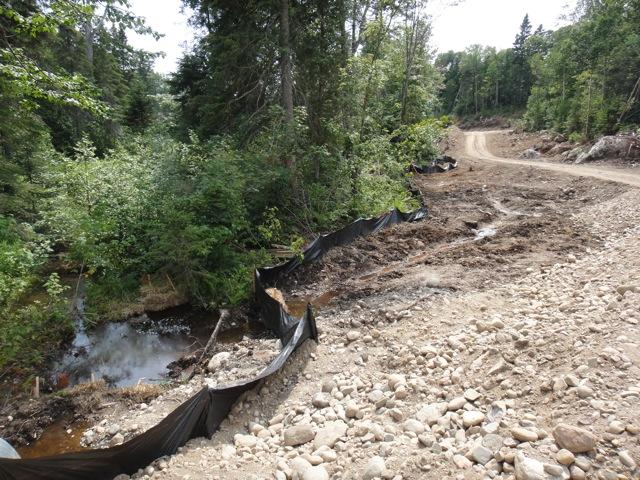
Embedded image permalink

Photo courtesy LSARC: devastation of landscape and erosion into streams from Northern Ontario wind farm construction

What’s a Redside Dace? Well, if you don’t know, don’t worry–it won’t matter for too much longer.

One of the principal points made by the Appellant in the recent appeal of the East Durham wind power project  by NextEra, was the damage that would be done by construction and the alteration of natural waterways. The prime witness testimony was:

[1]           He [Wren] also reviewed the 2004-2005 survey by Streams Ontario for the MNR.  In Dr. Wren’s opinion, the MOE “did not demonstrate due diligence in considering or evaluating sensitive fish and fish habitat in the project study area, with particular reference to the fish species Redside Dace”.

[2]           In Dr. Wren’s view, the sampling of the Saugeen River for Redside Dace was inadequate largely because too few samples were taken over too large an area.  It is his opinion that the MNR should have required the Approval Holder to conduct field investigations for Redside Dace in the Project Study Area to confirm their status.  He relied upon an email from the MNR to the Approval Holder’s ecologist which stated:

The absence of a species at risk occurrence does not mean that they are not present and as a result due diligence is still required … .  It should be noted that from a species at risk perspective this is an understudied area and as a result the MNR will be looking to ensure appropriate due diligence as it relates to field work was conducted to consider these species in further NHA reports for this site.

[3]           Dr. Wren’s opinion is that: “the Upper Saugeen Subwatershed contains an abundance of coldwater fisheries habitat that is unique in Southern Ontario.  Furthermore, the subwatershed is known to contain redside dace, an endangered species, which have a very specialized habitat.”

[4]           Dr. Wren also gave evidence about directional drilling and “fracking”, and soil erosion and sediment, and their likely effects on fish habitat and fish.  “Fracking” in this context is the accidental release of fluids toxic to fish that can occur during drilling to place transmission lines underground at water-crossings.  It is Dr. Wren’s view that a “frack out” could cause serious and irreversible harm to an endangered species such as the Redside Dace.

(Info on the Reside Dace here)

So, once again, the “overall benefit” of wind power supercedes damage to the environment, and to species of wildlife the Ontario government has already committed itself to protect? Ministry of the Environment lawyer Sylvia Davis, speaking in Toronto at the Ostrander Point appeal: “So a few animals get killed…”

The Minister of the Environment and Climate Change is Glen Murray, whose ministry is supposed to “ensure healthy communities, ecological protection…”

Reposted from Wind Concerns Ontario

Participate in PECFN’s BioBlitz at Ostrander Point, August 9-10, 2014

31 Thursday Jul 2014

Posted by Ottawa Wind Concerns in Renewable energy, Uncategorized, Wind power

≈ Leave a comment

Tags

at-risk species Ontario, environment, Ontario Ministry of the Environment, Ontario wildlife, Ostrander Point, Prince Edward County Field Naturalists, wind farms and environment, wind power

Love Nature? Want to save it from the Ontario government’s misguided “green energy” program which believes wind power trumps wildlife? Here’s a chance to help out. A 2 1/2 hour drive south-west.

CCSAGEadmin's avatarCCSAGE Naturally Green

BioBlitz poster FINAL low colour-page-001 Click on image to enlarge

FOR IMMEDIATE RELEASE

Public invited to help inventory the biologically significant Ostrander Point.

Prince Edward County (July 30, 2014) – The Prince Edward County Field Naturalists are hosting the county’s first ever BioBlitz at Ostrander Point. The event runs over a 24 hour period from noon on Saturday August 9 to noon on Sunday August 10, 2014 and includes guided tours for the public focussing on how to identify a variety of species from plants to birds, insects and amphibians and reptiles.

Ostrander Point is located within the South Shore Important Bird Area, a site recognized globally for its importance to birds and biodiversity.

“Much of the biodiversity of the South Shore Important Bird Area has not been identified” notes Myrna Wood of the Prince Edward County Field Naturalists Club. Wood continues “Ostrander Point was the subject of an Environmental Review Tribunal hearing during which…

View original post 237 more words

Wind farms in Northern Ontario: massive change

30 Wednesday Jul 2014

Posted by Ottawa Wind Concerns in Renewable energy, Wind power

≈ 1 Comment

Tags

appeals wind farm, Bow Lake, endangered species, George Brown, Goulais Bay, Lake Superior Action Research Conservation, LSARC, Northern Hoot, Northern Ontario, Ontario bats, Ontario Court of Appeal, Ontario Ministry of NAtural Resources, Steffanie Petroni, wind farm, wind farm environment, wind power northern Ontario

Northern Hoot

Northern Hoot is a new website run by journalist Steffanie Petroni on all things Northern Ontario. Devoted to “long-form” journalism, Petroni recently published an article on wind power development, of interest now because two very large projects–Bow Lake and Goulais Bay–will be proceeding. Appeals by First Nations groups and residents failed.

Of special interest in this posting are photos by Gary McGuffin, who is renowned for his depiction of Northern Ontario scenery.

Radar

Excerpt:

In Ontario there have been 20 appeals in opposition to industrial wind turbine farms brought before the Ministry of the Environment (MOE) and 19 have been dismissed. An appeal by Prince Edward County Field Naturalists to kill the development of an industrial wind turbine farm on Ostrander Point was won before an ERT in July 2013. However, the decision has since been reversed by the Ontario Divisional Court and appellants are seeking an appeal before the Ontario Court of Appeal.

George [Brown, of the Lake Superior Action Research Conservation] commented, “The 240 Bow Lake appeal came close to winning. Based on the Ostrander Judicial Review decision the Tribunal found that in order to prove irreversible harm it was necessary for the appellant to know the size of the populations being harmed. Having found that the 240 appeal failed to prove irreversible harm the Tribunal declined to make a finding on the issue of serious harm, though it agreed with virtually all the arguments on bats submitted by the 240 appeal.

As a result the Tribunal imposed immediate and more stringent mitigation measures on the project – a tacit admission that species-at-risk bats would otherwise be killed, which would be a serious harm.

The Tribunal’s decision is peculiar in that it allows these more stringent mitigation measures to be rescinded should they prove effective. Had the MNR required, or done, a baseline study, or had the 240 appeal had the time and money to do one, to determine the size of existing bat species populations in the project area, we would perhaps have had the final piece of the puzzle required to win.”

For more information, go to http://www.lsarc.ca


Parker Gallant on solar panels and school roofs in Toronto: not such a great deal

29 Tuesday Jul 2014

Posted by Ottawa Wind Concerns in Renewable energy

≈ 1 Comment

Tags

Ottawa solar, Parker Gallant, solar panels, solar power

For fans of Parker Gallant, his review of the situation in Toronto where the school board thought they were going to be “green” and save money on roof repairs, and even “make” money too (albeit on the backs of already stressed electricity ratepayers but…details, details).

Lots of solar panels going up on buildings in the Ottawa area, too: are “deals” like the Toronto one being repeated here? The “wolf in green clothing” continues to hunt.

The green mirage: Toronto school board gets free roof repairs for solar panels — or do they?

Toronto School Board flunks out

Canada’s largest school board, the Toronto District School Board (TDSB), is getting an F on management practices.  Ontario’s Ministry of Education and Ministry of Energy must also receive a failing grade.

It starts with Toronto’s public schools having leaky roofs.  The TDSB, with much fanfare May 2011, found the Holy Grail when they struck a deal with AMP Solar Limited Partnership for solar panels on school roofs.  TDSB thought the deal with AMP would result in free roof repairs on 450 schools, and, after AMP recovered the cost of the repairs, TDSB would also receive 14.5% of the solar power revenue generated from the Feed-In Tariff or FIT contracts they hoped to obtain from the OPA (Ontario Power Authority).  On paper it sounded wonderful; TDSB’s Director of Education Chris Spence said,  “This is a win-win for everyone involved.”

What he meant was, it would be a losing proposition for Ontario’s ratepayers.

What has happened since that announcement shows someone didn’t do their math homework or anticipate what might go wrong.

One year later: there were delays as the rules under the FIT program changed, creating lower prices for roof-top solar, and then McGuinty prorogued the Legislature.  The Toronto Sun quoted Chris Bolton, TDBS’s chair, confessing the Board didn’t have an alternate plan.  The story went on to say the Ontario government “encouraged” the TDSB to turn to FIT as a resolution to its roof repair backlog.   It is not clear if that suggestion came from the Ministry of Education or the Ministry of Energy.  If it was, it was as a neat budget gambit to fool the taxpayers while sticking it to the ratepayers.   Three weeks prior to the Sun article the Ministry of Education froze new construction approvals, “citing concerns the TDSB was going over budget on building projects and in danger of not wiping out an existing $50 million capital deficit.”

A few “snags”

Fast forward July 25, 2014: the reporter who wrote the Toronto Sun story wrote one for the National Post  headlined  “Solar panel upgrades for public schools hit snags”.  The article infers “the costs” to repair the roofs are “higher than first pegged” and goes on to explain, “That’s because of greater-than-expected costs to the board’s private partner-School Top Solar LP-for roofing, installing the panels and fees to Toronto Hydro for hooking up to its power grid.”  It is unclear who School Top Solar LP is—the original TDSB partner was AMP Solar Limited Partnership, but perhaps they flipped the project to take a nice profit (as has happened with so many companies) that have obtained FIT contracts).

The result of this wonder story is that the most TDSB will get out of this free deal will be to replace one-sixth (720,000 sq. ft.) of the 4.3 million square feet of roofs.    They can also kiss goodbye to the 14.5% energy revenue Chris Spence thought they would get.

Let’s see where the mistakes were made. First, the math on the 66 MW that will be installed: based on the original roof-top solar prices ($700 per megawatt hour), the 66 MW could have generated in excess of $40 million annually and $806 million over the 20-year life of the contract. The developer (AMP) claimed the 66 MW would produce enough electricity to power 6,000 average homes, which means 57,600 megawatt hours (MWh) of power yearly.

Now the roof repair costs: roof replacement repairs to the 4.3 million square feet would run to $8 or $9 per sq. ft., meaning total costs would be in the $40 million range.  Capital cost of solar per MW is $5 million (approximately) as estimated by the U.S. EIA, so 66 MW would have cost $330 million making total costs (including roof repairs) about $370 million and recovery of the cost outlays (including maintenance) should have taken nine to ten years.

If it looks too good to be true, maybe…

The reduction in the FIT rates threw the “free” roof idea into jeopardy. It now looks like the TDSB will have to go cap in hand to the Minister of Education, Liz Sandals, if they want those leaking roofs fixed, without making the Board’s $50-million capital deficit disappear.

What’s funny is that now, as reality hits, a few of the education board trustees interviewed for the National Post said they actually want to blame the school principals (some of them had requested adjustments to the placement of the equipment used to hook up the panels to Toronto Hydro’s electricity grid).

Perhaps Ms. Sandals will solve the TDSB dilemma by getting the teachers unions to back down on their demands for raises and pension benefits until the roof leaks have been plugged!

This is another example of the many logic failures brought to Ontario by the Liberal government and its push for renewable energy on a large-scale!

Parker Gallant,

July 28, 2014

 The views expressed here are those of the author and do not necessarily represent Wind Concerns Ontario policy.


Wind power: a “wolf in green clothing”

28 Monday Jul 2014

Posted by Ottawa Wind Concerns in Uncategorized

≈ 1 Comment

Tags

cost-benefit renewables, Feed In Tariff subsidy, FIT, green energy, PTC, renewable energy, renewable power, subsidies wind power, The Hill, Warren Buffett, wind energy, wind farm, wind farms environment, wind power

It’s clean, it’s “green,” and it wants your land and your money too

Here from The Hill, a US blog for policy-makers, a posting on wind power and the US form of subsidy, the Production Tax Credit.

July 25, 2014, 10:00 am

Wind power production tax credit: Wall St. wolf in green clothing

By Curtis Ellis, The Hill, July 25, 2014

The tax incentive for wind power expired last year, and the battle over its extension is now underway. Opponents say the wind power production tax credit, PTC, is a wasteful boondoggle while supporters say it’s crucial for renewable energy and jobs. The Sierra Club calls it “one of the best bets we’ve made on clean, domestic energy.”

But it’s a misplaced bet.  The PTC actually blocks the green energy technologies that hold the most promise.  Rather than helping an infant industry, the PTC is a handout to Wall Street.

Congress created the PTC in 1992, a tax credit of roughly 2 cents per kilowatt-hour of wind electricity, to nurture the infant wind energy industry. Government incentives to promote crucial industries are time-honored. That’s not the problem with the PTC.What’s important is that only big investors who want to offset tax liabilities on other investments need apply. The PTC can only be taken against “passive income” – income from other investments. Private equity firms put together investors who need a tax write-off courtesy of the PTC. Warren Buffett admits he uses the PTC to lower his Berkshire taxes: “we get a tax credit if we build a lot of wind farms. That’s the only reason to build them.”

The PTC doesn’t help the average Joe who wants to put a small wind turbine on his ranch to generate electricity and reduce the taxes he pays on his farm income.

But while the PTC boosts Wall Street investment schemes in large-scale wind farms, the fact is small-scale, individually owned generation facilities hold the most promise for renewable energy.

Noted environmentalist Bill McKibben writes, “One of the great side effects of moving to renewable power is that we will replace vulnerable, brittle centralized systems that are too big to fail with spread out democratic energy sources.” Unfortunately, the PTC only encourages more “brittle centralized systems.”

California’s Local Clean Energy Alliance (which includes the San Francisco Bay Area chapter of the Sierra Club) concurs. It’s report, Community Power, states “local, decentralized generation of electricity offers many benefits to California’s communities relative to large central-station solar or wind power plants in remote areas.”

The Institute for Local Self Reliance, a green energy cheerleader, says renewables work best “at small scales across the country,” what’s known as distributed generation, “a network of independently-owned and widely dispersed renewable energy generators” rather than “a 20th century grid dominated by large, centralized utilities.”

In fact the Institute explicitly says the PTC is a significant barrier to greater investment in renewable energy. Removing this barrier “makes smaller projects more accessible to the local community, and draws local investors back into the process,” says John Farrell of the Institute for Local Self-Reliance.

Utilities are also taking local-scale renewable energy seriously.  A report by the Edison Electric Institute, Disruptive Challenges expects small-scale solar and wind “to challenge and transform the electric utility industry” with “adverse impacts on revenues, as well as on investor returns.”

David Crane, CEO of NRG Energy, a wholesale power company that operates coal-fired plants, told Blooomberg Businessweek  “the grid will become increasingly irrelevant as customers move toward decentralized homegrown green energy.”

So, if local-scale wind and solar generated close to the end user makes the most sense, why do we have a PTC pushing large-scale wind farms? It’s a Wall Street play.

Environmentalists supporting the PTC mean well, but they fail to see the wolf of Wall Street hiding beneath the green clothes. Ironically, the national green organizations are fighting for the kind of massive generating stations and power lines their local chapters often fight against.

The PTC is an anachronism and an obstacle to developing the decentralized, independently owned power generation system appropriate for wind, solar and other renewables.

Anyone who believes in renewable energy should be happy to see the PTC expire. It’s time to replace this tax write-off for the financial services cabal with something that benefits everyone.

Ellis is executive director of the American Jobs Alliance.

Read more: http://thehill.com/blogs/congress-blog/energy-environment/213183-wind-power-production-tax-credit-wall-st-wolf-in-green#ixzz38c15D4Uf

← Older posts
Newer posts →

Recent Posts

  • The stats tell the story: wind doesn’t work
  • Wind power locally: reliably unreliable
  • Has Ottawa lost its focus on city priorities?
  • Pro-wind groups in Ottawa collaborate to “educate”
  • Thinking of signing for a wind turbine lease? Better get informed to protect yourself

Follow me on Twitter

My Tweets

Enter your email address to follow this blog and receive notifications of new posts by email.

Tags

Bob Chiarelli Green Energy Act IESO Ontario Ottawa Ottawa wind concerns wind energy wind farm wind power wind turbines

Contact us

PO Box 3 North Gower ON K0A 2T0

Blog at WordPress.com.

Privacy & Cookies: This site uses cookies. By continuing to use this website, you agree to their use.
To find out more, including how to control cookies, see here: Cookie Policy
  • Subscribe Subscribed
    • Ottawa Wind Concerns
    • Join 377 other subscribers
    • Already have a WordPress.com account? Log in now.
    • Ottawa Wind Concerns
    • Subscribe Subscribed
    • Sign up
    • Log in
    • Report this content
    • View site in Reader
    • Manage subscriptions
    • Collapse this bar
Loading Comments...