• About
  • Donate!
  • EVENTS
  • Ottawa’s “Energy Evolution”: wind turbines coming to rural communities
  • Thinking of signing a wind turbine lease?
  • Wind Concerns Ontario
  • Wind turbines: what you need to know

Ottawa Wind Concerns

~ A safe environment for everyone

Ottawa Wind Concerns

Author Archives: Ottawa Wind Concerns

Australian noise study: wind farm neighbours at risk

21 Wednesday Jan 2015

Posted by Ottawa Wind Concerns in Renewable energy, Wind power

≈ 1 Comment

Tags

adverse health effects wind farms, audiology, audiology study infrasound, Australia, low frequency noise, Steven Cooper, wind farm noise, wind turbine, wind turbine noise, wind turbines

This is a story provided by Wind Watch, which has access to a subscriber-only report from The Australian. [Re-posted from Wind Concerns Ontario.]

Turbines may well blow an ill wind over locals, ‘first’ study shows

Credit:  By: GRAHAM LLOYD. From: The Australian. January 21, 2015. ~~

People living near wind farms face a greater risk of suffering health complaints caused by the low-frequency noise generated by turbines, a groundbreaking study has found.

The study by acoustics expert Steven Cooper is the first in the world in which a wind turbine ­operator had fully co-operated and turned wind turbines off completely during the testing.

It opens the way for a full-scale medical trail that may resolve the contentious debate about the health impact of wind farms.

Funded by wind farm operator Pacific Hydro, the study was conducted at Cape Bridgewater in southwest Victoria where residents have long complained about headaches, chest pains and sleep loss but have been told it was all in their minds.

As part of the study, residents living between 650m and 1.6km of the wind turbines were asked to ­diarise what they were experiencing, including headaches, pressure in the head, ears or chest, ringing in the ears, heart racing or a sensation of heaviness.

Their observations were separated into noise, vibration and sensation using a one to five severity scale.

“The resident observations and identification of sensation indicates that the major source of complaint from the operation of the turbines would appear to be related to sensation rather than noise or vibration,” the report says. “For some residents experiencing adverse sensation effects, the impact can be exacerbated by bending over rather than standing, with the effect in some cases being reported as extremely severe and lasting a few hours.”

Mr Cooper said it was the first time that sensation rather than audible noise had been used as an indicator of residents’ perception of nearby wind turbines.

The report found offending sound pressure was present at four distinct phases of turbine operation: starting, maximum power and changing load by more than 20 per cent either up or down.

Mr Cooper said the findings were consistent with research into health impacts from early model wind turbines conducted in the US more than 20 years ago.

The relationship between turbine operation and sensation demonstrated a “cause and effect”, something Pacific Hydro was not prepared to concede, he said.

Survey participant Sonja Crisp, 75, said the first time she experience discomfort from the wind turbines, “it was like a thump in the middle of the chest.

“It is an absolute relief, like an epiphany to have him (Mr Cooper) say I was not crazy (that) when I am doing the dishes I feel nausea and have to get out of the house.”

David Brooks, from Gullen Range near Goulburn, NSW, said health concerns from wind farm developments were not confined to Cape Bridgewater.

The findings should be used as the basis for a thorough health study of the impacts from low frequency noise, he said. “Until this is done, there should be a moratorium on further wind farm developments,” he said.

Pacific Hydro and Mr Cooper agree that more widespread testing is needed. Andrew Richards, executive manager external affairs at Pacific Hydro, said: “While we acknowledge the preliminary findings of this report, what they mean at this time is largely unclear.

“In our view, the results presented in the report do not demonstrate a correlation that leads to the conclusion that there is a causal link between the existence of ­infrasound frequencies and the ‘sensations’ experienced by the residents.” Mr Cooper said the findings had totally discounted the so-called “nocebo” effect put forward by some public health ­officials, who said symptoms were the result of concerns about the possibility of experiencing them.

The Cape Bridgewater study included six residents over eight weeks in three houses.

One hearing-impaired participant had been able to identify with 100 per cent accuracy the performance of wind turbines despite not being able to see them.

Another Cape Bridgewater resident Jo Kermond said the findings had been “both disturbing and confirmation of the level of severity we were and are enduring while being ridiculed by our own community and society.”

Mr Cooper said residents’ threshold of sensations were experienced at narrow band sound pressure levels of four to five hertz at above 50 decibels.

The nominal audible threshold for frequencies of four to five hertz is more than 100 decibels. Mr ­Cooper said an earlier investi­gation into health impacts of wind farms by the South Australian EPA had been flawed by limiting the study to only one-third octave bands and not looking at narrow band analysis.

“By looking at high sensation and narrow band I have developed a methodology to undertake assessments using narrow band infrasound,” he said.

“We now have a basis on how to start the medical studies,”

Mr Cooper was not engaged to establish whether there was a link between wind turbine operation and health impacts, “but the findings of my work show there is something there,” he said.

Mr Cooper said Pacific Hydro should be commended for allowing the work to proceed.

“It is the first time ever in the world that a wind farm has co-­operated with a study including shutting down its operations completely,” he said.

Mr Cooper has coined the term Wind Turbine Signature as the basis of the narrow band infrasound components that are evident in other studies. He said the work at Cape Bridgewater had established a methodology that could be repeated very easily all over the world.

Pacific Hydro said it had conducted the study to see whether it could establish any link between certain wind conditions or sound levels at Cape Bridgewater and the concerns of the individuals involved in the study.

“Steven Cooper shows in his report, for the limited data set, that there is a trend line between discrete infrasound components of the blade pass frequency (and harmonics of the blade pass frequency) and the residents’ sensation observations, based on his narrow band analysis of the results,” Pacific Hydro said.

“However, we do not believe the data as it currently stands supports such a strong conclusion.”

The report has been sent to a range of stakeholders, including government departments, members of parliament, environmental organisations and health bodies.

The report may be downloaded from the following links:

The Results of an Acoustic Testing Program – Cape Bridgewater Wind Farm
Appendices A to H
Appendices I to J
Appendices K to M
Appendices N to P
Appendices Q to S
Appendices T to V

Source:  By: GRAHAM LLOYD. From: The Australian. January 21, 2015.

See also a story from January 21 in The Standard, here.

Wind farm areas forced “industrial zones,” says scientist

21 Wednesday Jan 2015

Posted by Ottawa Wind Concerns in Ottawa, Renewable energy, Wind power

≈ 1 Comment

Tags

David G. Stephenson, Inside Ottawa Valley, Metrolan, wind farm, wind farm efficiency, wind farms, wind power, wind power efficiency, wind turbines

A “boutique solution to a mega-mall problem”

This is from this week’s edition of Inside Ottawa Valley, in the Kemptville Advance,written by retired scientist David G. Stephenson. Part 2 appears next week.

An excerpt pertaining to wind power generation follows:

Across the province advancing wind turbines are changing the wind swept countryside into a scene from H.G Well’s “War of the Worlds”. Wind power is clean and cost competitive, but the turbines are very large, unsightly, noisy industrial installations. A wind turbine will immediately zone everywhere within eyeshot as industrial, and people prefer not to live or conduct their recreational pursuits in an industrial zone. Consequently large wind farms are now being built over water.

A wind farm filling all of this country’s portion of the great lakes might just, when the wind was blowing, generate enough power to replace our use of fossil fuels.

But the output of wind farms is unpredictable and only available a quarter of the time. Wind power, like geothermal and tidal power is a boutique solution to a Mega-mall sized problem. Their contributions can only be useful supplements to a robust anchoring source of non-polluting energy.

Does conserving power in Ontario save us money? (No.)

16 Friday Jan 2015

Posted by Ottawa Wind Concerns in Renewable energy, Wind power

≈ 1 Comment

Tags

Bob Chiarelli, conservation power Ontario, electricity bills Ontario, electricity consumption, electricity distribution companies, hydro bills Ontario, Independent Electricity Systems Operator, Ontario, Ontario economy, Ontario government, Parker Gallant, Robert Lyman, wind power

Here is a precis of an analysis of the Ontario government’s conservation efforts prepared by local economist Robert Lyman, based on research by Parker Gallant.

Here are the numbers.

In 2009, local electricity distribution companies in Ontario provided 124,206,032 megawatt-hours (MWh) for 4,748,577 households, a monthly average of 2,180 kilowatt hours (kWh).

In 2013, they provided 125,306,563 MWh for 4,944,488 households, a monthly average of 2,112 kWh. Average consumption fell by 3.3%, or 875 kilowatts annually between 2009 and 2013. For the average home, that is a monthly reduction from 800 kWh to 774 kWh (317 kWh per year).

In 2009, the cost of a kWh of electricity delivered averaged 6.15 cents and the “commodity” cost (just the electricity portion) for the full year was $590. By reducing annual consumption by 317 kWh, the savings should have been $19.50.

In 2013, the commodity cost had risen to 9.2 cents per kWh, or $854 per year. Not only did the $19.50 savings disappear, but also, the average household paid an additional $264 annually. That represents an additional cost to all ratepayers in the province of $1.2 billion annually. That does not include the $2 billion cost of installing smart meters.

The average household would have had to reduce its annual consumption by 33%, or 3,200 kWh, in order to have simply matched its cost for electricity consumption in 2009.

The Independent Electricity Systems Operator (IESO) is required to maintain an operating reserve of generating capacity of between 1,300 and 1,600 MW for contingencies. Since 2009 the available surplus has been between 4,000 MW and 5,900 MW. The IESO expects these surpluses will continue until at least the later part of this decade. Thus, while the official rationale for smart meters, time-of-use pricing and “conservation” programs is to avoid the addition of expensive new generation capacity, the province has continued to add that capacity even in the face of a substantial surplus.

What’s next? Current Energy Minister Bob Chiarelli has set new targets for both reductions in peak demand and “conservation” in his long-term energy plan. The target set for reducing peak demand is 10% (2,400 MW by 2025) and for “conservation” is 16% (30 TWh) by 2032. These will be combined with continuing large additions in industrial wind turbine and solar power generators at substantial premiums above most current generation. As a result, despite the lower consumption, ratepayers will be expected to dig deeper into their pockets.

Wind farm fight in Ontario 2014: no giving up

31 Wednesday Dec 2014

Posted by Ottawa Wind Concerns in Uncategorized

≈ 1 Comment

Tags

Algoma, Blanding's Turtle, Drennan case, Environmental and Lands Review Tribunal, Eric K Gillespie, Julian Falconer, legal actions wind farms, Northland Power, Not a Willing host, Ontario, Ontario government, prince Edward County, Rebecca Thompson, Sun News, Wind Concerns Ontario, wind farm appeals, wind farm lawsuits, wind farm property values

From Wind Concerns Ontario

Ontario wind farms in 2014: a look back

A spokesperson for Northland Power, whose Grand Bend wind power project can now proceed following decision in an appeal, told a London Free Pressreporter that “One would think the people opposed would lose their appetite for this fight, but they haven’t yet.”

Indeed not. And 2015 will be more of the same as almost every wind power project in Ontario has been appealed, and several are headed for judicial review. Plus, countless private individuals have lodged or plan to take legal actions related to noise nuisance and property value loss.

The truth will stand, eventually.

Here’s a look back in pictures at the year that was.

Parker Gallant (R) on the Dale Goldhawk consumer radio show for one hour on the $16-million Christmas Day power giveaway in Ontario. Wind Concerns Ontario documented the millions lost over 2014 through Ontario's mismanaged energy sector
Parker Gallant (R) on the Dale Goldhawk consumer radio show for one hour on the $16-million Christmas Day power giveaway in Ontario. Wind Concerns Ontario documented the millions lost over 2014 through Ontario’s mismanaged energy sector
Julian Falconer represented four families in a legal challenge; while many points about the appeal process were made, the appeal was lost
Lawyer Eric Gillespie continues to represent Ontario communities and appeals against wind power projects; more to come
Auditor General Lysyk becomes the 2nd A G in a row to lambaste the Ontario government for its incompetence in the energy file, and wasted money on green energy
Transport Canada bends to pressure from Big Wind and rescinds order to remove Chatham-Kent wind turbines for safety. (2015 is an election year!)
Invenergy pulls out of Listowel-area wind project
Health Canada releases non-peer-reviewed summary of noise and health study; shows that 16.5% of people within 1 km of turbines experience distress. Media misses this. (2015 is an election year!)
Energy Minister Bob Chiarelli tries to explain that Ontario's electricity bill increases are insignificant, thereby demonstrating his opinion of the intelligence of Ontario citizens
Energy Minister Bob Chiarelli tries to explain that Ontario’s electricity bill increases are insignificant, thereby demonstrating his opinion of the intelligence of Ontario citizens
Two wind power projecst approved for Ontario's world-famous Algoma region, showing the Ontario government has no regard for the environment, whatsoever
Two wind power projects are approved for Ontario’s world-famous Algoma region, showing the Ontario government has no regard for the environment, whatsoever
None so blind as those who will not see. Or listen. Toronto-based Ontario Premier Kathleen Wynne ignores rural and small-town communities. New procurement process for large-scale power projects still does not allow municipalities to say "No" to Big Wind.
None so blind as those who will not see. Or listen. Toronto-based Ontario Premier Kathleen Wynne ignores rural and small-town communities. New procurement process for large-scale power projects still does not allow municipalities to say “No” to Big Wind.
Rallies and protests continue throughout the province; this one to Save the Nor'Westers
Rallies and protests continue throughout the province; this one to Save the Nor’Westers
Dr Robert McMurtry, officer of the Order of Canada, publishes a case definition for adverse health effects associated with wind turbine noise, with health researcher Carmen Krogh
87 communities have now passed Not A Willing Host resolutions
Fund-raising events occur throughout the province: here Stephana Johnston attends a supper for SWEAR and the Drennan case
One of Tim Hudak's election promises was to end the Green Energy Act and enact new regulations; the PCs lose the election for various reasons, disappointing rural/small-town Ontario
One of Tim Hudak’s election promises was to end the Green Energy Act and enact new regulations; the PCs lose the election for various reasons, disappointing rural/small-town Ontario. The Liberals win a majority and vow to continue their (money-losing) green energy policies.
Sun Media's Down Wind doc film with Rebecca Thompson attracts $30,000 in crowd-funding in days
Sun Media’s Down Wind doc film with Rebecca Thompson attracts $30,000 in crowd-funding in days
The Blandings Turtle is in and out of court as Prince Edward County citizens fight the Ontario Ministry of the Environment to save the environment. CanWEA lawyer announces in Toronto court that no appeal was ever supposed to be successful, and the Environmental Review Tribunal needs "direction" so a successful appeal never happens again.
The Blandings Turtle is in and out of court as Prince Edward County citizens fight the Ontario Ministry of the Environment to save the environment. CanWEA lawyer announces in Toronto court that no appeal was ever supposed to be successful, and the Environmental Review Tribunal needs “direction” so a successful appeal never happens again.
Drs Ian Arra and Hazel Lynn publish a review that says there is evidence of an association between wind turbine noise and distress
After taking on Big Wind for years and NextEra in specific, members of the members of the Wrightman family of Middlesex-Lambton decamp to Nova Scotia (but continue to fight)
After taking on Big Wind for years and NextEra in specific,  members of the Wrightman family of Middlesex-Lambton decamp to Nova Scotia (but continue to fight)
Big Wind continues its indoctrination of schoolchildren with support of the Ontario government. In this case, distribution of the T-shirts was halted when parents complained
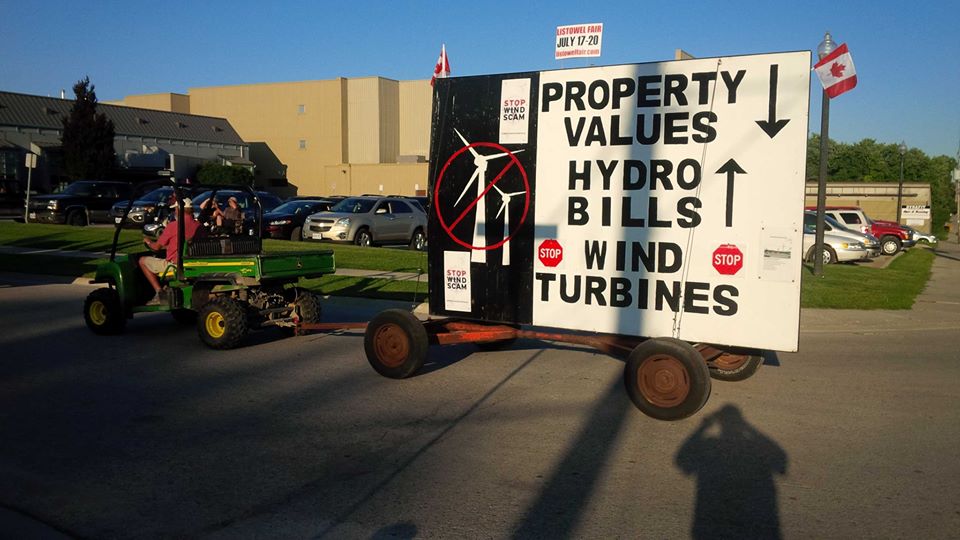
Ontario communities fight against the Big Wind "scam": wind power cannot deliver on its promises of reducing GHGs, creating jobs, protecting the environment
Ontario communities fight against the Big Wind “scam”: wind power cannot deliver on its promises of reducing GHGs, creating jobs, protecting the environment

Ontario’s $16-million Christmas power giveaway

31 Wednesday Dec 2014

Posted by Ottawa Wind Concerns in Renewable energy, Wind power

≈ 1 Comment

Tags

Bob Chiarelli, Dale Goldhawk, electricity bills, hydro bills Ontario, Ontario, Ontario economy, Ontario power exports, Ontario surplus power, Parker Gallant, Wind Concerns Ontario, wind power

Ontario’s $16-million Christmas power giveaway

Wind power half of surplus power sold off cheap

Ontario's energy policy: gifts for somebody---just not you

Christmas was great day for Michigan and New York, courtesy of Santa Claus Ontario and wind power: Ontario exported 16.5 % (about 66,000 MWh) of our total demand for power on Christmas Day, and those two neighbours got $500,000 in cash along with the 56,000 MWh of power we gave them.  Power generated from wind energy was 36,000 MWh or 51% of total exports—if the curtailed wind production was included that would be 77% of the surplus power exported, so the wind power developers must be happy with their Christmas presents from Ontario, too.

In fact, Ontario’s electricity ratepayers picked up the cost of the cash payments to Michigan and New York, along with the actual cost of the production which was $7 million.  And, we paid about $2 million for “curtailed” wind (17,000 MWh), close to $3 million for “steamed off” nuclear (49,000 MWh) and more than $3 million to the gas plant generators for their “net revenue requirement” while the gas power plants idled.  That’s $16 million… and it doesn’t include the cost of Christmas Day “hydro spillage” as the Independent Electricity Systems Operator or IESO doesn’t report on it.

Total demand for power in Ontario Christmas Day was only 325,000 MWh, perhaps due to mild weather or maybe everyone barbecued their turkeys.  The hourly Ontario energy price (HOEP) value of the total demand of 390,000 MWh was negative (-$2,900,000) based on the average negative price of $7.45/MWh, but Ontario ratepayers still paid the $40 million needed to produce that power.

So our Premier and her chief Elf in the Energy portfolio, Bob Chiarelli, rewarded Ontario’s ratepayers with lumps of coal on Christmas day while doling out goodies to our neighbours!

©Parker Gallant

December 26, 2014

Contact Wind Concerns Ontario at 1-855-517-0446 or

windconcerns@gmail.com

Reprinted from Wind Concerns Ontario

You may also listen to a 45-minute podcast of Parker Gallant on the Dale Goldhawk radio show here.

Economist summary of the A G report on “smart meters”: astounding incompetence

31 Wednesday Dec 2014

Posted by Ottawa Wind Concerns in Renewable energy, Wind power

≈ Leave a comment

Tags

Auditor General Ontario, Auditor General Report, Bob Chiarelli, energy issues, Ontario, Ontario consumers, Ontario economy, Ontario electricity bills, Ontario power rates, Robert Lyman, smart meters

Ottawa-based economist Robert Lyman, who specializes in energy issues, has provided us with a summary of the highlights of the recently released Auditor General report, on the energy sector in Ontario. The government’s handling of this portfolio is astounding for its mismanagement, and wasted taxpayer and ratepayer dollars.

Read the summary from Mr Lyman Here: Ontario Auditor General Report on the Smart Metering Initiative

Realtors dispute economist study on wind farm neighbour property values

31 Wednesday Dec 2014

Posted by Ottawa Wind Concerns in Renewable energy, Wind power

≈ 1 Comment

Tags

Canadian Journal of Agricultural Economics, Canadian Real Estate Wealth, Melancthon, mortgage financing, property value, property value loss, property values, real estate appraisers, real estate value, Realtor, Richard Vyn, University of Guelph, wind farm property value, wind farms, wind turbine, wind turbines

Wind farm “monsters bad for Ontario: Realtors shoot back at property value study

Looks like a great place to live!!

Jennifer Paterson, Canadian Real Estate Wealth, December 18, 2014

A recent study by the University of Guelph, which found wind turbines do not have an impact on nearby property values, might have earned a big sigh of relief from investors – but the study’s results have been strongly criticized by members of the real estate industry.

“I have had several deals fall apart in this area because, in the appraisal report, it has been mentioned that there are windmills visible or adjacent to the property and, once a lender gets wind of that (forgive the pun), they will not fund a mortgage,” said Angela Jenkins, a mortgage agent at Dominion Lending Centres, who lives and works in the Melancthon region, where the study was conducted.

“If a person cannot get financing due to windmills, then how can this be a positive thing?”

The study, which was published this month in the Canadian Journal of Agricultural Economics, analyzed more than 7,000 home and farm sales in the area, and found that at least 1,000 of these were sold more than once, some several times.*

John Leonard Goodwin, who has been a real estate broker for more than 10 years in the Grand Bend, Ont. market, asserted that wind turbines absolutely do affect property values. “Turbines complicate your property enjoyment, period,” he said. “That alone spells depreciated value(s).

“Turbines should be in remote, unpopulated locations. To all the folks who have turbines on their property: Enjoy your $18,000 per turbine per year, because you will be giving most of the lease payments back (in much lower property value) when you sell.

“These monsters are very bad for Ontario,” he continued. “We all pay to subsidize the electricity they produce and they will also cause a significant loss of real estate value.”

Lynn Stein, a sales representative at Hartford and Stein Real Estate, lives and sells real estate in Prince Edward County, where a large-scale wind turbine project is slated to begin.

“The turbines that are proposed here are quite large,” she said. “The majority of the population here very clearly doesn’t want them.

“Put simply, if you were to buy your future home, given the choice, would you buy where you would have noise, shadow flicker, an industrial view, potential health issues caused by the turbines, and the possibility of a very difficult resale, or would you spend your money elsewhere?”

Read the full story and comments here.

*Wind Concerns Ontario Editor’s note– The writer is incorrect: Vyn had a data set of 5,414 residences but very few, 124, were within 5 km of a turbine. Several were as far as 50 km from a turbine. This is a tactic designed to “dilute” any actual effect. Author Richard Vyn himself said that the limitations of this study (sponsored by MPAC, perhaps to buttress their own disastrous study on this issue earlier this year) were significant and should not be overlooked. Toward the end of his paper he admits, “…while the results indicate a general lack of significantly negative effects across properties examined in this study, this does not preclude any negative effects occurring on individual properties.”

The Realtors and financing professionals contacted for this article also did not note that Vyn failed to include expired listings, i.e., properties that were listed for sale, but never sold.

Legal actions against wind farms continue

18 Thursday Dec 2014

Posted by Ottawa Wind Concerns in Ottawa, Renewable energy, Wind power

≈ 1 Comment

Tags

City of Kawarth Lakes, environmental appeal, Environmental Review Tribunal, Eric Gillespie, Health Canada, Health Canada noise study, Healthy Environments and Consumer Safety Canada, Julian Falconer, legal action, Manvers Wind Concerns, Mothers Against Wind Turbines, North Gower, Ottawa wind concerns, Plympton-Wyoming, Renewable power projects, Sunco, wind farm, wind power, wind power generation, wind power project, wind turbine, WPD Canada

This is a heavy duty week as Ontario communities fight back against the unwanted incursion of huge wind power generation facilities. As you know, the Green Energy Act removed local land-use planning powers for renewable power projects, so the environmental appeal process and ultimately the courts, along with a noise nuisance bylaw, is the only way communities can act to protect their residents.

(The new procurement process for large-scale renewable power projects still does not allow for a return of municipal planning powers; communities can have a say, as long as it’s not “no” and in fact, the regional energy plans are pre-designed by the province—in other words, if the province decides you’re getting a wind “farm” then you are. But we digress…)

This week:

Manvers/Pontypool: last few days of the appeal of the Sumac Ridge wind power project, part of which is on the Oak Ridges Moraine, a fragile and (formerly) protected environment. The Green Energy Act over-rode the Oak Ridges Moraine Protection Act, along with 20 other pieces of legislation.) The City of Kawartha Lakes is involved.

Plympton-Wyoming: again, the municipality is involved with the appeal of the Suncor Cedar Point wind power generation project. Today, the Environmental Review Tribunal hears a motion for a stay of proceedings, until experts can review the raw data from the Health Canada Wind Turbine Noise and Health study. (No report or article has yet been published from this study; there is only a brief summary and PowerPoint presentation.) The Health Canada study showed that 16.5% of people living within 2 km of a wind turbine were experiencing distress.

Niagara Region: Mothers Against Wind Turbines is a appealing the 77, 3-megawatt turbine Niagara Region wind power project, which will affect over 4,000 homes. Preliminary hearing is tomorrow in Wellandport.

Other appeals have been filed and several judicial reviews are in various stages, as well as private legal actions on property value loss and nuisance. Decisions are expected on the Ostrander Point appeal (lawyer Eric Gillespie), and the Drennan/Dixon appeal (the Constitutional challenge, lawyer Julian Falconer).

Ottawa Wind Concerns has retained a legal firm and is prepared to enact legal actions should another proposal come forward for a wind power project.

Contact us at ottawawindconcerns@gmail.com Donations welcome at PO Box 3, North Gower K0A 2T0

Wind farm property value study should not have been published: Queens prof

09 Tuesday Dec 2014

Posted by Ottawa Wind Concerns in Renewable energy, Wind power

≈ Leave a comment

Tags

Andrejs Skasburskis, regression analysis, Richard Vyn, University of Guelph, wind farm effects on property values, wind farm locations, wind farm neighbours, wind farm property values, wind farm research

You may have seen the Canadian Press story that surfaced on Sunday and Monday about a study done by a University of Guelph agricultural economics teacher, which was published in the Journal of Agricultural Economics. While the headlines said wind turbines caused NO effect on property value, the real study said otherwise: the co-authors noted that they had very little data, that expired listings (houses listed for sale that never sold) were not included, and neither were sales not on the open market, such as the properties purchased by wind power developers.

So the situation was: very few sales, houses not selling at all, and some houses that did sell changed hands many times. What’s wrong with that picture?

Well, plenty. Here’s a letter to the editor of the journal that published the study, released today. Too bad the damage has been done by the headline writers.

Letter to the Editors of Canadian Journal of Agricultural Economics:

The paper by Vyn and McCullough (2014) should not have been published in its current form as the results are being misinterpreted and highly publicized in the press and in radio broadcasts. The core issue is the lack of power in the statistical tests, a problem partially acknowledged by the authors but then dismissed by their focusing attention on tests for the sensitivity of their model specification. The article appears to encourage the misinterpretation of its statistical findings.

Out of the 5414 sales, only 79 post-turbine sales are of properties within a 5 kilometer radius and the rest are within a 50 kilometer radius. The diversity of the houses in the sample is very large as indicated by their price range of ten thousand to two million dollars and by the relatively low R-squares (0.57) in the hedonic regressions. Given the small number of properties that may have been adversely affected and the great diversity of properties in the sample, it is not at all surprising that the regressions yield no ‘statistically significant’ results. The shortage of observations on properties close to the turbines cannot be overcome by extensive sensitivity testing of model form. The problem is with the lack of data not with model form and focusing on the form tends to obfuscate the issue.

The authors do recognize the data problem: “Unfortunately, there are relatively few observations in the post-turbine periods that are in close proximity to turbines” (p 375) and “Hence, these numbers of observations are likely too few to detect significant effects, which represents a major limitation of this analysis” (p 387). But there are three problems that should have been picked up and corrected through the peer review and editorial decision process.

First, the authors conclude:

“The empirical results generated by the hedonic models, using three different measures to account for disamenity effects, suggest that these turbines have not impacted the value of surrounding properties” (p 388). This is wrong for two reasons. First they could not discern an impact which is different from not having an impact. Second, they misuse the term ‘value’. If you have a choice between two identical properties, identical in all respects except that one is close to a turbine while the other is not and if you choose the far one, then the turbine has an effect on the value of the property. This hypothetical example tests the paper’s hypothesis using common sense rather than a statistical measure.

Second, the authors claim:

“The findings of this paper will provide evidence that may help to resolve the controversy that exists in Ontario regarding the impacts of wind turbines on property values” (p 369) and then proceed to do all they can to make a non-finding appear important and repeat the general statement that they found no significant impact. They correctly said in the CBC interview this morning that their study did not find a statistically significant price effect but the public and reporters, not being familiar with statistical terms interpret this as saying that there was no price effect. Not finding a statistically significant impact due to a data shortage does not mean that there was no significant (i.e. important) impact. This distinction was not made clear enough in the paper nor in the follow up interviews and newspaper articles.

Third, the reviewers and finally the editors should have insisted on the power of the statistical tests to be calculated and reported. I understand that editors in the major health science journals insist on this as their readers, doctors and other clinicians, are not always aware of statistical fine-points but they need to be fully aware of the qualifications before using the results to change their practice. Given the potential impact a misinterpretation of the findings could generate, the test of the power should be reported even in the abstract. The reader should be told how big an impact would have to be before it can be detected by a statistical test with this number of observations. Had the price of properties near the turbines been 10 percent lower than they actually were, would the model have yielded a statistically significant finding of a price decrease at say the 0.05 probability level? What about a 20 percent decrease, would it have been ‘statistically significant’? Answers to this type of question would have been easy to produce and far more relevant that sensitivity tests of the model form.

The paper deals with an important issue that can have serious policy implications affecting the wellbeing of many people. The results can affect the location of wind turbine farms and the compensation claims of affected parties. Incorrect information or interpretations can be very hard to correct. In such cases, it is the journal editors’ responsibility to ensure that results are presented in a manner that, at the very least, does not encourage the misinterpretation of the findings.

Sincerely,

Andrejs Skaburskis, Professor Emeritus

North American Editor: Urban Studies,

School of Urban and Regional Planning,

Queen’s University,

Kingston Ontario, Canada


___________________________________________________

Richard J. Vyn and Ryan M. McCullough (2014), The Effects of Wind Turbines on Property Values in Ontario: Does Public Perception Match Empirical Evidence? Canadian Journal of Agricultural Economics 62 p. 365–392


MPP MacLeod: return local land-use planning control

02 Tuesday Dec 2014

Posted by Ottawa Wind Concerns in Ottawa, Renewable energy, Wind power

≈ 1 Comment

Tags

green energy, Green Energy Act, land use plannin, Liberal government, Lisa MacLeod, Lisa MacLeod MPP, Nepean-Carleton, Queen’s Park, wind farm, wind power, wind power developers, wind turbine

LISA MACLEOD MPP-NEPEAN-CARLETON
NEWS RELEASE
December 2, 2014
END THE RURAL-URBAN DIVIDE, RESTORE LOCAL DECISION MAKING: MACLEOD
(Queen’s Park)- Nepean- Carleton PC MPP Lisa MacLeod brought the fight against wind turbine developments once again to Queen’s Park today.
“One of the big challenges the government has is credibility in rural and remote communities across the province because of the Green Energy Act.  The government should restore local decision making to municipalities in an effort to signal they respect those communities”, said MacLeod
The Green Energy Act overrides 21 different pieces of legislation, including the Heritage Act and the Planning Act, so wind turbine developers can build projects without any push back from municipalities or their residents.
“The rural-urban divide in Ontario is very real as a result of disastrous policies like the Green Energy Act.  It is never too late for the Liberal Government to admit it is wrong and make wind turbine developers go through the same processes any other developer would have to in the Province of Ontario”, concluded MacLeod.
-30-
For More Information Contact Jordan Milks
1-416-352-6351


← Older posts
Newer posts →

Recent Posts

  • The stats tell the story: wind doesn’t work
  • Wind power locally: reliably unreliable
  • Has Ottawa lost its focus on city priorities?
  • Pro-wind groups in Ottawa collaborate to “educate”
  • Thinking of signing for a wind turbine lease? Better get informed to protect yourself

Follow me on Twitter

My Tweets

Enter your email address to follow this blog and receive notifications of new posts by email.

Tags

Bob Chiarelli Green Energy Act IESO Ontario Ottawa Ottawa wind concerns wind energy wind farm wind power wind turbines

Contact us

PO Box 3 North Gower ON K0A 2T0

Blog at WordPress.com.

Privacy & Cookies: This site uses cookies. By continuing to use this website, you agree to their use.
To find out more, including how to control cookies, see here: Cookie Policy
  • Subscribe Subscribed
    • Ottawa Wind Concerns
    • Join 377 other subscribers
    • Already have a WordPress.com account? Log in now.
    • Ottawa Wind Concerns
    • Subscribe Subscribed
    • Sign up
    • Log in
    • Report this content
    • View site in Reader
    • Manage subscriptions
    • Collapse this bar
Loading Comments...