• About
  • Donate!
  • EVENTS
  • Ottawa’s “Energy Evolution”: wind turbines coming to rural communities
  • Thinking of signing a wind turbine lease?
  • Wind Concerns Ontario
  • Wind turbines: what you need to know

Ottawa Wind Concerns

~ A safe environment for everyone

Ottawa Wind Concerns

Tag Archives: wind turbines

North Stormont appeal delayed until September

22 Wednesday Aug 2018

Posted by Ottawa Wind Concerns in Health, Renewable energy, Wind power

≈ 1 Comment

Tags

bat deaths, Berwick, Concerned Citizens of North Stormont, environment, ERT, North Stormont, Ontario Farmer, Ontario Ministry of the Environment Conservation and Parks, Tom Van Dusen, wind farm, wind farm noise, wind turbines

Witnesses for the community opposition present fresh evidence on harm to people and the environment


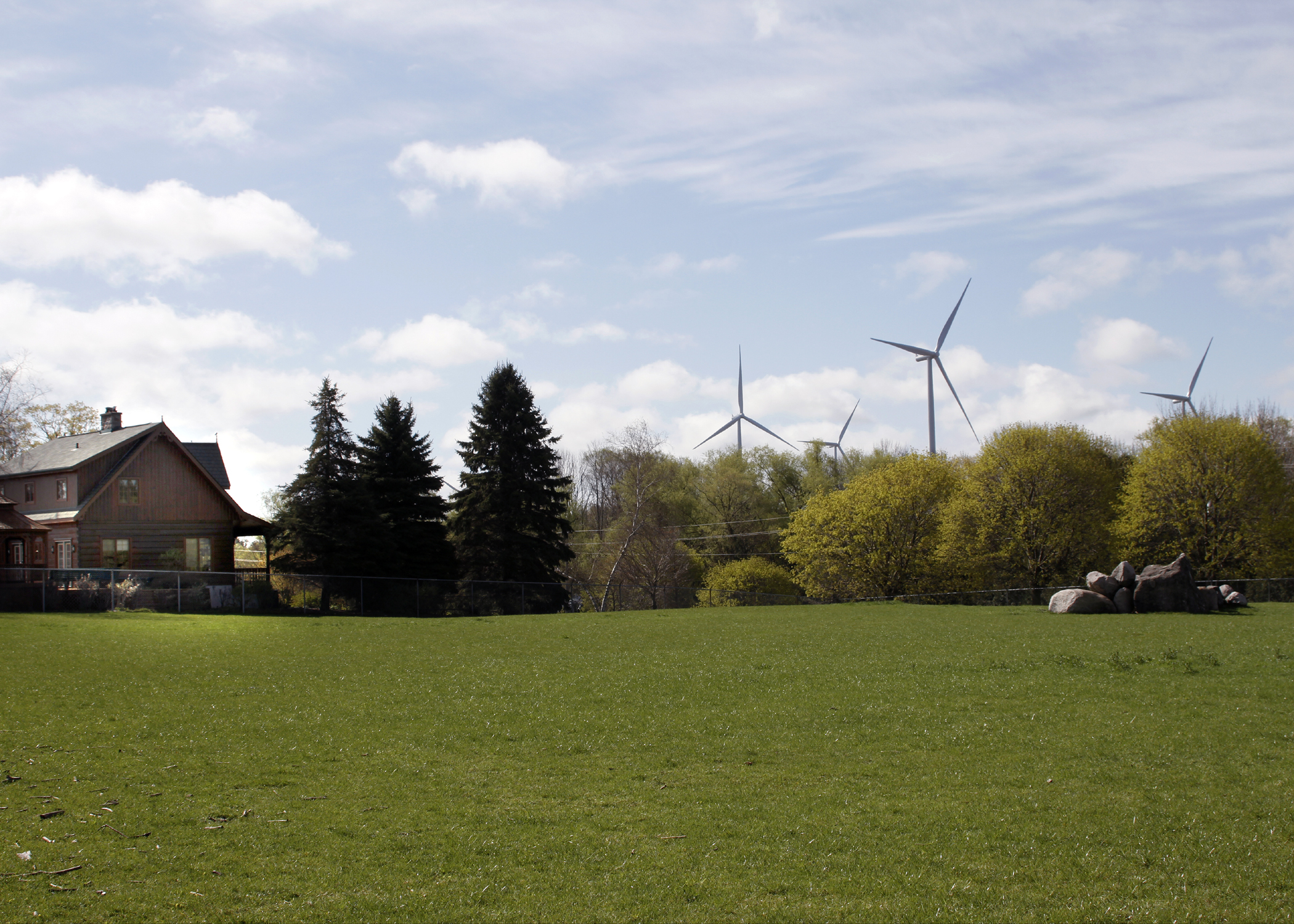
Berwick area farm: 33 huge industrial wind turbines proposed, with risk to health, safety, environment and wildlife [Photo Dorothea Larsen, Kemptville]

Ontario Farmer, August 14, 2018

By Tom Van Dusen

The Environmental Review Tribunal hearing into North Stormont’s approved Nation Rise wind turbine project has been adjourned until September 10-11.

The adjournment was called by tribunal chair Maureen Carter-Whitney July 31, with three days remaining on the original two-week schedule.

Key issues in deciding whether authorization given to EDP Renewables for the wind farm should be revoked are that it poses serious risk to human health, or that it could create irrevocable damage to the natural environment.

When the hearing resumes, hydrology will be the main topic. Before it broke, opponents presented their case on the threat to bats and birds posed by the installation of 33 turbines in the farming community south-east of Ottawa, the last wind power project to be approved in Ontario before the recent provincial election.

Expert witness Philippe Thomas, a resident of nearby Chesterville, educated the panel on barotrauma, a phenomenon which can cause the lungs of bats to implode when they fly in low-pressure areas close to turbine blades.

He described a study in Western Canada where it was part of his job to retrieve 400 bat carcasses at the base of wind turbines; only a few showed injuries consistent with being struck by blades, while the majority would have succumbed to barotrauma.

..EDP had a chance to rebut bird and bats arguments with its own expert witnesses. Biologist Andrew Ryckman and Dr Paul Kerlinger concluded the danger to bats would be minima and the impact on songbirds and migratory birds would be equally limited because they’re commonly found closer to shorelines. …

[Opposition coordinator Margaret Benke] indicated opposing witnesses brought forward some fresh points on wind turbine noise and on “debris fling” — the fact that pieces sometimes break off wind mills and are hurled long distances, posing a threat to humans in the area.

A major issue now, she emphasized, is paying the $20,000 debt opponents have accumulated in going against the project while raising more money to continue to fight to the end.

ottawawindconcerns@gmail.com

To help with fundraising for the North Stormont appeal, go to Go Fund Me here or send a cheque to Concerned Citizens of North Stormont c/o Wind Concerns Ontario, PO Box 509, 250 Wellington Main Street, Wellington ON  K0K 3L0.

Ottawa area community ramps up wind farm fight

17 Tuesday Jul 2018

Posted by Ottawa Wind Concerns in Health, Renewable energy, Uncategorized, Wind power

≈ 1 Comment

Tags

Conservation and Parks, EDP Renewables, environment, ERT, MECP, North Stormont, Ontario Environmental Review Tribunal, Ontario Ministry of Environment, wind power, wind turbines

Last chance for justice

CAM01025

Concerned Citizens of North Stormont leader Margaret Benke : power not needed, plenty of environmental dangers ahead

July 17, 2018

Residents of Berwick, Finch and Crysler, just 40 minutes south of Ottawa, are working day and night to prepare for their appeal of the Nation Rise wind power project, scheduled to begin next Monday in Finch.

The power project, planned to have a capacity of 100 megawatts of power (though wind power is typically less than 30% efficient) and would see more than 30 huge industrial wind turbines throughout the project area.

If it goes ahead, that is.

And that’s something many in the community are determined to fight.

The project was one of five new wind power contracts awarded in 2016 under the Large Renewable Procurement program (LRP). The 20-year cost of the contract, which will be added to Ontario electricity customers’ bills, will be more than $436 million, or almost $22 million a year. The new Ontario government pledged to cancel all five of those contracts and so far, has dispatched three of them, with an announcement last Friday.

Without formal cancellation, however, the community through a citizens group Concerned Citizens of North Stormont, is forced to proceed with its expensive appeal of the project’s Renewable Energy Approval. That approval, or REA, was given just three days before the writ period began for the recent Ontario election—an act that runs counter to the accepted idea that governments go into “caretaker” mode immediately prior to the election.

That is costing North Stormont residents thousands, but it’s costing all Ontario taxpayers, too, says Margaret Benke, spokesperson for the community group. “They have to send all those lawyers up here from Toronto, they have to stay somewhere, they have to eat — it all costs money, as they defend a bad decision made by the previous government.”

Why a bad decision? The majority of the power project would be built on land that is designated as a “highly vulnerable aquifer” meaning it is at risk for contamination by pollutants, and that the hydrogeology is such that the aquifer could be disturbed and wells for farms, homes and businesses could fail. That’s already happened near a wind power project in North Kent, and the new government has promised a public health investigation.

There are other environmental concerns about the project, including the risk of injury from blade failures and ice throw from the huge blades.

And then there’s the noise. The industrial-scale wind power generators produce a range of noise emissions which affect a significant portion of the population. The turbine noise can cause disturbance of sleep which results in other health problems; the unique quality of the turbine noise also results in “annoyance,” a medical term for stress or distress.

Almost every wind power project in Ontario has been appealed by Ontario citizens, and a few have been successful, but none on human health. At present, according to Wind Concerns Ontario, there are thousands of official reports of excessive wind turbine noise, almost none of which have ever been resolved.

The power developer, Portugal-based EDP Renewables, operates the South Branch wind power project in nearby Brinston; there have been noise complaints for that project, but they are unavailable under Freedom of Information requests because the Environment ministry’s Cornwall office did not follow procedures and issue tracking numbers for the complaints.

Wind Concerns Ontario president Jane Wilson, a Registered Nurse, says that situation “is an outrage. If it were anything else, like a model of automobile that had a few engine fires, or a food product that was contaminated, it would be recalled. In Ontario, this terrible situation is allowed to go on and on, with the Environmental Review Tribunal and the former Ministry of the Environment just letting it happen.”

“This appeal is the community’s last chance for justice outside of the court system or the Legislature,” says Wilson. “I hope the Tribunal will finally recognize its responsibility to this community, and rescind the approval for this project.”

The appeal begins Monday morning in Finch, at the Finch Community Centre/North Stormont Arena.

Rural Ontario heartbreak: wind power invasion was all for nothing

13 Wednesday Jun 2018

Posted by Ottawa Wind Concerns in Uncategorized

≈ 4 Comments

Tags

EDPR, hydro bills, La Nation, North Stormont, renewables, RES Canada, Steve Aplin, Wind Concerns Ontario, wind energy, wind farm, wind power, wind turbines

June 13, 2018

Many analysts and commentators are now looking over the ruins of the Ontario government from the election last week, and pointing to the McGuinty-Wynne government’s disastrous handling of the electricity sector, particularly the ideology-driven push for renewables, as a factor.

Two Auditors General said Ontario had never done a cost-benefit analysis for its aggressive support of industrial-scale wind power and that we were paying too much — far too much — for the power. Which was intermittent and unreliable to boot, so it could never do what they said it would.

Now, Ottawa-based energy insider Steve Aplin says, not only was large-scale wind expensive it was also a waste of time: wind power has never been shown to reduce CO2 or carbon emissions.

Never.

Wind did not replace the power produced by Ontario’s shuttered coal plants, gas and nuclear did.

Read Mr Aplin’s excellent analysis here, but remember, a 100-megawatt power project was just approved for North Stormont, just south of Ottawa, and an approval is pending for another project east, in The Nation.

Neither community wants the power projects, there are significant environmental concerns, and Ontario doesn’t need the intermittent power produced out-of-phase with demand.

For a list of other comments on the election and the role of Ontario’s renewable power program, please go to http://www.windconcernsontario.ca


A tale of two wind ‘farms’: betrayal and discrimination

04 Monday Jun 2018

Posted by Ottawa Wind Concerns in Ottawa, Renewable energy, Wind power

≈ 1 Comment

Tags

environment, Francophone, French language Ontario, language rights, MInistry of the Environment and Climate Change, MOECC, wind farm, wind power, wind turbines

June 4, 2018

Prior to the suspension*of Ontario’s “Large Renewable Procurement I” or LRP I, the government program to procure contracts for renewable power from solar and wind energy, five contracts were awarded in 2016 for new wind power projects.

Two of those were in the Ottawa area: the “Eastern Fields” project proposed by RES Canada in La Nation, the Township of Champlain and the United Counties of Prescott Russell, and “Nation Rise” proposed by Portugal-based EDPR.

Those projects are all now in the process toward approval and ultimate construction, in spite of the fact that the contracting authority, the Independent Electricity System Operator or IESO, says now that Ontario has surplus power for the forseeable future, and the fact that the communities do not unanimously support these power projects.

Let’s catch up with where the projects are right now.

Nation Rise, North Stormont

Concerned Citizens of North Stormont leader Margaret Benke : power not needed, plenty of environmental dangers ahead

This project was granted a Renewable Energy Approval or REA a few weeks ago, just days before the writ for the 2018 provincial election was drawn up. (The government is not allowed to make any major decisions after the writ.) The announcement came at 5 PM on a Friday; the community had 15 days to decide whether to appeal the REA, five days of those were on weekends, which restricts the ability of community members to consult with lawyers and subject matter experts.

The Concerned Citizens of North Stormont has decided to appeal, and a first appearance before the Environment Review Tribunal will be June 25 in Finch (to be confirmed).

There are a number of environmental concerns, principally the fact that the project will be located on what is designated a “highly vulnerable aquifer” — the Raisin-South Nation Protection Area serves 10,000 water wells. After the reports of disturbed and failed wells in Chatham-Kent during and following construction of a wind power project there, citizens in North Stormont are very worried about what could happen to their wells.

The other issue is noise: many residents will be exposed to the noise emissions coming from the more than 30 industrial-scale wind turbines planned for the area. Here’s the kicker: Ontario knew its noise assessment protocol for wind turbines was flawed so it revised the guidelines, and released a new document in April 2017. But, the five newest wind power projects don’t have to abide by them, instead using a “transitional” process, in spite of the fact their wind turbines are not yet purchased or built. A legal action on behalf of four community groups, North Stormont among them, is in process.

The wind power project will “have a huge impact on our communities,” said Concerned Citizens spokesperson Margaret Benke in a recent news release. North Stormont feels particularly betrayed because the current Premier told Ontario rural residents that wind power projects would not be put in areas that didn’t want them — a contract was awarded anyway, and last week the Premier, on a whirlwind election campaign tour that included North Stormont, was asked about that. She said “We had no choice.”

Listen to Wind Concerns Ontario president Jane Wilson here, in an interview with Bell Media’s Evan Solomon on the project.

This community group has started a GoFundMe effort to raise funds to defend the community, and they need help. Go to the GoFundMe link here: https://ca.gofundme.com/stop-wind-turbines-in-northstormont

Eastern Fields

Save The Nation protester: the MOECC and RES Canada don’t understand “Non”

This power project was in the mandated comment period which ended June 2nd, Saturday. The Ministry of the Environment and Climate Change (MOECC) says that consultation with the public is very important to the renewable energy process and that the comments from the public are welcome and valued.

That’s why all the documents were available in English only, in communities that are at least 60-percent francophone.

When pressed by residents and the community group Sauvons La Nation, the power developer RES Canada — which stands to make about $7 million a year–  said it would cost too much to translate the documents.

Apparently now, the MOECC says that francophone residents should have responded by the June 2nd deadline to say they need the French documentation and to request an extension to the deadline. Why wasn’t the information provided in the appropriate language in the first place, instead of discriminating against the francophone community?

There are environmental concerns with this power project as well, as it is close to the Alfred Bog, a site for migratory birds and other wildlife (Hint: migratory birds don’t count in Ontario — the wind power legislation, crafted by the industry, says that a species has to be on the edge of extinction before a wind power project could be denied).

There are concerns about water in the area as well, as it is rife with waterways, and also features areas of Leda clay or “quick” clay (as does North Stormont).

Noise will also be an issue for residents. Meanwhile, RES Canada, which also operates the Talbot wind power project, has had hundreds of complaints of excessive noise from the wind turbines, with no action taken by the MOECC.

Betrayal? Again, the Ontario government promised it would not inflict power projects on unwilling communities but again, it has. In this case, the gigantic turbines are all planned to be on land owned by members of a single family, involved in agriculture.


*The LRP/wind power program was suspended, which means, if the current government returns to power, or another is elected that also supports wind power, it could be revived and continue.

Wind turbine noise reports not answered: Global News report

02 Friday Jun 2017

Posted by Ottawa Wind Concerns in Renewable energy, Wind power

≈ 3 Comments

Tags

Glen Murray MPP, Global News, MOECC, Shirlee Engel, Wind Concerns Ontario, wind farm, wind farm noise, wind turbines

Turbines surround a home in Huron County, Ontario. Complaints get no response. [Photo by Gary Moon]

The Global News investigative team took on the task of finding out what happens when people in rural Ontario report excessive noise and other effects from industrial-scale wind turbines in nearby wind power projects?
The answer, said Global National reporter Shirlee Engel is, “Not much.”
Here are Parts 1 and 2 of the Global News investigative report. The investigation took four months, and was based on documents and analysis provided to Global by Wind Concerns Ontario. It took two years for Wind Concerns to get the documents from the Ministry of the Environment and Climate Change (MOECC) under Freedom of Information legislation.
In over half the cases in the documents, the MOECC made no response; in others there was limited response. The Ministry relied upon wind power companies “predicted modeling” to determine whether noise exceedance was possible. When actual measurements of noise were done, they were limited to a narrow range of audible noise and did not include low frequency or tonal noise.
Minister Glen Murray told the Legislature yesterday after a barrage of questions from Opposition MPPs that the Ministry will now be including “tonal” noise in its measurement; the Minister still insists there is no problem, and told Global News that he has no complaints on his desk at present — Wind Concerns Ontario documents show almost 3,200 complaints filed between 2006 and 2014.

http://globalnews.ca/video/3498008/ontario-wind-turbine-complaints-fall-on-deaf-ears/
http://globalnews.ca/video/3498012/community-fed-up-with-ministrys-response-to-wind-turbine-complaints

Wind turbines not clean, not green

22 Monday May 2017

Posted by Ottawa Wind Concerns in Renewable energy, Wind power

≈ 1 Comment

Tags

clean energy, Matt Ridley, renewables, wind energry, wind farm, wind power, wind turbines

“The phrase ‘clean energy’ is a sick joke,” says Matt Ridley of the U.K. Here’s why.

The Global Wind Energy Council recently released its latest report, excitedly boasting that ‘the proliferation of wind energy into the global power market continues at a furious pace, after it was revealed that more than 54 gigawatts of clean renewable wind power was installed across the global market last year’.

You may have got the impression from announcements like that, and from the obligatory pictures of wind turbines in any BBC story or airport advert about energy, that wind power is making a big contribution to world energy today. You would be wrong. Its contribution is still, after decades — nay centuries — of development, trivial to the point of irrelevance.

Here’s a quiz; no conferring. To the nearest whole number, what percentage of the world’s energy consumption was supplied by wind power in 2014, the last year for which there are reliable figures? Was it 20 per cent, 10 per cent or 5 per cent? None of the above: it was 0 per cent. That is to say, to the nearest whole number, there is still no wind power on Earth.

Even put together, wind and photovoltaic solar are supplying less than 1 per cent of global energy demand. From the International Energy Agency’s 2016 Key Renewables Trends, we can see that wind provided 0.46 per cent of global energy consumption in 2014, and solar and tide combined provided 0.35 per cent. Remember this is total energy, not just electricity, which is less than a fifth of all final energy, the rest being the solid, gaseous, and liquid fuels that do the heavy lifting for heat, transport and industry.

Such numbers are not hard to find, but they don’t figure prominently in reports on energy derived from the unreliables lobby (solar and wind). Their trick is to hide behind the statement that close to 14 per cent of the world’s energy is renewable, with the implication that this is wind and solar. In fact the vast majority — three quarters — is biomass (mainly wood), and a very large part of that is ‘traditional biomass’; sticks and logs and dung burned by the poor in their homes to cook with. Those people need that energy, but they pay a big price in health problems caused by smoke inhalation.

Even in rich countries playing with subsidised wind and solar, a huge slug of their renewable energy comes from wood and hydro, the reliable renewables. Meanwhile, world energy demand has been growing at about 2 per cent a year for nearly 40 years. Between 2013 and 2014, again using International Energy Agency data, it grew by just under 2,000 terawatt-hours.

If wind turbines were to supply all of that growth but no more, how many would need to be built each year? The answer is nearly 350,000, since a two-megawatt turbine can produce about 0.005 terawatt-hours per annum. That’s one-and-a-half times as many as have been built in the world since governments started pouring consumer funds into this so-called industry in the early 2000s.

At a density of, very roughly, 50 acres per megawatt, typical for wind farms, that many turbines would require a land area greater than the British Isles, including Ireland. Every year. If we kept this up for 50 years, we would have covered every square mile of a land area the size of Russia with wind farms. Remember, this would be just to fulfil the new demand for energy, not to displace the vast existing supply of energy from fossil fuels, which currently supply 80 per cent of global energy needs.

Do not take refuge in the idea that wind turbines could become more efficient. There is a limit to how much energy you can extract from a moving fluid, the Betz limit, and wind turbines are already close to it. Their effectiveness (the load factor, to use the engineering term) is determined by the wind that is available, and that varies at its own sweet will from second to second, day to day, year to year.

As machines, wind turbines are pretty good already; the problem is the wind resource itself, and we cannot change that. It’s a fluctuating stream of low–density energy. Mankind stopped using it for mission-critical transport and mechanical power long ago, for sound reasons. It’s just not very good.

As for resource consumption and environmental impacts, the direct effects of wind turbines — killing birds and bats, sinking concrete foundations deep into wild lands — is bad enough. But out of sight and out of mind is the dirty pollution generated in Inner Mongolia by the mining of rare-earth metals for the magnets in the turbines. This generates toxic and radioactive waste on an epic scale, which is why the phrase ‘clean energy’ is such a sick joke and ministers should be ashamed every time it passes their lips.

It gets worse. Wind turbines, apart from the fibreglass blades, are made mostly of steel, with concrete bases. They need about 200 times as much material per unit of capacity as a modern combined cycle gas turbine. Steel is made with coal, not just to provide the heat for smelting ore, but to supply the carbon in the alloy. Cement is also often made using coal. The machinery of ‘clean’ renewables is the output of the fossil fuel economy, and largely the coal economy.

A two-megawatt wind turbine weighs about 250 tonnes, including the tower, nacelle, rotor and blades. Globally, it takes about half a tonne of coal to make a tonne of steel. Add another 25 tonnes of coal for making the cement and you’re talking 150 tonnes of coal per turbine. Now if we are to build 350,000 wind turbines a year (or a smaller number of bigger ones), just to keep up with increasing energy demand, that will require 50 million tonnes of coal a year. That’s about half the EU’s hard coal–mining output.

Forgive me if you have heard this before, but I have a commercial interest in coal. Now it appears that the black stuff also gives me a commercial interest in ‘clean’, green wind power.

The point of running through these numbers is to demonstrate that it is utterly futile, on a priori grounds, even to think that wind power can make any significant contribution to world energy supply, let alone to emissions reductions, without ruining the planet. As the late David MacKay pointed out years back, the arithmetic is against such unreliable renewables.

The truth is, if you want to power civilisation with fewer greenhouse gas emissions, then you should focus on shifting power generation, heat and transport to natural gas, the economically recoverable reserves of which — thanks to horizontal drilling and hydraulic fracturing — are much more abundant than we dreamed they ever could be. It is also the lowest-emitting of the fossil fuels, so the emissions intensity of our wealth creation can actually fall while our wealth continues to increase. Good.

And let’s put some of that burgeoning wealth in nuclear, fission and fusion, so that it can take over from gas in the second half of this century. That is an engineerable, clean future. Everything else is a political displacement activity, one that is actually counterproductive as a climate policy and, worst of all, shamefully robs the poor to make the rich even richer.

Spectator.co.uk/podcast
Matt Ridley discusses wind power

Read the whole article here

Endangered turtles win wind farm appeal in Prince Edward County

27 Thursday Apr 2017

Posted by Ottawa Wind Concerns in Renewable energy, Wind power

≈ Leave a comment

Tags

APPEC, community opposition wind farm, endangered species Ontario, environmental damage wind farm, prince Edward County, Wind Concerns Ontario, wind energy, wind farm, wind farm legal action, wind power, wind turbines

ENDANGERED TURTLES WIN PROTECTION FROM WIND FARM IN ONTARIO, CANADA

The Environmental Review Tribunal determined the Blandings Turtle was endangered by the wind farm

Landmark legal decision overturns government approval of large power project

WELLINGTON, ONTARIO, CANADA, April 27, 2017 /EINPresswire.com/ —
A years-long legal battle over a wind power project by Germany-based wpd in Ontario, Canada, resulted in a ruling by the provincial government’s Environmental Review Tribunal yesterday, in favour of protecting an endangered species of turtle.

In the Tribunal ruling, government approval for 18 of 29 industrial-scale wind turbines in the “White Pines” project was reversed. With 60 percent of the project removed, it may be impossible for the power developer to meet its contractual obligation.

The citizens of Prince Edward County, about two hours east of Toronto, where the project was to be located, fought the wind turbines for almost 10 years, and spent almost $2 million CAD in legal fees.

“The County” as it is called, on the shores of Lake Ontario, is a stopping place for hundreds of thousands of birds migrating in eastern North America, and was identified as an Important Bird Area by conservation groups. The area is also a habitat for the endangered Blandings turtle, and home to the Little Brown Bat which is on the verge of extirpation.

“This [decision] is clearly a victory for the survival of the Blanding’s turtle and many other animal and plant species,” said Alliance to Protect Prince Edward County president Gordon Gibbins. “Although the Tribunal decision was specifically concerned with protecting the turtles and their habitat, we are very pleased that indirectly as a result of this decision there will be no turbines in the Prince Edward County Important Bird and Biodiversity Area.”

“The Tribunal decision has made it clear that this wind power project was never about protecting the environment,” said Jane Wilson, president of Wind Concerns Ontario, the coalition of community groups concerned about wind power projects.

“The wind power project was always about money. The citizens of Prince Edward County fought hard to protect the environment and wildlife against our own Ministry of the Environment.”

Citizen evidence was crucial in bringing forward evidence of harm to the environment in the various appeals of the power project, Wilson says. “The government did little or no oversight on how wildlife is to be protected, and it was the people of Prince Edward County who brought the information to the Tribunal. As a result, in Ontario now, wind power does not automatically override environmental concerns.”

Economic impacts were also a concern for the community. The County is a tourist destination with dozens of wineries and cheese establishments; winery owners were concerned about the negative impact of the huge power-generating turbines on the County with its quaint villages and pastoral views as a tourist attraction.

Prince Edward County Mayor Robert Quaiff said, “Our community has been fighting this project for quite some time. I’m glad to see that the Environmental Review Tribunal has recognized and given credence to our concerns.”

For more information, visit Wind Concerns Ontario at www.windconcernsontario.ca
905-362-9334

Jane Wilson
Wind Concerns Ontario
905-362-9334
email us here

Wind power developer uses threat to influence environmental agency

15 Saturday Apr 2017

Posted by Ottawa Wind Concerns in Renewable energy, Wind power

≈ 9 Comments

Tags

Alliance to protect Prince Edward County, APPEC, Blanding's Turtle, Environmental Review Tribunal, Ontario Ministry of the Environment and Climate Change, prince Edward County, wind farm, wind fram environmental damage, wind power, wind turbines

Power developer announcement it is about to clear land which is habitat for an endangered species is an attempt to force the Environmental Review Tribunal to issue a decision on the Prince Edward County wind power project, and proposed “remedies” for species at risk

The Environmental Review Tribunal determined the Blandings Turtle was endangered by the wind farm; the company is proceeding with construction in the absence of a final decision

April 15, 2017

Minutes before 4 PM on the Thursday of the Easter weekend, Germany-based wind power developer WPD issued notice to the Environmental Review Tribunal that the company intends to start clearing land in advance of building the White Pines power project.

Land clearing is to begin on Wednesday, the corporate power developer said, which meant there is only one day after the Easter weekend to file any documents against the action.

The White Pines project has been contested in an appeal before the Tribunal; the original decision found that the power project would cause harm to endangered species of turtles and bats. A hearing was held in late January to hear possible “remedy” actions to prevent loss of life, but a decision accepting or rejecting the remedies has not yet been rendered.

WPD is in danger of being in breach of its contract with the Ontario government if it does not begin supplying power by the critical Commercial Operation Date.

The Blandings Turtle, one of the endangered species at risk from the wind power project construction, has already been seen in the County by residents, so has emerged from hibernation.

The rush to construction shows how willing the wind power developer is to risk environmental damage, a spokesperson for the Alliance to Protect Prince Edward County told news media Quinte News.

At an earlier phase of the White Pines project WPD began unauthorized land clearing but was halted by an order from the Environmental Review Tribunal. WPD is also the power developer behind the contentious Fairview Wind project near Collingwood. It threatened to sue the Ontario government if a contract was not issued for the power project.

Previous attempt by WPD to clear land for unauthorized construction of the Prince Edward County wind power project


Picton barge incident highlights wind developer attitude to environment

02 Sunday Apr 2017

Posted by Ottawa Wind Concerns in Renewable energy, Wind power

≈ 1 Comment

Tags

Amherst Island, MInistry of the Environment and Climate Change, prince Edward County, wind farm construction, wind farm environmental damage, wind turbines

The recent sinking of a commercial barge near Picton, Ontario, in Prince Edward County, has resulted in a spotlight on the activities by wind power developer Algonquin Power, and its controversial Windlectric project on Amherst Island.

The project will virtually subsume the little island, which is home to 34 at-risk or endangered species of wildlife, and change life for its residents dramatically. However, that wasn’t enough to sway the Environmental Review Tribunal, which dismissed a citizen group appeal. The project is still before the courts, with a new phase beginning in Toronto this week, before Divisional Court.

One of the requirements in a power developer’s Renewable Energy Approval or REA is a marine logistics plan, which documents how marine safety will be managed as construction proceeds, and equipment and material such as gravel are transported over water.

Windlectric had no Marine Logistics Plan in place.

Until the day after the barge sank.

The barge was to transport gravel from Prince Edward County across the water to the Windlectric site but encountered ice which “sandpapered” a two-foot by two-foot hole in the hull, and partially sank.

Windlectric hastily issued a Marine Logistics Plan which, interestingly, made no mention whatsoever of the use of Picton Bay, and how the barge traffic was going to work with the Glenora Ferry trips every 15 minutes. Picton elected officials also expressed surprise at the use of the Picton Terminal: they had no idea that Algonquin Power was getting gravel from Prince Edward County, and there had been no agreements for road use.

Use of the Picton facility has now been halted, and Prince Edward County remains under a Boil Water advisory due to the spill of diesel fuel, although the state of emergency has been revised from earlier this week.

This weekend, the power developer issued a statement saying the barge sinking was “unfortunate” but “outside the project’s boundary at the time of the event.” So, not our concern.

Algonquin Power is also seeking the use of a stretch of parkland near Millhaven and Bath to use as a construction staging area; the company claims it will return the parkland to its original state after it is finished.

Barge carrying construction equipment and material: no plan in place at the time of accident [Photo Jay Pickerel/Facebook]

The fact remains that the construction of wind “farms” is actually construction of huge power plants, no matter what bucolic photos of benign “windmills” are used.

Questions should be raised about the environmental impact of these construction activities not only of the developers but also the Ontario Ministry of the Environment and Climate Change, which citizens have a right to expect is overseeing events and confirming that mandated conditions for environmental protection and safety are being met.

Site plan for North Stormont wind power project shows 34 turbines planned

22 Wednesday Mar 2017

Posted by Ottawa Wind Concerns in Renewable energy, Wind power

≈ 1 Comment

Tags

Concerned Citizens of North Stormont, EDP Renewables, Finch Ontario, Glenn Thibeault, hydro bills Ontario, IESO, North Stormont, power Ontario, Wind Concerns Ontario, wind energy, wind farm, wind power, wind turbines

The 100-megawatt project will cost more than $400 million, while Ontario already has a surplus of power

EDP Renewables, headquartered in Madrid, has posted the site plan for its 100-megawatt “Nation Rise” wind power project, in North Stormont, about 40 minutes south and east of Ottawa.

Details posted:

Project Name: Nation Rise Wind Farm

IESO Reference Number: L-006351-WIN-001-100

Project Location: The proposed Nation Rise Wind Farm will be located on private and public lands in the United Counties of Stormont, Dundas and Glengarry in the western portion of the Township of North Stormont, Ontario, and bounded to the south by the Township of South Stormont and to the west by the boundary of the Township of North Dundas. The north portion of the site is delimited by the municipality boundaries of Russell and the Nation. Courville Road and MacMillan Road are the east boundaries of the project.

Dated at: the Township of North Stormont this 17th day of March 2017.

Other project documents including the draft noise impact assessment are available on the Nation Rise wind “farm” website here.

Residents interested in learning more about the impact of the power project on the area’s homes, environment and wildlife, and in supporting the group’s activities and legal fund, should contact the Concerned Citizens of North Stormont*, whose website is here.

The 20-year contract with the Independent Electricity System Operator (IESO) will cost Ontario electricity ratepayers about $436 million.

The Minister of Energy, Glenn Thibeault, has stated, meanwhile, that Ontario currently has a surplus of power (which is being sold off at prices below what power developers are paid). The Nation Rise contract could be cancelled under a pre-construction liability clause for $600,000, according to IESO documents.

Minister Thibeault told a business audience in Toronto last year that the government’s “arbitrary” selection of wind power led to “sub-optimal siting” and “heightened community concerns.”

North Stormont is a Not A Willing Host community.

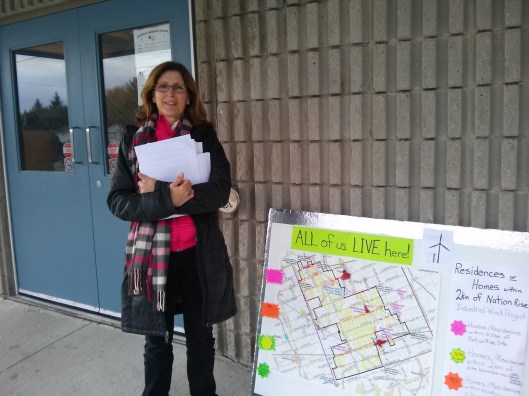
Concerned Citizens of North Stormont leader Margaret Benke, at a recent information event in Finch, Ontario

*Concerned Citizens of North Stormont is a chapter of Wind Concerns Ontario, as is Ottawa Wind Concerns.

← Older posts
Newer posts →

Recent Posts

  • Open letter to CAFES Ottawa
  • Ottawa Wind Concerns supports West Carleton residents
  • What does wind ‘farm’ construction really look like?
  • Unwilling Host communities surround Ottawa
  • How many birds do wind turbines kill?

Follow me on Twitter

My Tweets

Enter your email address to follow this blog and receive notifications of new posts by email.

Tags

Bob Chiarelli Green Energy Act IESO Ontario Ottawa Ottawa wind concerns wind energy wind farm wind power wind turbines

Contact us

PO Box 3 North Gower ON K0A 2T0

Create a free website or blog at WordPress.com.

Privacy & Cookies: This site uses cookies. By continuing to use this website, you agree to their use.
To find out more, including how to control cookies, see here: Cookie Policy
  • Subscribe Subscribed
    • Ottawa Wind Concerns
    • Join 379 other subscribers
    • Already have a WordPress.com account? Log in now.
    • Ottawa Wind Concerns
    • Subscribe Subscribed
    • Sign up
    • Log in
    • Report this content
    • View site in Reader
    • Manage subscriptions
    • Collapse this bar
 

Loading Comments...