MPP for Stormont-Dundas-South Glengarry Jim McDonell has launched a petition asking to Ontario government to return full consultation for the community regarding a proposed 30-50 turbine wind power project, and further, to do a complete study of any impacts of the proposed power project.
The petition MUST be printed out, signed, and mailed or delivered to Mr McDonell’s office as a legal document. Fax or scanned versions are not legal.
Wind developers can use farm leases as security for financing the power project
Ontario Farmer, May 5, 2015
by Garth Manning and Jane Wilson
It came as a surprise to many in Ontario when it was revealed that the multi-national power developers behind the K2 wind power generation project near Goderich had secured $1 B in financing, and that this arrangement is now registered on title for the 100 farm properties involved as lessors.
The arrangement is between K2 Wind Ontario Inc. and Mizuho Bank Ltd. Canada Branch. It secures a revolving credit facility of up to $1 billion at 25% on a number of items, including the contracts between landowners and K2 for land and road agreements with municipalities.
Another, smaller example has also come to light: a wind power project south of Ottawa in Eastern Ontario, where the five landowners leasing land for a 30-megawatt, 10-turbine project now have charges on their properties for $70 million.
Immediately, questions arise as to what would happen if the power developers were to default on their loans: would the lender then own the farm properties? How would that affect road use agreements with municipalities?
The fact is, this is a common practice. Property owners can refer to the leases imposed by the developers to review this potential situation, and many others that may affect operation and ownership of their land while leasing land for the power projects.
In an Invenergy standard contract, for example, is this clause: “In connection with the Lessee’s financing of the Project, the Lessee….is hereby given the right by the Lessor…to mortgage its interests in the Lease…and to assign this Lease, or any part of parts thereof, and any subleases as collateral security…”
The proper term for this is a “Charge of Lease” but may also be referred to as a “Demand Debenture.” What it means is, the present value of the wind power contract (i.e., the Feed In Tariff or FIT contract with the Ontario government) is greater than the present value of the lease amount. The difference between those two amounts is security for the loan to the power developer. It is a charge against all contracts favourable to the wind power developer, which may also include road use agreements.
It is like a line of credit for the developer and typically, advances against the amount are tied to certain milestones such as stages of construction.
The critical factor, however, is what it means for the lessors, in other words the farm owners who have leased their land for wind turbines, access roads, substations, transmission lines, etc. The importance lies not so much that the farmer lessors might on default lose their land (the farm land itself is not mortgaged, just the turbine contract on that land) but the damage it does to that property owner if he/she wants to sell, or to renew an existing mortgage, or place a new one, or in any way borrow money for which the lender would want security on his/her land.
Let’s assume a farm owner wants financing for farm operations or improvements. That might now pose difficulty: lenders do not like to be second in line, as they would be where a charge of lease is in place.
If the farm owner wishes to sell, similar difficulties arise: the lawyer for a purchaser in the case of an agreement to purchase will do a title search and discover the Charge of Lease on title, then immediately advise his or her client that the client is entitled to get out of the deal unless the registration of the Charge is removed from title. A purchaser is not expected to assume any risk of this nature.
In the case of renewing an existing mortgage or placing a new one, the lawyer for the bank or other lending institution would take the same position — no renewal or new mortgage unless the customer sees that the Charge disappears from title.
This is one of several important characteristics of signing a lease to have wind turbines, and needs to be thoroughly considered. Other legal issues to be carefully considered may include potential liability for the substantial cost of “decommissioning” turbines at the end of the lease, difficulty obtaining insurance on property with wind turbines, loss of autonomy over building on the property and carrying out regular farming practices, and, last, the potential for nuisance suits from neighbours affected by noise or property value loss.
Property owners should consult with a lawyer before signing any agreement.
Garth Manning is a retired lawyer and former president of the Ontario Bar Association, who lives in Prince Edward County. Jane Wilson is president of Wind Concerns Ontario; she lives in North Gower.
Ontario’s electricity customers pay and pay and pay while neighbours get our power cheap
Wind almost 40% of exported power; cost of surplus export $437 million in just 3 months
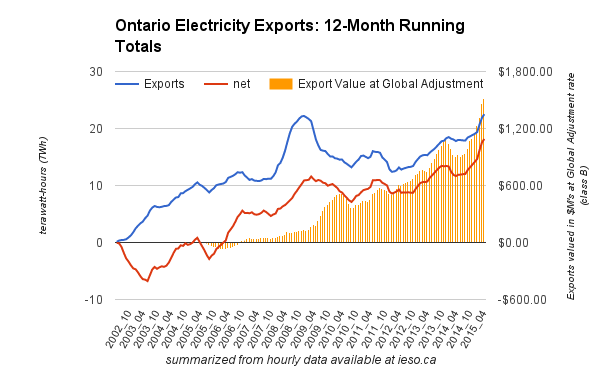
The first quarter of the current year indicates Ontario is exporting record quantities of surplus electricity.
It appears to be part of the Liberal government plan as this excerpt from Finance Minister Sousa’s budget “Building Ontario Up” claims: “Through our four-part economic plan, we are supporting greater investment in productivity and innovation, providing a renewed focus on international exports, encouraging the transition to a low-carbon economy and creating more jobs for Ontarians.”
It would be better if our surplus electricity was exported profitably, instead of a cost to ratepayers, but alas, that is not the way the Liberal Energy Ministers past and present have structured the portfolio.
The first quarter of the current year saw Ontario export a record 6.65 TWh (terawatts) — that’s enough to power 690,000 average households for a full year.
Export costs up 75% in first quarter
The 6.65 TWh sold to our neighbours was up 75% from 3.81 TWh in 2014′s first quarter. We sold that surplus at prices well below what we received. Exports represented 17.5 % of Ontario’s demand in 2015 versus 10% in the same period in 2014. Wind (generated and curtailed) in 2014 was 2.05 TWh and 53.7% of Ontario’s exports; in 2015, wind grew to 2.61 TWh and was 39.2 % of our exports.
The concept of exporting is one that economists encourage; however, they expect it will be profitable, create jobs, and not burden the rest of the economy though subsidization. Subsidizing exports is often referred to as “dumping” and frequently challenged under the WTO (World Trade Organization) rules.
Cost to ratepayers is shocking
Examining the cost to Ontario ratepayers for the 3.81 TWh exported in 2014 and the 6.65 TWh exported in 2015 using data from the Independent Electricity System Operator’s (IESO) “Market Summaries” is shocking.
The 2014 first Quarter exports cost (average of $102.6 million/TWh) ratepayers $391 million to produce and was sold via the HOEP (hourly Ontario electricity price) market at an average of $75.54 million/TWh. That cost Ontario’s ratepayers $103 million. In 2015, the 6.65 TWh exported cost Ontario’s ratepayers $672 million (average cost of $101 million/TWh), and sold at an average of $35.4 million/TWh, costing Ontario ratepayers $437 million.
To put some context to the latter, the money lost exporting the 6.65 TWh was equal to 6.6 cents per kilowatt hour. The foregoing subsidy does not include other costs Ontario’s ratepayers pick up including: spilled hydro, steamed-off nuclear or payments to idling gas plants. The subsidies supporting exports is double what Energy Minister Bob Chiarelli suggests is needed to assist almost 600,000 “low-income” households to pay their hydro bills. Ontario’s ratepayers will start paying the latter January 1, 2015.
This analysis would not be complete without noting the cost of wind generation (two quarters) in 2014 was $252.7 million (average cost of $123.5 million per/TWh) and $322.5 million for 2015!
Perhaps our Finance Minister should “focus” on the harm to Ontario’s ratepayers instead of dumping our surplus electricity on our neighbours who are happy to take it and not raise the issue with the WTO. If the first quarter of 2015 is indicative of the full year, ratepayers will pick up $1.8 billion in subsidies to supply our neighbours with cheap electricity, while Ontario’s citizens struggle.
Parker Gallant, April 28, 2015
The views expressed here are those of the author and do not necessarily represent Wind Concerns Ontario policy.
Chart courtesy Scott Luft of Cold Air Online
EDITOR’S NOTE: Parker Gallant will be on the Rob Snow show on radio CFRA, Friday May 1st, to discuss this. Listen in an AM 580 or online at cfra.com
Construction of one of the 3-MW turbines at Brinston, now operating–30-50 more proposed by EDP Renewables
Ottawa Wind Concerns has learned that a “Charge of Lease” has been placed on the South Branch wind “farm” in the amount of $70 million. The charge is on the leasehold interest in five properties, where property owners have leased land for wind turbines, access roads, substations, and other parts of the wind power generation project.
Earlier this month, details came to light on the 140-turbine K-2 project near Goderich, Ontario, where a charge of lease has been filed on the title for 100 farm properties, in the amount of $1 billion.
The Charge of Lease is basically a financing agreement between a lender (who may represent investors in the wind power project) and the wind power developer, that can function as a line of credit. The basis for the Charge, as we understand it, is that the present value of the contract for the turbines, i.e., the Feed In Tariff contract for power with the Province of Ontario is greater than the present value of the lease agreements with the landowners; the difference between those two values is the security for the loan.
The South Branch contract with the Ontario government runs for 20 years and is worth millions to the developer, who bought the project from Germany-based Prowind.
The importance of the existence of these agreements is the effect they have for the landowner leasing land for the wind turbines. In the opinion of a lawyer advising us (who prefers the term “Demand Debenture” for this arrangement:
It’s not so much that the farmer lessors might on default lose their land (the land itself is not mortgaged, just the turbine contract on that land) but the damage it does to that farmer if he/she wants to sell or to renew an existing mortgage, or place a new one or in any way borrow money for which the lender would want security on his/her land.
Assume a binding Agreement of Purchase and Sale. The lawyer for the purchaser does a title search and discovers the Demand Debenture. The lawyer would immediately tell his/her client that the client is entitled to get out of the deal unless the registration of the Demand Debenture is removed from title, and would also insist to the farmer’s lawyer that this be done otherwise the deal cannot close. A purchaser is not expected to assume any risk of this nature nor to be in the position of “buying a law suit”.
in the case of renewing an existing mortgage or placing a new one, the lawyer for the Bank or other lending institution would take the same position – no renewal or new mortgage unless the customer sees to it that the Demand Debenture disappears from title. Period. End of story.
This is another example of the very serious questions that need to be asked by anyone considering leasing their land for a wind power generation project. There are many serious and long-lasting effects to signing these agreements that need to be properly understood.
In 2013, the Not A Willing Host group of municipalities met in Ottawa at the Association of Municipalities of Ontario convention. At that meeting, one Ontario mayor said, What people need to understand is that basically, they sold their property for the amount of the lease agreement.
** Please see also, the article from the May 5th edition of Ontario Farmer on the charge of lease issue, here.
Reposted from Wind Concerns Ontario, today. Todd Smith, MPP for Prince Edward-Hastings, rose in the Ontario Legislature yesterday with a question for Environment Minister Glen Murray. In lieu of the fact that the Ontario Court of Appeal upheld the decision by the Environmental Review Tribunal to rescind approval for a wind power development that would cause serious and irreversible harm to an endangered species, Smith said, would the Minister’s department now stop development on that site and further, stop aiding the wind power developer to destroy the ecosystem on the south shore of Prince Edward County? Minister Murray said he commended the Prince Edward County Field Naturalists for their activism (saying nothing about the hundreds of thousands of after-tax dollars spent by Ontario citizens to protect the environment form thew Ministry of the Environment), and offered to meet with the MPP on this issue. See the video of the exchange here.
A turtle that insists on crossing a road has put a stop to a massive wind-energy development in Eastern Ontario.
The Ontario Court of Appeal ruled on Monday that a 324-hectare, nine-turbine wind farm proposed for the south shore of Prince Edward County puts a population of endangered Blanding’s turtles at risk of dying out in that region’s wetland. The risk is posed not by the wind farm itself but by 5.4 kilometres of roads to and from the site. Experts said the turtles, which range widely as part of their natural life cycle, would inevitably try to cross those roads, exposing them to vehicles, predators and human poachers.
The ruling restores an environmental tribunal’s 2013 decision that the wind farm, while not posing a serious risk to human health, would cause “serious and irreversible” harm to the Blanding’s turtle. That ruling had been rejected by Ontario Divisional Court partly because the tribunal did not know how many turtles live in the provincially significant wetland.
But the Ontario Court of Appeal said the number of turtles at risk does not matter. “The number of Blanding’s turtles, no matter what that number is, satisfies the criteria” for being deemed threatened and endangered, the court said in a 3-0 ruling written by Justice Russell Juriansz. It cited testimony from Frédéric Beaudry, a wildlife ecologist at Alfred University in New York State, that the number is “likely small.”
The Court of Appeal ruling means the case now goes back to the environmental tribunal to decide what should happen with the project, including whether an alternative plan can be permitted that takes the turtles into account. The company involved, Ostrander Point Wind Energy LP, had proposed at an earlier stage to close the road to public access.
The ruling is a setback for Ontario’s multibillion-dollar wind energy business. “It will mean that, in future, wind companies are going to have to pay attention to some of these environmental effects,” said Stephen Hazell, director of conservation and a lawyer with Nature Canada, which supported the suit launched by the Prince Edward County Field Naturalists, a local conservancy group.
Mr. Hazell added that other groups with concerns about the impact of wind projects in their own jurisdictions now have “a legal test that in some cases they may be able to meet.”
During the initial hearing, conservationists argued that the wind project would have adverse effects on a number of species, including migratory birds, but the final decision came down to the Blanding’s turtle alone because of its extreme sensitivity to human activity, particularly roads.
With a bright yellow throat, a gentle disposition and an expression that resembles a perpetual smile, the species makes a tempting target for poaching, even by well-meaning individuals looking for an unusual pet. But Blanding’s turtles usually die once they are captured or released in a different location.
Ponderously slow to grow and mature, females of the species generally do not reproduce until they reach 18 years of age. Even then, they may only lay eggs every other year. The turtle’s long life span offsets its slow replacement rate – adults may live 90 years or more – but only in places when individuals have a good chance of avoiding lethal encounters along the way.
“Losing a couple of females can, in the long run, do a population in,” said Dr. Beaudry, a world expert on the species.
He added that he had no doubt the turtles would be crossing the roads if the wind project went ahead, as they typically travel for kilometres from the places where they hatch in search of food or mates.
Blanding’s turtles are considered globally endangered. Small populations are found in scattered pockets from the American Midwest to Nova Scotia.
OWC editor’s note: counsel for the Prince Edward County Field Naturalists was Eric Gillespie, environmental lawyer based in Toronto. Ottawa Wind Concerns has Mr Gillespie’s firm on retainer.
Provincial government, Hydro One both to blame for the mess
West Carleton Review
To the Editor:
Your April 9 edition of the West Carleton Review contained a number of articles and letters to the editor regarding our sad state of affairs with regard to Hydro in Ontario.
Hydro in the last century has become one of our essential services, and as the ice storm of 1998 demonstrated, our lives revolve around electricity to power everything in our homes and even the gas stations that fuel our vehicles.
However, in Ontario the distribution, sale and production of hydro is treated as a political spectator sport with boondoggles, lies, smart meter errors, overpaid employees and corruption being the order of the day.
Even the Auditor-General (AG) has taken this government to task regarding hydro, but the Minister, Bob Chiarelli, tries to shame the AG by stating that it is a complicated file and she doesn’t have the knowledge required to ascertain the problems at hydro, let alone recommendations on how to fix them, a fact that was quickly debunked when we found out that the AG used to work for Manitoba Hydro.
I feel it is the minister that is “out of his league” on this file.
And now the same minister and government want to implement a low-income plan to help pay for the most expensive electricity in North America by further increasing the cost of electricity to the millions who will not qualify for this subsidy since the bar has been set so low as to be mostly ineffective and unavailable to most customers of hydro. This certainly appears to be nothing else but a PR exercise on the part of the government.
There is no good reason why we should have installed so many wind turbines or solar farms, both of which need an alternative back-up source of electrical power, since both wind and sun are unreliable sources of continuous energy available on demand.
The fact that there is no available mechanism to store surplus electrical power produced by wind or solar, Hydro One sells it on the open market at a substantial loss. Unfortunately, the current government has tied their hands for quite a few more years with multi-billion dollar contracts to foreign companies to supply either the turbines or the solar panels.
In my estimation, the only solution to the mess created by this government is to buy power from reliable and affordable sources of electricity producing jurisdictions, such as Quebec Hydro or Manitoba Hydro.
Hydro One cannot be trusted to produce the required amount of affordable power required and this government, regretably, has created most of the current (no pun intended) mess it finds itself in on the hydro file.
Ontario will follow the EU at its peril — power rates will soar while industries depart
As the Ontario government announces new unilateral climate policies, Canadian policymakers would be well advised to heed the lessons of Europe’s self-defeating green energy debacle.
The European Union has long been committed to unilateral efforts to tackle climate change. For the last 20 years, Europe has felt a duty to set an example through radical climate policy-making at home. Political leaders were convinced that the development of a low-carbon economy based on renewables would give Europe a competitive advantage.
European governments have advanced the most expensive forms of energy generation at the expense of the least expensive kinds. No other major emitter has followed the EU’s aggressive climate policy and targets. As a result, electricity prices in Europe are now more than double those in North America and Europe’s remaining and struggling manufacturers are rapidly losing ground to international competition. European companies and investors are pouring money into the U.S., where energy prices have fallen to less than half those in the EU, thanks to the shale gas revolution.
Although EU policy has managed to reduce CO2 emissions domestically, this was only achieved by shifting energy-intensive industries to overseas locations without stringent emission limits, where energy and labour is cheap and which are now growing much faster than the EU.
Most products consumed in the EU today are imported from countries without binding CO2 targets. While the EU’s domestic CO2 emissions have fallen, if you factor in CO2 emissions embedded in goods imported into EU, the figure remains substantially higher.
Of all the unintended consequences of EU climate policy perhaps the most bizarre is the detrimental effect of wind and solar schemes on the price of electricity generated by natural gas. Many gas power plants can no longer operate enough hours. They incur big costs as they have to be switched on and off to back-up renewables.
Most products consumed in the EU today are imported from countries without binding CO2 targets
This week, Germany’s energy industry association warned that more than half of all power plants in planning are about to fold: Even the most efficient gas-fired power plants can no longer be operated profitably.
Every 10 new units worth of wind power installation has to be backed up with some eight units worth of fossil fuel generation. This is because fossil fuel plants have to power up suddenly to meet the deficiencies of intermittent renewables. In short, renewables do not provide an escape route from fossil fuel use without which they are unsustainable.
Wind output up, exports up, cost of electricity up— no coincidence
Five years ago, in 2009, George Smitherman, Minister of Energy during the McGuinty reign, rammed through the Ontario Legislature the Green Energy and Green Economy Act. The Act ushered in the FIT (Feed In Tariff) and MicroFIT programs, attracting corporations from around the world who wanted the lucrative power contracts being let by the government-mandated Ontario Power Authority.
The result of the Act is now evident with huge chunks of rural Ontario covered with solar panels and spiked by 500-foot industrial wind turbines cranking out intermittent electricity, surplus to our demand, 99.9% of the time.
Early in 2010, the Independent Electricity System Operator (IESO) advised us of electricity generation for Ontario by fuel type for 2009. The headline in their press release stated: “Wind Power in Ontario Generates a New Record in 2009.” Wind produced 2.3 terawatt hours (TWh) or 1.6% of Ontario’s total demand of 139 TWh. The same press release noted Ontario exported 15.1 TWh, and wind’s percentage of those exports was 15.2%. The release also disclosed the average HOEP (hourly Ontario electricity price) for 2009 was $31.6 million per TWh, and the Global Adjustment (GA) $30.6 million/TWh.
That means, the costs of power generation (on average) were $60.2 million per/TWh.
Wind significant share of the loss
In 2009, Ontario exported 15.1 TWh generating revenue of $477.2 million (15.1 TWh x $31.6 million), but the TWh exported cost Ontario ratepayers $909 million (15.1 TWh X $60.2) — that means Ontario lost $432 million. The cost of power production from wind was $283 million (2.3 TWh X $123 million/TWh), representing 65.5% of the losses on the exported TWh.
Fast forward five years to January 2015: IESO’s announcement indicated Ontario’s demand in 2014 was 139.8 TWh. Wind was 6.8 TWh, or 4% of all generation. Exports grew to 19.1 TWh and wind’s percentage of exports shot up to 35.6%. HOEP was $36 million/TWh and the GA jumped to $54.6 million/TWh, making the all-in-cost to Ontario’s ratepayers $90.6 million/TWh. The cost to produce 19.1 TWh was $1,730 million (19.1 TWh X $90.6 million), and revenue generated from the sale was $688 million (19.1 TWh X $36 million). That left Ontario’s electricity ratepayers to pick up the $1.042 billion shortfall. The cost for 6.8 TWh of wind was $836 million plus another $42 million1. for curtailed wind bringing its cost to $878 million, representing 84 % of export losses.
$4 billion
The all-in-cost of Ontario’s electricity generation jumped from 6.2 cents/kWh in 2009 to 9.06 cents/kWh in 2014, an increase of 46%. Ratepayers picked up an additional burden of $4,048 million for 139.8 TWh.
The extra .8 TWh (800 million kWh) Ontario ratepayers consumed in 2014 versus 2009 cost us over $4 billion or $5.06 per/kWh, much of it was caused by the push for renewable energy and the need to have back-up power plants for when the wind is not blowing or the sun isn’t shining.
Imagine how many subway stations or hospitals $4 billion might have built.
As consumers, we pay for electricity twice: once through our monthly electricity bill and a second time through taxes that finance massive subsidies for inefficient wind and other energy producers.
Most cost estimates for wind power disregard the heavy burden of these subsidies on U.S. taxpayers. But if Americans realized the full cost of generating energy from wind power, they would be less willing to foot the bill—because it’s more than most people think.
Over the past 35 years, wind energy—which supplies just 2 percent of U.S. electricity—has received $30 billion in federal subsidies and grants. These subsidies shield people from the uncomfortable truth of just how much wind power actually costs and transfer money from average taxpayers to wealthy wind farm owners, many of which are units of foreign companies.
Proponents tend to claim it costs as little as $59 to generate a megawatt-hour of electricity from wind. In reality, the true price tag is more than two and a half times that.
This represents a waste of resources that could be better spent by taxpayers themselves. Even the supposed environmental gains of relying more on wind power are dubious because of its unreliability—it doesn’t always blow—meaning a stable backup power source must always be online to take over during periods of calm.
But at the same time, the subsidies make the U.S. energy infrastructure more tenuous because the artificially cheap electricity prices push more reliable producers—including those needed as backup—out of the market. As we rely more on wind for our power and its inherent unreliability, the risk of blackouts grows. If that happens, the costs will really soar.




 Ottawa Wind Concerns