
• About
  • Donate!
  • EVENTS
  • Ottawa’s “Energy Evolution”: wind turbines coming to rural communities
  • Thinking of signing a wind turbine lease?
  • Wind Concerns Ontario
  • Wind turbines: what you need to know

Ottawa Wind Concerns

~ A safe environment for everyone

Ottawa Wind Concerns

Tag Archives: wind farm noise

Report shows ‘flawed process’ for wind turbine noise complaints

31 Wednesday May 2017

Posted by Ottawa Wind Concerns in Renewable energy

≈ Leave a comment

Tags

MOECC, Ontario Ministry of Environment and Climate Change, Spills Action Centre Ontario, Wind Concerns Ontario, wind farm noise, wind turbine noise, wind turbine vibration
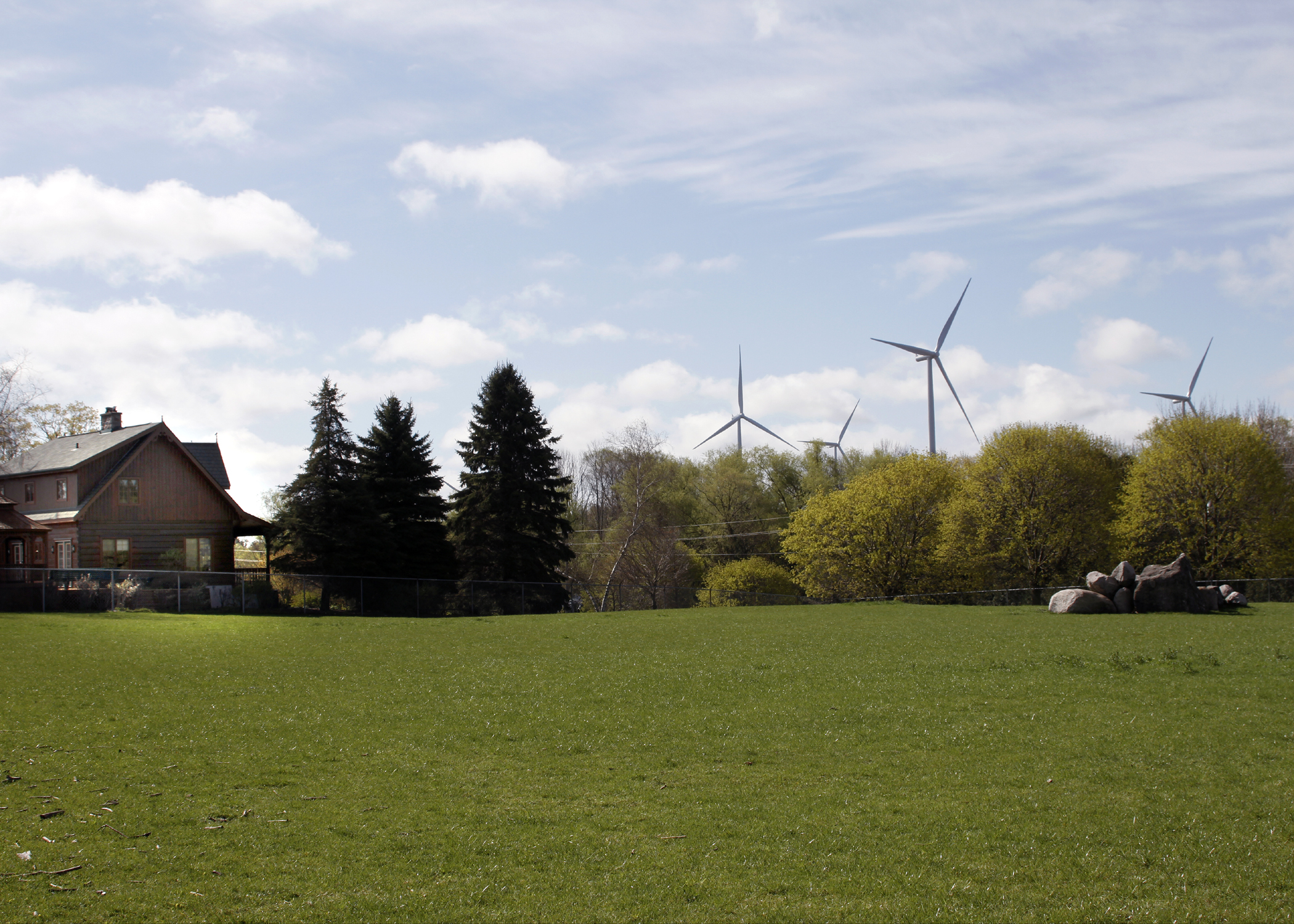
Turbines surround a home in Huron County, Ontario

Wind Concerns Ontario has released a report based on documents received via Freedom of Information request that shows the Ontario government’s process to deal with citizen complaints about wind farm noise is flawed.

From the news release on the website today:

[Documents] show that almost 3,200 reports of noise complaints were made in 2006-2014. In more than half, the government took no action.

“When Premier Dalton McGuinty brought in the Green Energy Act in 2009, he promised the people of rural Ontario to address concerns about health and safety from the turbines,” Wind Concerns Ontario president Jane Wilson said. “But they already had multiple complaints about wind turbine noise from 2006 onward, and they were unable and even unwilling to deal with them. This is failure of a government to protect people.

“Their goal appears to be protecting the interests of power development corporations instead.”

Ontario families called the MOECC hotline to report sleep disturbance, headaches, and dizziness from the wind turbine noise emissions. Some were desperate and reported not having slept for days, even weeks at a time.

The reports show, however, that ministry staff had no protocols or guidelines to deal with noise complaints and that high-level directives blocked staff from responding. Staff were told to rely on computer noise models provided by power developers instead of actual noise measurement.

“The noise models said that the turbine noise levels were safe, and within regulations,” Wilson explains, “but complaints continued — the Ministry did nothing. The MOECC chose power developers, their ‘clients,’ over Ontario families.”

Many reports referred to vibration or “pulsing” sensations from the huge turbines, but the MOECC restricted responses to audible noise alone.

“People just gave up and stopped calling,” Wilson, a Registered Nurse, says. “Then, in many cases, the Ministry simply closed their files. There was no help for these people from their government.”

A revised Compliance Protocol was released by the government on April 21, but contains no substantive change to the complaint process.

Wind Concerns Ontario recommends that no more approvals or Notices To Proceed be granted for wind power projects, and that the government develop and enforce new, tougher noise standards.

The full report is available at www.windconcernsontario.ca

Excerpts from the documents:

“ … noise emissions are causing an adverse effect..” Note by MOECC field officer, March, 2010

“…no resources for after-hours monitoring…” Note by MOECC staff November, 2015

[Wind turbine noise] “Sounds like a jet engine roaring” Citizen report, March, 2013

“House [is] vibrating…” Citizen report, February, 2011

“Staff have no options to address complaint” MOECC staff, November 2015

Wind Concerns Ontario can be reach via contact@windconcernsontario.ca

Ontario government not measuring wind turbine noise effectively, engineer tells international conference

22 Monday May 2017

Posted by Ottawa Wind Concerns in Health, Renewable energy, Wind power

≈ 1 Comment

Tags

environmental effects wind farms, MOECC, Ontario government, renewable energy, tonal noise wind turbines, William Palmer, wind farm, wind farm noise, wind turbine, Wind Turbine Noise 2017, Wynne government

Noise measurement protocol needlessly complex, failing to identify critical issues with wind turbine noise, Ontario engineer says.

He used MOECC data to confirm “tonal” quality to wind turbine noise emissions. One project has been operating for eight years — residents continue to complain, no action by Ontario government

Conference venue in Rotterdam: Wind Turbine Noise 2017

Ontario engineer William Palmer has proposed a rigorous, but simple and transparent technique to assess wind turbine noise, that could replace the problematic complex computer models and “black box” algorithms currently used in the Ontario Ministry of the Environment and Climate Change newest protocol to assess wind turbine noise compliance.

Speaking at the International Conference on Wind Turbine Noise that took place in Rotterdam beginning May 2, Palmer said of his proposed method,

The method had to consider that an effective monitoring system must take into account more than just averaging sound power levels over a long term. The method recognizes that humans are bothered by the changes and annoying characteristics that occur, as well as long term averages. Others describe this as the need to determine how the special characteristics of sound quality may impact quality of life.

To verify this approach, assessments were conducted using the method at two wind power developments in Ontario. In the K2 Wind project, he used MOECC data from testing in early March 2017 at a home within the K2 project. He was able to demonstrate that the MOECC data confirmed that the noise from the turbines surrounding the home had a tonal quality; that means it should require a 5 dB(A) penalty be applied to the other test results.

He reported:

Although the Ministry did not provide calibration files for their sound recordings they did provide in their report their assessment of the sound pressure level for each sample. Using the Electroacoustics Toolbox, and working backwards to set the given sound pressure level for a number of the recordings provided as the calibration level, permitted a “Quasi Calibration” of the Ministry data, and from that a calibrated FFT analysis was made. … Again, it was seen that when the residents described adverse effects in their comments filed with their initiation of recordings, FFT analysis of the sound recordings taken at those times clearly show a tonal condition occurring at about 450 Hz.

In the Enbridge project, where Mr. Palmer also conducted testing, he found similar tonal quality to the noise emissions in that project, and confirmed that the noise coming from the turbines is above the approved levels at several locations.

For this facility as an example, where the turbines first went into operation in November 2008, and citizen complaints occurred soon after, it has not yet been possible to complete a report to demonstrate compliance. The monitoring is still in progress, over 8 years later, with the turbines continuing in operation, and residents continuing to complain. The hypothesis is that individual samples are not representative due to variation.

Process is complex

He offered comment on the current protocol being used to assess compliance by the MOECC:

A premise of the Ministry of the Environment and Climate Change wind turbine monitoring protocol is that monitoring to show compliance must be conducted over a long period. The protocol requires the initial acoustic monitoring by residents to produce at least a 10-minute sample for each complaint period, and the final compliance protocol requires a minimum of 120 one-minute measurement intervals for each integer of wind speed. During each of those one-minute intervals there must be no changes in wind speed or direction. A further 60 samples are required for each integer wind speed with the turbines not operational. So far data collection has taken years to obtain a sufficient number of samples, and in at least one array, initial reports showed that over 90% of samples taken were discarded as non-compliant. All samples are logarithmically combined to determine the Leq produced by the facility, which eliminates any short-term change effects. This appears to be precisely the sort of monitoring that was cautioned against by Genuit and Fiebig described in Section 1 when they noted, “By relying on sound pressure levels averaged over long time periods and suppressing all aspects of quality, the specific properties of environmental noise situations cannot be identified, because annoyance caused by environmental noise has a broader linkage with various acoustical properties such as frequency spectrum, duration, impulsive, tonal and low-frequency components, etc. than only with SPL [Sound Pressure Level]. In many cases these acoustical properties affect the quality of life.”

The annoyance aspects that impact the quality of life of impacted residents are not being assessed.

People walking away from loved homes

The current protocol cannot possibly identify critical issues in wind turbine noise emissions, Palmer asserts. In conclusion, he said:

This paper has demonstrated a method for rigorous monitoring of wind turbine sound. The goal of the method was to establish evidence for the condition noted by Karl D. Kryter: “The most direct, and perhaps most valid, insight into the possible presence and magnitude of stress reactions in general living environments is probably that which has been obtained from attitude surveys and real-life behaviour of people.” Behaviours such as walking away from an unsold loved home to live at the home of a family member, or when normal people become activists in trying to communicate their concerns provide such valid insights. The rigorous method had to consider the present acceptance criterion for wind turbines, in light of the insight given by those who study the quality of noise and its relation to annoyance. Those who study the subject identify that, “Current acceptance criterion relying on sound pressure levels averaged over long time periods and suppressing all aspects of quality cannot identify the specific properties of environmental noise situations.”

The results reported by Bill Palmer are typical of the community testing being undertaken in many communities near wind turbine projects across Ontario.

These findings indicate that the complex processes used by the MOECC and required of wind companies for compliance testing fail to identify key issues that can be quickly identified using much simpler techniques.

Meanwhile, the turbines, shown by other methods to be out of compliance, continue to operate.

[Re-posted from Wind Concerns Ontario]

New wind turbine noise guidelines fail to address problems

26 Wednesday Apr 2017

Posted by Ottawa Wind Concerns in Health, Renewable energy, Wind power

≈ 1 Comment

Tags

community opposition wind farm, Glen Murray, infrasound wind turbines, low frequency noise, MOECC, Ontario, Ontario Ministry of the Environment and Climate Change, renewable energy, tonal noise wind turbines, wind farm, wind farm noise, wind farm siting, wind mill, wind power, wind turbine, wind turbine noise

New Ontario wind turbine noise compliance protocol falls short

Way short.

As in, little or no understanding of the problems with wind turbine noise emissions.

New noise protocol misses all the problems


On Friday, April 21, the Ministry of the Environment and Climate Change released a new protocol document intended for “assessing noise from wind turbines that have already been built. It is used by industry and ministry staff to monitor compliance.”

While in the absence of guidance for staff, and the complete lack of compliance audit information from wind power developers and operators, this is a step forward, the truth is, the protocol doesn’t change much.

Here’s why:

  • the protocol still relies on audible noise only, when many of the complaints registered with the MOECC concern effects that are clearly linked to other forms of noise
  • the protocol does not take into account lower wind speeds, which is where problems are being experienced, particularly with newer, more powerful turbines
  • there is no comment on any sort of transition between the protocol that existed before and this one

Improvements:

  • the Ministry’s action in producing this protocol is an indication that they know they have a problem
  • the description of Ministry response is a good step forward
  • requiring wind power companies to actually have, and to publish, compliance audit documents could be a sign of expectations of greater accountability among the power developers/wind power project operators.

This table outlines the critical gaps in the new protocol document.


Issue     Protocol Requirements Actual Experiences
Wind Speeds Assessment of noise at wind speeds between 4 m/s and 7 m/s MOECC testing indicates problem noise starts below 3 m/s which is outside of wind speeds involved in the protocol.
Ambient Noise Narrow time period assessed Wide seasonal variations while wind turbine noise constant
Location Only test outside of home Very different inside noise conditions
Tonal Assessments Uses criticized techniques Narrow band analysis shows tonal noise present.
Resident Input None Resident concerns drive other MOECC procedures
Frequencies Excludes Infrasound Elevated levels of infrasound in homes

 The Ministry of the Environment and Climate Change needs to acknowledge that there is a problem with wind turbine noise, and accept that it must play a role as a government agency charged with protecting the environment and people in it — preparing an industry-led document may look like a positive step, but this document does not meet the needs of the people of Ontario forced to live with wind turbines, and their noise emissions.

Wind Concerns Ontario

Wind turbines found to exceed legal noise levels

12 Wednesday Apr 2017

Posted by Ottawa Wind Concerns in Health, Renewable energy, Wind power

≈ 4 Comments

Tags

Brinston wind farm, environmental impact wind farms, Goderich, health effects wind farm noise, infrasound wind turbines, K2 wind, low frequency noise wind turbines, MOECC, Ontario Ministry of the Environment and Climate Change, renewable energy, Scott Miller CTV, South Branch wind farm, wind farm infrasound, wind farm noise, wind turbine noise

Ministry of the Environment and Climate Change to conduct more tests on homes near Goderich; wind corporation says it is confident the power project is operating legally

April 11, 2017

CTV News London is reporting that several residents living near the K2 wind power project have received notification from the Ontario Ministry of the Environment and Climate Change (MOECC) that the turbines near their homes, and causing them to report excessive noise, are in fact out of compliance with provincial noise regulations for the power generating machines.

In the conclusion of the “Acoustic Recording Quantitative Screening Measurement Report” of testing performed by the MOECC recently, the MOECC states

… it is acknowledged that sound from the wind turbines was audible during the measuring campaign at levels that appear to exceed the applicable sound level limits, and based on C3 measurements conducted at a nearby receptor (the distance is about 1250 m from R876; where the same turbine(s) within 1500 m distance impact both receptors) it was further concluded that there is a possibility that sound from the nearby turbines could be tonal.

The use of the word “tonal” is key as the MOECC–and the wind power industry–have up to now refused to admit that the noise emissions from turbines are tonal, or producing vibration.

The complaints voiced by people living near turbines, however, seem to indicate that pressure or vibration is a key feature of the emissions being experienced.

See the CTV London video here:

http://london.ctvnews.ca/video?clipId=1098781&binId=1.1137796&playlistPageNum=1

K2 wind is located in Huron County and is operated by a consortium of Capital Power, Pattern Energy, Manulife, and the Alberta Teachers pension fund.

Residents near the South Branch project are reminded that they should report any adverse effects from wind turbine noise to the MOECC Spills Action Centre by calling 1-800-268-6060. Callers should provide their name and telephone number, location, location relative to the nearest wind turbines, direction of the wind and wind speed if available (this can be noted from weather data on your cellphone), and a rating of the noise/vibration on a scale of 1-10, with 10 being the most severe.

Callers should be sure to get an INCIDENT REPORT reference number at the time of their call, and keep a record of their call(s) together with the reference numbers.


Wind turbine noise adversely affects people and the environment

20 Tuesday Dec 2016

Posted by Ottawa Wind Concerns in Health, Renewable energy, Wind power

≈ 1 Comment

Tags

health effects wind farm noise, wind farm noise, wind turbine noise, World Health Organization

Wind turbine noise adversely affects people and the environment

Here is a paper from the Energy Collective, which includes a summary of noise regulations and setbacks. The writer’s conclusion is that worldwide regulation is needed, otherwise local regulation of noise is developed, with heavy influence from the wind power industry.

3-MW turbine south of Ottawa at Brinston: Ontario. Worldwide regulation needed to prevent wind industry influence [Photo by Ray Pilon, Ottawa]

3-MW turbine south of Ottawa at Brinston: Ontario. Worldwide regulation needed to prevent wind industry influence [Photo by Ray Pilon, Ottawa]

December 19, 2016

Willem Post

Europe and the US have been building onshore wind turbine plants in rural areas for more than 25 years. Anyone living within about 1.0 mile of such plants would hear the noises year-round, year after year. Those nearby people would be experiencing:

  • Decreasing property values.
  • Damage to their health, due to lack of sleep and peace of mind.
  • Living with closed windows and doors, due to year-round noises.
  • Exposure to infrasound.

The wind turbine noise problem is worldwide. Due to a lack of worldwide guidelines, various political entities have been developing their own codes for the past 30 years. The World Health Organization is finally addressing the lack of detailed guidelines regarding such noises.

World Health Organization Noise Guidelines: WHO, publishes detailed guidelines regarding various, everyday noises, such as near highways and airports, within urban communities and in work places. The guidelines serve as input to local noise codes.

In general, wind turbines are located in rural areas. When they had low rated outputs, say about 500 kW in the 1960s and 1970s, they made little audible noise, and the infrasound was weak. However, when rated outputs increased to 1000 kW or greater, the audible and infrasound noises became excessive and complaints were made by nearby people all over the world.

WHO, which has not published any detailed guidelines regarding wind turbine noises, will be releasing environmental noise guidelines for the European region in the near future.

Worldwide guidelines regarding wind turbine noises are needed to protect nearby rural people, such as regarding:

  • The maximum outdoor dBA value, how that value is arrived at, such as by averaging over one hour, where that value is measured, such as near a residence, or at the resident property line to enable that resident to continue to enjoy his entire property.
  • How to measure, or calculate the outdoor-to-indoor sound attenuation of a residence.
  • How much setback is needed, such as one mile to minimize infrasound impacts on nearby residents.
  • The maximum dB value of infrasound, how that value is arrived at, where that value is measured.
  • How to determine the need for a 5 dB annoyance penalty.

The lack of such guidelines has resulted in various political jurisdictions creating their own codes. That process has been heavily influenced by well-financed, pro-wind interests, which aim to have the least possible regulation to maximize profits.

Comparison of Wind Turbine Codes: Below are some highlights from the noise codes of various political entities to illustrate their diversity:

1) DENMARK: Because Denmark was an early developer of wind turbine plants, its noise code is more detailed than of most political entities. It has a buffer zone of 4 times total height of a wind turbine, about 4 x 500 = 2,000 ft, about 0.61 km (no exceptions), and it also has the following requirements regarding outdoor and indoor noise:

OUTDOOR

  • For dwellings, summer cottages, etc.: 39 dBA (wind speeds of 8 m/s, 18 mph) and 37 dBA (wind speeds of 6 m/s, 13 mph)
  • For dwellings in open country: 44 dBA (wind speeds of 8 m/s) and 42 dBA (wind speeds of 6 m/s)

The below regulations describe the methods and time periods over which sounds are to be measured:

  • Page 4, par 5.1.1 mentions averaging over various periods. Only the worst average readings of a period are to be considered for compliance.
  • Page 4, par 5.1.2 mentions a 5 dB annoyance penalty must be added to the worst average readings for a period for clearly audible tonal and impulse sounds with frequencies greater than 160 Hz, which would apply to wind turbine sounds.
  • Page 6, par 5.4 mentions limits for indoor A-weighted low frequency noise 10 – 160 Hz, and G-weighted infrasound 5 – 20 Hz.

“If the perceived noise contains either clearly audible tones, or clearly audible impulses, a 5 dB annoyance penalty shall be added to the measured equivalent sound pressure level” That means, if a measured outdoor reading is 40 dBA (open country, wind speed 6 m/s), and annoyance is present, the reading is increased to 45 dBA, which would not be in compliance with the above-required 42 dBA limit.

In some cases, a proposed wind turbine plant would not be approved, because of the 5 dB annoyance penalties. The noise of wind turbines varies up and down. The annoyance conditions associated with wind turbines occur year-round. The annoyance conditions associated with other noise sources usually occur much less frequently.

NOTE: The 5 dB penalty does not apply to indoor and outdoor low frequency and infrasound noises, i.e., 160 Hz or less.

INDOOR

– For both categories (dwellings, summer cottages, etc.; open country), the mandatory limit for low frequency noise is 20 dBA (Vermont’s limit is 30 dBA), which applies to the calculated indoor noise level in the 1/3-octave bands 10 – 160 Hz, at both 6 and 8 m/s wind speed. The purpose of the regulation is to ensure neither the usual noise, nor the low frequency noise, will annoy nearby people when the wind turbines are in operation.

Denmark’s Controversial Noise Attenuation Calculations: The controversy in Denmark is regarding the Danish EPA assuming high attenuation factors for calculating attenuation from 44 dBA (outdoor) to 20 dBA (indoor, windows closed) for frequencies above 63 Hz, which yield calculated indoor noise levels less than 20 dBA. The Danish EPA prefers assuming high factors, because they result in compliance, which is favorable for wind turbines.

However, acoustics engineers have made indoor field measurements (supposedly “too difficult to measure”, according to the Danish EPA), which indicate many houses near wind turbine plants have lower than assumed attenuation factors, which results in indoor noise levels greater than 20 dBA, i.e., non-compliance, which is not favorable for wind turbines.

However, the final arbiters should not be government personnel using assumptions, but the nearby people. Increasingly, those people are venting their frustrations at public hearings and in public demonstrations.

2) POLAND is considering a proposed a law with a 2.0 km (1.24 mile) buffer zone between a wind turbine and any building. That means at least 65% of Poland would be off limits to wind turbines. Future wind turbine plants likely would be offshore. …

Read the full article here.

Open House in Finch December 13

12 Monday Dec 2016

Posted by Ottawa Wind Concerns in Uncategorized

≈ 2 Comments

Tags

endangered species Ontario, environmental impacts wind farms, Glenn Thibeault, IESO, Jim McDonell MPP, North Stormont wind farm, Ontario Ministry of Energy, wind farm noise, wind farms Ontario

Wind power developer EDP Renewables, based in Portugal, will be holding an Open House information session on the 100-megawatt, 30+-turbine, $430-million wind power development they have called “Nation Rise” on December 13 in the arena in Finch.

Last week, MPPs Jim McDonell and Grant Crack took letters and petitions containing more than 1200 signatures from citizens of North Stormont and Nation Twp to the Legislature at Queen’s Park, demanding that the contracts for the two Ottawa-area power projects be cancelled.

The Open House information sessions are typically just poster sessions with developer staff available to answer any questions.

The site plan for the project has not yet been made available although proposed turbine locations are usually part of the application to the IESO for a power contract. The lack of a site plan means there are community members who may yet be unaware that they will have an industrial-scale wind turbine generating power near them.

Wind turbines emit a wide range of noise including low-frequency or inaudible noise which has been linked to adverse health effects. Wind turbines have also been implicated in disturbances to the water table and drinking water (Dover Twp, Ontario) via seismic vibration, and wind turbines are responsible for the deaths of migratory birds and endangered species of bats.

A few weeks ago, Ontario Premier Kathleen Wynne admitted that her government’s electricity policies have been “a mistake” and that they need to work to get consumer bills down. Last week, Energy Minister Glenn Thibeault admitted that an “arbitrary” choice of wind power as a source of power generation had led to “sub-optimal siting” and community concerns.

The Nation Rise power project will cost Ontario as much as $430 million over the 20-year life of the contract.

The Open House will be held from 3:30-7:30 PM.

EDP wind turbine and home at South Branch project, Brinston, Ontario. Photo by Ray Pilon.

EDP wind turbine and home at South Branch project, Brinston, Ontario. Photo by Ray Pilon.

Noise emissions from wind turbines cause adverse health effects: scientific paper

06 Thursday Oct 2016

Posted by Ottawa Wind Concerns in Health, Renewable energy, Wind power

≈ Leave a comment

Tags

infrasound wind turbines, Jerry Punch, Richard James, wind farm noise, wind power, wind power lobby, wind turbine noise

Hearing Health & Technology Matters

October 5, 2016 — A new paper from acoustician Richard James and audiologist and professor emeritus Jerry Punch, just published in the journal Hearing Health Matters, confirms support for the idea that “acoustic emissions from IWTs [industrial wind turbines] is a leading cause of AHEs [adverse health effects] in a substantial segment of the population.”

The authors deal with 12 commonly held beliefs about wind power and health effects, promoted by the global wind power development industry, that do not support a connection between wind turbine noise and health problems. They conducted a comprehensive literature review, and review the findings of the most up-to-date studies, including the Cape Bridgewater study by acoustician Steven Cooper, which changed the language of wind turbine noise research.

A paper by Paul Schomer of the U.S. is quoted for example, and the authors conclude “some people affected by WTN [wind turbine noise] may be responding directly to acoustic factors, rather than to non-acoustic factors, as argued by Leventhall.” (page 21)

Canada figures in the paper with references to work done by Dr Roy Jeffery, Dr Robert McMurtry, and researcher Carmen Krogh, among others.

The authors wrote a ccovering letter for windaction.org in which they said,

Finally, let it not be said that either of us believes in making any less than the best possible effort to develop clean and efficient sources of energy. Rather, we hope that our article will be instrumental in promoting public health through a better understanding of the issues underlying the potentially harmful effects of audible and inaudible noise from industrial wind turbines when the turbines are sited too close to where people live and work.

Jerry Punch

Richard James

Read the paper here.

Ontario ignored staff warnings on wind turbine noise

30 Friday Sep 2016

Posted by Ottawa Wind Concerns in Health, Ottawa, Renewable energy, Wind power

≈ 4 Comments

Tags

Bob Chiarelli, green energy, Kathleen Wynne, Ontario Ministry of Environment and Climate Change, rural Ontario, wind farm noise, wind power, wind turbine noise

More on the disaster that has been Ontario’s “green energy” program.

Premier Wynne with former Energy Minister and Ottawa MPP Bob Chiarelli [Photo: Canadian Press]

Toronto Sun

It’s too bad Premier Kathleen Wynne’s Liberal government didn’t have its epiphany on the pointlessness of subsidizing any more expensive, unreliable and unneeded wind turbines before it tore apart rural Ontario.

It’s too bad Premier Kathleen Wynne’s Liberal government didn’t have its epiphany on the pointlessness of subsidizing any more expensive, unreliable and unneeded wind turbines before it tore apart rural Ontario.

The Liberals’ treatment of rural Ontarians has been a disgrace.

They overrode local planning rights by passing the Green Energy Act of 2009 under Wynne’s predecessor, Dalton McGuinty, then rammed industrial wind factories down their throats.

Sometimes, it was hard for people in these communities to believe they were living in a democracy.

Rural communities were torn apart — neighbours cashing in by leasing land to wind developers for turbine construction, against neighbours forced to live in the shadow of the mega-structures.

The province received hundreds of complaints about health problems which people believed were being caused by the turbines and suppressed them.

During the 2011 election, the CBC reported government documents released under Freedom of Information legislation showed environment ministry staff had issued internal warnings the province needed stricter rural noise limits on turbines, that it had no reliable way to monitor or enforce them and that computer models for determining setbacks were flawed.

Ontario Provincial Police showed up at the homes of middle-aged women in one rural community who had never been involved in any form of law-breaking, warning them to keep their demonstrations against wind turbines peaceful.

As we reported, these visits were made at the request of a wind developer. (The government denied any involvement.)

While the Liberals dismissed wind protesters as NIMBYs, they simultaneously cancelled two unpopular natural gas plants in Oakville and Mississauga due to local opposition, at a public cost of $1.1 billion, in what the Tories and NDP dubbed the Liberal seat saver program.

When local residents wrote to Liberal MPPs asking for help in fighting the industrial wind factories imposed on them, they received form letters in reply.

For many rural Ontarians, the Liberal blunder into green energy, launched without any meaningful business plan according to the Auditor General of Ontario — and which wasn’t needed to eliminate coal-fired electricity — wasn’t just a case of their government wasting billions of dollars and sending their electricity bills skyrocketing.

It was a case of their government robbing them of fundamental democratic rights.


Trudeau government silent on wind farm noise and health problems

30 Thursday Jun 2016

Posted by Ottawa Wind Concerns in Ottawa, Renewable energy, Wind power

≈ 2 Comments

Tags

Environmental Review Tribunal, Health Canada, Jim McPherson, Justin Trudeau, Ottawa Sun, Trudeaufgovernment, wind farm noise, wind turbine noise, wind turbine noise and health impacts

In sworn testimony at an environmental review tribunal, a Health Canada official confirmed industrial wind turbines — large, noise-emitting devices — are regulated under the federal Radiation Emitting Devices Act

Ottawa Sun, Jun 28, 2016

The federal government’s inaction on wind turbine noise is making Canadians sick.

It’s been a year-and-a-half since Health Canada’s $2-million study determined low-frequency acoustic waves from industrial wind turbines cause community annoyance.

According to the World Health Organization, unwanted noise, even at a moderate level, can lead to a myriad of adverse health outcomes, including stress-related symptoms such as sleep disturbance, elevated blood pressure, cardiac events and depression.

It’s a “green” form of radiation sickness.

Canada’s Radiation Emitting Devices Act (REDA) is supposed to regulate the design and operation of devices that emit radiation, such as microwave ovens and tanning beds. In sworn testimony at an environmental review tribunal, a Health Canada official confirmed industrial wind turbines — large, noise-emitting devices — are regulated by REDA.

REDA requires a manufacturer or importer of such a device to “forthwith notify the Minister” upon becoming aware its device is emitting radiations not necessary for the performance of its function.

On June 15, Barbara Ashbee of Mulmur, Ontario, together with hundreds of other Ontarians, sent an open letter to Health Minister Jane Philpott, asking why Health Canada has not insisted wind energy corporations report citizen complaints about noise radiation. She wants the minister to meet with her and representatives of citizens suffering from turbine noise radiations.

Ashbee wrote: “Many in Ontario and elsewhere have logged serious health complaints with proponents/operators of wind turbine projects, provincial and federal government ministries as well as wind turbine manufacturers … As previous ministers and current Minister Philpott have been informed, the adverse effects of wind turbines are not trivial.”

Access to Information records indicate wind energy corporations have reported no complaints.

Why is Health Canada not forcing wind turbine operators to report citizen complaints, as required?

Is the wind industry lobby that strong?

Why were Canadians not told wind turbine corporations are required to report citizen complaints to Health Canada? Were wind energy companies also not told about the REDA?

Why did Health Canada’s Wind Turbine Noise and Health study exclude people under age 18 and over age 79, the most vulnerable segments of Canada’s population?

Why do REDA regulations not include standards for the design and operation of wind turbines, as they do for microwave ovens, etc.?

Prior to the 2015 federal election, Canadians for Radiation Emission Enforcement (CFREE) asked candidates in wind turbine-affected Ontario ridings: “Will you support a moratorium on new wind turbines within 2 km of residences, until REDA regulations are updated to clearly stipulate wind turbine operators must comply with REDA, and to include scientifically proven safe setback distances?”

The survey revealed equal support from candidates of all four parties for a wind turbine moratorium. Only three candidates opposed it, but none were elected. In Ontario, the turbine setback is only 550 meters from residences.

Other countries are extending setbacks to safer distances. In Poland, the setback is now ten times turbine height. In closely settled Bavaria, it is now two kilometres. But there is no such action from Health Canada. No moratorium. No change in setbacks. No standards in REDA. More wind projects are planned. More Canadians are getting sick.

Openness and transparency are supposedly important to the federal Liberal government.

What will Prime Minister Justin Trudeau do about Health Canada’s inaction on wind turbines?

Read the full story here.

North Stormont wind farm fight: no democracy, no truth, citizens say

03 Tuesday May 2016

Posted by Ottawa Wind Concerns in Renewable energy, Wind power

≈ 2 Comments

Tags

Concerned Citizens of North Stormont, EDP Renewables, environmetal damage wind farms, IESO, Margaret Benke, North Stormont, unwilling host, wind farm noise, wind farms, wind turbines

If province had a 1-km setback for wind power generators, almost none of the North Stormont project would be allowable, says community group. “They say wind power is ‘green’ ” says leader Margaret Benke, “but it’s not.”

<p>Margaret Benke surrounded by research into wind turbines on Monday April 25, 2016 in Berwick, Ont. Benke is hoping North Stormont Council will pass a resolution urging the IESO to rate an unwilling municipality as a mandatory requirement as opposed to rated criteria.</p><p>  Lois Ann Baker/Cornwall Standard-Freeholder/Postmedia Network

Margaret Benke: asking North Stormont Council to pass resolution May 10, making municipal support a mandatory requirement for wind power contracts [Photo: Cornwall Standard-Freeholder]

Cornwall Standard-Freeholder, May 2, 2016

BERWICK – She is fighting the good fight and not about to quit just yet.

Margaret Benke is chair of the Concerned Citizens of North Stormont and she and her group are hoping to stop the wind turbines from coming to the township.

Benke said the first time she heard about the turbines coming was when she read about a public meeting in the Chesterville Record.

“I said I’ve got to do something,” said Benke.

Earlier this year, EDP Renewables was awarded a contract for its proposed Nation Rise Wind Farm under the Independent Electricity System Operator’s large renewable procurement process. The project is rated at a potential 100,000 megawatts. On its website, EDP says it has secured contracts with about 40 local landowners covering over 4,000 hectares (10,000 acres).

Benke related a story of her nephew who had purchased his first home in Shelburne and within a year or two wind turbines went up around his land.

“He couldn’t live in his house anymore,” she said. “He abandoned his house. He likened (the noise) to living inside a drum.”

Benke said she had been hearing the stories at family get-togethers about issues with wind turbines.

This spurred Benke into action. Together with a family friend who happens to be a cartographer, they put together a map of the area and, allowing for the mandatory 550-metre setback for wind turbines, were able to determine approximately where the turbines could be erected.

She also looked into the Health Canada study done on wind turbines and found out of the 2,004 people originally selected for the study, 430 had abandoned or demolished their houses due to the turbines.

“It significantly decreased the number of people in the study,” she said. She said they interviewed people who were 550 metres away from turbines, but the only people who were that close were the landowners who were under contract with the wind turbine companies.

Benke then asked to be a delegation at a council meeting so she could present council with the information she researched on the wind turbines before council made any decision on whether to support the turbines or not.

“Immediately anybody with money sense, their antenna goes up, there is money in this,” she said. As every municipality is aware, there have been cutbacks into how much money they are receiving from the province, and that money has to come from somewhere.

“We did a very balanced overview of what the map looked like and what it would look like if you had a one-kilometre setback which is what the experts recommend,” she said. “There were only two fields that would have qualified.”

The one-kilometre recommended setback refers to a paper put out by the Ministry of the Environment where it recommended a setback of one kilometre for a wind farm of 10 turbines with noise level of 105 decibels.

Benke also found out each turbine generated just over $4,000, which was about the same amount of tax revenues from a home valued at $300,000 to $350,000.

“If you go ahead with the wind turbines, it pretty much kills any new development,” she said. “I couldn’t let this happen without at least being a voice in the wilderness. We needed to have our voices heard.”

Benke said wind turbines give the illusion they are “green” but they are not.

“It’s the perception that it’s doing something for us that it’s not,” she said. “Lack of democracy, lack of transparency, lack of truthfulness.”

Tom Loturco of EDP Renewables explained the next step is for contracted projects to obtain all necessary licences and approvals, including conducting an environmental assessment. According to the IESO website, these processes must include community engagement.

On behalf of the Concerned Citizens of North Stormont, Benke sent a letter to Mayor Dennis Fife and the councillors asking them to pass a resolution to request the Independent Electricity System Operator make a willing municipality for renewable energy a mandatory requirement as opposed to a rated criteria. Council deferred the passing of the resolution to a later date. North Stormont had already voted to declare itself an unwilling host for the large renewable procurement program.

Benke is asking council not to give up and if something as simple as passing the resolution will help, do it.

In any case, we strive to have good working relationships with landowners, municipalities and the public,” Loturco said. …

Read the full article here.

NoMeansNo_FB

← Older posts
Newer posts →

Recent Posts

  • Land use conflict prompts citizen legal action over West Carleton battery storage site
  • Energy Minister Stephen Lecce speaks out on renewable power sources wind and solar; emphasizes cost, reliability
  • Open letter to CAFES Ottawa
  • Ottawa Wind Concerns supports West Carleton residents
  • What does wind ‘farm’ construction really look like?

Follow me on Twitter

My Tweets

Enter your email address to follow this blog and receive notifications of new posts by email.

Tags

Bob Chiarelli Green Energy Act IESO Ontario Ottawa Ottawa wind concerns wind energy wind farm wind power wind turbines

Contact us

PO Box 3 North Gower ON K0A 2T0

Blog at WordPress.com.

Privacy & Cookies: This site uses cookies. By continuing to use this website, you agree to their use.
To find out more, including how to control cookies, see here: Cookie Policy
  • Subscribe Subscribed
    • Ottawa Wind Concerns
    • Join 379 other subscribers
    • Already have a WordPress.com account? Log in now.
    • Ottawa Wind Concerns
    • Subscribe Subscribed
    • Sign up
    • Log in
    • Report this content
    • View site in Reader
    • Manage subscriptions
    • Collapse this bar
 

Loading Comments...