And whether it will work. The Ottawa area has four active Battery Energy Storage proposals. But nobody knows whether BESS will do what the proponents say it will
November 14, 2023
The idea of Battery Energy Storage Systems or BESS has hit so fast, people don’t know what to make of it…and that’s the problem for proponents. (Most of whom are current and former wind power developers.)
There simply are not enough details about these projects from the technology used, to the risk of fire and other environmental hazards, noise, and impact on communities. That’s what proponents are hearing at the mandatory “community engagement” meetings held in rural Ottawa.
A big question is the cost, and whether these multi-million-dollar projects will be worth the price to Ontario’s electricity consumers. Proponents are currently vying for contracts with the Ontario Independent Electricity System Operator or IESO. Submissions are due December 12.
When wind and solar were being marketed as the solution to climate change, two Ontario Auditors General recommended to the McGuinty-Wynne governments that cost-benefit analyses should be done.
But it never was.
And now, here we go again.
Ottawa energy economist Robert Lyman says figures from the U.S. show that battery storage will be expensive, no question.
How much?
And at the moment, batteries can only provide power for a few hours at most. So, do they even work?
Here’s his comment:
Any plan to power an electrical grid with wind and solar generation and to eliminate the backup security of supply provided by fossil fuels like coal and natural gas must address the cost and feasibility of the battery storage needed.
The only battery storage technology that is widely available for grid scale storage is lithium-ion. The US federal government’s National Renewable Energy Laboratory produces periodic reports on the current and projected costs of utility-scale batteries of the lithium-ion type. The most recent edition, from June 2021, gives the current average cost as approximately US $350 per kilowatt-hour. It projects declining costs over time, but those projections are speculative and do not recognize the actual trends in recent battery costs. For example, in 2020-2021, the average costs for lithium ion battery installations in New York state was US$464/kwh and in 2022, the price for contracts actually awarded increased to US$567/kwh.
Storage is extremely expensive and if generally used will drive up electricity costs significantly. They are by far the largest part of the costs of an electricity system that relies upon wind and solar generation for essential supplies. They also give rise to the need for much more transmission facilities, which also adds to the costs, although these costs are rarely if ever made public in advance.
Lithium-ion batteries provide backup capacity for relatively short periods, usually measured in hours. However, variations in the demand for and supply of electricity due to weather or other events can occur over periods of days, weeks or even whole seasons. Lithium-ion batteries are incapable of providing such service yet, “long duration” battery technologies do not yet exist and are still at the research or pilot project stage.
The system-wide addition of lithium-ion batteries could increase electricity bills by up to 20 times depending on how much storage is needed. Research on possible long-duration batteries is at the earliest stages, and nobody has any idea what, if any, technology might work or how much it might cost.
Before the province of Ontario starts building several battery-storage plants, it might be a good idea to build one pilot to find out if the darn thing works and is affordable.
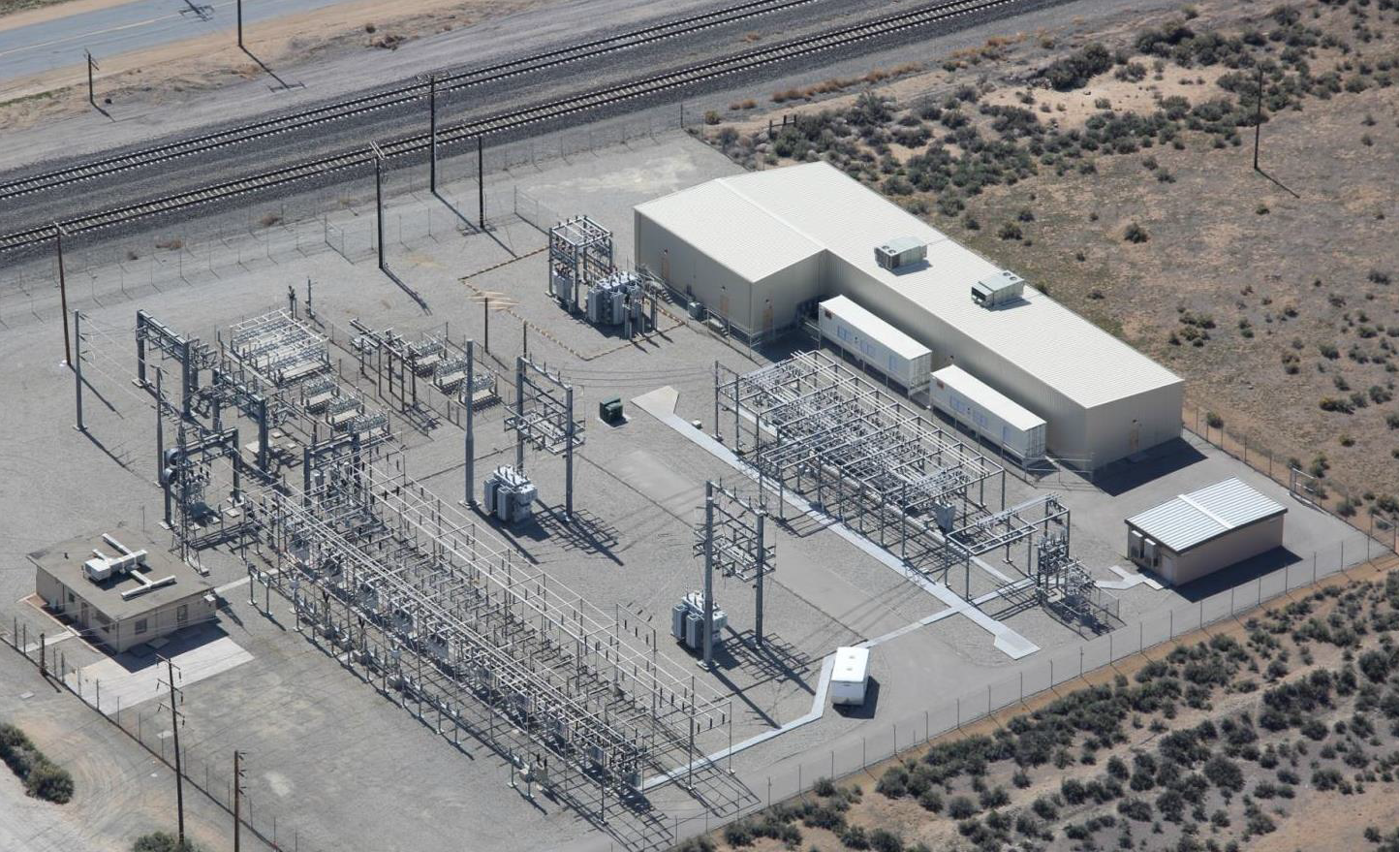
Overhead view of 8-megawatt battery storage facility in Tehachapi, USA-Wikipedia image
March 1, 2023
Green energy’s newest fad is Battery Energy Storage Systems or BESS, which is being promoted as an add-on to existing renewable power generation facilities to counteract intermittency and unreliability.
Lobbyist the former Canadian Wind Energy Association, now the Canadian Renewable Energy Association or CanREA is actively pushing BESS, and has even gone so far as to add storage to its corporate banner as in, Wind- Solar- Storage.
CanREA is pushing for TEN TIMES the amount of wind and solar we already have in Canada (won’t that look pretty? And cost us all, too) which they say will work with storage.
However, even the influential lobbyist points to concerns. First, there is a need to develop technical requirements for connecting and operating battery storage facilities CanREA says in its document, Laying the Foundation:
“In many jurisdictions, the technical details may be included in the operating documents of the crownowned utility. However, there are other elements, such as the scope of safety and environmental reviews, that will need legislated descriptions or will need to be included in the regulatory documents of the relevant ministry or government department.” (Page 10)
And, CanREA says, regulating authorities may need to get ready for BESS and develop new competencies:
“In most jurisdictions, the mandate and/or rules of the regulating authority (for example the Alberta Utilities Commission) may need to be enhanced. Regulatory authorities will need sufficient expertise to fairly evaluate proposed energy-storage installations.”
Most people don’t know what they are
In response to inquiries from members and the public, and because BESS is being proposed as an add-on to existing wind power installations, Wind Concerns Ontario undertook a review of experiences with BESS around the world, and reports of citizen concerns, as well as the current regulatory environment.
As one Ontario mayor said, most people don’t even know what they are.
Wind Concerns Ontario prepared a report, with the following conclusions:
Standards needed for emergencies – As BESS technology is relatively new, standards are rapidly changing in response to emergency situations encountered. Even projects developed by companies with extensive battery experience have experienced serious emergency situations.
Not enough information – The requirements for submissions to the IESO and to municipalities when requesting support for the project include few, if any, details on the actual project. The process appears to assume that once a company is awarded an IESO contract based largely on price, it will then proceed to develop the real proposal which will be submitted into an undefined permitting process or processes. Based on information submitted, it is not clear how the IESO will be able to distinguish between proposals with higher prices because they meet high standards for development and those with lower prices because the proposal includes the minimal safety standards.
Renewable energy or not? – BESS systems are neither defined as a Renewable Energy project by Regulation 359/09, nor are they included in the list of excluded projects. The intention may be to omit further provincial review of these projects and to proceed directly to the municipal permitting process but this would be a recipe for substantial delay as the building officials in each host municipality (many of which are small rural municipalities) individually develop the expertise needed to assess and approve these projects.
Safety regulations? – While Ontario Hydro has defined setbacks from BESS installations to protect their infrastructure, there are no setbacks for BESS installations established in Regulation 359/09 to protect other buildings and activities. Similarly, there are no noise standards for these systems which could create a new enforcement challenge for Ministry of Environment, Conservation and Parks field staff.
Potential for support to be withdrawn – As the submissions to municipalities have included minimal information, there is potential for municipalities to rescind their support resolution once they learn the risks associated with these projects and the municipal resources that will be potentially required to deal with emergency situations.
Clearly, there are significant issues to be addressed.
Ottawa area BESS
Here in Ottawa, a BESS facility was proposed for the recent Independent Electricity System Operator (IESO) Request for Proposals for new power generation. Located on Upper Dwyer Hill Road in the West Carleton-March ward of the city, the project is unheard of for most people. The company proposing the project held a public meeting in December but no one showed up. The IESO allows proponents to simply post a notice on their project website. If you don’t even know about the project, how do you know to check for announcements?
Here are the minutes for the “public” meeting:
MINUTES OF PUBLIC COMMUNITY ENGAGEMENT City of Ottawa Public Meeting Location: Alexander Community Centre, 960 Silver St, Ottawa, ON K1Z 6H5 Time: 6-7 pm, January 12th, 2023
Long-Term Reliability Project Name: 548
Site Address: 650 Upper Dwyer Hill Road, Ottawa, ON K0A 1A0
Facility: Battery Energy Storage Systems (BESS)
Size: 4.99-megawatt/19.96-megawatt hour
Proponents Name: 1000234763 Ontario Inc.
Attendance: • 0 community members •
Proponent – 1000234763 Ontario Inc., representative: o John Kozak, COO • Proponent’s Contractor, SolarBank Corporation (previously, Abundant Solar Energy Inc.) o Tracy Zheng, CAO o Mila Simon, Project Coordinator 6ii
6:00 PM: meeting called to order. Proponent and SolarBank waited for 45 minutes for attendees. No community members showed.
6:45 PM: Meeting adjourned.
Another BESS proposal is in development in Cumberland, that would be ten times the capacity of the Upper Dwyer Hill Rd facility. In response an email inquiry, developer Evolugen (a division of huge power developer Brookfield) replied:
We are still in the process of assessing potential sites for a battery storage energy system in the Cumberland area to respond to two announced procurements (expedited and long-term RFP).The two public meetings were held to gauge at a high level the type of reaction that this type of project would receive in this area. We don’t record public meetings because they are drop-in format rather than a presentation with a Q and A. But we are always available for one-on-one meetings.The IESO released the final RFP document in early December, but had released a series of documents (including a draft RFP) in preceding months to provide project proponents with a general idea of what public outreach requirements were required.
Another inquiry, this time to the Cumberland Community Association, revealed the association knew nothing about the proposal. Or the public meetings that were held.
Time to ask questions
Doubtless, still more BESS proposals are coming with the IESO set to open up yet another RFP later this year, this time for almost twice as much new power generation.
We need to learn more to be able to ask questions about the impact of these installations on our communities, the environment, and our economy.
New zoning bylaws to be fast-tracked for 2023 in light of Ontario government’s current new power procurement plan
See the presentation of the power generation bylaw motion by Councillor David Brown beginning at minute 53
February 23, 2023
OTTAWA
Ottawa City Council voted unanimously yesterday to approve a motion put forward by Ward 21 Rideau-Jock councillor David Brown, and seconded by West Carleton-March councillor Clarke Kelly, to hold off granting municipal approval for any new power project proposals that may come forward as a result of provincial government procurement plans. The motion directs staff to tell proponents that municipal support will not be granted until review by a Standing Committee; the Motion further stipulates that developing zoning bylaws for new power generation installation should be done in the Planning department’s 2023 “Workbook” ahead of 2024-2025 for the new suite of bylaws as a whole.
The deadline for the Independent Electricity System Operator’s first phase of new procurement, for 1,500 megawatts of power, was last Thursday, February 16. The IESO plans another RFP to be launched this spring or summer, for an additional 2,500 megawatts of new power.
The motion passed yesterday stipulates that staff be directed to inform proponents of any new power generation projects: “staff will not bring such requests to Council unless such requests are considered through the relevant Standing Committee, it being understood that the Standing Committee will act in accordance with the timelines provided in the LT1 RFP, furthermore, that Hydro Ottawa and its affiliates, shall be entitled to obtain any Municipal Support Resolution required per the LT1 RFP (or other similar processes), via bilateral discussions with its sole shareholder, the City of Ottawa,”
and
“staff will bring forward an amendment to the City of Ottawa’s Zoning By-law that implements the intent of the policies in the Official Plan with respect to renewable energy generation facilities and storage by Q4 2023 that is in advance of the municipal Comprehensive Zoning By-law update“.
Ottawa saw only one submission in response to the most recent IESO Request for Proposals, a small Battery Energy Storage System proposed for Upper Dwyer Hill Road. Another, larger battery project is in development for the Cumberland area; the proponent is Brookfield’s Evolugen division. Both projects are supposed to have had public meetings to present project details; the Upper Dwyer Hill Road project meeting notice was only on the company’s website, and no members of the public attended the January 12th meeting.
Ottawa Wind Concerns made several presentations to city committees including the Agricultural and Rural Affairs Committee to warn that the IESO RFP was on the way, and that Ottawa needed to be ready with protective bylaws for large power generation projects such as wind turbines. Ontario’s regulations for noise levels and setbacks for noise and safety have not been changed since 2009, and are generally viewed as inadequate today.
The community group’s advice was rebuffed, however, with one rural councillor claiming in September that no such procurement was on the way. At that time, the IESO RFP process was in the final stages of “engagement.” The first RFP launched December 7, 2022.
Do wind turbines make noise? YES
Rural Ottawa has already experienced a proposal for a large wind power project when a proposal came forward under the Ontario government’s Feed-In Tariff program in 2009. It was for as many as eight 600-foot industrial wind turbines to be located in the North Gower area, to be built by Pro-Wind, a small company based in Germany. Residents rejected the proposal at the time, saying the power generating machines would be too close to homes and the village school. Residents signed a petition and presented it to City Hall; almost every property-owning resident of the North Gower area signed the document.
Interestingly, one of the proponent’s staff was interviewed by then radio host and journalist Mark Sutcliffe who asked, Do the wind turbines make noise?
“Of course they do,” said the project salesperson. “They’re power generators.”
Citizens of rural Ottawa are concerned that new power projects, no matter what the technology, will be located in rural areas. Noise pollution, vibration, loss of valuable farmland, risk to aquifers, and danger to wildlife are all important concerns.
We are trying to respond to community concerns, said Councillor David Brown, “That is really what this is all about.”
Ottawawindconcerns@gmail.com
The motion, revised prior to Council, is here:
Re / Objet : Clarifying the process of approving new energy projects and infrastructure under the Requests for Proposals from Independent Electricity System Operator
Moved by / Motion de: Councillor D. Brown
Seconded by / Appuyée par: Councillor C. Kelly
WHEREAS the Independent Electricity System Operator has released an Expedited Procurement Process to procure 1.5 gigawatts of electrical capacity by mid-decade and has been engaging with municipalities with respect to Requests for Proposals for a significant number of new projects for energy generation, storage, and infrastructure; and
WHEREAS the Expedited Procurement Process (the E-LT1 RFP) closing February 16, 2023 includes three (3) of thirteen (13) Rated Criteria Points for municipal council support resolutions; and
WHEREAS after February 16, 2023 the Independent Electricity System Operator is planning two more procurement phases totalling 2.8 gigawatts of capacity to be available mid decade; and
WHEREAS the Independent Electricity System Operator requires a Municipal Support Resolution from the municipal council no later than sixty (60) days after the eighteen (18) month anniversary of the Contract Date; and
WHEREAS some Independent Electricity System Operator resources participate in the Ontario electricity market without contracts; and
WHEREAS it is not clear that the inability for a project to receive a “Municipal Support Resolution” will necessarily lead to the revocation of a proponent’s contract; and
WHEREAS Ottawa must decrease its reliance on greenhouse gas-emitting sources of energy, including by increasing local renewable energy generation and battery storage, to achieve its greenhouse gas emission reduction targets; and
WHEREAS the City has received a request for a Municipal Support Resolution for a 5-megawatt/20-megawatt hour battery energy storage system using lithium-ion battery technology at 650 Upper Dwyer Hill Road, Ottawa that is expected to occupy approximately 0.3 acres (0.12 ha) of land, including all required setbacks and spacing; and
WHEREAS municipalities, namely through land use policies in the Official Plan and provisions in the Zoning By-law, set their own priorities with respect to where energy generation, storage, and infrastructure may be permitted; and
WHEREAS increased energy generation, storage, and infrastructure can have significant impacts on local residents that are worth due consideration by Council under a framework in the Zoning By-law that reflects the City’s Official Plan; and
WHEREAS staff will bring forward an amendment to the City of Ottawa’s Zoning By-law that implements the intent of the policies in the Official Plan with respect to renewable energy generation facilities and storage by Q4 2023 that is in advance of the municipal Comprehensive Zoning By-law update;
THEREFORE BE IT RESOLVED that the Mayor, on behalf of Council, write a letter to the President and Chief Executive Officer of the Independent Electricity System Operator to formally request confirmation that projects approved through the LT1 RFP and future procurements shall not proceed without a Municipal Support Resolution from municipal council in the form of an approved motion; and
BE IT FURTHER RESOLVED that staff be directed, in consultation with Hydro Ottawa, to come forward with recommendations in advance of the new Zoning By-law to help inform City Council plans for energy generation, storage and infrastructure as a deliverable project in the 2023 Planning, Real Estate and Economic Development Department Workplan; and
BE IT FURTHER RESOLVED that the appropriate Standing Committees evaluate current and future requests for Municipal Support Resolutions, informed by the recommendations referenced above until amendments have been made to Zoning By-law 2008-250 in Q4 2023; provided, however, that projects proposed by Hydro Ottawa and its affiliates shall be entitled to obtain such Municipal Support Resolution through bilateral discussions with its sole shareholder, the City of Ottawa; and
BE IT FURTHER RESOLVED that until such time as amendments have been made to Zoning By-law 2008-250 in Q4 2023, staff be directed to advise any proponents seeking a Municipal Support Resolution through the LT1 RFP that staff will not bring such requests to Council unless such requests are considered through the relevant Standing Committee, it being understood that the Standing Committee will act in accordance with the timelines provided in the LT1 RFP, furthermore, that Hydro Ottawa and its affiliates, shall be entitled to obtain any Municipal Support Resolution required per the LT1 RFP (or other similar processes), via bilateral discussions with its sole shareholder, the City of Ottawa.
BE IT FURTHER RESOLVED that a copy of this motion be sent to the Premier of Ontario, the Ontario Minister of Energy, and the Association of Municipalities of Ontario.
RISK OF NOISE, FIRE, ENVIRONMENTAL CONTAMINATION FROM BATTERY STORAGE SYSTEM IS TOO GREAT, SAY RESIDENTS. FEW DETAILS AVAILABLE ON A LARGE ENERGY PROPOSAL: “A PIG IN A POKE”
January 24, 2023
Prince Edward County’s council voted to reject a proposal for a battery storage facility last week, responding to citizen concerns about safety and risk to the environment.
A Battery Energy Storage System or BESS was proposed by Compass Energy, a 250-megawatt facility that would require 15 acres of land.
Ontario’s Independent Electricity System Operator or IESO currently has a Request for Proposals for new power sources; the IESO is looking for 1,500 megawatts of power which can include new projects such as natural gas or wind, and battery storage. The proviso is that the power must be available immediately, and “can deliver a continuous amount of electricity to a connection point on a distribution system or transmission system for at least four consecutive hours,” according to the IESO website.
“When we first became aware of the Picton BESS proposal a few months ago, we thought the scale of the project warranted evaluation,” says APPEC president and County resident Orville Walsh.
“We anticipated that [the proponents’] community meeting in early December would provide many of the project details. That turned out not to be the case. According to the project website, they will only be designing or planning the project after obtaining a contract from the IESO.”
Walsh told Prince Edward County Council that on investigation of available information about the project, APPEC concluded that there is no information on the type of equipment that will be used, battery manufacturer, or other electrical components; no information on the HVAC systems to be utilized; no information on fire detection systems, fire suppression systems and equipment; and no noise studies or estimates of environmental noise, which can be significant.
“We can only imagine the noise that could be generated on a warm summer night by 250 HVAC units,” Walsh told Council.
There are few specifics about this project, Walsh explained, “not a single drawing or illustration that is reflective of the scale of the project.
“Giving support to a project lacking basic information is like buying a pig in a poke,” he said.
Residents of The County were also concerned about the loss of prime agricultural land to the power project, which contravened both the Ontario government’s statements and requirements of the local Official Plan to preserve valuable farmland.
Fire a significant risk
The danger of fire is an “unacceptable risk” from the lithium-ion batteries, say residents. Quoted in a report in the Picton Gazette, resident “Don Wilford spoke to council detailing the environmental devastation that would occur should a fire break out at a 250 megawatt BESS along with the immediate risk to the local population. ‘Lithium-ion batteries are susceptible to fires. At the scale proposed, the fire would cause vast damage to wetlands, the toxic gas plume requiring evacuation of Picton only 5 km away and potential loss of firefighters’ lives,’ Wilford stated.”
Others wondered why the Prince Edward County location was chosen as it is not near major population centres, or power generation facilities. (We can tell you: willing landowners, nothing else.)
Company competence in battery storage
Citizens also noted that the proponent had no experience with battery storage facility construction or operation. Resident Don Wilford presented background information about proponent Compass Energy: it is owned by Irving, which in turn is a subsidiary of Icon Infrastructure, a financial investment firm based in the U.K., he said.
“None of these companies have experience with battery storage,” said Wilford. “It appears Ontario is not only ignoring safer zinc battery tech but outsourcing a key component of its electricity infrastructure to financial companies that will outsource the tech to a systems integrator, which will, in turn, repackage lithium-ion units from major suppliers in China.”
It was also noted that the developer admitted there would be “zero” long term employment opportunities for people in Prince Edward County.
Valuable farmland would be lost
Sophiasburgh Councillor Bill Roberts tabled an amendment to deny the request from Compass Energy, listing all the concerns expressed by community members, adding that the Prince Edward Federation of Agriculture was also no in favour of the project.
“I’m opposed to the use of prime agricultural land for this purpose,” he said according to the story in the Picton Gazette. “I support the Prince Edward Federation of Agriculture in their opposition to non-agricultural development on prime farmland. I hear convincing and alerting information from the audience,” said Roberts.
Roberts repeated the concerns about the risk of fire: “I find the potential fire and contamination risks compelling. Since 2017 there have been 50 such failures including five at large BESS installations. One in Australia required 150 firefighters and four days to extinguish,” decried Roberts. “I don’t get a sense the proponents have the experience to complete and operate such a giant BESS project. I was particularly struck by the IESO’s own connection site identification, wherein at least 166 sites were deemed preferable.”
Roberts amended motion was seconded by councillor John Hirsch and passed by council.
Battery storage proposals are popping up in various locations throughout the province, with varying degrees of success.
Other projects proposed include solar power facilities. One developer put forward a proposal to the council in Sault Ste Marie but declined to tell the elected representatives where the project might actually be located. At another meeting, the proponent claimed full support by local indigenous communities, which turned out not to be true: there had been some conversations including email exchanges, but there had been no formal expression of support.
In the U.S., energy commentator Robert Bryce says that community opposition to large wind and solar power projects is rising; people understand that wind and solar (and now, battery storage) do little to help the environment or alter climate change, but they do have significant environmental impacts, and cause electricity bills to rise. Bryce maintains a database of community rejections of large renewable energy projects.
Comment: frankly, we cannot understand why any company would want to take on the folks in Prince Edward County. They spent more than 10 years, and more than $1.5 million after-tax dollars to defend the County against four wind power projects, all of which would have endangered wildlife, wetlands, and the fragile topography of the area, as well as having a negative impact on tourism, for which the area is rightly famous.
contact@windconcernsontario.ca
*APPEC is a corporate community group member of Wind Concerns Ontario
REPOSTED FROM WIND CONCERNS ONTARIO with permission
Ontario’s Independent Electricity System Operator or IESO will launch its Long Term-Request for Proposals (LT-RFP) next Tuesday, December 6th.
The aim of the LT-RFP according to the IESO is to: “seek resources that can be in service between 2026 and 2028 to address global and regional needs.”
Energy Minister Todd Smith issued a directive on October 7th:
11. The Expedited Process, Upgrades Solicitation, and L T1 RFP shall be open to all resource types that meet the mandatory criteria established by the IESO, which may include renewable energy, energy storage, hybrid renewable energy with storage, biofuels and natural gas-fired generation.
The RFP has been in development for many months, despite the continued assertion by former Ward 21 Councillor Scott Moffatt who insisted that there is no procurement process in Ontario.When he wrote to members of Ottawa’s Planning and Agricultural and Rural Affairs committees that there was no plans for new power procurement (to head off a presentation by Ottawa Wind Concerns), the IESO was in the final phases of implementing the RFP.
Now, Ottawa could see proposals for new power projects.
The process will be very quick: announcement of successful bidders will come in March of 2023, according to IESO documents dated mid-November.
But we’re not ready.
Ottawa has no new zoning bylaws in place to deal with new power proposals and in fact, the zoning bylaw process following the new Official Plan is stalled due to concerns about new provincial legislation.
As well, we know from the experience with wind turbines since 2009 and the Green Energy Act, there are lots of problems with these industrial-scale projects. Noise, damage to aquifers, and risk to wildlife including endangered species are impacts seen all over Ontario. But regulations for noise and setbacks have not changed.
When the Green Energy Act was revoked by the Ford government in 2018, planning powers were returned to municipalities, who are now able to set their own regulations for noise limits and setback distances.
But Ottawa hasn’t done that.
The solution? Recommended to us by our planning consultant, and as already done by several other Ontario municipalities, Ottawa could pass a motion that is a simple statement of policy intent, to the effect that until new zoning bylaws are approved, the City of Ottawa will not review or approve any proposals for power generation, including wind power.
City staff have already expressed concern about the speed of the LT-RFP process and the fact that municipal approval doesn’t seem to be mandatory, though the Ford government promised that it would be. Other municipalities are worried about this IESO process which, they say, doesn’t give enough time for proper public consultation, or for a full assessment of new power development proposals such as analysis of the effectiveness of the technology being proposed, and what impacts the project could have on the environment.
We met today with new Ward 21 Councillor David Brown, who shares our concerns about the IESO RFP. He is already taking action on it.
We hope that the new Council will act quickly to ensure that the City is not sandbagged by new power generation proposals that are not appropriate to our area, and specifically that Ottawa’s rural communities will be protected from industrialization by unreliable and noisy grid-scale wind turbines. We hope that any new power generation would be for power that is reliable and affordable, and actually does something for the environment and climate change. That’s not expensive, invasive, out-of-phase with demand wind power.
Councillor calls for alternative power sources including wind and solar
September 18, 2021
Image: IESO—looking at cost-benefit and impacts of phasing out gas
The City of Ottawa’s Committee for Environment, Water and Waste Management will hear a motion from Councillor Shawn Menard at its meeting on Tuesday, September 21, calling for the Ontario government to completely phase out power generation from natural gas by the year 2030.
In specific the motion says:
1. That the City of Ottawa request the Government of Ontario develop and implement a plan to phase-out gas-fired electricity generation by 2030 to help the City of Ottawa, the Province of Ontario and the Government of Canada meet their climate targets; 2. That the City of Ottawa call on the Independent Electricity System Operator (IESO) to give full consideration to wind and solar, demand response, Quebec Hydro, conservation and other models
Councillor Menard based his motion on a brief report which claims the Ontario government will increase “electricity generation and greenhouse gas pollution from Ontario’s gas-fired power plants by more than 300 % by 2030…due to the closing of the Pickering nuclear station and a forecast rise in the demand for electricity”.
The Ontario Independent Electricity System Operator of IESO is already undertaking an impact assessment of a gas phaseout but notes in its summary presentation that natural gas plays a significant role in providing reliable power to Ontario, and by providing a flexible supply of power to respond quickly if needed. As well, gas generators provide power locally.
Challenges, according to the IESO, include the fact that a number of natural gas plants are under contract and will have a useful life well beyond 2030, so cancelling them would not be cost-effective. Any “new resources” such as wind or solar would have to compete with equivalent characteristics such as reliability.
A recent court case in Minnesota, U.S., saw a wind power plant proposal turned down in favour of a natural gas facility precisely because the wind power plant could not compete on reliability or affordability; the court ruled that electricity prices would rise and the grid would be less stable if the choice were wind power.
The Ontario Society of Professional Engineers or OSPE has weighed in on the phase-out issue, saying that long-term energy planning in Ontario should be to “ensure reliable, cost-effective, affordable and sustainable energy systems. The OSPE recommended the IESO assessment be extended to 2040 to allow for the installation of clean technology including Small Modular Reactors and hydrogen technology.
The word “nuclear” does not appear anywhere in Mr. Menard’s motion except to note the closing of Pickering (which doesn’t have to happen).
The OSPE pointed out the role that gas plants play in Ontario winters: “Distributed gas plants are well suited to offset risks of a severe winter storm.”
This motion is premature, without factual support, and appears to be undertaken under pressure from special interest groups such as the Ontario Clean Air Alliance.
Some may dismiss it as “political theatre” but it is unfortunate that the City of Ottawa, Canada’s capital and the second largest city in Ontario, cannot find itself playing a leadership role and instead repeats tired tropes about wind and solar replacing reliable forms of power generation.
They can’t.
Readers are invited to email their City Councillor or file a comment with the environment
Crane used to dismantle grid-scale wind turbine in Prince Edward County this week. Meanwhile, more going up south of Ottawa [Photo: Alliance to Protect Prince Edward County]
Contrast between North Stormont and Prince Edward County an indication of Ontario’s muddled electricity file
November 19, 2019
While people in Prince Edward County are celebrating the demise of the “White Pines” wind power project as government-ordered decommissioning of the industrial-scale wind turbines is going on this week, the people of North Stormont, south-east of Ottawa, are watching the behemoths go UP.
The White Pines project in Prince Edward County, developed by Germany-based wpd, was a controversial power project appealed several times by residents concerned about the environmental impact of the wind power generators and infrastructure on wildlife and people. The original plan was for 29 turbines; that was reduced to 27 after legal action and finally, to nine.
The new Ontario government passed legislation not long after taking office cancelling the power project — residents say it should never have been approved in the first place.
But now, more than 30 giant grid-scale wind turbines are currently being erected in North Stormont, near the communities of Finch, Crysler and Berwick by Portugal-based power developer EDPR. EDPR sold the project last year to Axium Infrastructure; that consortium also owns the K2 Wind power project in Huron County, which has been the subject of appeals, and post-operation, hundreds of noise complaints.
K2 Wind is currently under order by the Director of the environment ministry to implement and evaluate a noise assessment plan for more than 80 of its 140 turbines, which were found to be out of compliance with Ontario regulations for wind turbine noise emissions.
“Nation Rise” as the North Stormont project is called, was also the subject of appeals, and a last appeal was submitted to the Ontario environment minister six months ago. No word on the status of the appeal, nor on the status of a request for a stay of construction, filed in May.
Residents are concerned not only about noise (the project got to use old, pre-2017 noise assessment rules under the Wynne government), and also damage to the environment, especially a fragile or “vulnerable” water table.
The Nation Rise final approval came through days before the provincial election in 2018, despite the “caretaker” government convention which discourages major decisions during the election period. The Independent Electricity System Operator (IESO) also granted a Notice To Proceed days after the election, despite being warned by government leader MPP Todd Smith not to approve any more projects.
Now, the giant towers are rising in the quiet communities of North Stormont, as the power developer races to meet a December operational deadline. The local MPP Jim McDonell claims there’s nothing he can do about it—that Notice To Proceed meant the project had to go ahead.
Pre-construction liability for Nation Rise (i.e., the cost of the government cancelling the contract) was about $400,000. If it goes into operation, the people of Ontario will bear the cost of the project which will add more than $400 million to electricity bills, over the 20-year life of the power contract.
So, while the turbines go up, others — already approved and built — come down. And you’re paying for it all.
OTTAWA WIND CONCERNS
Turbine blades at Johnstown, destined for Nation Rise
Citizens thought this power project was gone. Is it? [Photo: Ontario Farmer]
March 6, 2018
Citizens of The Nation are waiting for answers from the Ford government after it was discovered — by accident — that the Ontario Energy Board awarded a 20-year licence to generate electricity to the Eastern Fields wind power project.
Eastern Fields was on the list of 758 power projects cancelled by the Ford government last July, and a check with the Independent Electricity System Operator (IESO) shows that the power developer, U.K.-based RES Canada does not now have a contract.
On the other hand, when both Wind Concerns and community group Save The Nation checked with a Ministry of the Environment, Conservation and Parks officer on the project status, the response was that it is in “technical review.” (This is an onerous process by which civil servants look at boxes on an application and see whether there is a check mark. Important information such as the presence of unstable Leda Clay in the case of the Nation Rise project, need not be assessed, or even known.)
Save The Nation put out the following news release, and is waiting for answers from the Ontario Minister of Energy, Greg Rickford.
In the meantime, says Wind Concerns Ontario president Jane Wilson, the citizens of The Nation lost seven valuable months in which they could have been gathering data on environmental impacts from the wind turbines. Wind Concerns Ontario has government records of thousands of reports about excessive wind turbine noise, which have not been resolved.
Media Release
For immediate release
How Can a Cancelled Wind Turbine Project Receive a Licence to Produce Electricity?
ST-BERNARDIN – Save The Nation is seeking answers from the Ontario Minister of Energy, Greg Rickford, regarding the issuance of an Electricity Generation Licence to the ‘cancelled’ Eastern Fields industrial wind turbine project. The Ontario Energy Board issued the licence on December 6, 2018, even though Minister Rickford had announced the cancellation of Eastern Fields project on July 13, 2018.
“We were shocked to find out about this licence. We do not understand why or how a cancelled project can be issued a licence to produce electricity for a period of 20 years – until 2038. We’re also extremely disappointed that the Ford government does not seem to follow through with its announcement,” says Julie Leroux, spokesperson for Save The Nation.
Eastern Fields was one of 758 projects identified by Minister Rickford for wind-down on July 13, 2018, following a promise to cancel unnecessary and wasteful energy projects in order to cut hydro rates. “We’re asking Minister Rickford to confirm that this promise has been kept and that Eastern Fields Wind Farm LP is a dead project with no chance of ever moving forward. We also ask him to revoke the useless Electricity Generation Licence EG-2018-0213” adds Leroux.
The Electricity Generation Licence was issued on December 6, 2018. Incidentally, on that same day, the Ontario Government adopted the Green Energy Repeal Act, which will affect other acts and regulations, namely the Environmental Protection Act, the Renewable Energy Approvals Regulation 359/09 and the Planning Act when fully enacted.
Save The Nation is a grass-root movement that has been opposing the Eastern Fields industrial wind turbine project near St-Bernardin in The Nation Municipality and Champlain Township since it was publicly announced in June 2015. Save The Nation is not against green initiatives, but is fiercely opposed to the process that was used for the approval of renewable energy projects in Ontario under the Green Energy Act.
Residents in Arkwright, NY, are shocked at the noise and environmental disturbance from a wind power project, which just started operation.
The project developer and operator is Spain-based EDP, the same company that runs the South Branch project in Brinston and which is planning the contentious Nation Rise power project in North Stormont.
Residents had hoped the project would be cancelled when the new Ontario government cancelled three other wind power projects, but the IESO claims the project–which is under appeal–has met all its contractual milestones.
Here is the news story with resident complaints of never-ending noise and visual disturbance.
OBSERVER Photo by Jo Ward A large crowd fills the Arkwright Town Hall, as complaints of noise are heard regarding the wind turbines.
ARKWRIGHT– This week saw the powering up of the wind turbines in Arkwright, and the area received its first taste of what a wind farm is like when fully operational.
Kellen Ingalls, project manager for EDP Renewables, gave his report to a crowded house at Monday night’s Arkwright town board meeting, stating the obvious, “the turbines are operational. All 36 of them are connected to the grid. We’re waiting to hear back any day now that they accepted power and is declared operational.”
Despite what many deem as good news, others were not impressed.
“We were up at the lean-tos,” Joni Riggles, a concerned citizen stated. “I am so upset, EDP was asked not to put turbines within viewshot by the county planning board. It is a nightmare, a sonic nightmare, a visual nightmare. It sounded like sneakers in a laundromat. The campground is surrounded, it’s a toxic environment. Who’s going to want to camp here?”
Carrie Babcock, an Arkwright resident said, “It’s like jetliners surrounding my house. It’s a form of noise pollution. It’s awful. How can you help me move away from here? How do I get out of here and still have some property value?”
“I could be sitting on my couch reading and all I have to do is barely crack open a window and it sounds like a jet that’s going by that never goes by. We were told by these people everyday that you’ll never know they’re even there, and if you think that’s not a problem, you’re taking money from the windmill people,” Doug Zeller, another resident added.
“What do you want us to do about it?” Councilman Larry Ball asked. “What do you want us to do about it today?”
“Take them down,” Riggles voiced.
“That’s not going to happen,” Fred Norton, town supervisor, and others on the board responded.
In response to Riggles’ original question, Norton did note that the county gave a release to the developer allowing them to put their windmills there.
Beyond the noise complaints, a letter from Dorothy Fogelman-Holland was read by her husband, citing issues with cell phone interference. Within the letter she claims that there have been times, no matter the day or to who or what type of phone she calls, she’s unable to make a connection. These incidents are sometimes 11 calls being made consecutively and none of them connecting. She states that the issues started in July and are ongoing. Both she and her husband have spoken with their carrier and the carrier has found no issue with their phones or with the towers.
The problem for her is that she undergoes at home dialysis care, and is in need of a constant outside line in case she was to need emergency services. Fogelman-Holland is concerned that others might be in the same predicament with their phones, and that if someone is unable to make a call to 911 that it could be the difference of a life.
Concern was also raised with health issues the turbines might cause. In response Ingalls reminded citizens that, if there’s a complaint or health issue with them, the company has a hot line on the door of the Arkwright Town Hall that has been up throughout construction. If there is an issue they want to hear about it so that they can address it; those messages are checked every day.
There is a fund-raiser/information Brunch event Saturday September 15 9 a.m. to 1 p.m. at the arena in Finch, hosted by the Concerned Citizens of North Stormont.
Berwick area farm: 33 huge industrial wind turbines proposed, with risk to health, safety, environment and wildlife [Photo Dorothea Larsen, Kemptville]
September 12, 2018
The Concerned Citizens of North Stormont are hosting a special Country Breakfast-Brunch event this Saturday, September 15 at the Finch Arena, to offer information on the 100-megawatt “Nation Rise” wind power project, and to help raise funds for the citizen appeal of the power project.
The project is neither necessary nor wanted by the community.
The Independent Electricity System Operator (IESO) has stated that the project has met all the milestones; this is not possible as the project is under appeal, and is subject to a condition-laden Renewable Energy Approval. That approval was granted just three days before the writ for the recent Ontario election was drawn up.
In response to citizen concerns about damage to the aquifer and water supply and health impacts of exposure to noise emissions from the turbines, the power developer, EDPR of Spain, actually changed material aspect of the project in the middle of the appeal. The company announced in documents filed with the Environmental Review Tribunal that it was changed the method of construction to be used for the foundations, and changing the equipment type for the turbines.
The appeal has been halted for the moment but resumes next week with testimony on hydrogeology and risks to the environment.