Ontario to allow pollution of streams, rivers from wind farm: at-risk fish species in danger

Tags

, , , , , , , , , , , ,

Ontario says OK for East Durham wind farm to kill at-risk fish
Embedded image permalink

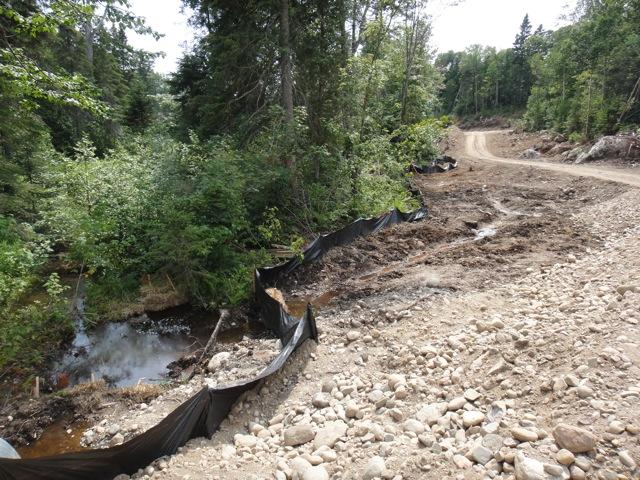
Photo courtesy LSARC: devastation of landscape and erosion into streams from Northern Ontario wind farm construction

What’s a Redside Dace? Well, if you don’t know, don’t worry–it won’t matter for too much longer.

One of the principal points made by the Appellant in the recent appeal of the East Durham wind power project  by NextEra, was the damage that would be done by construction and the alteration of natural waterways. The prime witness testimony was:

[1]           He [Wren] also reviewed the 2004-2005 survey by Streams Ontario for the MNR.  In Dr. Wren’s opinion, the MOE “did not demonstrate due diligence in considering or evaluating sensitive fish and fish habitat in the project study area, with particular reference to the fish species Redside Dace”.

[2]           In Dr. Wren’s view, the sampling of the Saugeen River for Redside Dace was inadequate largely because too few samples were taken over too large an area.  It is his opinion that the MNR should have required the Approval Holder to conduct field investigations for Redside Dace in the Project Study Area to confirm their status.  He relied upon an email from the MNR to the Approval Holder’s ecologist which stated:

The absence of a species at risk occurrence does not mean that they are not present and as a result due diligence is still required … .  It should be noted that from a species at risk perspective this is an understudied area and as a result the MNR will be looking to ensure appropriate due diligence as it relates to field work was conducted to consider these species in further NHA reports for this site.

[3]           Dr. Wren’s opinion is that: “the Upper Saugeen Subwatershed contains an abundance of coldwater fisheries habitat that is unique in Southern Ontario.  Furthermore, the subwatershed is known to contain redside dace, an endangered species, which have a very specialized habitat.”

[4]           Dr. Wren also gave evidence about directional drilling and “fracking”, and soil erosion and sediment, and their likely effects on fish habitat and fish.  “Fracking” in this context is the accidental release of fluids toxic to fish that can occur during drilling to place transmission lines underground at water-crossings.  It is Dr. Wren’s view that a “frack out” could cause serious and irreversible harm to an endangered species such as the Redside Dace.

(Info on the Reside Dace here)

So, once again, the “overall benefit” of wind power supercedes damage to the environment, and to species of wildlife the Ontario government has already committed itself to protect? Ministry of the Environment lawyer Sylvia Davis, speaking in Toronto at the Ostrander Point appeal: “So a few animals get killed…”

The Minister of the Environment and Climate Change is Glen Murray, whose ministry is supposed to “ensure healthy communities, ecological protection…”

Reposted from Wind Concerns Ontario

Participate in PECFN’s BioBlitz at Ostrander Point, August 9-10, 2014

Tags

, , , , , , ,

Love Nature? Want to save it from the Ontario government’s misguided “green energy” program which believes wind power trumps wildlife? Here’s a chance to help out. A 2 1/2 hour drive south-west.

CCSAGEadmin's avatarCCSAGE Naturally Green

BioBlitz poster FINAL low colour-page-001 Click on image to enlarge

FOR IMMEDIATE RELEASE

Public invited to help inventory the biologically significant Ostrander Point.

Prince Edward County (July 30, 2014) – The Prince Edward County Field Naturalists are hosting the county’s first ever BioBlitz at Ostrander Point. The event runs over a 24 hour period from noon on Saturday August 9 to noon on Sunday August 10, 2014 and includes guided tours for the public focussing on how to identify a variety of species from plants to birds, insects and amphibians and reptiles.

Ostrander Point is located within the South Shore Important Bird Area, a site recognized globally for its importance to birds and biodiversity.

“Much of the biodiversity of the South Shore Important Bird Area has not been identified” notes Myrna Wood of the Prince Edward County Field Naturalists Club. Wood continues “Ostrander Point was the subject of an Environmental Review Tribunal hearing during which…

View original post 237 more words

Wind farms in Northern Ontario: massive change

Tags

, , , , , , , , , , , , , , ,

Northern Hoot

Northern Hoot is a new website run by journalist Steffanie Petroni on all things Northern Ontario. Devoted to “long-form” journalism, Petroni recently published an article on wind power development, of interest now because two very large projects–Bow Lake and Goulais Bay–will be proceeding. Appeals by First Nations groups and residents failed.

Of special interest in this posting are photos by Gary McGuffin, who is renowned for his depiction of Northern Ontario scenery.

Radar

Excerpt:

In Ontario there have been 20 appeals in opposition to industrial wind turbine farms brought before the Ministry of the Environment (MOE) and 19 have been dismissed. An appeal by Prince Edward County Field Naturalists to kill the development of an industrial wind turbine farm on Ostrander Point was won before an ERT in July 2013. However, the decision has since been reversed by the Ontario Divisional Court and appellants are seeking an appeal before the Ontario Court of Appeal.

George [Brown, of the Lake Superior Action Research Conservation] commented, “The 240 Bow Lake appeal came close to winning. Based on the Ostrander Judicial Review decision the Tribunal found that in order to prove irreversible harm it was necessary for the appellant to know the size of the populations being harmed. Having found that the 240 appeal failed to prove irreversible harm the Tribunal declined to make a finding on the issue of serious harm, though it agreed with virtually all the arguments on bats submitted by the 240 appeal.

As a result the Tribunal imposed immediate and more stringent mitigation measures on the project – a tacit admission that species-at-risk bats would otherwise be killed, which would be a serious harm.

The Tribunal’s decision is peculiar in that it allows these more stringent mitigation measures to be rescinded should they prove effective. Had the MNR required, or done, a baseline study, or had the 240 appeal had the time and money to do one, to determine the size of existing bat species populations in the project area, we would perhaps have had the final piece of the puzzle required to win.”

For more information, go to http://www.lsarc.ca


Parker Gallant on solar panels and school roofs in Toronto: not such a great deal

Tags

, , ,

For fans of Parker Gallant, his review of the situation in Toronto where the school board thought they were going to be “green” and save money on roof repairs, and even “make” money too (albeit on the backs of already stressed electricity ratepayers but…details, details).

Lots of solar panels going up on buildings in the Ottawa area, too: are “deals” like the Toronto one being repeated here? The “wolf in green clothing” continues to hunt.

The green mirage: Toronto school board gets free roof repairs for solar panels — or do they?

Toronto School Board flunks out

Canada’s largest school board, the Toronto District School Board (TDSB), is getting an F on management practices.  Ontario’s Ministry of Education and Ministry of Energy must also receive a failing grade.

It starts with Toronto’s public schools having leaky roofs.  The TDSB, with much fanfare May 2011, found the Holy Grail when they struck a deal with AMP Solar Limited Partnership for solar panels on school roofs.  TDSB thought the deal with AMP would result in free roof repairs on 450 schools, and, after AMP recovered the cost of the repairs, TDSB would also receive 14.5% of the solar power revenue generated from the Feed-In Tariff or FIT contracts they hoped to obtain from the OPA (Ontario Power Authority).  On paper it sounded wonderful; TDSB’s Director of Education Chris Spence said,  “This is a win-win for everyone involved.”

What he meant was, it would be a losing proposition for Ontario’s ratepayers.

What has happened since that announcement shows someone didn’t do their math homework or anticipate what might go wrong.

One year later: there were delays as the rules under the FIT program changed, creating lower prices for roof-top solar, and then McGuinty prorogued the Legislature.  The Toronto Sun quoted Chris Bolton, TDBS’s chair, confessing the Board didn’t have an alternate plan.  The story went on to say the Ontario government “encouraged” the TDSB to turn to FIT as a resolution to its roof repair backlog.   It is not clear if that suggestion came from the Ministry of Education or the Ministry of Energy.  If it was, it was as a neat budget gambit to fool the taxpayers while sticking it to the ratepayers.   Three weeks prior to the Sun article the Ministry of Education froze new construction approvals, “citing concerns the TDSB was going over budget on building projects and in danger of not wiping out an existing $50 million capital deficit.”

A few “snags”

Fast forward July 25, 2014: the reporter who wrote the Toronto Sun story wrote one for the National Post  headlined  “Solar panel upgrades for public schools hit snags”.  The article infers “the costs” to repair the roofs are “higher than first pegged” and goes on to explain, “That’s because of greater-than-expected costs to the board’s private partner-School Top Solar LP-for roofing, installing the panels and fees to Toronto Hydro for hooking up to its power grid.”  It is unclear who School Top Solar LP is—the original TDSB partner was AMP Solar Limited Partnership, but perhaps they flipped the project to take a nice profit (as has happened with so many companies) that have obtained FIT contracts).

The result of this wonder story is that the most TDSB will get out of this free deal will be to replace one-sixth (720,000 sq. ft.) of the 4.3 million square feet of roofs.    They can also kiss goodbye to the 14.5% energy revenue Chris Spence thought they would get.

Let’s see where the mistakes were made. First, the math on the 66 MW that will be installed: based on the original roof-top solar prices ($700 per megawatt hour), the 66 MW could have generated in excess of $40 million annually and $806 million over the 20-year life of the contract. The developer (AMP) claimed the 66 MW would produce enough electricity to power 6,000 average homes, which means 57,600 megawatt hours (MWh) of power yearly.

Now the roof repair costs: roof replacement repairs to the 4.3 million square feet would run to $8 or $9 per sq. ft., meaning total costs would be in the $40 million range.  Capital cost of solar per MW is $5 million (approximately) as estimated by the U.S. EIA, so 66 MW would have cost $330 million making total costs (including roof repairs) about $370 million and recovery of the cost outlays (including maintenance) should have taken nine to ten years.

If it looks too good to be true, maybe…

The reduction in the FIT rates threw the “free” roof idea into jeopardy. It now looks like the TDSB will have to go cap in hand to the Minister of Education, Liz Sandals, if they want those leaking roofs fixed, without making the Board’s $50-million capital deficit disappear.

What’s funny is that now, as reality hits, a few of the education board trustees interviewed for the National Post said they actually want to blame the school principals (some of them had requested adjustments to the placement of the equipment used to hook up the panels to Toronto Hydro’s electricity grid).

Perhaps Ms. Sandals will solve the TDSB dilemma by getting the teachers unions to back down on their demands for raises and pension benefits until the roof leaks have been plugged!

This is another example of the many logic failures brought to Ontario by the Liberal government and its push for renewable energy on a large-scale!

Parker Gallant,

July 28, 2014

 The views expressed here are those of the author and do not necessarily represent Wind Concerns Ontario policy.


Wind power: a “wolf in green clothing”

Tags

, , , , , , , , , , , , ,

It’s clean, it’s “green,” and it wants your land and your money too

Here from The Hill, a US blog for policy-makers, a posting on wind power and the US form of subsidy, the Production Tax Credit.

July 25, 2014, 10:00 am

Wind power production tax credit: Wall St. wolf in green clothing

By Curtis Ellis, The Hill, July 25, 2014

The tax incentive for wind power expired last year, and the battle over its extension is now underway. Opponents say the wind power production tax credit, PTC, is a wasteful boondoggle while supporters say it’s crucial for renewable energy and jobs. The Sierra Club calls it “one of the best bets we’ve made on clean, domestic energy.”

But it’s a misplaced bet.  The PTC actually blocks the green energy technologies that hold the most promise.  Rather than helping an infant industry, the PTC is a handout to Wall Street.

Congress created the PTC in 1992, a tax credit of roughly 2 cents per kilowatt-hour of wind electricity, to nurture the infant wind energy industry. Government incentives to promote crucial industries are time-honored. That’s not the problem with the PTC.What’s important is that only big investors who want to offset tax liabilities on other investments need apply. The PTC can only be taken against “passive income” – income from other investments. Private equity firms put together investors who need a tax write-off courtesy of the PTC. Warren Buffett admits he uses the PTC to lower his Berkshire taxes: “we get a tax credit if we build a lot of wind farms. That’s the only reason to build them.”

The PTC doesn’t help the average Joe who wants to put a small wind turbine on his ranch to generate electricity and reduce the taxes he pays on his farm income.

But while the PTC boosts Wall Street investment schemes in large-scale wind farms, the fact is small-scale, individually owned generation facilities hold the most promise for renewable energy.

Noted environmentalist Bill McKibben writes, “One of the great side effects of moving to renewable power is that we will replace vulnerable, brittle centralized systems that are too big to fail with spread out democratic energy sources.” Unfortunately, the PTC only encourages more “brittle centralized systems.”

California’s Local Clean Energy Alliance (which includes the San Francisco Bay Area chapter of the Sierra Club) concurs. It’s report, Community Power, states “local, decentralized generation of electricity offers many benefits to California’s communities relative to large central-station solar or wind power plants in remote areas.”

The Institute for Local Self Reliance, a green energy cheerleader, says renewables work best “at small scales across the country,” what’s known as distributed generation, “a network of independently-owned and widely dispersed renewable energy generators” rather than “a 20th century grid dominated by large, centralized utilities.”

In fact the Institute explicitly says the PTC is a significant barrier to greater investment in renewable energy. Removing this barrier “makes smaller projects more accessible to the local community, and draws local investors back into the process,” says John Farrell of the Institute for Local Self-Reliance.

Utilities are also taking local-scale renewable energy seriously.  A report by the Edison Electric Institute, Disruptive Challenges expects small-scale solar and wind “to challenge and transform the electric utility industry” with “adverse impacts on revenues, as well as on investor returns.”

David Crane, CEO of NRG Energy, a wholesale power company that operates coal-fired plants, told Blooomberg Businessweek  “the grid will become increasingly irrelevant as customers move toward decentralized homegrown green energy.”

So, if local-scale wind and solar generated close to the end user makes the most sense, why do we have a PTC pushing large-scale wind farms? It’s a Wall Street play.

Environmentalists supporting the PTC mean well, but they fail to see the wolf of Wall Street hiding beneath the green clothes. Ironically, the national green organizations are fighting for the kind of massive generating stations and power lines their local chapters often fight against.

The PTC is an anachronism and an obstacle to developing the decentralized, independently owned power generation system appropriate for wind, solar and other renewables.

Anyone who believes in renewable energy should be happy to see the PTC expire. It’s time to replace this tax write-off for the financial services cabal with something that benefits everyone.

Ellis is executive director of the American Jobs Alliance.

Read more: http://thehill.com/blogs/congress-blog/energy-environment/213183-wind-power-production-tax-credit-wall-st-wolf-in-green#ixzz38c15D4Uf

Brinston wind farm noise complaints lead to monitoring

Tags

, , , , , , , , , , , ,

And this is a SMALL one...

And this is a SMALL one…

The South Branch wind “farm” has been operating since mid-March, but it didn’t take long for the first noise complaints to be registered. This wind power generation facility is the first of the 3-megawatt machines to operate in Ontario; many more, mostly in southwestern Ontario, are to follow. The increased capacity is a concern to people who have done research on wind turbines, as they are more likely to produce infrasound or sound pressure, which disturbs some people.

Noise complaints lead to monitoring

by Sandy Casselman
Press staff

BRINSTON – It has been more than six months since the blades of the South Branch Wind Farm turbines began to spin, leaving more than one nearby resident with some sleepless nights.

“I call when it gets to the point I can’t tolerate it anymore and I go to the basement [to sleep],” Brinston resident Leslie Disheau, former president of the South Branch Wind Opposition Group, said. “It is an issue and I’m not the only person in town with the issue.”

Disheau, who is running for the Municipality of South Dundas’ deputy-mayor seat in this fall’s municipal election, has been staying close to home since the Ministry of the Environment (MOE) installed noise-monitoring equipment at her Brinston Road property last week.

“MOE contacted me and asked if they could put this noise monitoring equipment up,” Disheau said.

The two pieces of equipment measure wind speed and direction, barometric pressure, rainfall, and more, she said.

She has submitted three separate noise complaints so far. Every complaint must be filed with EDP Renewables’ project leader Ken Little and local MOE representative Terry Forrester to be officially registered.

During EDP’s first open community liaison meeting in March, a Brinston man spoke out about his own sleep disturbances, suggesting the turbines be shut off for a period during the early hours of the morning, beginning around midnight. At that time, Little confirmed that there had been one official complaint already registered. He also said an acoustic audit had been ordered, which he expected to get underway within two months of the meeting.

“EDP has not released their post-construction noise audit report,” Disheau said during an interview with the Winchester Press Fri., July 18.

In conversation with one of the MOE officials who installed the equipment, Disheau said she learned that the provincial authority also had not seen a report from EDP.

“They can take a long as they want,” she said, crediting the Green Energy Act with the responsibility for not specifying a deadline. “There is a 40-decibel limit [on the noise the turbines can make], and we have no idea if they’re in the threshold or not.”

To describe what the sound is like, she used Highway 401 versus airplane noise as an example, pointing out that the highway noise is more of a hum, and when she lived near it, the sounds did not bother her at all.
However, the turbines produce something more in line with the “drone of an airplane that goes into your head,” she said. “It’s a deeper tone, and that’s where you get the disturbance of sleep.”

Explaining the noise and its effects on her is not easy, she said, but it is similar to the sensation people get in their chest when listening to bass guitar.

Disheau said she explained her experiences to MOE’s acoustical engineer, adding that the sensations are at their worst when the blade tips of the turbine across the road (south of Brinston) and the one to the north behind her home (west of Brinston) are facing one another.

“The acoustical engineer said ‘yes, that it all makes sense,’ ” Disheau added. “This is not normal. You should not be in sleep disturbance in your own house.”

Meanwhile, Disheau is the only one in her home experiencing the effects of the rotating blades, as her husband, who shares the second storey bedroom on the home’s vinyl-sided addition, is tone deaf, and her children sleep on the first floor of the brick-sided main house.

The noise-monitoring equipment is controlled by a switch, which has been placed inside Disheau’s home. When she notices the noise, she flips the switch and the machinery calculates and documents the findings.

“Once everything is taken down, the ministry guy goes through [the recordings] and writes his report,” she said, which will list the decibel readings for various weather conditions (wind speed and direction).

When asked what she hopes to accomplish through this procedure, Disheau said the findings could require that EDP shut down operations during specific times of the day or during specific wind conditions should they prove the decibel levels exceed the regulated amount.

Read the full story here.

People with complaints about excessive noise from the turbines at Brinston must call both the developer, EDP Renewables (1-877-910-3377 ext 3) AND the Ministry of the Environment (1-800-860-2760). 


CanWEA execs venture down to Brinston wind ‘farm’

Tags

, , , , , , , , , , , , , , , ,


Not from around here: just visiting for the brainwashing

The executives at the wind power developers’ lobby group, the Canadian Wind Energy Association, took a trip down the road from their offices on Carling Avenue in Ottawa to see the wind power project in Brinston, just south and east of Ottawa.

Here’s a report on the visit:

CanWEA Staff Tours South Branch Wind Farm

On June 25, several EDPR employees led a tour of the South Branch wind farm for staff members of the Canadian Wind Energy Association (CanWEA) , including CanWEA’s president, Robert Hornung, who had this to say about the visit: The siting characteristics of South Branch and how well the wind farm blends with the natural landscape are truly impressive, said Mr. Hornung. We were equally impressed by the care and attention that EDPR has taken in building a high level of enduring community acceptance. 
The tour of the wind farm, located near Brinston, Ontario, included stops in the O&M building as well as the inside of the base of a tower and the substation building. After an informative tour, CanWEA expressed interest in working with EDPR to improve its information packages for farmers.  Several CanWEA representatives also said they planned to stop by the upcoming South Branch Kid Wind Day, which will be held on Thursday, July 24, and attended by 150 kids.

The claim that EDP has “enduring community acceptance” would be laughable, were it not for the truth about this community: once the wind project was publicly announced by the original developer, Germany-based Prowind, the community became divided between the few farm owners leasing their land for turbines, and others in the community who had no choice but to watch this happen to them. A community group was organized and held several information meetings…but of course, with the Green Energy Act, there are no solutions through elected representatives. South Dundas Council voted on a resolution to say there would be no support for further wind power development as Ontario doesn’t need any more power generation.

The so-called South Branch Kid Wind Day is NOT for local families (hard for them to miss the huge, 3-megawatt turbines) but it will be for kids being bused in from elsewhere. The community has not even been informed of this PR event.

Of greater concern, though, is the news that an “information package” is being developed for farmers: this is being worked on because Eastern Ontario has a green light from the province for wind power development…it is rumoured that 5,000 more acres in North Dundas have been optioned for future wind power development.

Our question: will EDP and CanWEA provide full disclosure on noise, health problems, sleep disturbance, property value loss, and the potential for lawsuits from neighbouring landowners?

Email us at ottawawindconcerns@gmail.com


Brinston residents: call toll-free number to complain about turbine noise

Tags

, , , , , , , , ,

168191.jpg

The South Branch wind “farm” has only been in operation for two and a half months, but already people are talking about the noise and vibration from the turbines. Last week’s super-windy days were especially troublesome. The turbines are 3-megawatt capacity, the first of the powerful turbines to be operational in Ontario … for now.

From contacts we have, it appears that some residents are completely unaware that they can–and should–alert the Ministry of the Environment’s “spills action” line and notify them about the excessive noise.
Complaints have to be Registered with BOTH EDP Renewables and Ministry of Environment. You need to provide your Name, Civic number Address, date and time of the noise and be specific with your complaint information.

Contact:
Ken Little, EDP Renewables 1-877-910-3377 ext.3 or southbranchwindfarmcomments@edpr.com

Ministry of Environment – spills action line 1-800-860-2760 request the Cornwall Office and speak with Terry Forrester.

We should add that we know from experiences with contacts in Harrow, Norfolk, and Grand Valley, that callers must be polite, and have details about the noise experienced, and the time of day and duration.

More information on the Ministry of the Environment Spills Action line may be found here.

South Branch was originally developed by Prowind of Germany, and sold to EDP Renewables, a firm with headquarters in Portugal.

Brinston residents may also wish to contact your MPP, Jim McDonell.

At-risk Golden Eagles to die if Prince Edward Cty wind farm built

Tags

, , , , , , , , , , , ,

A Prince Edward County community group has received documents via Freedom of Information that show Golden Eagles, an at-risk species of bird, would almost certainly die in significant numbers, if a 49-turbine wind “farm” is built as planned in Prince Edward County. The County is about two hours south-west of Ottawa, near Kingston, and is in the North American eastern flyway for migratory birds.

The County Coalition for Safe Appropriate Green Energy (CCSAGE) says the documents it obtained show that even with the limited number of days the wind power developer wpd Canada surveyed for the birds (just three days), substantial numbers of the birds would fly through at the height of the turbine blades, and die.

CCSAGE is also deeply concerned that this information was not made available to the public by either the developer or the Ontario government and, in addition, their request for this specific information was answered only AFTER the comment period closed. This information calls for questions about the scientific veracity of the so-called “technical review” done by the government of developer documentation.

See the posting on the Wind Concerns Ontario website here. Wind Concerns Ontario has filed a complaint with the Office of the Ombudsman of Ontario regarding the technical review process. Ottawa Wind Concerns followed suit with a letter to the Ombudsman with details on the lack of openness and transparency regarding the Prowind proposal for North Gower and Richmond.

Email us at ottawawindconcerns@gmail.com

Transport Canada demands removal of airport turbines for safety

Tags

, , , , , , , , , , ,

CTV Windsor
Published Sunday, July 6, 2014 6:14PM EDT 
Last Updated Monday, July 7, 2014 9:03AM EDT

Pro-wind power Mayor says “there is no safety issue”

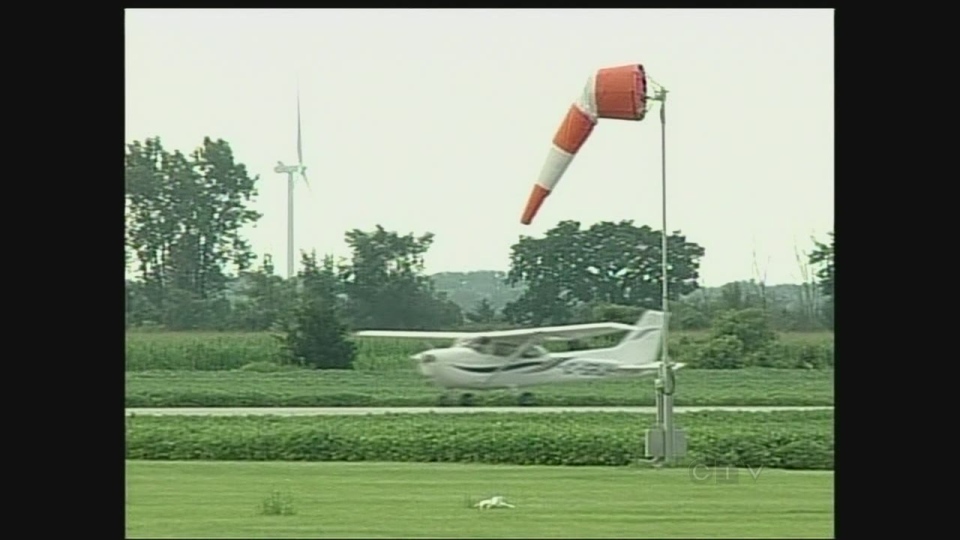
Transport Canada has issued an order requiring the eight wind turbines near Cedar Springs be removed by the end of this year.

The organization originally issued a letter requesting “voluntary compliance” last year.

In a release sent out by the municipality, Chatham-Kent mayor Randy Hope, says,“there is no safety issue so we need to change the regulation rather than force the removal of the turbines.”

The municipality had been waiting for a reply from Transport Canada on this proposal and was surprised this week to learn that Transport Canada had taken this new step of issuing letters demanding that the turbines be removed by Dec. 31.

The affected wind turbines are in a “no fly zone” south of the airport.

It is expected that GDF SUEZ, the owner of the affected turbines, will formally object to the order from Transport Canada and seek a hearing before the Minister of Transport through the process laid out in the Aeronautics Act.

Read more: http://windsor.ctvnews.ca/transport-canada-demanding-wind-turbines-be-removed-near-chatham-airport-1.1901446#ixzz36n9X6XXM

Read the full story and see photos here.