Drs Ian Arra and Hazel Lynn, together with several associates, have now published a peer-reviewed article based on their literature review of studies on wind turbine noise and health impacts.
Their conclusion: we have demonstrated the presence of reasonable evidence (Level Four and Five) that an association exists between wind turbines and distress in humans. The existence of a dose-response relationship (between distance from wind turbines and distress) and the consistency of association across studies found in the scientific literature argues for the credibility of this association.
The wind power development lobby insists there is not relationship between wind turbine noise, inaudible noise/low-frequency noise/infrasound, and often implies that people who claim such effects are actually ill-informed or not receiving money. A spokesperson for the Ontario Federation of Agriculture told an audience at this year’s Rural Ontario Municipalities Association meeting that anyone claiming to experience health impacts from turbine noise had questionable mental health stability and that the listener should “just cough on them.” His remarks were withdrawn by the OFA with an apology shortly thereafter.
Two information events were held in North Stormont last week; a panel discussion on wind power issues, hosted by the Lions’ Club in Finch on May 6, and in Crysler on May 7, the first Open House on the North Stormont wind “farm” hosted by power developer EDP Renewables.
We have already reported on the Lions’ Club event and doubtless the media will be along shortly, too; we have reports from people who attended the EDP event.
Apparently, the power developer had brochures available on health and property value impacts. Here is the “other side” on these issues.
Health
The wind power lobby is focusing on the Health Canada study which, they say, claims no “causal link” between wind turbine noise and health effects. The truth? The Health Canada study was not designed to find a causal link, so, surprise! What it DID find, however was that significant numbers of people are distressed by the turbine noise and infrasound (low frequency or inaudible sound). In Health Canada’s PowerPoint presentation of its results, the following points were made:
as wind turbine noise levels increased, so did respondents’ annoyance (distress)…this was a statistically significant finding
in comparison to aircraft, rail or road traffic noise, annoyance/distress due to wind turbine noise was found to begin at lower levels, e.g., ~35dBA
the prevalence of wind turbine noise annoyance/distress was higher in Ontario than in PEI (the other area studied) and,
wind turbine noise annoyance/distress in the Ontario sample persisted up to distances between 1 and 2 km–in PEI this was restricted to
In fact, the Health Canada study found,16.5% of people within 1 km of a turbine experienced annoyance/distress, and at 550 metres, that went up to 25%
More recently, the Council of Canadian Academies released their report, a literature review on wind turbine noise, with the following important findings:
the evidence is sufficient to support a causal association between exposure to wind turbine noise and annoyance
standard methods of measuring sound may not capture low-frequency sound characteristic of wind turbine noise (in other words, the way Ontario is measuring turbine noise–and not measuring infrasound at all–is not adequate to protect health)
there is limited evidence to establish a causal relationship between exposure to wind turbine noise and sleep disturbance (which is known to cause health effects), and
knowledge gaps prevent a full assessment of health effects of wind turbine noise–proper population studies, especially studies of sensitive populations such as children, have not yet been done.
Did EDP Renewables present these facts at their Open House?
Property values
We’ll keep this short: we’re betting EDP brandished the recent study done by Richard Vyn of the University of Guelph, which is supposed to prove that property values around wind turbines don’t change. Aside from the fact that this is nonsense, and Vyn’s study was poorly structured—that’s not what he says!!! In fact, Vyn cautions the reader that there were significant limitations in how he went about his study and this [his conclusion] does not preclude any negative effects from occurring on individual properties. Read more analysis of the Vyn report at Wind Farm Realities.
The wind power developer is taking care to be seen to address the issues of health and property values, but they are being very selective in their choice of reference material (and in the coming federal election, you might ask candidates WHY the federal government used taxpayer money to create a misleading, attractive colour brochure to help the wind industry)
Email us at ottawawindconcerns@gmail.com
NOTE: This post certainly got us a lot of attention from the wind power industry. A wind industry communications officer from the UK accused us of causing harm to people by putting this information out there (he claimed people with real illnesses would not seek treatment because they will think instead it’s just wind turbine noise–absolutely unjustified and frankly, stupid); he was seconded by pro-wind physician George Crisp from Australia, and they were joined on Twitter by Chris Young, board member with the Ontario Sustainable Energy Association and employee of NorSun Energy in Ottawa. Mr Young pronounced us as “irrelevant.”
Eastern Agri-Business News is running a poll, asking whether you think “green” energy sources will be enough to power Ontario, and at an affordable price.
MPP for Stormont-Dundas-South Glengarry Jim McDonell has launched a petition asking to Ontario government to return full consultation for the community regarding a proposed 30-50 turbine wind power project, and further, to do a complete study of any impacts of the proposed power project.
The petition MUST be printed out, signed, and mailed or delivered to Mr McDonell’s office as a legal document. Fax or scanned versions are not legal.
Wind developers can use farm leases as security for financing the power project
Ontario Farmer, May 5, 2015
by Garth Manning and Jane Wilson
It came as a surprise to many in Ontario when it was revealed that the multi-national power developers behind the K2 wind power generation project near Goderich had secured $1 B in financing, and that this arrangement is now registered on title for the 100 farm properties involved as lessors.
The arrangement is between K2 Wind Ontario Inc. and Mizuho Bank Ltd. Canada Branch. It secures a revolving credit facility of up to $1 billion at 25% on a number of items, including the contracts between landowners and K2 for land and road agreements with municipalities.
Another, smaller example has also come to light: a wind power project south of Ottawa in Eastern Ontario, where the five landowners leasing land for a 30-megawatt, 10-turbine project now have charges on their properties for $70 million.
Immediately, questions arise as to what would happen if the power developers were to default on their loans: would the lender then own the farm properties? How would that affect road use agreements with municipalities?
The fact is, this is a common practice. Property owners can refer to the leases imposed by the developers to review this potential situation, and many others that may affect operation and ownership of their land while leasing land for the power projects.
In an Invenergy standard contract, for example, is this clause: “In connection with the Lessee’s financing of the Project, the Lessee….is hereby given the right by the Lessor…to mortgage its interests in the Lease…and to assign this Lease, or any part of parts thereof, and any subleases as collateral security…”
The proper term for this is a “Charge of Lease” but may also be referred to as a “Demand Debenture.” What it means is, the present value of the wind power contract (i.e., the Feed In Tariff or FIT contract with the Ontario government) is greater than the present value of the lease amount. The difference between those two amounts is security for the loan to the power developer. It is a charge against all contracts favourable to the wind power developer, which may also include road use agreements.
It is like a line of credit for the developer and typically, advances against the amount are tied to certain milestones such as stages of construction.
The critical factor, however, is what it means for the lessors, in other words the farm owners who have leased their land for wind turbines, access roads, substations, transmission lines, etc. The importance lies not so much that the farmer lessors might on default lose their land (the farm land itself is not mortgaged, just the turbine contract on that land) but the damage it does to that property owner if he/she wants to sell, or to renew an existing mortgage, or place a new one, or in any way borrow money for which the lender would want security on his/her land.
Let’s assume a farm owner wants financing for farm operations or improvements. That might now pose difficulty: lenders do not like to be second in line, as they would be where a charge of lease is in place.
If the farm owner wishes to sell, similar difficulties arise: the lawyer for a purchaser in the case of an agreement to purchase will do a title search and discover the Charge of Lease on title, then immediately advise his or her client that the client is entitled to get out of the deal unless the registration of the Charge is removed from title. A purchaser is not expected to assume any risk of this nature.
In the case of renewing an existing mortgage or placing a new one, the lawyer for the bank or other lending institution would take the same position — no renewal or new mortgage unless the customer sees that the Charge disappears from title.
This is one of several important characteristics of signing a lease to have wind turbines, and needs to be thoroughly considered. Other legal issues to be carefully considered may include potential liability for the substantial cost of “decommissioning” turbines at the end of the lease, difficulty obtaining insurance on property with wind turbines, loss of autonomy over building on the property and carrying out regular farming practices, and, last, the potential for nuisance suits from neighbours affected by noise or property value loss.
Property owners should consult with a lawyer before signing any agreement.
Garth Manning is a retired lawyer and former president of the Ontario Bar Association, who lives in Prince Edward County. Jane Wilson is president of Wind Concerns Ontario; she lives in North Gower.
“Why us?” was one of the questions raised, as more than 125 people gathered in the North Stormont Community Arena Hall in Finch on a fine spring evening in the middle of busy planting time, to hear a panel discuss various aspects of wind power in Ontario.
Speakers for the Lions’ Club event were: Tom Levy, Director of Technical and Utility Affairs, for the Canadian Wind Energy Association/CanWEA, the industry lobby group; Jane Wilson, president, Wind Concerns Ontario; and Don McCabe, president of the Ontario Federation of Agriculture.
Tom Levy went over the numbers for wind power in Canada and showed wind power development is growing as a source of power; Ontario currently has over 4,000 megawatts of installed wind power. Wind is cheaper than other forms of power generation, he said, fast to build, emissions-free, and–because power contracts are for 20 years–provides price stability whereas prices for other forms of “fuel” such as natural gas, can fluctuate, he said.
Wilson called for balance in the approach to wind power development in Ontario communities: “If a community wants a wind power project, that’s fine,” she said, “but you have to be assured that no one single person is going to be harmed by it.” Wilson said the recent Health Canada study showed health impacts (“annoyance” is a medical term meaning distress, she said) and called the Ontario setbacks of 550 metres into question.
Quoting a document from CanWEA, Wilson said, “You have a right to ask questions, you have a right to have concerns, and –based on what you learn–you have the right to oppose.” Wilson also mentioned the charge of lease possibility in wind power contracts which meant developers can obtain financing based on the leases on farm properties for turbines.
OFA president Don McCabe pounded the lectern with his fist on the contract issue, saying, Get a lawyer, get a lawyer, get a lawyer. It is up to each property owner to obtain proper legal advice before signing contracts, he said. His view was that farm owners contemplating leases need to get an agreement that will get the most benefit for them.
Mr McCabe made no mention of farm communities, or the effect of farmers’ decisions to lease on their neighbours.
The issue of Ontario’s power supply and electricity bills came up through the evening as Wilson asserted Ontario does not need more power, and has already sold off surplus power cheap in the first quarter of 2015, for a $450-million loss for ratepayers.
McCabe joked that he didn’t think there was excess surplus power at night, and that there was no real surplus of power, only mismanagement “in Toronto.”
The question, “Why us?” was answered by Levy and Wilson. Levy said it was a number of factors that motivated developers to choose an area for power development, including access to the power grid, willing landowners, available wind resource. “Mr Levy hit the nail on the head,” said Wilson; “willing landowners. The real question is, why are power developments not located closer to cities like Toronto where the power is being used?”
The power developer proposing a project for Stormont Dundas and Glengarry, EDP Renewables, will be holding an open house tonight in Crysler at the Community Centre, between 4 and 8 PM.
The power developer who bought the 30-MW South Branch project in South Dundas from German developer Prowind, EDP Renewables, is now proposing to expand into Stormont, Dundas and Glengarry, and apply for a Feed In Tariff contract. Spokesman Ken Little told South Dundas council the company was planning 30-50 turbines.
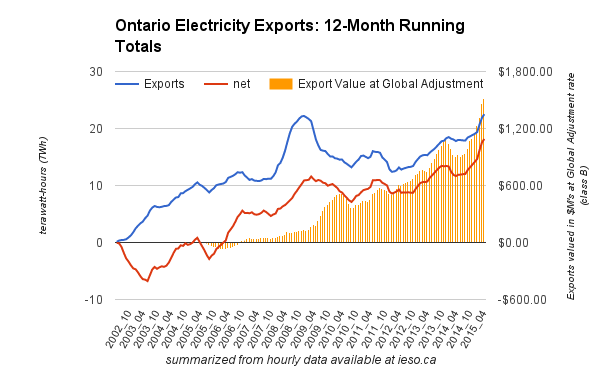
Ontario is currently offering contracts for 300 MW of new wind power in 2015, despite a situation of surplus power in Ontario, and the fact that Ontario lost more than $425 million in the first quarter of 2015, exporting surplus power cheap.
A public meeting will be held in Finch this coming Wednesday at the community centre/arena at 7 PM. The goal is to have a panel present various viewpoints on wind power.
Guest speakers will be Tom Levy of CanWEA, Jane Wilson of Ottawa Wind Concerns /Wind Concerns Ontario, and Don McCabe of the Ontario Federation of Agriculture.
EDP’s Brinston project is about 40 minutes south of Ottawa.
Ontario’s electricity customers pay and pay and pay while neighbours get our power cheap
Wind almost 40% of exported power; cost of surplus export $437 million in just 3 months
The first quarter of the current year indicates Ontario is exporting record quantities of surplus electricity.
It appears to be part of the Liberal government plan as this excerpt from Finance Minister Sousa’s budget “Building Ontario Up” claims: “Through our four-part economic plan, we are supporting greater investment in productivity and innovation, providing a renewed focus on international exports, encouraging the transition to a low-carbon economy and creating more jobs for Ontarians.”
It would be better if our surplus electricity was exported profitably, instead of a cost to ratepayers, but alas, that is not the way the Liberal Energy Ministers past and present have structured the portfolio.
The first quarter of the current year saw Ontario export a record 6.65 TWh (terawatts) — that’s enough to power 690,000 average households for a full year.
Export costs up 75% in first quarter
The 6.65 TWh sold to our neighbours was up 75% from 3.81 TWh in 2014′s first quarter. We sold that surplus at prices well below what we received. Exports represented 17.5 % of Ontario’s demand in 2015 versus 10% in the same period in 2014. Wind (generated and curtailed) in 2014 was 2.05 TWh and 53.7% of Ontario’s exports; in 2015, wind grew to 2.61 TWh and was 39.2 % of our exports.
The concept of exporting is one that economists encourage; however, they expect it will be profitable, create jobs, and not burden the rest of the economy though subsidization. Subsidizing exports is often referred to as “dumping” and frequently challenged under the WTO (World Trade Organization) rules.
Cost to ratepayers is shocking
Examining the cost to Ontario ratepayers for the 3.81 TWh exported in 2014 and the 6.65 TWh exported in 2015 using data from the Independent Electricity System Operator’s (IESO) “Market Summaries” is shocking.
The 2014 first Quarter exports cost (average of $102.6 million/TWh) ratepayers $391 million to produce and was sold via the HOEP (hourly Ontario electricity price) market at an average of $75.54 million/TWh. That cost Ontario’s ratepayers $103 million. In 2015, the 6.65 TWh exported cost Ontario’s ratepayers $672 million (average cost of $101 million/TWh), and sold at an average of $35.4 million/TWh, costing Ontario ratepayers $437 million.
To put some context to the latter, the money lost exporting the 6.65 TWh was equal to 6.6 cents per kilowatt hour. The foregoing subsidy does not include other costs Ontario’s ratepayers pick up including: spilled hydro, steamed-off nuclear or payments to idling gas plants. The subsidies supporting exports is double what Energy Minister Bob Chiarelli suggests is needed to assist almost 600,000 “low-income” households to pay their hydro bills. Ontario’s ratepayers will start paying the latter January 1, 2015.
This analysis would not be complete without noting the cost of wind generation (two quarters) in 2014 was $252.7 million (average cost of $123.5 million per/TWh) and $322.5 million for 2015!
Perhaps our Finance Minister should “focus” on the harm to Ontario’s ratepayers instead of dumping our surplus electricity on our neighbours who are happy to take it and not raise the issue with the WTO. If the first quarter of 2015 is indicative of the full year, ratepayers will pick up $1.8 billion in subsidies to supply our neighbours with cheap electricity, while Ontario’s citizens struggle.
Parker Gallant, April 28, 2015
The views expressed here are those of the author and do not necessarily represent Wind Concerns Ontario policy.
Chart courtesy Scott Luft of Cold Air Online
EDITOR’S NOTE: Parker Gallant will be on the Rob Snow show on radio CFRA, Friday May 1st, to discuss this. Listen in an AM 580 or online at cfra.com
Construction of one of the 3-MW turbines at Brinston, now operating–30-50 more proposed by EDP Renewables
Ottawa Wind Concerns has learned that a “Charge of Lease” has been placed on the South Branch wind “farm” in the amount of $70 million. The charge is on the leasehold interest in five properties, where property owners have leased land for wind turbines, access roads, substations, and other parts of the wind power generation project.
Earlier this month, details came to light on the 140-turbine K-2 project near Goderich, Ontario, where a charge of lease has been filed on the title for 100 farm properties, in the amount of $1 billion.
The Charge of Lease is basically a financing agreement between a lender (who may represent investors in the wind power project) and the wind power developer, that can function as a line of credit. The basis for the Charge, as we understand it, is that the present value of the contract for the turbines, i.e., the Feed In Tariff contract for power with the Province of Ontario is greater than the present value of the lease agreements with the landowners; the difference between those two values is the security for the loan.
The South Branch contract with the Ontario government runs for 20 years and is worth millions to the developer, who bought the project from Germany-based Prowind.
The importance of the existence of these agreements is the effect they have for the landowner leasing land for the wind turbines. In the opinion of a lawyer advising us (who prefers the term “Demand Debenture” for this arrangement:
It’s not so much that the farmer lessors might on default lose their land (the land itself is not mortgaged, just the turbine contract on that land) but the damage it does to that farmer if he/she wants to sell or to renew an existing mortgage, or place a new one or in any way borrow money for which the lender would want security on his/her land.
Assume a binding Agreement of Purchase and Sale. The lawyer for the purchaser does a title search and discovers the Demand Debenture. The lawyer would immediately tell his/her client that the client is entitled to get out of the deal unless the registration of the Demand Debenture is removed from title, and would also insist to the farmer’s lawyer that this be done otherwise the deal cannot close. A purchaser is not expected to assume any risk of this nature nor to be in the position of “buying a law suit”.
in the case of renewing an existing mortgage or placing a new one, the lawyer for the Bank or other lending institution would take the same position – no renewal or new mortgage unless the customer sees to it that the Demand Debenture disappears from title. Period. End of story.
This is another example of the very serious questions that need to be asked by anyone considering leasing their land for a wind power generation project. There are many serious and long-lasting effects to signing these agreements that need to be properly understood.
In 2013, the Not A Willing Host group of municipalities met in Ottawa at the Association of Municipalities of Ontario convention. At that meeting, one Ontario mayor said, What people need to understand is that basically, they sold their property for the amount of the lease agreement.
** Please see also, the article from the May 5th edition of Ontario Farmer on the charge of lease issue, here.





 Ottawa Wind Concerns