• About
  • Donate!
  • EVENTS
  • Ottawa’s “Energy Evolution”: wind turbines coming to rural communities
  • Thinking of signing a wind turbine lease?
  • Wind Concerns Ontario
  • Wind turbines: what you need to know

Ottawa Wind Concerns

~ A safe environment for everyone

Ottawa Wind Concerns

Category Archives: Uncategorized

Wind farm fight in Ontario 2014: no giving up

31 Wednesday Dec 2014

Posted by Ottawa Wind Concerns in Uncategorized

≈ 1 Comment

Tags

Algoma, Blanding's Turtle, Drennan case, Environmental and Lands Review Tribunal, Eric K Gillespie, Julian Falconer, legal actions wind farms, Northland Power, Not a Willing host, Ontario, Ontario government, prince Edward County, Rebecca Thompson, Sun News, Wind Concerns Ontario, wind farm appeals, wind farm lawsuits, wind farm property values

From Wind Concerns Ontario

Ontario wind farms in 2014: a look back

A spokesperson for Northland Power, whose Grand Bend wind power project can now proceed following decision in an appeal, told a London Free Pressreporter that “One would think the people opposed would lose their appetite for this fight, but they haven’t yet.”

Indeed not. And 2015 will be more of the same as almost every wind power project in Ontario has been appealed, and several are headed for judicial review. Plus, countless private individuals have lodged or plan to take legal actions related to noise nuisance and property value loss.

The truth will stand, eventually.

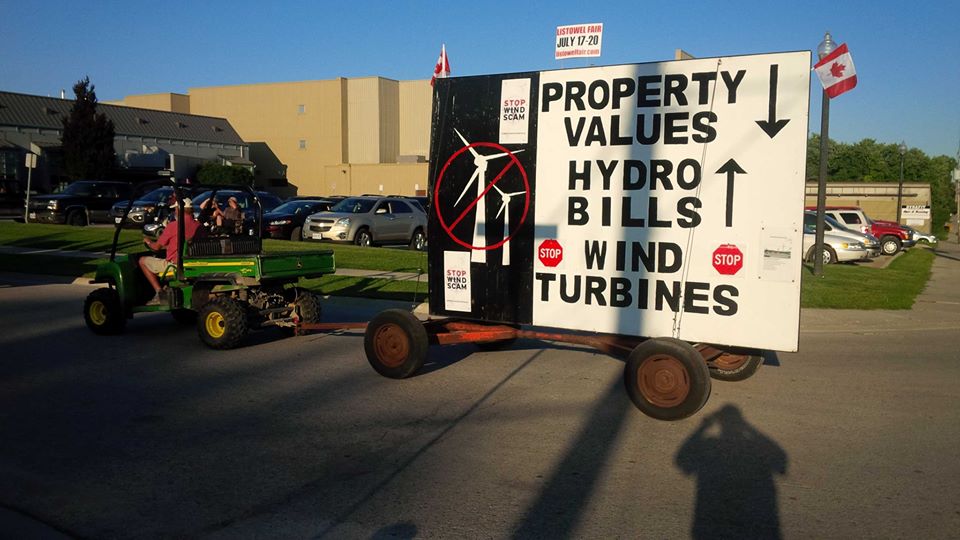
Here’s a look back in pictures at the year that was.

Parker Gallant (R) on the Dale Goldhawk consumer radio show for one hour on the $16-million Christmas Day power giveaway in Ontario. Wind Concerns Ontario documented the millions lost over 2014 through Ontario's mismanaged energy sector
Parker Gallant (R) on the Dale Goldhawk consumer radio show for one hour on the $16-million Christmas Day power giveaway in Ontario. Wind Concerns Ontario documented the millions lost over 2014 through Ontario’s mismanaged energy sector
Julian Falconer represented four families in a legal challenge; while many points about the appeal process were made, the appeal was lost
Lawyer Eric Gillespie continues to represent Ontario communities and appeals against wind power projects; more to come
Auditor General Lysyk becomes the 2nd A G in a row to lambaste the Ontario government for its incompetence in the energy file, and wasted money on green energy
Transport Canada bends to pressure from Big Wind and rescinds order to remove Chatham-Kent wind turbines for safety. (2015 is an election year!)
Invenergy pulls out of Listowel-area wind project
Health Canada releases non-peer-reviewed summary of noise and health study; shows that 16.5% of people within 1 km of turbines experience distress. Media misses this. (2015 is an election year!)
Energy Minister Bob Chiarelli tries to explain that Ontario's electricity bill increases are insignificant, thereby demonstrating his opinion of the intelligence of Ontario citizens
Energy Minister Bob Chiarelli tries to explain that Ontario’s electricity bill increases are insignificant, thereby demonstrating his opinion of the intelligence of Ontario citizens
Two wind power projecst approved for Ontario's world-famous Algoma region, showing the Ontario government has no regard for the environment, whatsoever
Two wind power projects are approved for Ontario’s world-famous Algoma region, showing the Ontario government has no regard for the environment, whatsoever
None so blind as those who will not see. Or listen. Toronto-based Ontario Premier Kathleen Wynne ignores rural and small-town communities. New procurement process for large-scale power projects still does not allow municipalities to say "No" to Big Wind.
None so blind as those who will not see. Or listen. Toronto-based Ontario Premier Kathleen Wynne ignores rural and small-town communities. New procurement process for large-scale power projects still does not allow municipalities to say “No” to Big Wind.
Rallies and protests continue throughout the province; this one to Save the Nor'Westers
Rallies and protests continue throughout the province; this one to Save the Nor’Westers
Dr Robert McMurtry, officer of the Order of Canada, publishes a case definition for adverse health effects associated with wind turbine noise, with health researcher Carmen Krogh
87 communities have now passed Not A Willing Host resolutions
Fund-raising events occur throughout the province: here Stephana Johnston attends a supper for SWEAR and the Drennan case
One of Tim Hudak's election promises was to end the Green Energy Act and enact new regulations; the PCs lose the election for various reasons, disappointing rural/small-town Ontario
One of Tim Hudak’s election promises was to end the Green Energy Act and enact new regulations; the PCs lose the election for various reasons, disappointing rural/small-town Ontario. The Liberals win a majority and vow to continue their (money-losing) green energy policies.
Sun Media's Down Wind doc film with Rebecca Thompson attracts $30,000 in crowd-funding in days
Sun Media’s Down Wind doc film with Rebecca Thompson attracts $30,000 in crowd-funding in days
The Blandings Turtle is in and out of court as Prince Edward County citizens fight the Ontario Ministry of the Environment to save the environment. CanWEA lawyer announces in Toronto court that no appeal was ever supposed to be successful, and the Environmental Review Tribunal needs "direction" so a successful appeal never happens again.
The Blandings Turtle is in and out of court as Prince Edward County citizens fight the Ontario Ministry of the Environment to save the environment. CanWEA lawyer announces in Toronto court that no appeal was ever supposed to be successful, and the Environmental Review Tribunal needs “direction” so a successful appeal never happens again.
Drs Ian Arra and Hazel Lynn publish a review that says there is evidence of an association between wind turbine noise and distress
After taking on Big Wind for years and NextEra in specific, members of the members of the Wrightman family of Middlesex-Lambton decamp to Nova Scotia (but continue to fight)
After taking on Big Wind for years and NextEra in specific,  members of the Wrightman family of Middlesex-Lambton decamp to Nova Scotia (but continue to fight)
Big Wind continues its indoctrination of schoolchildren with support of the Ontario government. In this case, distribution of the T-shirts was halted when parents complained
Ontario communities fight against the Big Wind "scam": wind power cannot deliver on its promises of reducing GHGs, creating jobs, protecting the environment
Ontario communities fight against the Big Wind “scam”: wind power cannot deliver on its promises of reducing GHGs, creating jobs, protecting the environment

Are Ontario wind power subsidies keeping Florida bills low? (Yes)

24 Friday Oct 2014

Posted by Ottawa Wind Concerns in Uncategorized

≈ 1 Comment

Tags

electricity bills Ontario, FIT, Florida Power and Light, gas plants, gas-fired power plants, hydro bills, natural gas, NextEra, NextEra Energy Inc, Ontario Power Authority, renewables, subsidies for wind farms, subsidies for wind power, wind power developers Ontario, wind power Ontario

Ontario: keeping Florida’s fossil-fuel power bills low

Florida: plenty of natural gas-fired power. No wind

Florida Power & Light Company (FPL), the largest subsidiary in NextEra Energy Inc’s portfolio with 4.7 million customers, is doing a fantastic job of keeping their rates low.  In fact they have had declining rates for a few years as noted in this post from one of their webpages:  “Bills Are Decreasing – Again!  Since 2009, FPL’s typical 1,000-kWh customer bill has decreased by 7 percent. And in January 2015, FPL expects to decrease the typical residential customer bill by nearly $2 a month.”

While the FPL customers can currently consume 1,000 kWh a month at an all-in price of 10.2 cents/kWh, rates in Ontario have been increasing at about 10% annually.   That 1,000 kWh purchased from Toronto Hydro will set you back $169.00 (65% higher) versus $102.00 from FPL.   The natural and first inclination is to believe that it is probably due to their sources of electricity and perhaps their efficiency levels; while the latter is probably true (they claim 8,900 employees versus the 20,000 plus we have in Ontario) their sources of electricity only include a passing nod at renewables and then only “solar” which seems reasonable in the Sunshine State!  The pie chart showing FPL’s “Fuel mix & purchased power” indicates at least 75% of electricity supplied to their ratepayers is fossil fuel-based.  Solar provides just over a half of 1%!

NextEra power sources: barely a nod to renewables in the U.S.

Look at the parent company, NextEra: it generates electricity from wind turbines where the company can find subsidies.  They rushed to Ontario to snap up at least six Ontario Power Authority (OPA) contracts with a rated capacity of just over 482 MW (megawatts).  A quick calculation of that rated capacity discloses Ontario’s ratepayers will pay a lot of money to NextEra over the next 20 years, which NextEra can use to either pay dividends to their shareholders, or allow some of the revenue used to keep rates low in the Sunshine State for Canadian “Snowbirds.”

The 482 MW of rated capacity should produce power at 29% of capacity, which means they should generate about 1.2 million MWh (megawatt hours).  The equation therefore is as follows:  482 MW @ 29% X 8760 hours in a year X $135 per MWh x 20 years = $3.2 billion.  That means revenue per FPL customer of about $35 per year. If only $2 finds its way to FPL’s customers, it will help to keep the rates down.

Ironically, Ontario’s Snowbirds pay much higher rates at home; no wonder Canadians own more property in Florida than citizens from the next five nationalities combined! Too bad their winter electricity bills will be waiting for them when they get back home.

©Parker Gallant

October 23, 2014

The views expressed are those of the author.

Reposted from Wind Concerns Ontario http://www.windconcernsontario.ca

Big Wind: losing the PR battle

15 Wednesday Oct 2014

Posted by Ottawa Wind Concerns in Uncategorized

≈ 1 Comment

Tags

Big Wind, health problems wind turbines, infrasound, NIMBY, North Gower, subsidies for renewables, US Department of Energy, wind farm, wind farm noise, wind farms health problems, wind farms Vermont, wind power climate change, wind power energy dependence, wind turbine noise

Thanks to an Alert Reader in North Gower for sending this to us.

Big Wind: losing the PR battle

This excellent commentary details how Big Wind has sought to drive all discussion toward it as the answer for everything from air pollution to energy independence and economic prosperity and, now, climate change.

This commentary is by Mark Whitworth, who is the executive director of Energize Vermont.

Big Wind has a big public relations problem. A new WCAX poll shows public support for wind plummeting from 66 percent in 2013 to 50 percent now.

Wind developers may search for clues about this reversal of fortune in a UVM honors undergraduate thesis written by Neil Brandt. Mr. Brandt says that media coverage of ridgeline wind in Vermont dropped in favorability from 47 percent in 2003 to a measly 26 percent in 2012.

One of Gov. Shumlin’s aides didn’t need a university study to see this: “We are losing the water cooler debate about wind.” This may be why the governor’s talk of renewable energy now emphasizes solar, not wind.

(Of course, if Mr. Brandt were to conduct a similar study of solar, he’d find that poor siting choices are creating a backlash against solar that’s reflected in the state’s media. How long before that shows up in statewide polls?)

In carrying out his ridgeline wind study, Brandt collected 10 years’ worth of relevant news stories from the Caledonian Record, Burlington Free Press and the Associated Press’ Vermont bureau. He broke each of the stories down into individual statements and classified each statement in a variety of ways: who made the statement, what issue it addressed, and did it support or oppose wind.

He identified trends in Big Wind’s media messaging as well as trends in public attitudes.

For example, between 2003 and 2012, Big Wind stopped emphasizing energy independence. The argument must not have been working. Were Vermonters skeptical of the claim that small amounts of electricity produced at random times would make them independent? Was it David Blittersdorf’s pronouncement that he needed 200 miles of ridgeline wind in Vermont?

Brandt says that local economic gain was once the dominant pro-wind theme. Not anymore. Now we know that the wind jobs were temporary. And the good ones went to out-of-state specialists. Heck, even the driver that tipped over his tractor-trailer on his way to Lowell was a specialist from Texas. Any of my neighbors could have driven that truck off the road. I would have been proud to do it myself.

Brandt analyzed coverage of aesthetics. For years, Big Wind has tried to ridicule opponents by calling them NIMBYs (Not in My Back Yard) who selfishly imperil the planet in order to preserve scenery. Brandt dismisses the NIMBY characterization: “…local opposition to renewable energy development is multi-faceted and based on more than a knee-jerk NIMBY reaction.” Brandt says that aesthetics arguments were prevalent in 2003, but in 2012, only 12 percent of anti-wind statements related to aesthetics.

While aesthetics arguments were falling, human health arguments were rising. By 2012, 33 percent of anti-wind statements involved human health impacts. Interestingly, he found no statements about health impacts from state government. This is not surprising—both the governor and the Department of Health have been missing in action on wind’s health impacts. The department has met with neither turbine neighbors nor the doctors who treat them. But, that hasn’t deterred the department from announcing that negative health impacts result from bad attitudes and are thus the fault of the sufferers themselves.

Big Wind knows that their turbines create ill health because the U.S. Department of Energy told them so. A study conducted for the DoE from 1979 to 1985 investigated complaints of families living near a single 200-foot tall wind turbine. (Picture this pathetic little turbine amidst Lowell’s 459-footers.) The cause of the complaints was found to be infrasound.

Vermont turbines are not monitored for infrasound; only audible noise is monitored. And it’s not monitored continuously. Turbine operators can choose who does the monitoring; they only hire firms that will swear everything is ok. In Vermont, this is easy because the standards are so lax.

Big Wind uses audible noise as a red herring to divert attention away from infrasound. They compare turbine noise to rustling leaves. But neighbors describe turbine effects that cut right through rustling leaves — concussive, more felt than heard. That’s how it is with infrasound.

Brandt found that Big Wind has latched on to climate change in a big way and it now dominates their sales pitch.

Brandt found that Big Wind has latched on to climate change in a big way and it now dominates their sales pitch. It’s used in conjunction with a technique called “the fallacy of the excluded middle” – the oldest advertising gimmick in the book: Chew Clorets and have lots of fabulous lovers. Don’t chew Clorets and watch Gilligan’s Island — alone.

It’s the same technique that Texas Gov. Rick Perry uses to talk about immigration, terrorism, and Ebola.

Here’s how it goes: If we don’t convert our ridgelines into wind power plants, we’re going to get wiped out by another tropical storm Irene.

Whoa. This proposition excludes more than the middle:

1. We cannot reverse climate change just by reducing our carbon emissions.

2. Climate change or not, next big storm will come; industrializing our ridgelines will only worsen storm damage.

3. Healthy ridgelines are crucial for enabling climate adaptation and survival for a wide range of species. Our best response to climate change is to preserve essential wildlife habitat.

4. If we’re serious about reducing carbon emissions, we should first focus our limited resources on weatherization: bigger payoff, less cost, no environmental destruction, no disasters. No big money for Big Wind.

Do industrial wind turbines reduce carbon emissions? Can they even erase their own carbon footprints? During the last legislative session, one Senate committee entertained a bill that would have required developers to account for carbon emissions over the life of a wind project—from manufacture to decommissioning. Vermont’s leading faux-environmental group opposed the bill, calling it “anti-renewable.” I guess it wouldn’t serve the public interest to question industry propaganda.

Big Wind probably won’t just pack its bags and leave—there’s too much money to be made off Vermonters. The energy independence and economic growth arguments haven’t worked, so Big Wind will make its last stand in Vermont by turning up the heat on climate change.

Be on the lookout for the excluded middle — that’s where Big Wind hides its inconvenient truths.

Canadian Nuclear Association: wind is not ‘green”

14 Tuesday Oct 2014

Posted by Ottawa Wind Concerns in Uncategorized

≈ 1 Comment

Tags

air pollution Ontario, Canadian Nuclear Association, Canadian Wind Energy Association, GHGs, green wind power, Ontario, power sources Ontario, Southwestern Ontario, Wind Concerns Ontario, wind energy, wind farm, wind farms, wind power

Wind’s dirty little secret: fossil fuel back up essential

JOHN MINER | QMI AGENCY

October 13, 2014

LONDON, Ont. — I’m green, you’re not.The battle to be embraced as the best environmental choice for Ontario’s power supply is getting down and dirty.

Fed up with the wind-farm sector enjoying what it considers an undeserved reputation as a pristine energy supplier, Canada’s nuclear industry — it generates the lion’s share of electricity in Ontario — has launched a public relations assault against wind.

Both nuclear and wind are major players in the power mix of Southwestern Ontario, home to one of the world’s largest nuclear plants — Bruce Power, near Kincardine — and many of Ontario’s biggest wind farms.

“Wind power isn’t as clean as its supporters have claimed. It performs unreliably and needs backup from gas, which emits far more greenhouse gas than either wind or nuclear power,” said Dr. John Barrett, president and chief executive of the Canadian Nuclear Association, in an e-mail to QMI Agency.

The Canadian Nuclear Association hired Toronto-based Hatch Ltd., a global consulting and engineering firm, to compare wind farm and nuclear energy.

Hatch reviewed 246 studies, mostly from North America and Europe. Its 91-page report concludes wind energy over the lifetime of an installation produces slightly less greenhouse gas — implicated in climate change — than nuclear and both produce a lot less than gas-fired generating plants.

But Hatch says it’s an entirely different picture when wind energy’s reliance on other generating sources is considered.

The engineering firm calculates wind turbines only generate 20% of their electrical capacity because of down time when no wind blows.

When gas-fired generating stations are added into the equation to pick up the slack, nuclear produces much less greenhouse gases, the Hatch study concludes.

Its analysis is that for every kilowatt-hour of electricity produced, nuclear power emits 18.5 grams of greenhouse gases. Wind backed by natural gas produces more than 20 times more — 385 grams per kilowatt hour.

The nuclear industry attack on wind might not be a welcome message for the Ontario Liberal government that has justified its multibillion-dollar investment in Southwestern Ontario wind farms on the basis it’s providing green energy.

But its a position that resonates with Ontario’s anti-wind farm movement.

“We share their concerns on this issue and have been speaking about this for years. We have taken advice from engineers in the power industry, who say that wind power cannot fulfill any of the environmental benefit promises made for it, because it needs fossil-fuel backup.,” said Jane Wilson, president of Wind Concerns Ontario.

On the other side of the debate, the Canadian Wind Energy Association said it has had an opportunity to review the Hatch study.

It said there’s no surprise that when wind and natural gas generation are paired that the mix creates more greenhouse gases than nuclear. But when wind is paired with other potential electricity suppliers, the results are different.

“Unfortunately, by choosing to focus on only one scenario, the study failed to consider a broad range of equally or more plausible scenarios for the evolution of Canada’s electricity grid,” the Canadian Wind Energy Association said.
WHERE ONTARIO’S POWER COMES FROM

For the year 2013:
Nuclear: 59.2%
Hydro: 23.4%
Gas: 11.1%
Wind: 3.4%
Coal: 2.1%
Other: 0.8%

For one minute in time:
(Oct. 13, 2014, 8 a.m.)
Nuclear: 65.8%
Hydro: 24.6%
Wind: 5.9%
Gas: 2.7%”

Source: Ontario Independent Electricity System Operator

Read the original article and reader comments here.

Parker Gallant on Hydro One: use less, pay more

01 Monday Sep 2014

Posted by Ottawa Wind Concerns in Uncategorized

≈ Leave a comment

Tags

electricity rates, energy poverty, hydro bills, hydro bills Ontario, Hydro One, LDCs, Parker Gallant

Reposted from Wind Concerns Ontario

What Hydro One is doing to over a million ratepayers is a shame

People who know me know it’s like Christmas for me when the Ontario Energy Board (OEB) posts the Yearbook of Distributors and it’s true, the data is a big gift!  You can imagine how a banker might react when confronted with the details the OEB releases.  It gets better when you look at it in detail.

Here is my take on the information as it relates to Hydro One, only one of Ontario’s 73 LDCs (local distribution companies). Hydro One is a monopoly that services 1,221,100 customers (according to the Yearbook) in Ontario, and has exclusive rights to the transmission of energy generation.  Caution some of the fact that follow may disturb some readers.

  • Total Hydro One full-time employees as at December 31, 2013 was 5,641, plus what are referred to as “non-regular” employees numbering 2,109.  In 2002 Hydro One had 3,933 regular employees, so full-time employees have grown by 1,708 (up 43.4%).
  • In 2002, Hydro One had 1,219,614 customers; at year-end December 31, 2013, they reported 1,221,100 customers but they apparently needed 1,708 additional full-time employees to service those additional 1,486 customers.   (The number of “non-regular” employees for 2002 was not available.)
  • Total “Purchased Power” by the 73 local distribution companies in 2013 was 125,306 million kWh and by Hydro One was 25,829 million, or 20.6% of the total. Yet Hydro One services 24.7% of all Ontario ratepayers.
  • The average OMA (operations, management and administration) costs for the 73 local distribution companies was $325.00 per ratepayer, but for Hydro One’s customers it was $495.60—that’s $170.60 more, or 52.5% higher.
  • If one removes the hard data for Hydro One and calculates the OMA for 2013 for the 72 LDCs the average comes to $269,  meaning Hydro One’s OMA is 84.8% higher. For 2012 it was only (I use the term lightly) 65.4% higher.
  • Gross Income (net of Power Purchased) was $3.418 billion for all 73 local distribution companies but for Hydro One it was $1,323 billion or 38.7% of all the Gross Revenue from those 24.7% of ratepayers.
  • Net Income, after PILT (payment in lieu of taxes) was $624.6 million for the 73 local distribution companies and $258.3 million for Hydro One—that represents 41.3% of Net Income for only 24.7 of all ratepayers.
  • Average monthly kWh (kilowatt hours) consumed per customer was 2,112 for all customers of the 73 local distribution companies, but only 1,764 kWh for Hydro One’s customers. That means Hydro One’s customers consume 16.5% less kWh. But… (see the next bullet for the other shoe to drop).
  • Average Power & Distribution Revenue less Cost of Power & Related Costs per customer annually for all customers for the73 local distribution customers was $691.35; for Hydro One (24.7% of all ratepayers) it was $1,084.10— a difference of $392.75 or 56.8% higher for Hydro One ratepayers.
  • Average Power & Distribution Revenue less Cost of Power & Related Costs per total kWh purchased for all 73 local distribution companies was 0.027 cents/kWh; for Hydro One customers it was 0.051 cents/kWh, a difference of 0.024 cents or about 89% higher.
  • Line losses, which we are all billed for, vary and those averaged 4.1% for all 73 local distribution companies; but for Hydro One they amounted to 6.8% or 69.5% more.
  • If one adds the 900 employees Hydro One outsourced in 2002 to Inergi to for their customer service/billing process to the 3,291 reported to be employed in their LDC unit, and then add that number to the 10,022 employees all 73 LDCs reported, Hydro One employees represent 38.4% of all LDC employees, while servicing only 24.7% of all ratepayers.
  • If one calculates the number of customers per employee of the foregoing it works out to 2,914 customers per Hydro One employee and 5,532 for the other 72 LDCs. In other words, employees of the other LDCs support 2,616 more ratepayers per employee compared to Hydro One.
  • Why are Hydro One employees paid more on average if they service 47.3 % fewer ratepayers?

There are a lot more damning statistics that even a mediocre mathematician could use to demonstrate how Hydro One is the least efficient of the 73 LDCs. I believe it is obvious that there are standards applied to municipally owned LDCs that simply do not apply to Hydro One.  They are given carte blanche by the regulator, the OEB,  to run roughshod over 24.7% of all of the ratepayers of the province without consequences.

The Ontario Ombudsman’s report, expected in the fall of 2014, will highlight the mess of Hydro One’s billing system; what will the Ontario Liberal Government do to correct the blatant mistreatment of over a million ratepayers by Hydro One?

©Parker Gallant

August 27, 2014

The views expressed here are those of the author.

MP Cheryl Gallant calls for smart meter investigation

01 Monday Sep 2014

Posted by Ottawa Wind Concerns in Uncategorized

≈ Leave a comment

Tags

Cheryl Gallant, Hydro One, smart meters

For Immediate Release
August 29, 2014.

MP Gallant Investigates Hydro One Smart Meters

Ottawa, Ontario… Cheryl Gallant, MP recently met with Industry Canada officials regarding the controversial Ontario Hydro One “smart meter” program. The meeting was a result of an investigation that was requested by the Renfrew-Nipissing-Pembroke MP due to the thousands of complaints she has received about Hydro One. While the regulation of electricity is a provincial responsibility, measuring devices like electricity meters falls under Federal jurisdiction.

“When I started my investigation into Hydro One so-called smart meters after receiving thousands of complaints from electricity customers, the Saskatchewan smart meter fires that prompted calls to remove all installed meters in that Province were not yet in the media,” observed Cheryl Gallant, MP. “While our Federal Minister of Industry was already working with me in my investigation, the observation that other jurisdictions were experiencing problems with the new electricity meters added a sense of urgency to my investigation,” remarked MP Gallant. “The odd fact about the billing problems and smart meters at Hydro One, is that they seemed to be confined only to the Ontario Provincial Crown Corporation. Ottawa River Power Solutions, one of our locally-controlled electricity distribution companies, verified that in 10 years, they received no complaints about their smart meters.”

“Measurement Canada, the Federal Agency at the Department of Industry tasked with the responsibility to regulate metering devices, confirmed for me the problem is not with individual electricity meters when they are received from the manufacturer for certification. Laboratory tests confirm this. That means the problem is with Hydro One. “Whether it’s corruption of data between meters and the billing department, erroneous estimates where connectivity does not exist, gross incompetency or something else on the part of the provincial government, this merits further investigation.”

“Measurement Canada also confirmed to me its interest is seeing full disclosure on an individual’s Hydro One bill. Of particular note is the charge for “line loss.” It is not clear what the “line loss” or “delivery” charge on someone’s bill is actually for. Actual line loss is an easy calculation. Hydro One and the provincial government have made the calculation so convoluted, this needs an independent investigation. This is all about fairness. Not considered a tax, electrical use increases hurt more than a tax hike because at the end of the day you have less money in your pocket for food, rent, heat mortgage payments and other necessities of life,” concluded Cheryl Gallant, MP.
-30-
For more information contact MP Cheryl Gallant at 613-732-4404

Editor’s note: Cheryl Gallant is a Conservative Party of Canada MP

Read the full story here.

Ontario energy ministers’ hydro rate forecasts off

20 Wednesday Aug 2014

Posted by Ottawa Wind Concerns in Uncategorized

≈ Leave a comment

Tags

Bob Chiarelli, Brad Duguid, electricity bills Ontario, hydro bills Ontario, Hydro One, Parker Gallant, wind power

Parker Gallant: Ontario’s energy ministers’ forecasts: don’t believe a word

Hydro One serves less than one-quarter Ontario customers, yet has more “costs”

In late 2009, with the advent of the Green Energy and Green Economy Act, then Energy Minister George Smitherman proclaimed that electricity rates would only rise by 1% per year.  The 2010 Minister of Energy Brad Duguid launched his personal version of the Long-Term Energy Plan (LTEP) and included a forecast that electricity rates would rise by an average of 7.9 %over the next three years.   In late 2013 Energy Minister Bob Chiarelli produced his LTEP. His forecast? Electricity rates would rise by 42% over the ensuing five years and by 33% over the next three.

George, Brad and Bob have a treat in store: the Ontario Energy Board’s 2013Yearbook of Distributors is now out, and actual results show that all their forecasts appear to have been grossly understated.

Comparing the “cost of power” (COP) for the year ended December 31, 2013 to that of 2012 shows the COP increased by over $1.6 billion (for less consumption) by Ontario’s ratepayers (not including Ontario’s large industrial users and exports) which translated to a 15% jump, well over forecasts of the past and present Energy Ministers.

$350 a year more to our bills

That $1.6 billion jump in the cost of power from 2012 to 2013 added about $350 annually to the typical ratepayers bill.

The Yearbook is a labyrinth of data to be mined for more interesting information.  For example, the OMA (operations, maintenance & administration) costs for 2013 increased by $97 million (6.4%) over 2012 for the 73 LDCs (local distribution company) reporting.  One could assume that the increase can be shared equally by all 73 LDCs, but no: $68 million or 69% of that increase came from Hydro One even though they only service 24.7% of Ontario’s ratepayers.

Looking back to the first Yearbook (2005 year end) and comparing average kilowatts (kWh) consumed per customer per month, you calculate that it has decreased by 11.2% from 2,378 kWh to 2,112 kWh.  At the same time Hydro One customers decreased their usage by only 5.6 % (104 kWh) but started at a much lower average level of consumption. This is surprising in that the OEB allows Hydro One to use a higher average consumption level when applying for a rate increase.  It may be a reflection on the inability of OEB staff to look at data in a different fashion instead of the “isolation” they appear to apply to each and every rate increase application.

In 2012 the OEB started collecting new data referred to as “Full-time Equivalent Number of Employees” (FTE) and if one totes up the numbers you find that the LDC sector had 10,022 FTEs at the 2013 year-end, of whom 3,291 (33%) are FTEs of Hydro One. Again, Hydro One serves just 24.7% of Ontario’s ratepayers.

Take those FTE numbers and use the data supplied in some of the other 102 Yearbook pages you can determine the average cost of each FTE  (adding up OMA costs for 2013, all staffing costs, and then dividing by the number of FTEs).  For 2013, if you deduct Hydro One’s OMA costs and FTEs you get  72 LDCs claimed costs at $1.001 billion and FTEs were 6,731 — so the “average” cost per FTE $148,760.  For Hydro One the OMA costs were $604.7 million for 3.291 employees making the “average” cost for a Hydro One FTE $183,744.  One has to ask, Are Hydro One workers worth the extra $35,000?

The other information that started appearing in the Yearbook a couple of years ago under “liabilities” was what is referred to as “Employee future benefits” (EFB) which one assumes is what the individual LDC has allocated towards pension and other retirement benefits.   For 2013 the EFB for the 72 LDCs (excluding Hydro One) was $468 million and if one simply divides that value by the FTEs (excluding Hydro One) you determine those EFBs average $69,529 per FTE or about $70,000 per employee to cover future pension and post retirement benefits.

Do that for Hydro One and you see they allocated $824 million (increased by $248 million, up 43% in just two years, from 2011) towards their EFBs.  Calculating what that is for each of their 3,291 employees you are better able to understand what the Leech Report highlighted about the unaffordability of the pensions and benefits at Hydro One, OPG, and the other electricity-related Crown corporations. Employees chip in $1 for every $4 of employer (in other words, you and me, the ratepayer) contributions.

Hydro One’s liability for “future benefits” represented almost 64% of the total of “Employee future benefits” at the end of 2013 — again to service just 24.7% of all ratepayers.

In fact, the liability per Hydro One employee of $250,000 at the end of 2013 was more than three times that of the other 72 local distribution companies.

More pain in the future

Ontario finished 2013 with slightly less than 1,200 MW of solar and 2,800 MW of wind in operation.  That amount of wind and solar played the major role in causing the extraordinary jump in the cost of power.  As of March 31, 2014 an additional 3,000 MW of wind generation and 1,000 MW of solar is either contracted for or under construction, which will double the sources of intermittent and unreliable  generation.  Those contracts will push up the cost of power by $350, or more, per annum, for the “typical” householder — in other words,  George, Brad and Bob all missed forecasts by a long shot.

Don’t expect to see the Ontario government tackle the rising costs of electricity caused by the incredibly generous salary and benefits programs and increasing amounts of wind and solar added to the grid. With billions of dollars destined annually for wind and solar developers, and huge shortfalls in the overly generous pensions and future benefits of the (mainly) provincial owned electricity entities, Ontarians will see continuing double digit growth in electricity costs.

Ontario ratepayers simply cannot believe what the Energy Ministers say.

©Parker Gallant

August 18, 2014

The views expressed here are those of the author.

Republished from Wind Concerns Ontario.

Tough questions on spending for Energy Minister Chiarelli from Parker Gallant

13 Wednesday Aug 2014

Posted by Ottawa Wind Concerns in Renewable energy, Uncategorized

≈ 1 Comment

Tags

Bob Chiarelli, electricity bills, Energy Bob Chiarelli, energy poverty, government spending, hydro bills, Ontario, Ontario economy, Ontario government grants, Ontario Power Authority, Parker Gallant, Tesla cars

Stipula_fountain_pen

Parker Gallant has written a letter to Ontario Minister of Energy Bob Chiarelli, as a concerned citizen of Ontario. He has included a series of pointed questions on the energy portfolio in Ontario, specifically what value there is for taxpayers and ratepayers, and what the effect will be on the Ontario economy.

Sample questions:

Why does the Ontario Power Authority claim it will pick up old refrigerators for “free” when the truth is, everyone is paying for that service?

Why does Ontario list “conservation” as a source of power when you can’t exactly plug a toaster into it.

Why does Ontario hand out grants of $650 to people buying energy-efficient air conditioners but only give $400 to less than 1% of Ontario’s citizens who are suffering from “energy poverty” and can’t pay their electricity bills? (And don’t get him started on the huge grants to people buying expensive Tesla electric cars…)

Read the full letter here! Letter to Energy Minister with questions

(Originally posted at http://www.windconcernsontario.ca )

Participate in PECFN’s BioBlitz at Ostrander Point, August 9-10, 2014

31 Thursday Jul 2014

Posted by Ottawa Wind Concerns in Renewable energy, Uncategorized, Wind power

≈ Leave a comment

Tags

at-risk species Ontario, environment, Ontario Ministry of the Environment, Ontario wildlife, Ostrander Point, Prince Edward County Field Naturalists, wind farms and environment, wind power

Love Nature? Want to save it from the Ontario government’s misguided “green energy” program which believes wind power trumps wildlife? Here’s a chance to help out. A 2 1/2 hour drive south-west.

CCSAGEadmin's avatarCCSAGE Naturally Green

BioBlitz poster FINAL low colour-page-001 Click on image to enlarge

FOR IMMEDIATE RELEASE

Public invited to help inventory the biologically significant Ostrander Point.

Prince Edward County (July 30, 2014) – The Prince Edward County Field Naturalists are hosting the county’s first ever BioBlitz at Ostrander Point. The event runs over a 24 hour period from noon on Saturday August 9 to noon on Sunday August 10, 2014 and includes guided tours for the public focussing on how to identify a variety of species from plants to birds, insects and amphibians and reptiles.

Ostrander Point is located within the South Shore Important Bird Area, a site recognized globally for its importance to birds and biodiversity.

“Much of the biodiversity of the South Shore Important Bird Area has not been identified” notes Myrna Wood of the Prince Edward County Field Naturalists Club. Wood continues “Ostrander Point was the subject of an Environmental Review Tribunal hearing during which…

View original post 237 more words

Wind power: a “wolf in green clothing”

28 Monday Jul 2014

Posted by Ottawa Wind Concerns in Uncategorized

≈ 1 Comment

Tags

cost-benefit renewables, Feed In Tariff subsidy, FIT, green energy, PTC, renewable energy, renewable power, subsidies wind power, The Hill, Warren Buffett, wind energy, wind farm, wind farms environment, wind power

It’s clean, it’s “green,” and it wants your land and your money too

Here from The Hill, a US blog for policy-makers, a posting on wind power and the US form of subsidy, the Production Tax Credit.

July 25, 2014, 10:00 am

Wind power production tax credit: Wall St. wolf in green clothing

By Curtis Ellis, The Hill, July 25, 2014

The tax incentive for wind power expired last year, and the battle over its extension is now underway. Opponents say the wind power production tax credit, PTC, is a wasteful boondoggle while supporters say it’s crucial for renewable energy and jobs. The Sierra Club calls it “one of the best bets we’ve made on clean, domestic energy.”

But it’s a misplaced bet.  The PTC actually blocks the green energy technologies that hold the most promise.  Rather than helping an infant industry, the PTC is a handout to Wall Street.

Congress created the PTC in 1992, a tax credit of roughly 2 cents per kilowatt-hour of wind electricity, to nurture the infant wind energy industry. Government incentives to promote crucial industries are time-honored. That’s not the problem with the PTC.What’s important is that only big investors who want to offset tax liabilities on other investments need apply. The PTC can only be taken against “passive income” – income from other investments. Private equity firms put together investors who need a tax write-off courtesy of the PTC. Warren Buffett admits he uses the PTC to lower his Berkshire taxes: “we get a tax credit if we build a lot of wind farms. That’s the only reason to build them.”

The PTC doesn’t help the average Joe who wants to put a small wind turbine on his ranch to generate electricity and reduce the taxes he pays on his farm income.

But while the PTC boosts Wall Street investment schemes in large-scale wind farms, the fact is small-scale, individually owned generation facilities hold the most promise for renewable energy.

Noted environmentalist Bill McKibben writes, “One of the great side effects of moving to renewable power is that we will replace vulnerable, brittle centralized systems that are too big to fail with spread out democratic energy sources.” Unfortunately, the PTC only encourages more “brittle centralized systems.”

California’s Local Clean Energy Alliance (which includes the San Francisco Bay Area chapter of the Sierra Club) concurs. It’s report, Community Power, states “local, decentralized generation of electricity offers many benefits to California’s communities relative to large central-station solar or wind power plants in remote areas.”

The Institute for Local Self Reliance, a green energy cheerleader, says renewables work best “at small scales across the country,” what’s known as distributed generation, “a network of independently-owned and widely dispersed renewable energy generators” rather than “a 20th century grid dominated by large, centralized utilities.”

In fact the Institute explicitly says the PTC is a significant barrier to greater investment in renewable energy. Removing this barrier “makes smaller projects more accessible to the local community, and draws local investors back into the process,” says John Farrell of the Institute for Local Self-Reliance.

Utilities are also taking local-scale renewable energy seriously.  A report by the Edison Electric Institute, Disruptive Challenges expects small-scale solar and wind “to challenge and transform the electric utility industry” with “adverse impacts on revenues, as well as on investor returns.”

David Crane, CEO of NRG Energy, a wholesale power company that operates coal-fired plants, told Blooomberg Businessweek  “the grid will become increasingly irrelevant as customers move toward decentralized homegrown green energy.”

So, if local-scale wind and solar generated close to the end user makes the most sense, why do we have a PTC pushing large-scale wind farms? It’s a Wall Street play.

Environmentalists supporting the PTC mean well, but they fail to see the wolf of Wall Street hiding beneath the green clothes. Ironically, the national green organizations are fighting for the kind of massive generating stations and power lines their local chapters often fight against.

The PTC is an anachronism and an obstacle to developing the decentralized, independently owned power generation system appropriate for wind, solar and other renewables.

Anyone who believes in renewable energy should be happy to see the PTC expire. It’s time to replace this tax write-off for the financial services cabal with something that benefits everyone.

Ellis is executive director of the American Jobs Alliance.

Read more: http://thehill.com/blogs/congress-blog/energy-environment/213183-wind-power-production-tax-credit-wall-st-wolf-in-green#ixzz38c15D4Uf

← Older posts
Newer posts →

Recent Posts

  • High-Speed Rail opposition in Rural Eastern Ontario: a lesson for wind power developers
  • Land use conflict prompts citizen legal action over West Carleton battery storage site
  • Energy Minister Stephen Lecce speaks out on renewable power sources wind and solar; emphasizes cost, reliability
  • Open letter to CAFES Ottawa
  • Ottawa Wind Concerns supports West Carleton residents

Follow me on Twitter

My Tweets

Enter your email address to follow this blog and receive notifications of new posts by email.

Tags

Bob Chiarelli Green Energy Act IESO Ontario Ottawa Ottawa wind concerns wind energy wind farm wind power wind turbines

Contact us

PO Box 3 North Gower ON K0A 2T0

Create a free website or blog at WordPress.com.

Privacy & Cookies: This site uses cookies. By continuing to use this website, you agree to their use.
To find out more, including how to control cookies, see here: Cookie Policy
  • Subscribe Subscribed
    • Ottawa Wind Concerns
    • Join 380 other subscribers
    • Already have a WordPress.com account? Log in now.
    • Ottawa Wind Concerns
    • Subscribe Subscribed
    • Sign up
    • Log in
    • Report this content
    • View site in Reader
    • Manage subscriptions
    • Collapse this bar
 

Loading Comments...