• About
  • Donate!
  • EVENTS
  • Ottawa’s “Energy Evolution”: wind turbines coming to rural communities
  • Thinking of signing a wind turbine lease?
  • Wind Concerns Ontario
  • Wind turbines: what you need to know

Ottawa Wind Concerns

~ A safe environment for everyone

Ottawa Wind Concerns

Category Archives: Renewable energy

Single turbine to hamper development near Kincardine

13 Wednesday Aug 2014

Posted by Ottawa Wind Concerns in Renewable energy, Wind power

≈ 1 Comment

Tags

Bayshore Broadcasting Kincardine, future development, John Divinski, Kincardine, Kincardine Council, property values, Quixote wind turbine, Tiverton, wind farm, wind turbine

Council looking for legal strategy

Concerns Over Single Turbine

Wednesday, August 13, 2014 6:05 AM by John Divinski, Bayshore Broadcasting
Kincardine says Quixote turbine could hamper future development.

There is audio for this story.
MP3 - click to open click to open MP3 version
or click the play button to listen now.
(Kincardine )-It’s only one turbine but its recent approval by the province has many Kincardine councillors seeing red.

The Quixote One stand-alone turbine is to be constructed on Bruce County Road 23, near Tiverton and Kincardine CAO Murray Clarke says it could have ramifications on future growth in the area.

Because the turbine did not meet the set-back rules of the municipality of 2,000 metres, it flatly opposed the project and wrote a letter to the ministry stating so.

Clarke says they received no acknowledgement about their letter of concern until a directive was received in late July stating the turbine project had been approved.

He says the location of the turbine could potentially conflict with future growth in the Tiverton and Inverhuron areas, even if it abides by the provincial set-back requirement of 550 metres.

Clarke says they’ve invested millions of dollars in infrastructure in the area on the premise that there would be future development but the turbine approval could throw a wrench into their investment.

The Quixote One project is a single 2.5 megawatt industrial wind turbine project.

Council has instructed staff to get a legal opinion to see if any option is open to the community.

Achtung Ontario! Renewables are a money pit

12 Tuesday Aug 2014

Posted by Ottawa Wind Concerns in Renewable energy, Wind power

≈ 1 Comment

Tags

electricity prices Ontario, Feed In Tariff, Germany renewables, Green Energy Act, Ontario, Ontario economy, renewable energy, renewable power, renewables subsidies, wind farms, wind power

Germany, the model for Ontario’s wind and solar developments, now regrets its spending spree

Brady Yauch, Financial Post, August 12, 2014

Germany – the country on which Ontario modelled its approach to renewable energy development – has a $412-billion lesson for Ontario. That’s the amount the country has spent on subsidies in support of solar and wind energy, among other renewables, over the past 20 years, all in the push to wean the country off fossil fuel and nuclear generation.

On the surface – and according to many news sites – the program has been a success, and not just because of the 378,000 people renewables now employ.

By the end of 2012 (the most recent year for data), wind and solar provided about 13% of all German electricity consumption. Adding in hydro and biomass, renewables provided more than 23%. And in May, headline writers around the world proudly trumpeted that renewable energy provided 75% of the country’s total electricity consumption.

Not what it seems

But scratch a bit below the surface and an entirely different picture emerges – one with households being pushed into “energy poverty” as renewable subsidies lead to soaring power bills, handouts to the country’s big businesses and exporters so they can avoid paying for those subsidies and a systematic bankrupting of traditional utilities. As for that one day in May when headlines celebrated that 75% of power generation came from renewables, well, it was a Sunday when demand for power is at its lowest level.

Germany’s decision to support renewable energy at all costs has, ultimately, cost the country’s ratepayers billions of dollars and led to a doubling of monthly electricity bills over the past decade. Households now pay the second highest rates for electricity in the EU – second only to Denmark, the world leader in wind turbines. The country’s feed-in tariff program – which offers renewable energy producers a guaranteed rate for their power – has already cost $412-billion, but could, according to one estimate from the former Minister of the Environment Peter, produce an $884-billion price tag by 2022. Germany will hand out $31.1-billion of renewable energy subsidies in this year alone.

The price of electricity paid by German households has increased from 14 cents (euro) per kilowatt hour in 2000 to 29 cents per kilowatt hour last year – marking a 107% increase, while inflation over that time period was about 22%. The biggest reason for that increase is the renewable energy subsidy, which amounted to 1.4% of the total bill when it was first introduced in 2000, but now accounts for 18%. That renewable levy now costs the average household in Germany more than $320 a year.

Electricity now a luxury

Rising electricity prices for households led Der Spiegel, one of the country’s most respected magazines, to warn that electricity was becoming a “luxury good.” More than 300,000 households each year are being left in the dark because they can’t afford electricity.

German households are being hit particularly hard by the cost of renewable subsidies because the country’s largest businesses – many of them exporters and in energy-intensive sectors – have been exempt from paying for them. Regulators and politicians – fearing that that high electricity prices would hurt the economy and result in job losses or plant closures – gave big business a free pass and instead shifted the costs to households.

The renewable subsidies have distorted Germany’s power market to such an extent that traditional utilities are being pushed to the brink of collapse. Electricity generated from solar and wind has no relationship with the market. Because the price the producers receive is guaranteed and is not based on demand, they dump their output whenever it is produced. This glut of power has, at times, pushed the price of wholesale power below zero – meaning the utilities need to pay someone to use it. This has skewed the price to such an extent that traditional generators can’t economically produce power – they simply stop producing when the price goes too low.

While the answer would seem to be to close those uneconomic generators, that’s not possible since renewable energy is intermittent – at times it will produce no power, while at others it will produce too much – and traditional generators are needed to provide a secure, reliable source of power. Utilities are being asked to keep producing power even though the economics of it don’t make sense anymore. To prevent utilities in Germany from pulling out of the business of generation, the government now offers more than billion dollars in “balancing payments” – sometimes 400 times the price of power – to stabilize the grid.

Renewable producers still can’t survive without subsidies

The rise of renewable power has also led to coal making a comeback. The amount of generation from coal actually increased from 43% of all output in 2011 to nearly 45% in 2012. Electricity generation from lignite, a cheaper and dirtier form of coal, has also been on the rise because, according to one Germany utility, it’s the only thing that can compete with subsidized renewable energy.

The energy situation in Germany has become so disruptive and politically untenable that the government has recently done everything it can to pull back on subsidies and other support for renewable energy, much to the dismay of renewable producers that still can’t survive on their own.

Far from being a success, Germany’s rush into renewable energy has crushed households, taxpayers and utilities. Ontario needs a better model.

Brady Yauch is an economist and the executive director of Consumer Policy Institute.

Read the full article here.

Enviro Canada needs new radar technology due to wind farms

11 Monday Aug 2014

Posted by Ottawa Wind Concerns in Renewable energy, Wind power

≈ 3 Comments

Tags

environment Canada, radar, radar weather stations, wind farm clutter, wind farms environment

Loess Hills Wind farm

By Clare Clancy, The Windsor Star, August 10, 2014

TORONTO – Environment Canada is preparing to roll out new radar technology in order to combat wind farm clutter, which clouds weather forecasts, misleads meteorologists and can even block radar signals.

Jim Young, who works at the agency’s national radar program, said new software will be incorporated into Canada’s radar system this fall in an effort to address the “contamination” caused by wind turbines.

“I certainly have very high hopes,” he said, adding that Environment Canada has been concerned about wind farm clutter for years.

The agency uses Doppler radar to predict storms, but the movement of wind turbine propellers can mimic weather.

Young said accurate radar data relies on movement — still objects including buildings, trees and towers are filtered out to allow for an analysis of the weather.

On its website, Environment Canada warns that the degradation of data can be “significantly misleading for forecasters under storm conditions.”

Young said the disruption caused by wind farms is based on their proximity to radar sites.

“The closer you get, that clutter becomes larger and larger,” he said.

In extreme circumstances, wind turbines can block radar scans, which Young compares to beams of light emanating from a flashlight.

“If you put a large obstruction in front of your flashlight, you are going to create a shadow behind it, where you can’t see anything,” he said, adding that the same thing can happen when scanning wind farms.

He said so far Environment Canada hasn’t had to deal with full blockages.

“Environment Canada will be very concerned if any wind farms are built that close to a radar site,” he said.

Young added that he has been working with research groups at McGill University and the University of Oklahoma on software for the past year.

The project will allow forecasters to better distinguish between weather and wind farms, but it still might not be enough in extreme weather, he said.

As an “extra layer of protection,” Environment Canada is in the process of finalizing a curtailment agreement with a major wind energy company, he said.

Young said the agreement will include shutting down wind turbines if necessary during extreme weather events.

A spokeswoman for NextEra Energy Canada, which has wind projects in Ontario, Quebec, Alberta and Nova Scotia, said the company has worked with Environment Canada to understand weather radar equipment and its compatibility with wind turbines.

Josie Bird said the agreed upon “exceptional weather event protocol” outlines how the company can work with Environment Canada in extreme weather.

“The mitigation agreement would provide Environment Canada the ability to request a change in the operations of the nearby wind farm, which will then be managed by our operations team,” she said via email.

Part of the problem is the competition for prime real estate, Young said.

“The ideal places for locating a wind farm are also ideal locations for weather radar,” he said. “You are close to populations and close to infrastructure.”

He added that he works with a U.S. counterpart to discuss wind farms close to the U.S.-Canada border, where most of Environment Canada’s radar network is set up.

But Canada has a “sparse” radar network compared to the U.S., he said, adding that when the U.S. system faces obstruction, there is often overlap so another radar site will compensate for the problem.

“Our radar coverage is nowhere near as dense as the U.S. network,” he said.

He added that other types of radar in Canada, such as air surveillance and air traffic control, could also be affected by wind turbines.

Read the full story here

Brinston wind farm noise prompts MoE investigation

11 Monday Aug 2014

Posted by Ottawa Wind Concerns in Renewable energy, Wind power

≈ 1 Comment

Tags

Brinston wind farm, EDP, EDP Renewables, infrasound, Leslie Disheau, Ontario Ministry of the Environment, sleep disturbance, South Branch wind farm, South Dundas, wind energy, wind farm, wind farm noise, wind power, wind turbines

Turbine neighbour prompts noise probe by ministry

By Nelson Zandbergen – AgriNews Staff Writer, August, 2014

Ontarios Ministry of Environment and Climate Change installed the basketball-sized microphone atop a temporary 30-foot listening post in her backyard, along with a smaller meteorological tower.BRINSTON Leslie Disheau has her ear to the ground in South Dundas, and for 10 days last month, a very powerful ear trained on the sky around her Brinston home as well.

The ministrys move was prompted by Disheau and partner Glen Baldwins complaints about nighttime noise emanating from two industrial wind turbines on either side of their place, one to their immediate northwest, the other to the southeast. Comprising part of the 10-turbine South Branch project that went into serviceearlier this year, both of the nearest units are less than one kilometre away from the home the couple shares with their two teenaged children.

But Disheau, candidate for deputy mayor in the municipal election and a fierce critic of the turbine industry, feared that developer EDP Renewables was intentionally slowing the two windmills to quiet them down while the ministry data-collection and audio-recording effort was underway with her participation.

The Houston-based firm almost immediately learned about the microphone on the day of the install, she said with some frustration.

Located just down the road from the projects main depot, it wasnt more than three hours after the arrival of two ministry trucks in her driveway that EDP called the same ministry to question the presence of those vehicles, according to Disheau.

She says the audio technician putting up the equipment learned of EDPs inquiry while talking to his office bycell phone, then told her about it.

Wind developer has not filed a compliance report yet

Disheau expressed unhappiness that a mandatory post-construction noise report had yet to be publicly filed by the company itself, after putting the project into service in March.

In the meantime, over a 10-day period in July, the ministry captured its own sound data with Disheaus help. During those times she considered the turbines to be noisiest, she pressed a button inside her home, triggering the recording process via the outdoor microphone, which was tethered to audio equipment in a locked box.

Comparing the sound to that of a rumbling plane or jet, she got up at night when she couldnt sleep to push the audio recording button located at the end of a long cord connected to the stuff outside. She also kept an accompanying log as part of the initiative.

The noise is most acute, she said, when the direction of the wind causes the blades to swivel toward her home in perpendicular fashion.

Effect of multiple turbines not considered by government

She scoffed at regulations that mandate 500-meter setbacks to neighbouring homes, pointing out the rule doesnt take into account the cumulative, “overlapping” impact of multiple turbines that surround. Nor does the regulation change with the actual size of a turbine, she adds, asserting that, at 3-megawatts apiece, “these are the largest turbines in Ontario.”

Ultimately, the ministry will use the data collected by Disheau to create a report, which could potentially form the basis of ministry orders against the two offending turbines. “To shut them down at night so that people can sleep,” she said with a hopeful tone, though she also acknowledged the ministry may not issue orders. And even if it does, she expects the developer to appeal and appeal.

Disheau also said there are measures that municipal governments can undertake to curtail the noise, including a nuisance noise bylaw of 32 decibels, which recently survived a court challenge in another Ontario municipality. She espouses such a policy in South Dundas and will push for it at the council table if elected.

Read the full story here.

Email us at ottawawindconcerns@gmail.com

The “green” movement: exploitation of the well-intentioned?

07 Thursday Aug 2014

Posted by Ottawa Wind Concerns in Renewable energy, Wind power

≈ 1 Comment

Tags

Ben Acheson, green, greenwashing, renewables, wind power

Sure looks "green" to us

Sure looks “green” to us

You may recall we posted an earlier video prepared by Ben Acheson.

This video is currently making the rounds. The spokesperson here is Ben Acheson, who is actually a Policy Advisor in the European Parliament. He has made several other videos on “green” power and wind in particular, which are well worth seeing. Perhaps you have seen Wind Energy: chalk it up to a loss, which is also one of Ben’s.

In this video, Acheson suggest that business is capitalizing on people’s wishes to do the “right thing” for the environment, but that various money-making ideas which DON’T help the environment (like wind power) have been promoted.

On to the current video:

https://www.youtube.com/watch?v=Cw1MyiMyKsQ&list=PL4kAMiuuZB8kzmFIy1x0c_i_bSLvCBqnJ&index=9

Count birds and at-risk species in Prince Edward Cty this Saturday

07 Thursday Aug 2014

Posted by Ottawa Wind Concerns in Renewable energy, Wind power

≈ 1 Comment

Tags

at-risk species, endangered species, environment, Not a Willing host, Ostrander Point, prince Edward County, Prince Edward County Field Naturalists, wind farm

Count me IN!!!

Count me IN!!!

As you know, despite the objections and legal actions brought forward by the citizens of Prince Edward County—and its municipal government, which declared the County “Not A Willing Host”—the province is proceeding with applications from two wind power developers for wind power generation projects, including one in a widely recognized Important Bird Area.

This Saturday, naturalists and ordinary people will be gathering to listen to speakers, and observe wildlife in the County.

Prince Edward County is just two to two and a half hours from Ottawa.

For more information go to the website for the Prince Edward County Field Naturalists at http://www.saveostranderpoint.org

Have your say in Ottawa Public Health survey

31 Thursday Jul 2014

Posted by Ottawa Wind Concerns in Health, Ottawa, Renewable energy, Wind power

≈ Leave a comment

Tags

Ottawa Public Health, public health department, wind power project

Ottawa Public Health is asking members of the public for help as they determine their priorities for 2015-2018. You may take the survey and provide responses here.

If a wind power project is to accepted and approved for any area of Ottawa, it would be appropriate for the City of Ottawa and its public health department to have made provision to protect residents. Some suggestions might be

-pre-operational noise measurements

-pre-operational baseline health survey of residents within 3 km

-post-operational health assessments

-measurement of noise AND infrasound to ensure compliance with regulations (note: there are presently NO regulations concerning infrasound and the province will not have a protocol until 2015)

The Green Energy Act removed local land-use planning powers for municipalities facing renewable power projects, but municipalities remain responsible for protecting their residents from “nuisance” and harm.

Ottawa should be prepared now to address this, should a wind power project come forward.

Ontario to allow pollution of streams, rivers from wind farm: at-risk fish species in danger

31 Thursday Jul 2014

Posted by Ottawa Wind Concerns in Renewable energy, Wind power

≈ 1 Comment

Tags

at-risk species Ontario, fish habitat, Fisheries and Oceans Canada, NextEra, Ontario, Ontario fisheries, Ontario Ministry of Natural Resources and Forestry, Ontario Ministry of the Environment, Redside Dace, Streams Ontario, water pollution, wind farm, wind farm environment

Ontario says OK for East Durham wind farm to kill at-risk fish

Embedded image permalink

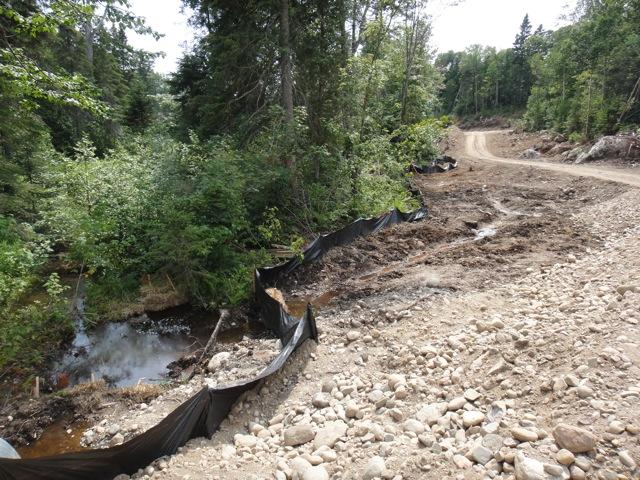
Photo courtesy LSARC: devastation of landscape and erosion into streams from Northern Ontario wind farm construction

What’s a Redside Dace? Well, if you don’t know, don’t worry–it won’t matter for too much longer.

One of the principal points made by the Appellant in the recent appeal of the East Durham wind power project  by NextEra, was the damage that would be done by construction and the alteration of natural waterways. The prime witness testimony was:

[1]           He [Wren] also reviewed the 2004-2005 survey by Streams Ontario for the MNR.  In Dr. Wren’s opinion, the MOE “did not demonstrate due diligence in considering or evaluating sensitive fish and fish habitat in the project study area, with particular reference to the fish species Redside Dace”.

[2]           In Dr. Wren’s view, the sampling of the Saugeen River for Redside Dace was inadequate largely because too few samples were taken over too large an area.  It is his opinion that the MNR should have required the Approval Holder to conduct field investigations for Redside Dace in the Project Study Area to confirm their status.  He relied upon an email from the MNR to the Approval Holder’s ecologist which stated:

The absence of a species at risk occurrence does not mean that they are not present and as a result due diligence is still required … .  It should be noted that from a species at risk perspective this is an understudied area and as a result the MNR will be looking to ensure appropriate due diligence as it relates to field work was conducted to consider these species in further NHA reports for this site.

[3]           Dr. Wren’s opinion is that: “the Upper Saugeen Subwatershed contains an abundance of coldwater fisheries habitat that is unique in Southern Ontario.  Furthermore, the subwatershed is known to contain redside dace, an endangered species, which have a very specialized habitat.”

[4]           Dr. Wren also gave evidence about directional drilling and “fracking”, and soil erosion and sediment, and their likely effects on fish habitat and fish.  “Fracking” in this context is the accidental release of fluids toxic to fish that can occur during drilling to place transmission lines underground at water-crossings.  It is Dr. Wren’s view that a “frack out” could cause serious and irreversible harm to an endangered species such as the Redside Dace.

(Info on the Reside Dace here)

So, once again, the “overall benefit” of wind power supercedes damage to the environment, and to species of wildlife the Ontario government has already committed itself to protect? Ministry of the Environment lawyer Sylvia Davis, speaking in Toronto at the Ostrander Point appeal: “So a few animals get killed…”

The Minister of the Environment and Climate Change is Glen Murray, whose ministry is supposed to “ensure healthy communities, ecological protection…”

Reposted from Wind Concerns Ontario

Participate in PECFN’s BioBlitz at Ostrander Point, August 9-10, 2014

31 Thursday Jul 2014

Posted by Ottawa Wind Concerns in Renewable energy, Uncategorized, Wind power

≈ Leave a comment

Tags

at-risk species Ontario, environment, Ontario Ministry of the Environment, Ontario wildlife, Ostrander Point, Prince Edward County Field Naturalists, wind farms and environment, wind power

Love Nature? Want to save it from the Ontario government’s misguided “green energy” program which believes wind power trumps wildlife? Here’s a chance to help out. A 2 1/2 hour drive south-west.

CCSAGEadmin's avatarCCSAGE Naturally Green

BioBlitz poster FINAL low colour-page-001 Click on image to enlarge

FOR IMMEDIATE RELEASE

Public invited to help inventory the biologically significant Ostrander Point.

Prince Edward County (July 30, 2014) – The Prince Edward County Field Naturalists are hosting the county’s first ever BioBlitz at Ostrander Point. The event runs over a 24 hour period from noon on Saturday August 9 to noon on Sunday August 10, 2014 and includes guided tours for the public focussing on how to identify a variety of species from plants to birds, insects and amphibians and reptiles.

Ostrander Point is located within the South Shore Important Bird Area, a site recognized globally for its importance to birds and biodiversity.

“Much of the biodiversity of the South Shore Important Bird Area has not been identified” notes Myrna Wood of the Prince Edward County Field Naturalists Club. Wood continues “Ostrander Point was the subject of an Environmental Review Tribunal hearing during which…

View original post 237 more words

Wind farms in Northern Ontario: massive change

30 Wednesday Jul 2014

Posted by Ottawa Wind Concerns in Renewable energy, Wind power

≈ 1 Comment

Tags

appeals wind farm, Bow Lake, endangered species, George Brown, Goulais Bay, Lake Superior Action Research Conservation, LSARC, Northern Hoot, Northern Ontario, Ontario bats, Ontario Court of Appeal, Ontario Ministry of NAtural Resources, Steffanie Petroni, wind farm, wind farm environment, wind power northern Ontario

Northern Hoot

Northern Hoot is a new website run by journalist Steffanie Petroni on all things Northern Ontario. Devoted to “long-form” journalism, Petroni recently published an article on wind power development, of interest now because two very large projects–Bow Lake and Goulais Bay–will be proceeding. Appeals by First Nations groups and residents failed.

Of special interest in this posting are photos by Gary McGuffin, who is renowned for his depiction of Northern Ontario scenery.

Radar

Excerpt:

In Ontario there have been 20 appeals in opposition to industrial wind turbine farms brought before the Ministry of the Environment (MOE) and 19 have been dismissed. An appeal by Prince Edward County Field Naturalists to kill the development of an industrial wind turbine farm on Ostrander Point was won before an ERT in July 2013. However, the decision has since been reversed by the Ontario Divisional Court and appellants are seeking an appeal before the Ontario Court of Appeal.

George [Brown, of the Lake Superior Action Research Conservation] commented, “The 240 Bow Lake appeal came close to winning. Based on the Ostrander Judicial Review decision the Tribunal found that in order to prove irreversible harm it was necessary for the appellant to know the size of the populations being harmed. Having found that the 240 appeal failed to prove irreversible harm the Tribunal declined to make a finding on the issue of serious harm, though it agreed with virtually all the arguments on bats submitted by the 240 appeal.

As a result the Tribunal imposed immediate and more stringent mitigation measures on the project – a tacit admission that species-at-risk bats would otherwise be killed, which would be a serious harm.

The Tribunal’s decision is peculiar in that it allows these more stringent mitigation measures to be rescinded should they prove effective. Had the MNR required, or done, a baseline study, or had the 240 appeal had the time and money to do one, to determine the size of existing bat species populations in the project area, we would perhaps have had the final piece of the puzzle required to win.”

For more information, go to http://www.lsarc.ca


← Older posts
Newer posts →

Recent Posts

  • High-Speed Rail opposition in Rural Eastern Ontario: a lesson for wind power developers
  • Land use conflict prompts citizen legal action over West Carleton battery storage site
  • Energy Minister Stephen Lecce speaks out on renewable power sources wind and solar; emphasizes cost, reliability
  • Open letter to CAFES Ottawa
  • Ottawa Wind Concerns supports West Carleton residents

Follow me on Twitter

My Tweets

Enter your email address to follow this blog and receive notifications of new posts by email.

Tags

Bob Chiarelli Green Energy Act IESO Ontario Ottawa Ottawa wind concerns wind energy wind farm wind power wind turbines

Contact us

PO Box 3 North Gower ON K0A 2T0

Create a free website or blog at WordPress.com.

Privacy & Cookies: This site uses cookies. By continuing to use this website, you agree to their use.
To find out more, including how to control cookies, see here: Cookie Policy
  • Subscribe Subscribed
    • Ottawa Wind Concerns
    • Join 380 other subscribers
    • Already have a WordPress.com account? Log in now.
    • Ottawa Wind Concerns
    • Subscribe Subscribed
    • Sign up
    • Log in
    • Report this content
    • View site in Reader
    • Manage subscriptions
    • Collapse this bar
 

Loading Comments...