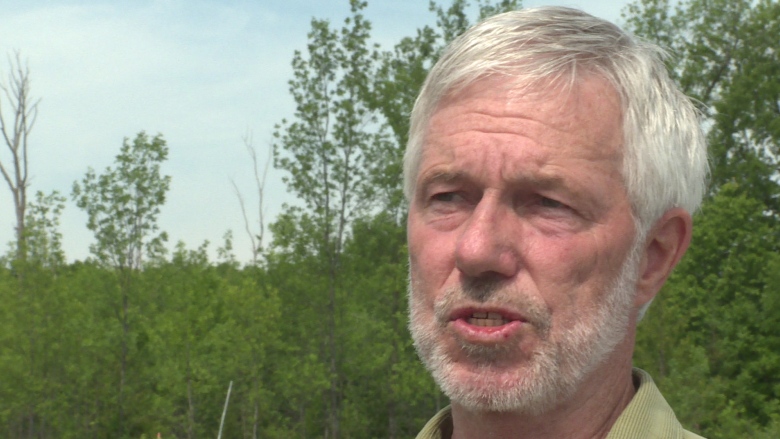
No community support for greed in Nation Twp [Photo: Ontario Farmer]
December 6, 2016
Residents of Nation Township and North Stormont recently gathered signatures on a petition and letters demanding the Ontario government halt the Large Renewable Procurement (LRP) process permanently (it is currently “suspended”), cancel the LRP I contracts awarded for five wind power projects earlier this year, and cancel contracts for wind power projects that have not yet been built.
The Premier of Ontario recently admitted that her government’s energy policies were a “mistake” that resulted in higher costs for Ontario citizens.
The Ontario Association of Food Banks recently released its Hunger report, placing the blame for Ontario’s “shockingly high levels of food bank use” on the electricity bills, and other factors. Hydro rates have increased 3.5 times and “off-peak” rates are now eight times what they were. Remedies proposed by the Wynne government, the association says, are a “drop in the bucket.”
The petitions filed at Queen’s Park yesterday refer to the high electricity rates and growing poverty and also to the fact that the Wynne government, specifically Energy Minister Glenn Thibeault, says it now has a “robust supply of power” for the years ahead.
So why pay out the millions for these new contracts, for power we don’t need, say the residents.
MPPs Jim McDonell and Grant Crack (the LIBERAL MPP for Glengarry-Prescott-Russell) read the petitions in the Legislature yesterday, while representatives of Save The Nation/Sauvons La Nation and Concerned Citizens of North Stormont watched from the Gallery.
“Poverty is getting worse in Ontario,” says Wind Concerns Ontario president
Wind Concerns Ontario welcomes the acknowledgement by Premier Kathleen Wynne of financial hardship imposed by her government’s energy policies, and has sent six recommendations for action that will provide immediate relief.
“We know that energy poverty in Ontario is real and worsening under this government,” says WCO president Jane Wilson. “Hundreds of thousands of people are having difficulty paying their electricity bills, and many are having to choose between ‘heat and eat.’ Meanwhile, corporate power developers are getting paid huge profits in Ontario – this has to change, now.”
Wind Concerns Ontario sent the Premier a list of recommendations:
Immediately cancel LRP II renewable power program. Currently “suspended,” its target was to acquire 1,000 megawatts (MW) of power, even though the government says we have a “robust” supply of power for the future. The cost of this new capacity would go straight to Ontario’s electricity bills
Cancel the five wind power contracts awarded under LRP I for 299 MW. This action will save ratepayers about $65 million annually and $1.3 billion over 20 years. Cancellation costs will amount to a small fraction of the annual cost, probably on the order of about $2 million, at most. In addition, cancelling approved but not yet built wind power projects, and the new FIT 5.0 program will also save money. Together, these cancellations can save ratepayers from future rate increases of nearly $4 per month.
Cancel “conservation” spending of $400 million annually. This action would have an immediate effect on ratepayers’ bills, reducing them by $5.50 per month or about $70 a year. Ontario’s ratepayers have already reduced their consumption from 157 TWh in 2005 to 137 TWh in 2015, for a significant 12.7% decrease.
Allocate the Ontario Electricity Support Program (OESP) to the Ministry of Community and Social Services. The OESP is essentially a social assistance program and it is questionable as to whether ratepayers should bear the burden of its costs. With an estimated annual cost of $200 million, the effect of this would be an immediate savings of about $4 per month on ratepayers’ bills, and an annual savings of $50. We recognize, however, that the move would impact the budgetary shortfall by a like amount so we recommend the following action.
Levy a tax on wind and solar power generation on a per-megawatt basis starting at $10 per/MWh. This would result in raising sufficient revenues to offset the OESP costs. The effective rate could be held at that level or increased in the event the OESP costs exceed the forecast $200 million per annum. The Auditor General previously reported the award value per MWh of the 20-year contracts to wind and solar power developers exceeded those in other jurisdictions by a considerable margin. The tax would serve as a recognition of those excessive margins. (Note: the wind power contracts also contain cost of living increases of up to 20% over the term of the contracts.)
Immediately reduce the Time of Use (TOU) off-peak rate. We recommend an immediate reduction in the TOU off-peak rate from 8.7 cents/kWh to 7.4 cents/kWh to encourage the shift of power consumption from peak to off-peak time in order to flatten daily demand.
“Poverty is a major factor in population health,” says Wilson, a Registered Nurse. “It is time Ontario takes action to help people now, and not cause further hardship for Ontario families.”
Wind Concerns Ontario is a coalition of community groups, individuals and families concerned about the impact of industrial-scale wind power development on the economy, on the natural environment, and on human health in Ontario.
OTTAWA WIND CONCERNS NOTE: The contract for the “Nation Rise” wind power project in North Stormont, just south-east of Ottawa, will cost Ontario residents $430 million over its 20-year contract, for intermittent wind power we don’t need. Cancelling the power project, slated to be 100 megawatts and over 30 industrial-scale wind turbines, would cost no more than $600,000. Other projects in our area would be the much-contested Amherst Island project which will endanger birds and other wildlife species, and the White Pines project in Prince Edward County, also a danger to migratory birds and other wildlife. Cancelling these projects which are not yet built will save millions.
EDP wind turbine and home at South Branch project, Brinston, Ontario. Photo by Ray Pilon.
October 21, 2016
Portugal-based power developer EDP Renewables is holding an Open House for its Nation Rise wind power project on Tuesday, October 25, from 4-8 PM in Finch Ontario, at the Finch arena.
The 100-megawatt power project is located completely in the Township of North Stormont; it was one of five to receive a contract from the Independent Electricity System Operator (IESO) earlier this year, and one of three projects to win a contract despite being proposed in an unwilling host community.
The contract is worth $436 million over 20 years.
In September, the IESO announced that Ontario has a surplus of power and that the new contract process scheduled for 2017 is now suspended. The IESO did not announce plans to cancel any of the contracts for more unneeded wind power announced a few months previous, despite IESO representative statements that the contracts are contributing to Ontario’s electricity bills.
Citizens of the area have formed a community group Concerned Citizens of North Stormont, and vowed to fight approval of the project, including legal action in future if necessary.
People gather at EDP Renewables open house in August, 2015
In January 2014, John Terry, the lawyer for the well-funded wind power development lobbyist the Canadian Wind Energy Association (CanWEA) told the panel of judges in an Ontario court at the appeal of a decision at Ostrander Point, that their decision was very important for the future of wind power development in Ontario because, he said, “This [a successful appeal] was never supposed to happen.”
One might think that he meant the approval process was so rigorous that wind power projects should pose no danger to the environment or to people and that’s why “this,” the successful Ostrander appeal shouldn’t have happened. But no, what he meant was, the rules and procedures attached to wind power development were supposed to be so iron-clad that mere citizens acting on behalf of the environment, wildlife and their own health, could have no hope of success. Lawyers acting for appellants have said, the test set up by Regulation 359-09 to prove serious harm to human health and serious and irreversible harm to wildlife was impossible to meet.
Except, now, that test has been met.
Four times.
The successful appeals at Ostrander Point, White Pines, Settlers Landing and yesterday, Clearview, show that when proper attention is paid to the requirements to preserve the environment and actually balance development against potential harm, the wind power developments can be demonstrated to be in the complete wrong place.
But the wind power development industry, coached and encouraged by their huge lobbyist and the very compliant Ontario government, felt entitled to propose wind power projects wherever they found willing landowners. Such was the case at Clearview where the eight, 500-foot turbines were to be located near not one, but two aerodromes, the Collingwood Regional Airport and a private airstrip. WPD Canada felt so entitled to success and money that it believed it could locate huge turbines even where pilots’ safety would be in danger and where wildlife would almost certainly be killed.
The Environmental Review Tribunal decision was released Friday, October 7: yes, there would be serious harm to human health because of the risk to aviation safety and yes, there would be serious and irreversible harm to the endangered Little Brown Bat.
Paragraphs [149-151] are interesting: the appellants’ expert witness arguments were “informed and reasoned” the panel wrote, finding they had established “the evidentiary base to support their qualitative assessments.”
Although a remedy hearing is possible, the Tribunal expressed doubts as to the effectiveness of any measures proposed.
The Tribunal used very strong language in places in the decision, saying “it would be trite to say …” or “it is obvious …” and they noted the federal Ministry of Transport’s carefully crafted opinion letter on aviation safety at the airport.
The people of Ontario have despaired at times as wind power projects have been put in fragile environments, too close to people’s homes and workplaces, without any real demonstration of environmental benefit. Millions have been spent by ordinary citizens as they took on corporate Big Wind to defend—what? The environment against their own Ministry of the Environment.
One lawyer for the Ministry has often been heard to say “wind trumps everything.” She is wrong, as this latest decision demonstrates.
Actions taken in the name of preserving the environment must really do that, and not rely on ideology-based trite statements for justification. Ontario has still never done a cost-benefit analysis on its wind power program even though clearly, wind power has a high impact on the natural environment, on communities, and on the economy, without actual demonstrated benefits.
Clearview was a victory for all Ontario, and the environment.
The Mayor of North Frontenac has written to Energy Minister Glenn Thibeault on behalf of all the 115 municipalities demanding change to the Large Renewable Procurement process. While relieved the next round of bids is “suspended,” he says, the municipalities say more can be done to stop the dramatic rise of Ontario electricity bills.
October 5, 2016
Mayors across Ontario who united together as a result of a resolution being supported to have municipal support mandatory for industrial wind turbines are relieved that procurement of future wind power has been cancelled for now. The Mayors still feel however that the government needs to take very aggressive actions to address the ongoing crisis caused by high electricity costs in this province. Taking steps to not add $2.45 per month in 2020 does not address the real hardship being felt by our residents now. It is also not clear that the other measures announced by the government will even offset the ongoing increases in hydro rates that can be expected in the short term unless additional changes are made.
It was important that the Minster of Energy’s statement confirmed that the province has a “robust” supply of electricity and the procurement process could be cancelled without increasing greenhouse gas emissions. This provides room for more aggressive actions that will address increasing costs. Our tracking of wind turbine contracts shows that there are still many wind turbine projects in the pipeline that will add at least another $7.9 billion to electricity generating costs. This is equivalent to another $82 per annum for each Ontario electricity user. Seven of these projects are under construction but will not be connected to the grid until sometime this fall or in 2017. Another five have not been issued ‘Notices to Proceed’ as they are, or have been until recently, involved in Environmental Review Tribunal proceedings or other legal appeals of Renewable Energy Approvals. The final six projects are in the pre-MOECC submission stage. These include the five contracts issued in early 2016 plus one outstanding project from earlier FIT offers.
In all of these cases, the IESO has the option of terminating the agreement for any reason with very limited cost liabilities relative to the 20 year commitment to electricity that is not required. We respectively ask that all industrial and solar wind projects be cancelled to avoid ongoing costs to our residents.
October 5, 2016 — A new paper from acoustician Richard James and audiologist and professor emeritus Jerry Punch, just published in the journal Hearing Health Matters, confirms support for the idea that “acoustic emissions from IWTs [industrial wind turbines] is a leading cause of AHEs [adverse health effects] in a substantial segment of the population.”
The authors deal with 12 commonly held beliefs about wind power and health effects, promoted by the global wind power development industry, that do not support a connection between wind turbine noise and health problems. They conducted a comprehensive literature review, and review the findings of the most up-to-date studies, including the Cape Bridgewater study by acoustician Steven Cooper, which changed the language of wind turbine noise research.
A paper by Paul Schomer of the U.S. is quoted for example, and the authors conclude “some people affected by WTN [wind turbine noise] may be responding directly to acoustic factors, rather than to non-acoustic factors, as argued by Leventhall.” (page 21)
Canada figures in the paper with references to work done by Dr Roy Jeffery, Dr Robert McMurtry, and researcher Carmen Krogh, among others.
The authors wrote a ccovering letter for windaction.org in which they said,
Finally, let it not be said that either of us believes in making any less than the best possible effort to develop clean and efficient sources of energy. Rather, we hope that our article will be instrumental in promoting public health through a better understanding of the issues underlying the potentially harmful effects of audible and inaudible noise from industrial wind turbines when the turbines are sited too close to where people live and work.
It’s too bad Premier Kathleen Wynne’s Liberal government didn’t have its epiphany on the pointlessness of subsidizing any more expensive, unreliable and unneeded wind turbines before it tore apart rural Ontario.
The Liberals’ treatment of rural Ontarians has been a disgrace.
They overrode local planning rights by passing the Green Energy Act of 2009 under Wynne’s predecessor, Dalton McGuinty, then rammed industrial wind factories down their throats.
Sometimes, it was hard for people in these communities to believe they were living in a democracy.
Rural communities were torn apart — neighbours cashing in by leasing land to wind developers for turbine construction, against neighbours forced to live in the shadow of the mega-structures.
The province received hundreds of complaints about health problems which people believed were being caused by the turbines and suppressed them.
During the 2011 election, the CBC reported government documents released under Freedom of Information legislation showed environment ministry staff had issued internal warnings the province needed stricter rural noise limits on turbines, that it had no reliable way to monitor or enforce them and that computer models for determining setbacks were flawed.
Ontario Provincial Police showed up at the homes of middle-aged women in one rural community who had never been involved in any form of law-breaking, warning them to keep their demonstrations against wind turbines peaceful.
As we reported, these visits were made at the request of a wind developer. (The government denied any involvement.)
While the Liberals dismissed wind protesters as NIMBYs, they simultaneously cancelled two unpopular natural gas plants in Oakville and Mississauga due to local opposition, at a public cost of $1.1 billion, in what the Tories and NDP dubbed the Liberal seat saver program.
When local residents wrote to Liberal MPPs asking for help in fighting the industrial wind factories imposed on them, they received form letters in reply.
For many rural Ontarians, the Liberal blunder into green energy, launched without any meaningful business plan according to the Auditor General of Ontario — and which wasn’t needed to eliminate coal-fired electricity — wasn’t just a case of their government wasting billions of dollars and sending their electricity bills skyrocketing.
It was a case of their government robbing them of fundamental democratic rights.
Bids were to be accepted beginning early in 2017. But Ontario now says it has enough power and wants to take steps to reduce electricity bills, so it doesn’t need the new renewable power capacity.
September 27, 2016
Moments ago, the Wynne government announced it is suspending its controversial Large Renewable Procurement program for sources of power such as wind and solar.
“Ontario will immediately suspend the second round of its Large Renewable Procurement (LRP II) process and the Energy-from-Waste Standard Offer Program, halting procurement of over 1,000 megawatts (MW) of solar, wind, hydroelectric, bioenergy and energy from waste projects. …
On September 1, 2016, the Independent Electricity System Operator (IESO) provided the Minister of Energy with the Ontario Planning Outlook, an independent report analyzing a variety of planning scenarios for the future of Ontario’s energy system. The IESO has advised that Ontario will benefit from a robust supply of electricity over the coming decade to meet projected demand.”
Wind Concerns Ontario(and two Auditors General for Ontario) has been saying for years that a cost-benefit analysis of the renewable energy program was never done, and should have been.
“Now, the impacts of this program are clear,” says President Jane Wilson.”We have unsustainable and punishing rises in electricity bills for the people of Ontario, with a corresponding rise in rates of energy poverty, while there is no evidence of any environmental benefit. In fact, there are widespread concerns about the damage being done to the environment from this high-impact form of power generation.”
Wind Concerns Ontario says that in addition to suspending the Large Renewable Procurement program, contracts for power projects not yet under construction need to be cancelled immediately.
“The government admits it has adequate power,” Wilson says. “There is no need to continue this assault on Ontario citizens, on our economy, and on the natural environment for little or no benefit.”
With more electricity bill increases to come, the Wynne government still planning to give out contracts for more wind and solar that the province doesn’t need, and the privatization of Hydro One ongoing, today’s proposed 8-percent rebate on electricity bills is nothing more than a “Band-Aid.”
Christine van Geyn of the Canadian Taxpayers Federation says that real change is needed to halt the dramatic rise in consumer electricity bills, including the halting of new contracts for wind and solar. See her statement from today, here.
Wind Concerns Ontario president Jane Wilson (also chair of Ottawa Wind Concerns) said that real changes to programs are needed. Contracts that could be cancelled now, should be, and the government should halt the new Large Renewable Procurement program, scheduled to begin in 2017.
Patrick Brown of the Progressive Conservative Party of Ontario told Evan Solomon on Ottawa Now (CFRA) that the Wynne government needs to stop giving out expensive contracts for wind power, and reverse the Green Energy Act.
Locally, councilor George Darouze, who has been collecting signatures for MPP Lisa MacLeod to take to the Legislature on blending Hydro Ottawa with Hydro One’s rural Ottawa customers, said the 8-percent rebate was a “joke.” Rural customers pay 30 percent more than urban Ottawa customers. “An 8 percent rebate isn’t going to close that gap,” he said on CFRA.
Meanwhile, Ontario municipalities have been passing resolutions and endorsing resolutions to demand the Wynne government return local land-use planning, removed by the Green Energy Act. Now 111 municipalities — one-quarter of all municipalities in Ontario — are asking that no contract for wind power be given without municipal support of the power project. Ottawa councilor Scott Moffatt, in presenting an motion to Ottawa City Council, said that municipalities are required to have an Official Plan, and that they know best what development is appropriate, and sustainable.
Wind turbines may close busy airport: pilots launch political campaign
This is an excerpt from the August edition of COPA Flight, provided by a member of the Canadian Owners and Pilots Association.
So ridiculous, pilots can’t believe anyone would put turbines at an airport
Windmills may close airport
By Russ Niles
The owner of an Ontario airport that will be in the shadow of a proposed wind turbine project fears Transport Canada [TC] will close his strip if the windmills are built.
Kevin Elwood says he’s been told by a senior TC official that the department will not intervene to prevent construction of the windmills but it will act to ensure public safety after the fact by restricting or even stopping operations at the affected airport.
“He said that if [the province of Ontario] chooses to put green energy before airports, that’s their choice,” he said. “We will respond by restricting airport operations and we will go so far as to close airports,” he {Elwood] quoted the official as saying.
That would seem to fit with the scenario now playing out over the so-called Fairview Project, a group of eight, 152-metre turbines planned for farmland adjacent to Elwood’s Clearview Aerodrome (also known as Stayner Airport). The huge windmills will be directly in the flightpath of aircraft in the circuit for his airport and the nearby Collingwood Airport.
TC has declined to oppose the project and that means the only hope Elwood and other opponents of the windmills have is the rarely used power on the Minister of Transport to unilaterally stop the project on safety grounds.
Minister Marc Garneau has so far been silent on the issue and COPA is calling on its 17,000 members (and voters) to apply their significant political influence to nudge him out of that complacency.
COPA has launched a full-scale letter writing campaign to draw attention to the issue that Elwood is convinced is an immediate threat to both airports and will set a precedent that could affect airports across the country.
The turbines would be in blatant violation of Transport Canada’s airport obstacle guidelines and Garneau, a long-time pilot and COPA member, has the power to stop their construction. In fact, because of the protection afforded such projects by Ontario’s Green Energy Act, Garneau is probably one of the few who can stop them. He won’t even talk about the issue, however.
“We really have a good working relationship with Transport Canada, very open and collaborative,” [says COPA President Bernard Gervais]. “As part of our regular discussions I presented the situation and possible course of action,” Gervais said. “Section 6.41 of the Aeronautics Act authorizes the minister to make an interim order to deal with such threats to aviation. If the minister is of the opinion that the windmills are hazardous to aviation safety, he (or his deputy) has the authority to stop such construction. … the lack of feedback from TC and knowing this is a very sensitive political issue, drives me to think that our only course of action at this point is to go on the political front.”
ERT members unfamiliar with aviation safety
COPA appeared at the original [ERT] hearings in the approval* process along with many other opponents, and all of the arguments were essentially ignored. … Complicating that process is the fact that the two members hearing the health arguments have no aviation background at all and have had to be schooled on airport operations and aviation terminology.
… [Elwood] says that if it plays out as he thinks it might, TC will either close his airport or make it so difficult and inconvenient to use that it might as well be closed. The aerodrome is home bas to Elwood’s business, an aircraft management and business charter operation. Over the years he’s invested heavily in hangars and other infrastructure and if the windmills go ahead, a lifetime of work might go down the drain.
[The wind turbines] will prevent pilots from using the recently re-invigorated [Collingwood Airport]. Ironically, the federal government has spent millions on improvements to the field, including a new terminal and lots of new pavement.
“Even people who don’t fly, [says Collingwood based pilot Austin Boake], they realize it’s just common sense …It’s just so ridiculous I can’t even believe it.”