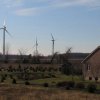
More than 100 bird species will be at risk from wind turbines
When multi-national wind power developer EDP Renewables revealed the project map at its Open House in Crysler last week, many attending were surprised to note that the project area covers and includes the Reveler Conservation Area.
The conservation area shelters more than 100 species of birds and offers a place for them to rest on their migrations twice a year. The spot is popular with bird enthusiasts and others who enjoy Nature.
Wind turbines are known for killing birds and bats, both of which are necessary parts of the eco-system. The wind “farm” at Wolfe Island is responsible for “shockingly high” numbers of bird deaths, said a report in the Globe and Mail.
The wetlands and woodlands of the South Nation watershed attract many species of wildlife.
EDP plans to erect 30-50 wind turbines in Stormont Dundas and Glengarry.
Wind developers typically claim that cats kill more birds than wind turbines, but the fact is that wind turbines are responsible for the death of many raptor species such as hawks and eagles, who are unlikely to be preyed upon by cats.
LOS ANGELES (CN) – Wind energy companies bulldozed a black family’s house because they were the sole holdouts who refused to sell out to a huge wind farm, the family claims in court.
Darlene Dotson and her sons David and Daniel sued EDP Renewables North America, Horizon Wind Energy Co., Rising Tree Wind Farm, CVE Contracting Group, and Renewable Land LLC, on May 7 in Superior Court.
The family wastes no time in getting down to specifics. “Plaintiffs in this action are the victims of a multinational energy developer who refused to accept ‘No’ for an answer,” the 32-page complaint begins.
“The heart of the issue is that the Dotsons own property in Mojave that is sought after by EDP Renewables for windmills, and they refuse to sell,” the family’s attorney Morgan Stewart told Courthouse News.
Mojave, pop. 4,300, is 50 miles east of Bakersfield, below the Tehachapi Mountains, on the edge of the immense Mojave Desert.
“The home on the property was a family home they used for family vacations and gatherings. EDP pressured them to sell, but they still refused,” Stewart said.
“The house was damaged several times when they were away. And then one time when they went back to the house they found that it had been demolished, scraped to the foundations, along with all of their belongings. The companies did it.
“We see it as intentional because EDP needed the property for the wind farm, but the Dotsons wouldn’t sell,” Stewart said.
EDP Renewables is building the Rising Tree Wind Farm about 3 miles west of Mojave in Kern County.
Project leaders estimate the wind farm will generate 199 megawatts of electricity when it goes online sometime this year – enough to power around 60,000 homes and take 33,000 cars off the road.
The Dotsons say the defendants first approached them about the wind farm in 2009, claiming they needed to buy the surrounding parcels of land, including the Dotsons’ land, for the wind farm.
The Tehachapi Mountains, which top out at 7,992 feet, generate nearly constant winds, as the cool air on top and the Pacific Ocean to the west suck the superheated desert air through the mountain passes.
“Like the infamous Daniel Plainview from Paul Thomas Anderson’s Film, ‘There Will Be Blood,’ defendants held themselves out as friends to the local community and a source of prosperity for its residents. Among other things, defendants promised Mrs. Dotson and her neighbors that the wind farm would stimulate the local economy and generate energy revenue for cooperating landowners. All that Mrs. Dotson and her neighbors had to do was to sign over the rights to their homes,” the complaint states.
But Darlene Dotson says she resisted the sales pitch, telling the companies she was not interested in selling because her family “cherished” their home and its underlying history more than the companies’ offers of money.
“The house had been in their family for 20 years, and was one of the original homesteads built by African Americans in the early 20th century,” attorney Stewart said.
The Dotsons used the home for family gatherings, vacations, barbeques and birthday parties. Daniel and David Dotson grew up playing in the house and then took their own children to play there. It was “hallowed ground” to the family, according to the complaint.
In addition to memories, the house contained the Dotsons’ family mementos, including photographs of deceased family members, family heirlooms and antiques.
Though all of their neighbors agreed to sell or lease their land, the Dotsons held out and “respectfully declined” the companies’ numerous offers, according to the complaint.
When the companies realized the family was adamant about keeping their home, they became aggressive and hostile, the Dotsons say. Mrs. Dotson claims the companies’ agents insulted her and spoke to her disrespectfully, and told her that “the home was worthless and that the Dotsons should take the money because it was the best they would ever get for the land.”
They harassed her sons and tried to bully them into persuading her to sell the house by threatening to “surround the home on all sides with the wind farm, restricting the Dotson’s access to the home and causing the home’s property value to plummet,” the complaint states.
Stewart said the companies wanted the property so badly they approached the Dotsons’ neighbors and asked them how to persuade the Dotsons to sell.
Then the defendants vandalized the house, breaking windows and patio furniture, the Dotsons claim. “In essence, the Dotsons were being terrorized in their home,” the complaint states.
In February this year the defendants started demolishing the surrounding homes to develop the land for the wind farm.
When David Dotson went up to the family home in late March to do some maintenance, he discovered that the home was “literally wiped off the face of the Earth,” that all the furnishings and family belongings “were simply eviscerated,” the complaint states.
Stewart said the family is not sure exactly when the house was demolished, but suspects it was around the time the companies started knocking down the other homes.
The Dotsons say several people from the companies called and left messages admitting that they had demolished the Dotson’s home and insisting that it was a mistake.
But the Dotsons claim it was a deliberate ploy to make them sell their land.
“The pressure to sell from EDP, the strong-arm tactics leading up to the demolition, and coming along afterward and trying to buy again, all indicate that this was not an accident,” Stewart said. “This was an intentional act by a company that thought it could strong-arm these people.”
Though there is no direct evidence of racism, Stewart thinks the Dotsons’ race had something to do with it.
“They are the only African American family in the area, the only ones pressured very hard by the companies, and the only ones who had their house demolished when they refused to sell,” he said.
Stewart said it takes a deliberate effort to destroy a house because the gas and water must be turned off, among other things.
“It’s especially sad because they described how they built parts of the house with their own hands. It’s ugly,” he said.
Representatives with the companies did not reply to requests for comment.
The Dotsons seek punitive damages for trespass to land, violation of the Bane Civil Rights Act, intentional infliction of emotional distress, conversion, nuisance, unfair business practices and negligence.
Attorney Stewart is with Manly, Stewart & Finaldi, of Irvine.
[NOTE: EDP Renewables is the power developer proposing a 150-megawatt, 50-turbine wind power project in Stormont-Dundas-Glengarry, and currently operates the South Branch wind “farm” in Brinston, Ontario]
Drs Ian Arra and Hazel Lynn, together with several associates, have now published a peer-reviewed article based on their literature review of studies on wind turbine noise and health impacts.
Their conclusion: we have demonstrated the presence of reasonable evidence (Level Four and Five) that an association exists between wind turbines and distress in humans. The existence of a dose-response relationship (between distance from wind turbines and distress) and the consistency of association across studies found in the scientific literature argues for the credibility of this association.
The wind power development lobby insists there is not relationship between wind turbine noise, inaudible noise/low-frequency noise/infrasound, and often implies that people who claim such effects are actually ill-informed or not receiving money. A spokesperson for the Ontario Federation of Agriculture told an audience at this year’s Rural Ontario Municipalities Association meeting that anyone claiming to experience health impacts from turbine noise had questionable mental health stability and that the listener should “just cough on them.” His remarks were withdrawn by the OFA with an apology shortly thereafter.
Wind developers can use farm leases as security for financing the power project
Ontario Farmer, May 5, 2015
by Garth Manning and Jane Wilson
It came as a surprise to many in Ontario when it was revealed that the multi-national power developers behind the K2 wind power generation project near Goderich had secured $1 B in financing, and that this arrangement is now registered on title for the 100 farm properties involved as lessors.
The arrangement is between K2 Wind Ontario Inc. and Mizuho Bank Ltd. Canada Branch. It secures a revolving credit facility of up to $1 billion at 25% on a number of items, including the contracts between landowners and K2 for land and road agreements with municipalities.
Another, smaller example has also come to light: a wind power project south of Ottawa in Eastern Ontario, where the five landowners leasing land for a 30-megawatt, 10-turbine project now have charges on their properties for $70 million.
Immediately, questions arise as to what would happen if the power developers were to default on their loans: would the lender then own the farm properties? How would that affect road use agreements with municipalities?
The fact is, this is a common practice. Property owners can refer to the leases imposed by the developers to review this potential situation, and many others that may affect operation and ownership of their land while leasing land for the power projects.
In an Invenergy standard contract, for example, is this clause: “In connection with the Lessee’s financing of the Project, the Lessee….is hereby given the right by the Lessor…to mortgage its interests in the Lease…and to assign this Lease, or any part of parts thereof, and any subleases as collateral security…”
The proper term for this is a “Charge of Lease” but may also be referred to as a “Demand Debenture.” What it means is, the present value of the wind power contract (i.e., the Feed In Tariff or FIT contract with the Ontario government) is greater than the present value of the lease amount. The difference between those two amounts is security for the loan to the power developer. It is a charge against all contracts favourable to the wind power developer, which may also include road use agreements.
It is like a line of credit for the developer and typically, advances against the amount are tied to certain milestones such as stages of construction.
The critical factor, however, is what it means for the lessors, in other words the farm owners who have leased their land for wind turbines, access roads, substations, transmission lines, etc. The importance lies not so much that the farmer lessors might on default lose their land (the farm land itself is not mortgaged, just the turbine contract on that land) but the damage it does to that property owner if he/she wants to sell, or to renew an existing mortgage, or place a new one, or in any way borrow money for which the lender would want security on his/her land.
Let’s assume a farm owner wants financing for farm operations or improvements. That might now pose difficulty: lenders do not like to be second in line, as they would be where a charge of lease is in place.
If the farm owner wishes to sell, similar difficulties arise: the lawyer for a purchaser in the case of an agreement to purchase will do a title search and discover the Charge of Lease on title, then immediately advise his or her client that the client is entitled to get out of the deal unless the registration of the Charge is removed from title. A purchaser is not expected to assume any risk of this nature.
In the case of renewing an existing mortgage or placing a new one, the lawyer for the bank or other lending institution would take the same position — no renewal or new mortgage unless the customer sees that the Charge disappears from title.
This is one of several important characteristics of signing a lease to have wind turbines, and needs to be thoroughly considered. Other legal issues to be carefully considered may include potential liability for the substantial cost of “decommissioning” turbines at the end of the lease, difficulty obtaining insurance on property with wind turbines, loss of autonomy over building on the property and carrying out regular farming practices, and, last, the potential for nuisance suits from neighbours affected by noise or property value loss.
Property owners should consult with a lawyer before signing any agreement.
Garth Manning is a retired lawyer and former president of the Ontario Bar Association, who lives in Prince Edward County. Jane Wilson is president of Wind Concerns Ontario; she lives in North Gower.
Construction of one of the 3-MW turbines at Brinston, now operating–30-50 more proposed by EDP Renewables
Ottawa Wind Concerns has learned that a “Charge of Lease” has been placed on the South Branch wind “farm” in the amount of $70 million. The charge is on the leasehold interest in five properties, where property owners have leased land for wind turbines, access roads, substations, and other parts of the wind power generation project.
Earlier this month, details came to light on the 140-turbine K-2 project near Goderich, Ontario, where a charge of lease has been filed on the title for 100 farm properties, in the amount of $1 billion.
The Charge of Lease is basically a financing agreement between a lender (who may represent investors in the wind power project) and the wind power developer, that can function as a line of credit. The basis for the Charge, as we understand it, is that the present value of the contract for the turbines, i.e., the Feed In Tariff contract for power with the Province of Ontario is greater than the present value of the lease agreements with the landowners; the difference between those two values is the security for the loan.
The South Branch contract with the Ontario government runs for 20 years and is worth millions to the developer, who bought the project from Germany-based Prowind.
The importance of the existence of these agreements is the effect they have for the landowner leasing land for the wind turbines. In the opinion of a lawyer advising us (who prefers the term “Demand Debenture” for this arrangement:
It’s not so much that the farmer lessors might on default lose their land (the land itself is not mortgaged, just the turbine contract on that land) but the damage it does to that farmer if he/she wants to sell or to renew an existing mortgage, or place a new one or in any way borrow money for which the lender would want security on his/her land.
Assume a binding Agreement of Purchase and Sale. The lawyer for the purchaser does a title search and discovers the Demand Debenture. The lawyer would immediately tell his/her client that the client is entitled to get out of the deal unless the registration of the Demand Debenture is removed from title, and would also insist to the farmer’s lawyer that this be done otherwise the deal cannot close. A purchaser is not expected to assume any risk of this nature nor to be in the position of “buying a law suit”.
in the case of renewing an existing mortgage or placing a new one, the lawyer for the Bank or other lending institution would take the same position – no renewal or new mortgage unless the customer sees to it that the Demand Debenture disappears from title. Period. End of story.
This is another example of the very serious questions that need to be asked by anyone considering leasing their land for a wind power generation project. There are many serious and long-lasting effects to signing these agreements that need to be properly understood.
In 2013, the Not A Willing Host group of municipalities met in Ottawa at the Association of Municipalities of Ontario convention. At that meeting, one Ontario mayor said, What people need to understand is that basically, they sold their property for the amount of the lease agreement.
** Please see also, the article from the May 5th edition of Ontario Farmer on the charge of lease issue, here.
Provincial government, Hydro One both to blame for the mess
West Carleton Review
To the Editor:
Your April 9 edition of the West Carleton Review contained a number of articles and letters to the editor regarding our sad state of affairs with regard to Hydro in Ontario.
Hydro in the last century has become one of our essential services, and as the ice storm of 1998 demonstrated, our lives revolve around electricity to power everything in our homes and even the gas stations that fuel our vehicles.
However, in Ontario the distribution, sale and production of hydro is treated as a political spectator sport with boondoggles, lies, smart meter errors, overpaid employees and corruption being the order of the day.
Even the Auditor-General (AG) has taken this government to task regarding hydro, but the Minister, Bob Chiarelli, tries to shame the AG by stating that it is a complicated file and she doesn’t have the knowledge required to ascertain the problems at hydro, let alone recommendations on how to fix them, a fact that was quickly debunked when we found out that the AG used to work for Manitoba Hydro.
I feel it is the minister that is “out of his league” on this file.
And now the same minister and government want to implement a low-income plan to help pay for the most expensive electricity in North America by further increasing the cost of electricity to the millions who will not qualify for this subsidy since the bar has been set so low as to be mostly ineffective and unavailable to most customers of hydro. This certainly appears to be nothing else but a PR exercise on the part of the government.
There is no good reason why we should have installed so many wind turbines or solar farms, both of which need an alternative back-up source of electrical power, since both wind and sun are unreliable sources of continuous energy available on demand.
The fact that there is no available mechanism to store surplus electrical power produced by wind or solar, Hydro One sells it on the open market at a substantial loss. Unfortunately, the current government has tied their hands for quite a few more years with multi-billion dollar contracts to foreign companies to supply either the turbines or the solar panels.
In my estimation, the only solution to the mess created by this government is to buy power from reliable and affordable sources of electricity producing jurisdictions, such as Quebec Hydro or Manitoba Hydro.
Hydro One cannot be trusted to produce the required amount of affordable power required and this government, regretably, has created most of the current (no pun intended) mess it finds itself in on the hydro file.
Ottawa (April 9, 2015) – A new expert panel report, Assessing the Evidence: Wind TurbineNoise, released today by the Council of Canadian Academies provides an in-depth examination of 32 potential adverse health effects linked to wind turbine noise. For most of the identified symptoms, the evidence is inadequate to draw a direct link between wind turbine noise and a negative health effect.
However, there is sufficient evidence of a causal relationship between exposure to such noise and annoyance.
Determining whether wind turbine noise causes adverse health effects is an important issue as demand for renewable energy, including wind power, is expected to grow in Canada and around the world. The wind sector has expanded rapidly since the 1990s, and Canada is now the fifth-largest global market for the installation of wind turbines. With this demand, however, come concerns that the presence of wind turbines may pose a public health risk to nearby residents. In response to public concern, Health Canada asked the Council of Canadian Academies to conduct an in-depth expert panel assessment to evaluate the evidence and identify gaps in knowledge.
“The Panel looked at what had been written on the potential health effects of exposure to wind turbines, in the scientific literature, legal cases, and the most informative public documents,” said Dr. Tee Guidotti, Expert Panel Chair. “We identified 32 health issues and then analyzed the published peer reviewed studies on each problem to determine if there was evidence for a causal relationship with wind turbine noise.”
The Panel’s report stresses that, given the nature of the sound produced by wind turbines and the limited quality of available evidence, the health impacts of wind turbine noise cannot be comprehensively assessed and further information and study are required.
The Panel outlined 11 main findings discussed in the full report. Some findings include:
1. The evidence is sufficient to establish a causal relationship between exposure to wind turbine noise and annoyance.
2. There is limited evidence to establish a causal relationship between exposure to wind turbine noise and sleep disturbance.
3. The evidence suggests a lack of causality between exposure to wind turbine noise and hearing loss.
4. For all other health effects considered (fatigue, tinnitus, vertigo, nausea, dizziness, cardiovascular diseases, diabetes, etc.), the evidence was inadequate to come to any conclusion about the presence or absence of a causal relationship with exposure to wind turbine noise.
5. Technological development is unlikely to resolve, in the short term, the current issues related to perceived adverse health effects of wind turbine noise.
6. Impact assessments and community engagement provide communities with greater knowledge and control over wind energy projects and therefore help limit annoyance.
The Expert Panel’s assessment was extensive; they considered a wide range of evidence and developed a rigorous methodology for their work. The resulting report provides key information and insights on what is known and not known about wind turbine noise and its possible impacts on human health. The foundation of knowledge contained in the report can support all levels of government, the scientific community, industry, and community stakeholders as future policies, regulations, and research agendas are considered.
For more information or to download a copy of the Panel’s report, visit the Council of Canadian Academies’ website, http://www.scienceadvice.ca
About the Council of Canadian Academies
The Council of Canadian Academies is an independent, not-for-profit organization that began operation in 2005. The Council undertakes independent, authoritative, science-based, expert assessments that inform public policy development in Canada. Assessments are conducted by independent, multidisciplinary panels (groups) of experts from across Canada and abroad. Panel members serve free of charge and many are Fellows of the Council’s Member Academies. The Council’s vision is to be a trusted voice for science in the public interest. For more information about the Council or its assessments, please visit www.scienceadvice.ca.
EDITOR’S NOTE: The wind industry works hard to demean the use of the term “annoyance” which is in fact an accepted medical term denoting distress, or stress. Find a definition of annoyance as it applies to environmental noise and degradation of health, here.
Ottawa Wind Concerns will present an overview of the new Ontario contracting process for wind power at the Agricultural and Rural Affairs committee today.
The group has prepared a presentation that outlines the process for developers, based on the 100-page document from the Independent Electricity System Operator or IESO, and has added recommendations for the City of Ottawa, should a proposal for a wind power project come forward.
“Our rural communities are completely opposed being industrialized for wind power projects, to produce power Ontario doesn’t need,” says chair Jane Wilson. “Almost 1,300 residents of the North Gower area signed a petition in 2013 to say they do not support a wind power project in their community, due to the economic and social costs.”
Ontario is contracting for 300 more megawatts of wind power in 2015, which will cost Ontario $200 million annually.
U.S.-based EDP Renewables has stated it is planning to propose 30-50 turbines just 30 minutes south of Ottawa, in North Dundas.
Ottawa Wind Concerns is a community group and corporate member of Wind Concerns Ontario.
TVOntario is showing the new documentary film Big Wind again on Tuesday, March 31st, at 10 PM
The film documents the legal struggle of one farm family in Ontario about to be surrounded by over 100 wind turbines and two transformer stations, and other communities already dealing with the effects of living near the huge power generating machines.
Key interviews include former nursing teacher Norma Schmidt, whose sleep was so disturbed she became ill and had to leave her job; she and her husband are now unable to live in the family home. Another is with a farmer who has a turbine on his property, and thus receiving lease payments; he said “We decided we weren’t going to be bothered” by the turbine.
One wind developer was interviewed for the film but Head Office later tried to have all the recording erased; last week the Canadian Wind Energy Association (CanWEA, the lobby group for the developers in Canada) claimed it was too bad no wind developers were interviewed for the film!
A podcast of Big Wind, and a special edition of The Agenda which featured a panel discussion on the effects of wind power on communities, are available on the TVOntario website at TVO.org
Here is a story from the Irish Examiner, fitting on St Patrick’s Day.
By Conall Ó Fátharta
Irish Examiner Reporter
Leading doctors have called on the Government to reduce the noise levels of wind turbines — which they claim are four times that recommended by World Health Organisation (WHO) guidelines.
The Irish Doctors’ Environmental Association also said the set-back distance of 500m is not enough, that it should be increased to at least 1,500m.
Visiting Research Professor at Queen’s University, Alun Evans and lead clinical consultant at Waterford Regional Hospital Prof Graham Roberts have both expressed concerns over the current noise levels and distance of turbines from homes.
Environment Minister Alan Kelly is currently reviewing the wind energy planning guidelines and the group is calling for both issues to be examined closely in the interest of public health.
The association has called for the introduction of a maximum noise level of 30 decibels as recommended by the WHO and for the set-back distance from inhabited houses to at least 1,500m from the current 500m.
Prof Evans said the construction of wind turbines in Ireland “is being sanctioned too close to human habitation”.
“Because of its impulsive, intrusive, and sometimes incessant nature, the noise generated by wind turbines is particularly likely to disturb sleep,” he said.
“The young and the elderly are particularly at risk. Children who are sleep-deprived are more likely to become obese, predisposing them to diabetes and heart disease in adulthood. As memory is reinforced during sleep, they also exhibit impaired learning.”
Prof Evans said adults who are sleep-deprived are at risk of a ranges of diseases, particularly “heart attacks, heart failure, and stroke, and to cognitive dysfunction and mental problems”.
Prof Evans, attached to the Centre for Public Health at Queen’s, said the Government should exercise a duty of care towards its citizens and exercise the ‘precautionary principle’ which is enshrined in the Lisbon Treaty.
“It can achieve this by raising turbine set-back to at least 1500m, in accordance with a growing international consensus,” said Prof Evans.
In a statement, the Department of the Environment said that in December 2013 it published draft revisions to the noise, set-back distance, and shadow-flicker aspects of the 2006 Wind Energy Development Guidelines.
These draft revisions proposed: 1. The setting of a more stringent day and night noise limit of 40 decibels for future wind energy developments; 2. A mandatory minimum setback of 500m* between a wind turbine and the nearest dwelling for amenity considerations; 3. The complete elimination of shadow flicker between wind turbines and neighbouring dwellings.
A public consultation process was initiated on these proposed revisions to the guidelines, which ran until February 21, 2014.
“The department received submissions from 7,500 organisations and members of the public during this period. In this regard, account has to be taken of the extensive response to the public consultation in framing the final guidelines,” the department said in the statement.
“However, it is the department’s intention that the revisions to the 2006 Wind Energy Development Guidelines will be finalised in the near future and will address many of the issues raised in that bill.”
*Editor’s note: Ontario’s wind turbine noise regulations, which are based on geography and wind power lobby group instruction, not science, work out to 550 meter setbacks. Health Canada’s Wind Turbine Noise and Health study revealed that problems exist at 55 meters, with 25% of people exposed to the turbine noise and low frequency noise being distressed; 16.5% were distressed at 1 km. The Health Canada research results suggest that a setback should be a minimum of 1300 meters, which means Ontario’s existing noise regulations are completely inadequate to protect health.

 LOS ANGELES (CN) – Wind energy companies bulldozed a black family’s house because they were the sole holdouts who refused to sell out to a huge wind farm, the family claims in court.