• About
  • Donate!
  • EVENTS
  • Ottawa’s “Energy Evolution”: wind turbines coming to rural communities
  • Thinking of signing a wind turbine lease?
  • Wind Concerns Ontario
  • Wind turbines: what you need to know

Ottawa Wind Concerns

~ A safe environment for everyone

Ottawa Wind Concerns

Tag Archives: unwilling host

Unwilling Host communities surround Ottawa

10 Tuesday Dec 2024

Posted by Ottawa Wind Concerns in Ottawa, Renewable energy, Rural issues, Wind power

≈ Leave a comment

Tags

energy, environment, Green Energy Act, IESO, noise, Ottawa, Ottawa wind concerns, Renewable energy, unwilling host, Wind Concerns Ontario, wind energy, wind farm, Wind power, wind turbine setbacks

Experience with existing industrial wind power sites and community opposition to expensive, unreliable power generation leads rural municipalities to say NO

December 10, 2024

One of the many effects of the Green Energy and Green Economy Act passed in 2009 by the McGuinty government to give wind and solar power developers an advantage was the removal of local land use planning powers from municipalities.

Today, that authority has been restored by the repeal of the Act (which altered 20 other pieces of legislation), and now, a Municipal Support Resolution is required by the Independent Electricity System Operator or IESO before any power generation contract can be awarded. 

In 2013, in protest against the carpeting of rural Ontario with industrial wind turbines against community wishes, municipalities across the province began passing resolutions declaring themselves to be “Unwilling Hosts” to new industrial wind power sites. The first was Wainfleet, spearheaded by then Mayor April Jeffs, and others quickly followed.

Today, there are 157 Unwilling Host municipalities.

What’s interesting is the fact that most already have operating wind power sites, or they are neighbours to active projects, so they are well aware of the negative impacts.

In Eastern Ontario, several municipalities are now Unwilling Hosts following the 2016 approval of the “Nation Rise” industrial wind power project in North Stormont, and in Renfrew County after there was a spate of wind power proposals. To the south east, Prince Edward County is an Unwilling Host after fighting off at least three wind power projects, and where residents spent more than $1.5 million on appeals and court challenges.

Wind Concerns Ontario recently developed a map of Unwilling Host communities that is a graphic demonstration of the dissatisfaction of municipalities with wind power development, and the fact that after 16 years, the Ontario government has not updated noise or setback regulations. Environmental noise pollution has been a problem for a number of industrial wind power sites.

The IESO is planning a new Request For Proposals, probably coming in January (more details will be revealed in an IESO event this Thursday) but municipalities remain unhappy, as indicated in communications to the IESO during “engagement.” Part of the process is an Agricultural Impact Assessment that must be reviewed and approved by any municipality dealing with proposals for new wind power.

Municipalities say they don’t have the time or the resources to deal with these assessments. And, the timing is not appropriate: a proponent can file a cursory Agricultural Impact Assessment or AIA at the time of proposal and request for a Municipal Support Resolution but a full assessment does not really have to be done until 18 months after the company gets a contract.

That’s still not enough time, said a planner from Oxford County in the IESO November 21 event: there are just too many pieces of these assessments to be looked at. The process may not “align” with reality, she said.

We’ll do our best to keep you informed.

ottawawindconcerns@gmail.com


Local investor consortium plans bids for power contracts

05 Monday Aug 2024

Posted by Ottawa Wind Concerns in Ottawa, Renewable energy, Rural issues, Uncategorized, Wind power

≈ 4 Comments

Tags

IESO, noise pollution, OREC, Ottawa, Ottawa wind concerns, rural, unwilling host, wind energy, wind turbines

Just “another form of farming” investor group claims, says it will bid in next IESO round

Industrial wind turbine just south of Ottawa: industrial land use

Following a web event held by the Independent Electricity System Operator or IESO a few weeks ago, Ottawa-based investor consortium Ottawa Renewable Energy Cooperative filed a comment in which it stated the group plans to bid for renewable energy projects, when the IESO releases its next Request For Proposals.

OREC already has invested in 24 renewable energy projects in Ontario, mostly solar, but also two small wind turbines, in the Kincardine and Bluewater areas of western Ontario (Huron County).

OREC’s comments to the IESO include the claim that it intends to bid for contracts. It acknowledges community opposition to some types of renewable energy development but claims it can avoid that by building smaller projects that will not attract opposition. The group correctly states that opposition to the Battery Energy Storage Systems or BESS was aided by the inability of developers to provide answers to citizen concerns.

OREC’s comments follow. Emphasis in italics is ours.

Concern 1: We previously noted a qualification bias in LT2 material in favour of indigenous engagement, including indigenous participation as co-proponents. We wish again to request that community-based investment entities such as OREC will be granted equivalency to indigenous participation in terms of rated criteria points as well as set-asides, particularly if such set-asides will be structured to incentivise partnership with indigenous communities. Our question is, “why not community groups too?”

Concern 2: Rural Ottawa is still reverberating from the process of approving large BESS contracts in LT1. Much negative feeling has grown since November 2023 when a plethora of Open House events were held in Ottawa’s rural areas and developers were not ready with adequate answers about appropriate project scale and risks to communities. OREC is monitoring continuing conversations among opponents and their municipal representatives, and we anticipate greater opposition to LT2 projects. OREC believes a development model involving multiple small projects on distribution lines, funded by community investors, will attract significant interest within municipalities. This approach will attract municipal councils to the benefits of local economic activity, and the virtuous loop of generating energy locally, thereby relying less on large energy sources from outside community boundaries. OREC believes that scaling generation and BESS units such as OREC is proposing, meaning smaller, more widely distributed locally owned projects will attract positive attitudes, especially within rural areas, to what is effectively another form of farming. OREC recommends to the IESO that future energy procurements accommodate smaller scale projects, particularly clusters of small projects that have commonality of ownership and regional proximity. Clustered projects on different but proximate distribution feeder lines could be considered as single projects. OREC further recommends that the IESO include rating criteria that reward developers who partner with community-based organizations, similar to indigenous engagement criteria.

Our comments:

Community support: OREC is requesting that community groups supposedly representing local residents should get the same consideration as Indigenous peoples. First, although OREC claims to be “local” its membership is unknown, and in fact the consortium actively reached out to residents in Huron County to invest, as well as Ottawa area residents. So, what is “local”? But more important, OREC misses the point of the IESO’s initiatives regarding Indigenous communities. The goal is to assist these communities with a “clean, reliable and affordable” energy, such as, for example, reducing communities’ reliance of diesel generators for power supply.

Community opposition: After acknowledging the problems of the BESS proposals in the fall of 2023 (a rushed process with little information available), OREC says it anticipates more community opposition. Instead of acknowledging citizen concerns about loss of farmland, industrialization of rural communities, and the significant environmental impact that industrial wind turbines can have, OREC says it has the answer — “multiple small projects.”

OREC has demonstrated grid illiteracy in the past and this is more of the same. Former energy minister Todd Smith commented in February of this year that the addition of renewables (wind and solar) under the McGuinty-Wynne governments created “a lot of instability” on the power grid. The answer, Minister Smith said, was to build a supply of “clean, reliable, baseload power” and the best way to do that was to use Canada’s proven nuclear technology to build large power sites.

Creating multiple small sources of intermittent power generation will not provide reliable power for Ottawa, and it may add to grid instability. That’s not good for anyone.

Citing a “virtuous loop” of local power generation, OREC seems to imply that cute little windmills operating in the area will be like locally grown food. It is not.

Local benefits: OREC claims there are “local benefits” to renewable energy projects. What are they? There are no jobs after the construction phase (and few of those unless you drive trucks), and few if any jobs afterward. Wind turbine maintenance and monitoring is done from remote centres, with a few highly trained technicians on the ground. As the president of Canadians for Nuclear Energy Dr Chris Keefer commented, There are no employee parking lots for wind farms. There are plenty of problems with wind turbines, which is why in Ontario there are currently 157 municipalities that have passed resolutions declaring themselves to be Unwilling Hosts to industrial wind power sites. Most of the Unwilling Hosts either have wind turbines already or are nearby jurisdictions that dothey know the problems, such as noise pollution, risk to wildlife, and irreversible damage to aquifers.

Farming: While possibly drawing analogies to local food production OREC purposely ignores a very big question about wind and solar power development—they use up a lot of land. Good land. Wind and solar are both “low density” forms of power generation because they require so much land for very little power generation. Ottawa’s Official Plan states that renewables cannot be sited on prime farmland, but in truth, all classes of farmland have value. This goes against the public’s wish to encourage local food production. OREC counters with the preposterous claim that operating industrial wind and solar power sites is ”another form of farming.” No, it isn’t. It’s industrialization.*

While OREC promotes itself as a “green” organization, interested in “sustainability,” the fact is, it is an investor group, interested in making money. They have shown little concern, even disdain for citizen concerns (see note below) about the environment and community well-being.

While OREC presents dreamy ideas about “local” power generation as if it were sweet corn, we are ready with the facts: wind power is ineffective, intermittent, unreliable, and expensive —it doesn’t make sense for Ottawa.

OTTAWA WIND CONCERNS

ottawawindconcerns@gmail.com

*OREC founder and Board member Dick Bakker spoke at an Ottawa IESO web event several years ago and when citizen concerns about the environment were raised, he angrily snapped that people who objected to industrialization of their communities were just “NIMBYs.” Industrialization. Acknowledged.

Power developer to hold open house Tuesday on North Stormont wind farm

22 Saturday Oct 2016

Posted by Ottawa Wind Concerns in Renewable energy, Uncategorized, Wind power

≈ 1 Comment

Tags

EDP Renewables, electricity bills Ontario, hydro bills Ontario, IESO, Nation Rise wind farm, North Stormont, Not a Willing host, unwilling host, wind farm, wind power

EDP wind turbine and home at South Branch project, Brinston, Ontario. Photo by Ray Pilon.

EDP wind turbine and home at South Branch project, Brinston, Ontario. Photo by Ray Pilon.

October 21, 2016

Portugal-based power developer EDP Renewables is holding an Open House for its Nation Rise wind power project on Tuesday, October 25, from 4-8 PM in Finch Ontario, at the Finch arena.

The 100-megawatt power project is located completely in the Township of North Stormont; it was one of five to receive a contract from the Independent Electricity System Operator (IESO) earlier this year, and one of three projects to win a contract despite being proposed in an unwilling host community.

The contract is worth $436 million over 20 years.

In September, the IESO announced that Ontario has a surplus of power and that the new contract process scheduled for 2017 is now suspended. The IESO did not announce plans to cancel any of the contracts for more unneeded wind power announced a few months previous, despite IESO representative statements that the contracts are contributing to Ontario’s electricity bills.

Citizens of the area have formed a community group Concerned Citizens of North Stormont, and vowed to fight approval of the project, including legal action in future if necessary.

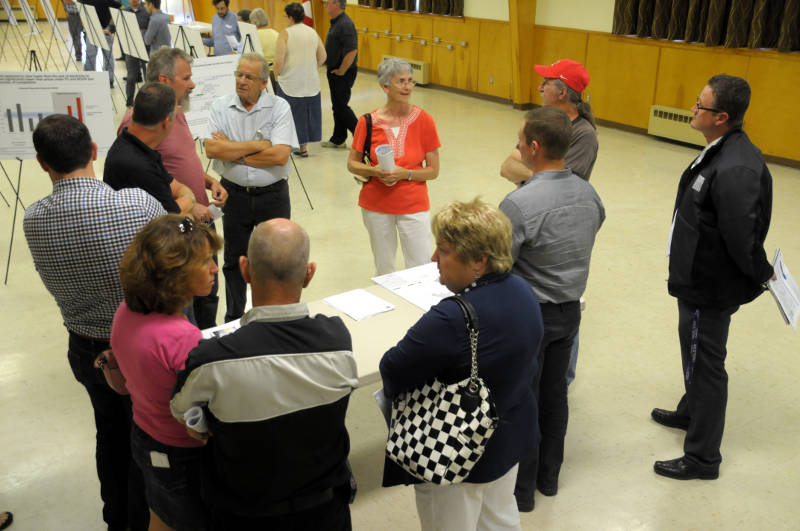
South Dundas councillors and staff, spokesmen from EDP Renewables and local residents chat about the proposed South Branch Wind Farm II project during an open house Aug. 5, 2015 at Matilda Hall in Dixons Corners. (Cornwall Newswatch/Bill Kingston)

People gather at EDP Renewables open house in August, 2015

Related news story.


North Stormont wind farm fight: no democracy, no truth, citizens say

03 Tuesday May 2016

Posted by Ottawa Wind Concerns in Renewable energy, Wind power

≈ 2 Comments

Tags

Concerned Citizens of North Stormont, EDP Renewables, environmetal damage wind farms, IESO, Margaret Benke, North Stormont, unwilling host, wind farm noise, wind farms, wind turbines

If province had a 1-km setback for wind power generators, almost none of the North Stormont project would be allowable, says community group. “They say wind power is ‘green’ ” says leader Margaret Benke, “but it’s not.”

<p>Margaret Benke surrounded by research into wind turbines on Monday April 25, 2016 in Berwick, Ont. Benke is hoping North Stormont Council will pass a resolution urging the IESO to rate an unwilling municipality as a mandatory requirement as opposed to rated criteria.</p><p>  Lois Ann Baker/Cornwall Standard-Freeholder/Postmedia Network

Margaret Benke: asking North Stormont Council to pass resolution May 10, making municipal support a mandatory requirement for wind power contracts [Photo: Cornwall Standard-Freeholder]

Cornwall Standard-Freeholder, May 2, 2016

BERWICK – She is fighting the good fight and not about to quit just yet.

Margaret Benke is chair of the Concerned Citizens of North Stormont and she and her group are hoping to stop the wind turbines from coming to the township.

Benke said the first time she heard about the turbines coming was when she read about a public meeting in the Chesterville Record.

“I said I’ve got to do something,” said Benke.

Earlier this year, EDP Renewables was awarded a contract for its proposed Nation Rise Wind Farm under the Independent Electricity System Operator’s large renewable procurement process. The project is rated at a potential 100,000 megawatts. On its website, EDP says it has secured contracts with about 40 local landowners covering over 4,000 hectares (10,000 acres).

Benke related a story of her nephew who had purchased his first home in Shelburne and within a year or two wind turbines went up around his land.

“He couldn’t live in his house anymore,” she said. “He abandoned his house. He likened (the noise) to living inside a drum.”

Benke said she had been hearing the stories at family get-togethers about issues with wind turbines.

This spurred Benke into action. Together with a family friend who happens to be a cartographer, they put together a map of the area and, allowing for the mandatory 550-metre setback for wind turbines, were able to determine approximately where the turbines could be erected.

She also looked into the Health Canada study done on wind turbines and found out of the 2,004 people originally selected for the study, 430 had abandoned or demolished their houses due to the turbines.

“It significantly decreased the number of people in the study,” she said. She said they interviewed people who were 550 metres away from turbines, but the only people who were that close were the landowners who were under contract with the wind turbine companies.

Benke then asked to be a delegation at a council meeting so she could present council with the information she researched on the wind turbines before council made any decision on whether to support the turbines or not.

“Immediately anybody with money sense, their antenna goes up, there is money in this,” she said. As every municipality is aware, there have been cutbacks into how much money they are receiving from the province, and that money has to come from somewhere.

“We did a very balanced overview of what the map looked like and what it would look like if you had a one-kilometre setback which is what the experts recommend,” she said. “There were only two fields that would have qualified.”

The one-kilometre recommended setback refers to a paper put out by the Ministry of the Environment where it recommended a setback of one kilometre for a wind farm of 10 turbines with noise level of 105 decibels.

Benke also found out each turbine generated just over $4,000, which was about the same amount of tax revenues from a home valued at $300,000 to $350,000.

“If you go ahead with the wind turbines, it pretty much kills any new development,” she said. “I couldn’t let this happen without at least being a voice in the wilderness. We needed to have our voices heard.”

Benke said wind turbines give the illusion they are “green” but they are not.

“It’s the perception that it’s doing something for us that it’s not,” she said. “Lack of democracy, lack of transparency, lack of truthfulness.”

Tom Loturco of EDP Renewables explained the next step is for contracted projects to obtain all necessary licences and approvals, including conducting an environmental assessment. According to the IESO website, these processes must include community engagement.

On behalf of the Concerned Citizens of North Stormont, Benke sent a letter to Mayor Dennis Fife and the councillors asking them to pass a resolution to request the Independent Electricity System Operator make a willing municipality for renewable energy a mandatory requirement as opposed to a rated criteria. Council deferred the passing of the resolution to a later date. North Stormont had already voted to declare itself an unwilling host for the large renewable procurement program.

Benke is asking council not to give up and if something as simple as passing the resolution will help, do it.

In any case, we strive to have good working relationships with landowners, municipalities and the public,” Loturco said. …

Read the full article here.

NoMeansNo_FB

Chiarelli promises more input on wind farm locations (again)

28 Monday Mar 2016

Posted by Ottawa Wind Concerns in Renewable energy, Wind power

≈ Leave a comment

Tags

Bob Chiarelli, Clearview wind farm, IESO, renewable energy, unwilling host, wind farm, wind farm contracts, wind farms, wind power, Wynne government

Rubbing salt in the wounds of the communities who just got notice of wind power contracts forced on them, despite unwilling host declarations, Energy Minister now says process will allow for input earlier in the process. (We’re still not hearing communities can say “No.”)

Just a little bit more "input"? But Bob still doesn't want to hear you say "no."

Just a little bit more “input”? But Bob still doesn’t want to hear you say “no.”

simcoe.com, March 28, 2016

By Jenni Dunning Barrie Examiner

Towns to have input ahead of solar, wind farm decisions

A few weeks after the province approved a wind energy project in Clearview Township, sparking an appeal, Ontario’s energy minister said municipalities will soon be asked for input ahead of future decisions.

“There was a problem with particular large wind and solar farms. There was not enough of an alignment of what they were doing and what the municipalities wanted,” said Energy Minister Bob Chiarelli.

“We are in the process now… It involves much more communication with the municipality. It (will be) almost impossible for (contractors) to win a contract without having participation with a municipality.”

Chiarelli clarified that “participation” referred to approval from a municipality, adding all contractors will be required to show proof they consulted municipalities. One wind energy and 13 solar projects have been approved in Simcoe County, according to the provincial Renewable Energy Projects Listing.

The Clearview project is the only wind farm. There are five solar energy projects in Springwater Township (three of which are in Midhurst), four in Tay Township (three of which are in Waubaushene), three in Orillia, and one in Oro-Medonte.

Chiarelli said he expects the ministry to announce more projects “in a month or two.”

Springwater Township Mayor Bill French said he has noticed the province has slowly started asking municipalities for more input on solar and wind projects in the past year.

They have been asked to use a scoring system to rank their support for proposed projects, he said.

“We always thought there should be a final approval process at the municipal level. It should’ve always been that way,” he said. “We’re quite welcome to that change in legislation.”

French said the township has been concerned when “fairly good agricultural land” was chosen as the location for solar farms.

“The ones that are approved, you can’t turn back the clock on those ones,” he said, adding once municipalities are more involved, Springwater will likely approve energy projects in areas with steep slopes or on smaller properties.

“Multi-acre ones, that’s going to be much more of a challenge,” he said. “We have acres and acres of rooftops around. That’s where solar panels belong.”

Collingwood Mayor Sandra Cooper said she has heard the promise of more municipal involvement from Ontario Premier Kathleen Wynne.

“I’m hopeful. I just have not seen it thus far,” she said. “Municipalities have been sending the message for quite some time — we need to be part of the process.”

Cooper and the rest of Collingwood council voted last month to legally oppose plans to build a wind farm with eight turbines west of Stayner, near the Collingwood Regional Airport. The town is concerned about the possibility of a plane hitting a turbine.

Cooper said the province made a “snap decision” to approve a wind farm despite of this possibility.

By allowing municipalities more say in the approval process, they can help stop decisions that may negatively affect residents, said Oro-Medonte Mayor Harry Hughes.

For example, a couple in the township built a home about five years ago that ended up being surrounded by a solar farm, he said.

“If municipalities had a say in it, that would never have happened,” he said. “Residents expect their municipal council to have some protection for their property.”

When municipalities are more involved, they can demand companies complete up-to-date soil testing to avoid solar projects taking up quality agricultural land, he added.

The province also does not require companies to repair local roads if damage is caused by solar or wind projects, but some have anyway in Oro-Medonte, said Hughes. …

Read the full story here.

Samsung project “dead” in Southgate

03 Thursday Apr 2014

Posted by Ottawa Wind Concerns in Health, Renewable energy, Wind power

≈ 4 Comments

Tags

Brian Milne, community opposition wind farms, Feed In Tariff, Not a Willing host, Samsung, Southgate, unwilling host, wind farms

Mayor says there were too many “issues” and not enough municipal control. Samsung’s proposed agreement demanded all building permits, access to roads and virtually everything they needed, in return for payments of $180,000 per year for the wind power project. Each of the 56 turbines would have netted Samsung $775,000 per year, under the government’s Feed In Tariff subsidy program.

The community held a meeting a few weeks ago, featuring a local Realtor who said property values in Southgate would disappear, and University of Guelph economics professor Ross McKitrick, who said wind power is expensive and ineffective as a reliable source of power.

Here is the news story.

News Centre

Samsung Project Dead

Thursday, April 3, 2014 8:28 AM by Jon Meyer

Southgate Council votes against the wind project with unwilling host status.

There is audio for this story.

MP3 - click to open click to open MP3 version

or click the play button to listen now.

(Southgate) – The large wind turbine project in Southgate has apparently been stopped.

Mayor Brian Milne says the Samsung, Pattern Energy project needed willing host status from the Township to move ahead.

At last night’s meeting, Milne says Council voted unanimously to stop the wind  project by declaring itself an unwilling host.

Milne says there was no way the township could resolve a number of issues it had with the project, without more control.

He says it was apparent the project would tear the community apart.

Samsung needed willing host status to move ahead with its 50 turbine, 120-megawatt wind farm proposal.

Milne applauds the Province for giving them that out clause, and the ability to say no.

But Milne wishes the Province gave them site plan control.

Instead, he says council had to say yes, with no conditions.

He says just three weeks ago Southgate was in the process of considering being a willing host.

But Milne says that was only if they could come to terms on a agreement on a number of issues — which included a good neighbour policy and issues around health and property values.

But Milne says they couldn’t come to those terms, and they had no choice but to stop the project.

The decision comes…

Read the full story here.

Recent Posts

  • Open letter to CAFES Ottawa
  • Ottawa Wind Concerns supports West Carleton residents
  • What does wind ‘farm’ construction really look like?
  • Unwilling Host communities surround Ottawa
  • How many birds do wind turbines kill?

Follow me on Twitter

My Tweets

Enter your email address to follow this blog and receive notifications of new posts by email.

Tags

Bob Chiarelli Green Energy Act IESO Ontario Ottawa Ottawa wind concerns wind energy wind farm wind power wind turbines

Contact us

PO Box 3 North Gower ON K0A 2T0

Blog at WordPress.com.

Privacy & Cookies: This site uses cookies. By continuing to use this website, you agree to their use.
To find out more, including how to control cookies, see here: Cookie Policy
  • Subscribe Subscribed
    • Ottawa Wind Concerns
    • Join 379 other subscribers
    • Already have a WordPress.com account? Log in now.
    • Ottawa Wind Concerns
    • Subscribe Subscribed
    • Sign up
    • Log in
    • Report this content
    • View site in Reader
    • Manage subscriptions
    • Collapse this bar
 

Loading Comments...