Source: IESO power data, accessed 11:30 a,m. July 30, 2026
July 30, 2026
A few months ago, Ontario energy minister Stephen Lecce said that Ontario was pursuing an aggressive program of nuclear and hydro power because, he said, “You can’t run a full-time economy on part-time power.”
This summer has offered almost daily proof that, in Ontario at least, wind power just can’t do what is asked of it.
At the time of writing for example, IESO power supply and demand stats show that while demand of more than 18,000 megawatts, wind power is providing just over 300 megawatts. Last hour it was 200. For the entire province.
Locally, output from the 29 wind turbines at Crysler-Finch-Berwick have been in the single digits all day and at the time of writing, output is exactly zero. It was zero last hour too, and hasn’t gone over 7 MW all day, so far.
Several “environmental” and “climate” organizations in Ottawa are pushing wind power as a clean alternative to current electricity production (though emissions-free nuclear an hydro do most of the work) despite the fact that the many environmental concerns about low power-density, land-gobbling, noise polluting wind turbines clearly go against their other program goals. Like, saving birds.
But whatever else you think about industrial wind power sites, the fact remains: in ONtario, with our climate and weather patterns, wind doesn’t work. It can’t. And battery storage can only do so much. Very little, in fact.
With a very important municipal election approaching, it will be important to ask candidates, do they believe in the wind power public relations? Or the truth. The numbers tell the story.
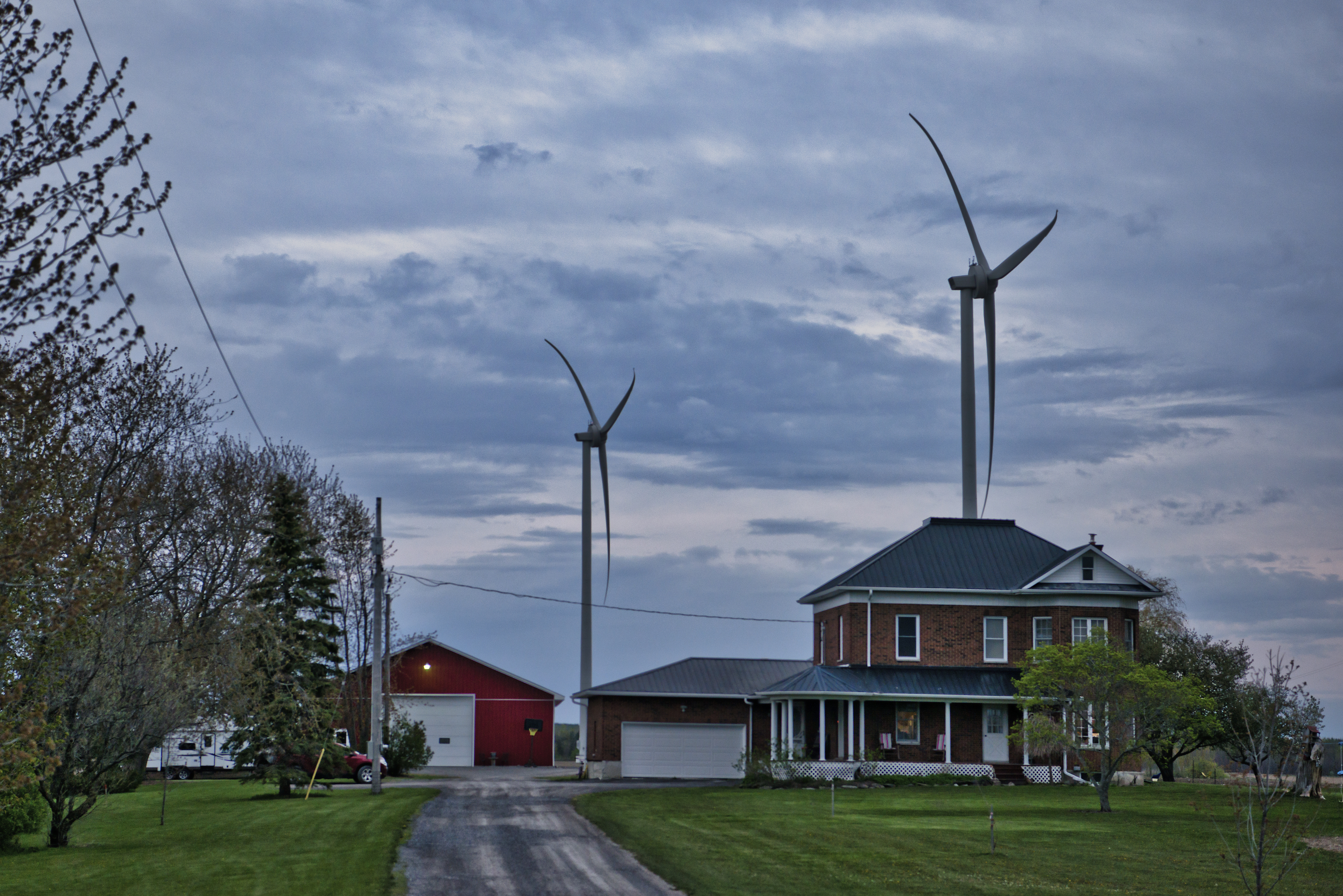
Wind turbines at Crysler near Ottawa: not replacing any fossil fuels today (Photo: Wind Concerns Ontario)
Wind power in the Ottawa area is outperforming IESO forecasts this hour (5 p.m. July 12).
Yes, it’s true.
The IESO forecast ONE MEGAWATT of power output from the 100-megawatt industrial wind power site at Crysler, but instead, the turbines are generating an impressive TWO megawatts.
Wind power has not had a great week in Ontario where warm summer weather has pushed up demand daily over 20,000 megawatts but Ontario’s wind turbines have struggled to produce more than a few hundred.
This is typical of wind power in our province: in periods of high demand—either hot of cold weather—wind takes off for the beach.
(Mr Sepulveda offered to address the City of Ottawa’s environment committee on this issue but as far as we know, his offer was never accepted…or even given a response.)
The influencers
Meanwhile, Ottawa’s $57-B Energy Evolution plan (sneaked by both citizens and Council during the early months of COVID) is still official city policy, and includes a plan for “investment” of $4B in unreliable, part-time, non-performing wind power. The chapter on energy was written for the City by activist Pollution Probe, and its prescription for massive amounts of wind power (3200 megawatts) goes against the City’s own preliminary research which said, There really isn’t a lot of wind here, guys, but if you want to have a showpiece demonstration turbine, go ahead. (CANMET on Timm road was suggested)
Wind power is pushed by local “environmental sustainability” group CAFES, which even told the Agricultural and Rural Affairs Committee that fewer regulations and approval requirements are needed—let’s get those multi-billion-dollar projects built, never mind the environment consequences. And Ottawa Climate Action Fund, which was launched several years ago with a $20-million grant from the federal government. Its debut was hosted by none other than Diana Fox Carney.
Clearly, the pro-wind lobby thinks Ottawa should have wind turbines. Despite the fact we have no wind.
Never mind that Ottawa’s rural residents (promised much more voice in the 2024 Rural Summit but whose voices were ignored in favour of Brookfield’s battery storage project on farmland in West Carleton) are not keen on seeing their quite farming and residential communities turned into industrial power sites. The approval of the battery storage and the amendments to zoning that allowed it to proceed is currently before the courts in legal action brought by residents.
Not great for Ontario, either
Ontario’s own energy minister Stephen Lecce has said wind power can’t do what Ontario needs: “You can’t run a full-time economy on part-time power,” he said on social media last fall.
Of 22 wind power proposals put forward in 2025, only one is proceeding to construction (one other by Enbridge got a contract but has since been withdrawn when the company and the First Nation involved could not agree to terms).
Many proposals were thwarted by refusal of local councils to grant formal approval. In Ontario, there are 159 municipalities that are formally Unwilling Hosts to new wind power, including multiple jurisdictions around this city such as Merrickville-Wolford and North Stormont (hope of the listless Crysler turbines today).
The myth of wind power needs to end, and the people of Ottawa should ensure that conversations about power generation are part of discussions with candidates in the coming municipal election.
Has Ottawa lost sight of local issues such as food supply as it follows a climate change agenda? Is farmland just empty space for power projects? [Photo: Shady Lane Farms]
As we get closer to the October municipal election, and candidate nominations have begun, discussions about the current state of the City of Ottawa are starting to get interesting.
Mayor Sutcliffe has had the job of mopping up after the Watson years, and the difficult state of affairs with the Light Rail, for example.
Issues of concern are: transit, roads, affordable homes, food prices and taxes, among others
One commentator, Mike Patton, recently remarked that the reason Ottawa is having difficulty with these issues is that over recent years, Councils have lost focus on local issues and devoted time—and lots and lots of money—-to larger, non-Ottawa, issues like climate change, he says.
Of course, the City should do what it can to improve performance in areas such as air pollution and emissions, but is a $57-billion “Energy Evolution” plan, which calls for an investment of $4 billion in unreliable, unaffordable wind power the way to go? (The electricity section of the report was written by activist group Pollution Probe.)
The Ontario experience with wind power demonstrates it is not an appropriate use of funds, and an unsuccessful way to generate reliable power.
Yet there are promoters here in Ottawa. The Ottawa Climate Action Fund or OCAF recently released a statement claiming that Ottawa’s farmland was “opportunity” … not for local food production and food security, but for renewable energy.
“Nearly eighty percent of Ottawa’s land is rural, including farmland, greenspace, forested land and of course rural communities. For OCAF, thinking about sustainable city planning and climate solutions in Ottawa extends far beyond the urban boundary and must include rural strategies,” says OCAF.
Farmers, not to be totally left out as we industrialize farmland for an energy resource plantation, can make money through these rural strategies, OCAF asserts.
(In a very unfortunate sidebar, OCAF suggested that farmers could perhaps do a better job of using their land more productively, via “regenerative farming”, as if they are not already do that and everything they can. This suggestion was not met with enthusiasm by farmers we know. )
Another group, CAFES (very busy building up its “environmental” cred by hosting bird-spotting and tree-planting events), is ideologically committed to invasive, noise-polluting, wildlife-killing wind power, and has suggested that there should be fewer approval requirements, not more, so big wind power projects can get built faster.
As we move toward October’s election, Mr Patton’s comments about priorities might also guide questions to candidates.
What plans do we have for the whole city, that benefit everyone, not just a certain ideology and agenda? Do candidates really see Ottawa’s valuable and important farmland as simply empty space? Where will the food come from?
Rural Ottawa residents waiting to be “educated” by downtown Ottawa “environmental” group [Photo Pexels Canada]
April 2, 2026
Local “environmental” coalition CAFES or Community Associations for Environmental Sustainability and OREC, the Ottawa Renewable Energy Cooperative, are teaming up this year to “educate” Ottawa’s rural residents on the positive benefits of accepting renewable energy projects.
In its most recent email newsletter, CAFES announces “Thumbs Up for Renewable Energy” program which “will focus particularly on rural areas of Ottawa, where many projects may be proposed.”
The timing is linked to the next Independent Electricity System Operator (IESO) Request For Proposals, which may include large industrial wind power installations.
CAFES says it will host “workshops, site visits, community events, and accessible information resources, the project will help residents better understand the electricity system, engage in discussions about local energy project planning with proper safeguards, and position us to maximize local benefits.”
CAFES claims that Ontario needs a “more resilient grid” without mentioning that industrial-scale or grid-scale wind power projects actually destabilize the grid, require fossil-fuel backup, and in Ontario at least, are completely out of phase with demand. Last year saw weeks when there was no wind, and wind power in Ontario was dramatically below capacity.
Hardly “resilient.”
Although not a charity because of its political bent, CAFES nonetheless receives grants from unnamed sources.
Unaudited financial statements filed for the organization for 2024 show that CAFES received $86,848 in “grant revenue” and a further $28,799 from “donations and fundraising for a total of $138,055 in revenues that year.
As written in this space before, CAFES is all about saving trees and birds and frogs but at the same time quite OK with deforestation of landscapes and the use of productive farmland for wind turbines, which are an industrial land use.
Acknowledging that municipalities have an important role in renewable energy installations (the Ontario government made municipal support a mandatory requirement for successful project applications), CAFES also says their goal is to get projects approved faster and with fewer regulations: “CAFES will be advocating for a more enabling provincial regulatory environment for renewable energy and energy storage.”
In an Open Letter to CAFES written last year following their appearance at Ottawa’s Agricultural and Rural Affairs Committee (ARAC), Ottawa Wind Concerns criticized the group for their stance to reduce regulation and simply approve projects. CAFES had told ARAC that the City of Ottawa needed to “minimize delays” and simply approve renewable energy projects.
Translation: get out of the way and approve big projects.
No matter what citizen concerns exist for the environment, loss of farmland, and money spent on an unreliable, weather-dependent power source. Or that the energy minister himself, Stephen Lecce, has said renewables, i.e., industrial wind, are not the affordable reliable solution Ontario needs.
CAFES and its partner OREC that seeks investment in power projects certainly have the money to put on workshops and events (even free lunches as they did to promote battery storage) to promote their agenda, but we’ve already seen the enthusiasm rural communities will bring to opposing industrial projects in quiet rural areas. In Ontario, 159 municipalities are now Unwilling Hosts to new wind power project, a decision they made out of experience with industrial wind, not fear of the unknown.
The patronizing nature of this campaign to “educate” rural residents on their electricity system will not go unnoticed.
Wind turbines are an industrial land use that affects property owners, neighbours and the wider community. The decision to lease land for these structures is deadly serious. [Photo: D. Larsen]
April, 2026
With the IESO soon to launch its Long-Term 2-Request For Proposals window 2 which will include industrial wind power, it’s likely that rural Ottawa could see some proposals.
If you, or someone you know, has been approached by a wind power developer to sign a lease, it is important to learn all the facts about this transaction. It will affect you, your family, the future of your farm, your neighbours and your community for a very long time.
The best advice we’ve seen comes from the Ontario Federation of Agriculture (OFA) which has prepared a fact sheet on what to consider. Prepared by a farm owner with experience in wind turbine leases, it is a valuable document.
Your neighbours and your community at large will be affected, too. To learn more about the impacts of wind power installations, check out Wind Concerns Ontario’s Impacts page, here: https://www.windconcernsontario.ca/impacts-of-wind-energy/
Wind power developers can be very persuasive, telling you this power is desperately needed (it isn’t, it’s expensive and unreliable), you’ll make lots of money (you’ll lose a lot too), while helping the environment and climate change (false, wind power does nothing for either of these things).
The IESO is an independent agency, that is responsible for contracting for new power sources. They don’t care about agriculture, the environment or health or in fact YOU. It is your duty to be responsible in making any decisions that will result in impacts for 20, 40 even 50-60 years.
It’s not just about money.
For more information contact us at ottawawindconcerns@gmail.com
Small, rural communities are aware of impacts on the environment and wildlife, and the effect of industrial projects…and they’re saying NO. That likely means NO to huge, noisy, invasive, land gobbling wind turbines, too.
Opposition to high-speed rail through fragile environmental areas in Ontario sprang up fast … and hard.
Eastern Ontario rural communities just north of the St Lawrence River are buzzing with the news of a proposed, $90-billion high speed rail system.
In a matter of days, Facebook groups have been formed, community meetings held, petitions organized, and small municipalities (Rideau Lakes, Hawkesbury, Tyendinaga, more) have already seen councils voting against the project.
Several issues dominate the discussion: the outrageous cost of the proposal (estimate is $90B for the first stages, but a McGill U study says it’s more likely hundreds of billions, Chris Selley reports in the Financial Post, branding the proposal a “fantasy”), murky details about the project (engagement events are storyboard presentations, just like wind power developers use), there is no clear assurance of who would actually use the system at elevated fares, and last—the environment.
One of the proposed routes involves the South Frontenac and Rideau Lakes areas, geography familiar to many Ottawa residents, and would result in significant impacts to the Frontenac Arch and the UNESCO World Heritage Site the Rideau Canal.
Properties would be expropriated, farms divided, wildlife affected, noise introduced to quiet environments along with multiple other impacts.
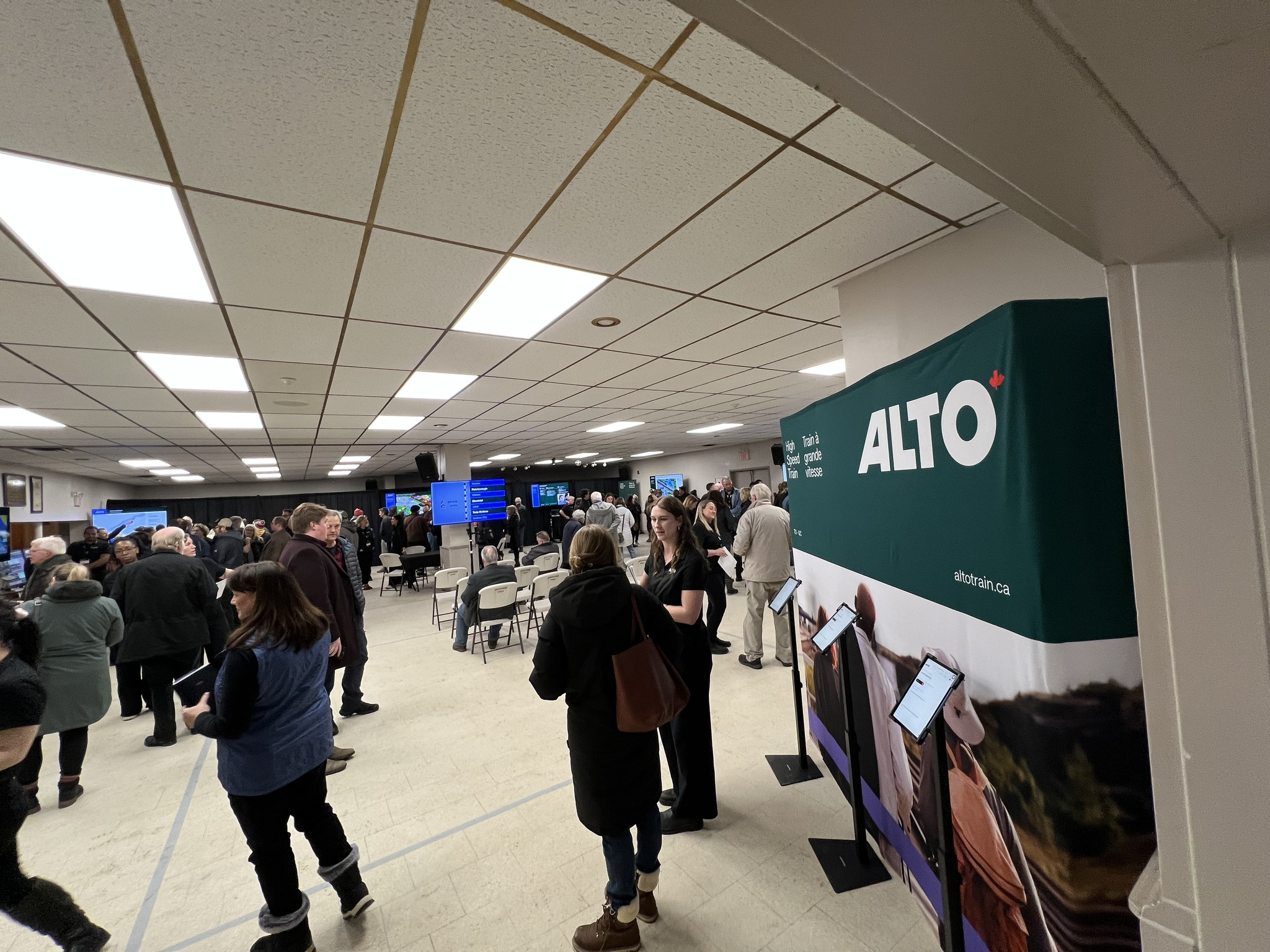
Active participation at recent ALTO community “engagement” event—same playbook as the wind power developers, where do citizen comments go?
Communities aware of the negatives
At the time of writing, information events are being held, petitions signed, even inventive “PIN pointing” opportunities so property owners can put their locations on the proposed route maps, and citizens are turning out to speak up—one event in Small-township Sunbury attracted 700-800 people over the course of the day, according to the spokesperson for Save South Frontenac.
To us, with yet another phase of the Independent Electricity System Operator (IESO) Long-Term 2 Request For Proposals looming in the months ahead, the High Speed Rail opposition may be a sign to any wind power developers out there cajoling landowners into signing up for 20-,40-, even 50-year leases: rural communities are sick of proposals for industrialization of natural environments and quiet communities, together with more lost farmland.
Out of possibly 20 proposals made last year for new wind power projects in Ontario, only ONE has proceeded to the submission stage. One hundred and fifty-nine Ontario municipalities are officially Unwilling Hosts to new windpower proposals.
Wind power is seen now as expensive, invasive, environmentally harmful, and erratic. It is not a cost-effective reliable source of electricity. Even the Ontario energy minister Stephen Lecce remarked in January (during a wind no-show in very cold weather) that, “You can’t run a full-time economy on part-time power.”
Recently, a community in Wales insisted on a cost-benefit analysis for a proposed wind power project. The result was that for five positive impacts (one of which was the vague “we need clean energy”), there were sixteen negative impacts. Council voted NO.
Ottawa’s urban-dominated City Council ignored the environmental concerns of West Carleton residents over a recent Battery Storage project, and approved it anyway. Battery storage is a new development, but the impacts of massive, noisy, industrial wind turbines will be easier to understand, and environmental damage clear for all to see.
The renewables lobby works through so-called “environmental” groups. Last fall, Ottawa “environmental” network CAFES leader told the Agricultural and Rural Affairs Committee (ARAC) that existing approvals, i.e., environmental and impact assessments were too onerous and expensive for power developers. As reported in local news media West Carleton Online, Angela Keller-Herzog advised getting rid of pesky approval requirements altogether and instead using “good neighbour” agreements for nearby residents. That is an inappropriate site-specific approach that purposely ignores the fact that industrial wind power projects affect the entire city. The noise and low frequency emissions alone, for example, can be detected as far as 5, even 10 kms away.
In short, the fairy tale is over. Rural communities are ready and willing to take on corporations to protect the environment, wildlife and the economy from unjustified industrialization.
Concerns about installing large industrial power projects into quiet communities on productive farmland are likely to continue should large wind power projects be proposed in Ottawa’s rural areas
Going to court an ‘extraordinary step’ says community group, but a review of process needed [Photo Katrin Bolovtsova Pexels Canada]
February 2, 2026
Should a corporate power developer be able to install a large power storage project on farmland in a quiet rural community, near homes, farms and fragile wetlands?
A citizens’ group in rural west Ottawa says no. And is willing to go to court over the issue. The West Carleton Community Alliance or WCCA, has retained a law firm and filed for a judicial review of the decision by the City of Ottawa to approve a zoning amendment to allow a Battery Energy Storage System or BESS on farmland.
The project has been proposed by Brookfield subsidiary, Evolugen, and already has a contract with the Independent Electricity System Operator or IESO to store power from the grid and return if needed. At 250-megawatts in capacity, it will be a significant storage facility, located near the village of Dunrobin.
Support from Ottawa City Council was granted, despite a recommendation by the Agricultural and Rural Affairs or ARAC not to (two other BESS did get ARAC support), and more recently, Council approved the request for a zoning amendment to allow the project to be built on agricultural land.
Industrial land use
The community group, an incorporated not-for-profit, is acting on citizen concerns about the siting for the large battery project, which is essentially an industrial land use. The group acknowledges that while the likelihood of fire or a “thermal runaway” event is small, it is not non-existent, and the rural location away from emergency services such as fire makes the site inappropriate. They also point to the loss of productive farmland. Although not in the highest classes of land, the property has been used for crops, and recently for grazing cattle.
Local online newspaper West Carleton Online has published letters of concern (and support) about the project, including these comments from resident Brian Parisien:
“I, for one, am not reassured by platitudes about adhering to all currently relevant standards and regulations for this relatively new type of facility. While, as a retired electrical engineer, I am the last person to oppose the use of new technology to improve our future, I’d like to see a better informed and more honest dialog about the issues, and more diligence toward safety and monitoring as we go forward.”
The judicial review is an extraordinary step, WCAA says.
“The community exhausted all ordinary channels to raise concerns and was left without a meaningful venue to be heard,” said Board Chair and West Carleton resident Leigh Fenton. “We’re asking the court to assess the legality of the decision [to amend the zoning to allow the project] — we welcome that oversight.”
“The siting of new industrial uses, such as a 22-acre lithium battery facility on farmland, in groundwater-dependent communities raises important questions that must be addressed through transparent municipal planning.”
The legal action names the City of Ottawa, Stantec Consultants, Brookfield Renewable Power and Evolugen as respondents.
“When planning decisions affect groundwater, wetlands, farmland and the fabric of rural communities, residents have a legitimate expectation of meaningful participation,” Fenton adds. “These natural features cannot ever be re-created once altered.”
The approval process for the BESS was fraught with controversy, as chronicled in local online paper West Carleton Online .
Local city councillor Clarke Kelly was opposed to the zoning amendment and made a statement after the Council vote.
“I firmly believe this is not the right location for a project of this scale, that the public consultation was entirely inadequate, and that the political and procurement process that forced this through was unfair to the residents of Ward 5, particularly to those who will have to live in close proximity to this project.”
At the heart of the issue is the process used by the Independent Electricity System Operator of Ontario or IESO by which proposals for energy projects are made. The process has been criticized by several municipalities across Ontario as rushed and incomplete, forcing municipalities to make decisions to approve power projects on the barest details.
The power developers in turn claim it’s not worth their while to pay money to prepare detailed reports for municipalities if they don’t know whether they are going to get a contract.
This leaves municipalities — and citizens — without power, the exact opposite of the intent of the repeal of the Green Energy Act.
IESO process shortchanges municipalities: councillor
As to the West Carleton BESS, there are those who think it shouldn’t have gotten as far as a zoning amendment request — it should not have received municipal support at the proposal stage. The process to get municipal support is rushed, and based on IESO contract proposal submission deadlines, not the need to provide information to municipalities.
Critical documents and reports were not complete and therefore not available for Council to review, a point noted by Ward 5 Councill Clarke Kelly, who has made no secret of his concerns about the IESO procurement process.
Councillor Kelly summed up the criticism in his report following the recent ROMA convention:
“It won’t come as a surprise that I raised the issues around the IESO and the procurement process for energy projects like BESS. I remain absolutely convinced that the provincial government and the IESO continue to ignore their responsibility to:
be active in the conversation with communities where these projects are being proposed.
be there to provide information and answers to questions that people can actually rely on.
ensure the discussion with communities happens much earlier. Until this happens, the conversations will continue to be contentious.”
The Township of Rideau Lakes recently decided it would create its own guidelines for any power developers pitching new projects, including BESS. The new process will require a greater level of community engagement, and detailed reporting on environmental and economic impact.
Discontent in Ontario over power project approvals process
With the IESO launching more Requests For Proposals or RFPs this year, there will be scrutiny of these controversial and unsatisfactory processes, particularly if the Ottawa area should see proposals for industrial wind power projects.
Of the 20 or so proposals for new wind turbine projects put forward in Ontario last year, only two proceeded to submission. Others were rejected, and a total of 159 municipalities have passed resolutions declaring themselves to be “Unwilling Hosts” to new wind power projects. Of these, many already have wind turbines operating.
Citizens are concerned not only about noise pollution and the danger to local aquifers, but also the loss of productive farmland, particularly at a time when the focus is on self-sufficiency and local produce.
The WCCA legal action will hopefully shed light on the municipal approval process, and offer hope of improvement for affected citizens.
We ask the question,How can an “environmental” organization claiming to protect the environment and support “sustainability” be promoting invasive industrial wind power?
March 3, 2025
CAFES Ottawa
Re: March newsletter and comments on renewable energy
We have just seen your most recent Bulletin to your followers and have several serious concerns about the content as regards “renewable energy” in Ottawa.
You say that City Council paused the siting of renewable energy projects, “effectively banning renewable energy projects.”
This is not accurate. The intent of that motion passed in 2023 was to protect the people of Ottawa in the event that proposals for industrial-scale wind power and solar power projects were made, in the absence of up-to-date, appropriate zoning protection.
This is the exact wording:
BE IT FURTHER RESOLVED that all future requests for MSRs continue to rise through the appropriate Committee of Council to allow for public engagement and consultation, including for LT2 RFP and all future IESO procurements, until such time as new direction is provided by Council
The motion was not a permanent “ban” as you so dramatically put it, but rather, a step taken to ensure that the City has appropriate regulations in place to protect citizens.
Instead of supporting a rigorous, detailed process to ensure appropriate siting, you say that CAFES wants to “minimize delay” and allow for approvals of industrial-scale or grid-scale power generation projects. This is very curious and would seem to conflict with your organizations’ other goals, namely protection of the environment and “sustainability.”
How is it that during the presentations to the Agricultural and Rural Affairs Committee on the Ferry Road property, CAFES spoke about saving the “frogs and turtles” but is also advocating for pushing through approvals of gigantic wind turbines which we know introduce harmful noise pollution to the environment, and pose a grave risk to wildlife including birds and bats?
You also say that communities across North America already have wind power sites that are “regulated and safe technologies.” This is far from the truth. Ontario now has 157 municipalities who have gone so far as to pass motions at Council designating themselves to be “Unwilling Hosts” to new wind power sites. In the main, these are communities that already have wind turbines, or are adjacent to jurisdictions that do, and they are acutely aware of the problems.
And in the United States, there is a running total of communities that have rejected new wind power sites outright, mainly due to environmental impacts. At present, the tally is 427 municipalities in the U.S.
Ontario’s environment ministry has more than 7,000 files of wind turbine noise complaints, including hundreds for the nearby Nation Rise wind power site, which had more than 140 complaints even before the project started commercial operation.
The problems with wind turbines are not limited to noise pollution. The municipality of Chatham-Kent has officially requested the Ontario government to take action on contaminated well water which an independent science panel found to be connected to the construction and operation of industrial-scale wind turbines in North Kent.
The American Bird Conservancy has stated that wind turbines are a serious threat to North American bird populations and advises officials to take great care in siting new power generation projects. Ottawa is on a major migratory bird pathway, and several species of bats (Important to the ecosystem and agriculture) are already endangered.
A recent cost-benefit analysis done by an economist showed that for Ontario at least, with its low wind resource, if you want effective action against climate change, and to provide a reliable source of power generation, wind power is not the answer. Add to that, wind power is an incredibly low power density source, meaning it uses up a great deal of land for little return.
I ask again, How can CAFES be supporting a rush to approvals for this industrial land use which offers little real benefit except profits for a few power developers and investors, with your other goals of environmental protection and sustainability?
Security of our food supply is becoming a more important issue every day in Canada. Wind power is a low-density form of power generation which uses up a lot of land — how can you justify that along with your goal of promoting “sustainability”?
I invite you to reassess this situation and realize we have interests in common. Why not support making Ottawa a leader in environmental protection by choosing more effective, efficient forms of clean power generation, and ensuring people, wildlife and the environment overall have the best protection?
Destruction of woodlands, loss of farmland, disruption of rural community life for an unsupportable, intermittent source of power
View of trucks and oversize turbine parts from Green Madness
A documentary film made in Upper New York State provides much needed insight into what really happens during construction of an industrial wind power site.
It’s one thing to read about the environmental destruction that results from the construction of these industrial sites, but it’s another to actually see see the horrific damage day by day, as filmed by the crew.
A well written voice over details the reality of wind power: it is supported by subsidies, it is intermittent and out of phase with demand in New York as in Ontario (in fact, Ontario energy economist Edgardo Sepulveda says Ontario is bad for unreliable wind power—New York is worse), and it is simply a tool to make money for investors.
“Wind power is a charade sponsored by investment banks,” is one comment. “Somebody’s making money but it’s not the little guy.”
Promises of jobs are also false, as the film makers demonstrate by filming the license plates on cars and trucks owned by workers on the project: Texas, Arizona, California…anywhere but upper New York State.
Likewise, promises of increased revenues for the municipality are not accurate—expenses incurred outweigh any pittance revenues from the huge multi-national wind power developers.
It’s important for the people of Ottawa to see this film and to understand the reality of wind power construction and development.
Local “environmental” or “climate” groups promote tree planting and wildflower gardens while also hypocritically pushing for industrial wind power in rural Ottawa. The loss of good farmland and woodlands, plus the danger to wildlife and the environment will be horrendous.
If wind power proposals come forward, everyone needs to know what is really involved: it’s not “clean” “green” innocent “windmills,” it’s industrialization of our rural communities and farmland.
To join our mailing list, email ottawawindconcerns@gmail.com and be sure to subscribe to this page.
A documentary film follows the construction of a 37-turbine industrial wind power project in upper New York State, and is a chilling portrayal of the destruction that comes with these industrial power projects.
Experience with existing industrial wind power sites and community opposition to expensive, unreliable power generation leads rural municipalities to say NO
December 10, 2024
One of the many effects of the Green Energy and Green Economy Act passed in 2009 by the McGuinty government to give wind and solar power developers an advantage was the removal of local land use planning powers from municipalities.
Today, that authority has been restored by the repeal of the Act (which altered 20 other pieces of legislation), and now, a Municipal Support Resolution is required by the Independent Electricity System Operator or IESO before any power generation contract can be awarded.
In 2013, in protest against the carpeting of rural Ontario with industrial wind turbines against community wishes, municipalities across the province began passing resolutions declaring themselves to be “Unwilling Hosts” to new industrial wind power sites. The first was Wainfleet, spearheaded by then Mayor April Jeffs, and others quickly followed.
Today, there are 157 Unwilling Host municipalities.
What’s interesting is the fact that most already have operating wind power sites, or they are neighbours to active projects, so they are well aware of the negative impacts.
In Eastern Ontario, several municipalities are now Unwilling Hosts following the 2016 approval of the “Nation Rise” industrial wind power project in North Stormont, and in Renfrew County after there was a spate of wind power proposals. To the south east, Prince Edward County is an Unwilling Host after fighting off at least three wind power projects, and where residents spent more than $1.5 million on appeals and court challenges.
Wind Concerns Ontario recently developed a map of Unwilling Host communities that is a graphic demonstration of the dissatisfaction of municipalities with wind power development, and the fact that after 16 years, the Ontario government has not updated noise or setback regulations. Environmental noise pollution has been a problem for a number of industrial wind power sites.
The IESO is planning a new Request For Proposals, probably coming in January (more details will be revealed in an IESO event this Thursday) but municipalities remain unhappy, as indicated in communications to the IESO during “engagement.” Part of the process is an Agricultural Impact Assessment that must be reviewed and approved by any municipality dealing with proposals for new wind power.
Municipalities say they don’t have the time or the resources to deal with these assessments. And, the timing is not appropriate: a proponent can file a cursory Agricultural Impact Assessment or AIA at the time of proposal and request for a Municipal Support Resolution but a full assessment does not really have to be done until 18 months after the company gets a contract.
That’s still not enough time, said a planner from Oxford County in the IESO November 21 event: there are just too many pieces of these assessments to be looked at. The process may not “align” with reality, she said.