You’re not listening to us: IESO publishes comments on renewable power bid process

Tags

, , , , , , , ,

“Overwhelmingly fraudulent”; “we were ready with a team of lawyers”; “property values are decreased because of forced wind turbine projects” … and more.

Ontario community groups, municipal representatives and individual citizens responded to the Independent Electricity System Operator (IESO) request for feedback on its renewable power bid process.

The IESO published a summary of comments received in its online survey, yesterday.

Ottawa Wind Concerns was among the community groups responding to this survey.

Key issues were the fact that the process was difficult to understand, unfair to individuals and communities, and that so-called “community engagement” was a false promise, given that community support (or lack of it) was just one of the rated criteria in the bid process, not a mandatory requirement.

Municipal governments are forced to determine whether they support a power project with very little information, representatives said. The rated criteria activities to indicate community support were ineffective, said most of the municipal government representative responding: 70 percent said the activities prescribed were “somewhat” or “very” ineffective.

The mandatory meeting was set up in a format that was to leave everyone with the least amount of say as possible. There were large displays set up showing the project. There was no intention for any real interaction with the participants. We had to basically demand a question and answer period. Questions and answers in a public format is the way these mandatory meetings should be set up to ensure that the correct info is actually being presented.
The mandatory community engagement requirements and optional rated criteria community support activities were neither clear nor successful in raising awareness within the Project Community. How can a requirement to consult members of a community (and having owners sign a support form) on an existing line that had already been fully and duly permitted and that represents no new or additional impact for them be considered mandatory and successful in raising awareness or support for the project? The Rated Criteria points associated with obtaining a support resolution from the municipal council gives too much negotiation leverage to the Municipalities. Rated Criteria points should also be allocated following a prorated basis instead of a all or nothing basis, especially the ones associated with abutting landowners support.

Some respondents questioned the municipal support process, saying that councils ignored community wishes and/or had pecuniary interests in the proposed power projects.

I was part of the General Public who attended meetings and proposal meetings. Our elected officials were not responsive to the general public opinion which was 80% plus against the proposal so we had to fight our representatives. The process was very poor and at least 1 of our political persons refused to withdraw from voting and would directly benefit from the projects if approved. I felt like I lived in a 3rd world country.

Other respondents decried the loss of good Ontario farmland for power projects, and the social impact on communities when some landowners took out leases or accepted payments for support of abutting power projects.

Another concern was the communities and neighbours to power projects had no idea the bid was coming until it was put together.

Very simple. Let communities decide whether they want these projects or not. Let neighbors know from the very outset that their communities are being considered. Holding a propaganda session once the project is ready to be submitted is not community involvement.

The IESO document is available here.

ottawawindconcerns@gmail.com

House and wind turbine at Brinston, just south of Ottawa. Propaganda meetings are not 'community engagement' says an Ontario citizen

House and wind turbine at Brinston, just south of Ottawa. Propaganda meetings are not ‘community engagement’ says an Ontario citizen


Wynne government thumbs nose at Ontario’s small communities

Tags

, , , , , , , , ,

While Manitoba is bending over backwards to foster cooperation and benefit for both rural and urban communities, the Ontario government is doing the opposite, says PostMedia writer Jim Merriam. In fact, the Wynne government has made it very clear what it thinks of rural/small-town Ontario –you’re there to supply our power and bury our garbage.

Orillia Packet, May 31, 2016

You tiny little annoying people...
You tiny little annoying people…

Rural-urban divide a wedge issue in Ontario

By Jim Merriam

Although Manitoba and Ontario are neighbours, their differences far outnumber their similarities.

One of these differences is the way their leaders treat the rural-urban divide.

Brian Pallister, recently elected Conservative premier of Manitoba, has coined two new words: “rurban” and “urbal,” according to the Western Producer.

The Manitoba premier is trying to create a new reality in Manitoba, wherein his urban members of the legislature care about rural areas and vice versa. He is trying to convince legislators that, “You do not think about yourself. You think about your team.”

The new boss went on to say “there are rural situations that many people in the city don’t fully appreciate.”

In contrast, Ontario Premier Kathleen Wynne has been all over the map on the same issue.

As recently as two years ago she denied the divide even existed. Then last November, she told a rural audience “the issue of bridging the rural-urban gap” has been on her mind since she was first elected in 2003.

The reasons for the divide are various, but some stand out.

No. 1 is the way this government has shoved industrial wind turbines down the throats of rural dwellers. The province is still approving new developments over the strongest objections of municipal leaders in a wide area of the province.

During the last provincial election, the Liberals told rural Ontarians their voices would be heard on wind farm developments.

Yet, in April, just weeks after awarding controversial contracts for five wind farms, Ontario said it’s opening bidding for double that amount of wind energy.

Recent approvals included a development in Dutton-Dunwich in southwestern Ontario where 84 per cent of residents who voted, didn’t want such developments.

In November 2013, Energy Minister Bob Chiarelli testified before a legislature committee that municipalities wouldn’t be given a veto over projects but it would be “very rare indeed” for any to be approved without local backing.

Garbage is another source of friction …

Read the full article here.

NOTE: The City of Ottawa does not presently have any wind power projects under contract, but the IESO is set to begin its new Large Renewable Procurement process later this summer. Eastern Ontario has a “green light” in the wind power expansion process. Earlier this month, Ottawa City Council unanimously passed a resolution asking that municipal support of power projects be a mandatory requirement for new bids.

ottawawindconcerns@gmail.com

Wind power contracting process trounces democracy in Ontario

Tags

, , , , , , , , , ,

No one is forced to have wind turbines on their land, and communities shouldn’t be forced to have them, either.

Ontario Farmer, May 17, 2016

By Jane Wilson and Warren Howard

Recently, a Mitchell, Ont. resident wrote to Ontario Farmer saying that the wind turbine siting process seems fair to him: “no one [has been] forced to have a wind turbine.”

We beg to differ: with almost 2,600 industrial-scale wind turbines now operating or under construction, the fact is thousands of Ontario residents have been forced to live with wind turbines, without any effective say in the matter.

The decision to host wind turbines should not rest with the few individuals who lease land for the project, but also with the entire community; many people can be affected by this decision.

The Green Energy Act of 2009 removed local land-use planning for wind power projects, at the same time as it overrode 21 pieces of democratically passed pieces of legislation, including the Planning Act, the Heritage Act, the Environmental Bill of Rights — even the Places to Grow Old Act.

Can’t say NO

The result is a process in which citizens and their elected governments now have no “say” whatsoever. Ontario Minister of Energy Bob Chiarelli said this past March that it would be “virtually impossible” for a power developer to get a contract in a community that did not support turbines, but that’s exactly what happened.

It's 'impossible' to get a wind power contract without community support, Minister Chiarelli said. Turns out, it wasn't.
It’s ‘impossible’ to get a wind power contract without community support, Minister Chiarelli said. Turns out, it wasn’t.

Even a community that held a formal referendum, in which 84 per cent of residents said “no” to wind power, is now being forced to have turbines.

Compare this to the procedures for other forms of development: they are relatively open, in which the community is presented with detailed information and opportunities to comment on the type and scope of development proposed.

The opposite is true for industrial-scale wind power projects. Municipalities are asked for support with very little information on environmental, economic, or social impacts. In some cases, where the developer has determined formal municipal support is unlikely, the company simply files a document saying it “tried” to get municipal support but failed — the truth is, municipalities will meet with anyone. Failure to meet on such an important project should be a red flag to contracting authorities about the nature of the development and the degree of opposition to it.

The public information meetings held by developers often occur after municipal support is requested. A paper produced by a team of academics published this year termed these meetings “dog-and-pony shows” which is an indication of how much real information is offered.

Municipal support must be mandatory

Wind Concerns Ontario submitted a series of recommendations to the Independent Electricity Systems Operator (IESO) on the contracting process, which included: a requirement that all documents related to the project should be released prior to any public meeting or municipal consultation; the precise location of turbines must be revealed as well as a broader set of site considerations; there must be a process through which municipal government, community groups and individuals can comment on these documents and their accuracy; and last, municipal support must be a mandatory requirement of any contract bid.

It may be true as the letter writer suggests: no one is forced to have a turbine on their own property, but communities and neighbours should not be forced to have them either.

Before people sign for lease turbines, they need to talk to their neighbours (because the whole community will be affected by the decision to lease) and learn from the experiences in other communities where turbines are operating. They may discover that the small lease payments offered are not worth the impact on the community, and on their friends and neighbours.

The fact is, wind turbines result in high impact on communities for very little benefit. The Ontario government needs to respect the right of Ontario citizens to make decisions on wind power developments for themselves.

Jane Wilson is president of Wind Concerns Ontario. Warren Howard is a former municipal councillor for North Perth.


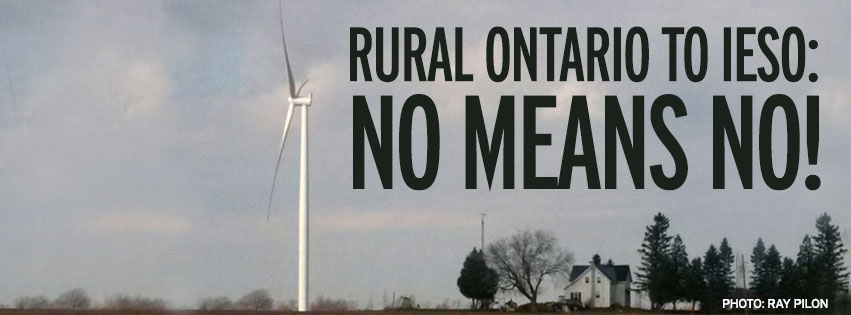
NoMeansNo_FB (2)

OTTAWA WIND CONCERNS NOTE: The City of Ottawa is among the 59 municipalities to date which have passed resolutions demanding that municipal support be a mandatory requirement for wind power contracts.

Ontario’s big green suicide plan: The Financial Post

Tags

, , , ,

The end of Ontario’s lifetime of economic progress…

Environment Minister Murray : the first time assisted death has been tried on a whole province, says Kevin Libin

Environment Minister Murray : the first time assisted death has been tried on a whole province, says Kevin Libin

The Financial Post, May 17, 2016

To get an idea of what Ontario could look like a couple of decades out under Liberal energy minister Glen Murray’s “climate action plan” — which was revealed in detail in Monday’s Globe and Mail — who better to rely on than the man himself, Glen Murray?

Back in 2008, when he chaired the National Roundtable on the Environment and the Economy, Murray — along with his acting CEO, Alex Wood, now executive director of the Ontario Climate Change Directorate — offered up a plan that looked remarkably similar to the new Liberal cabinet document. In fairness, the NRTEE document hardly offered the perniciously micro-managed prescriptions for people and businesses that Murray has graduated to now. And this new plan, billed by the Liberals as a “once-in-a-lifetime transformation” for Ontario’s economy, may also prove the end of Ontario’s lifetime of economic progress. In an era where assisted dying is the big thing with Liberals, this could be the first case where it’s tried on a province.

The leaked cabinet document, reportedly signed-off on by Premier Kathleen Wynne, lists a jaw-dropping 80 or so policies including: The eventual ban on heating new homes and buildings with natural gas, with only electric or geothermal being legal; $4 billion to be doled out by a “green bank,” funded by carbon taxes, to subsidize retrofits of buildings to get them off natural gas; the requirement that homes undergo an “energy-efficiency audit” before they can be sold; and a stack of rules, regulations and handouts to get an electric car into every two-car household within eight years, including rebates, free electric charging, and plug-in stations at every liquor store. Naturally, there will be billions more in traditional government-spending programs on public transit, bike paths, upgrades for schools and hospitals, and “research” funds and centres of climate excellence, not to mention new ethanol fuel standards that will gratify the Liberals’ top corporate donors in the biofuel lobby.

Read the full Comment here.

Ottawa to Wynne government: municipal support must be mandatory requirement in new wind power contract bids

Ottawa City Council has endorsed a motion put forward by the Chair of the Agricultural and Rural Affairs Committee (ARAC), Councillor Scott Moffatt, requesting that the province make municipal support a mandatory requirement of any bids for wind power contracts.

Ottawa is the second largest city in the province of Ontario.

Council previously passed a motion in 2013, asking for more meaningful input to the power contracting process; this followed a citizen “referendum” by a majority of residents in North Gower and Richmond, stating they were unwilling hosts to a proposed wind power development, that would have resulted in hundreds of families being within a few kilometres of huge wind turbines.

As of May 11, 45 Ontario municipalities have passed resolutions at Council, requesting that municipal support be a mandatory requirement in any new wind power contract bids. In the last round of contract bids, three of the five communities where power developers obtained contracts had designated themselves unwilling hosts to wind power projects. That includes Dutton Dunwich, near London, Ontario, which held a formal referendum — 84% of residents said “no” to a proposed power project.

In March of this year, Energy Minister Bob Chiarelli said it would be “virtually impossible” for any company to get a contract in a community that did not support the proposed power project.

The Ottawa motion is as follows. An unofficial record of the vote is posted here.

COMMITTEE RECOMMENDATIONS

That Council:

1.         Ask the Province of Ontario to make the necessary legislative and/or regulatory changes to provide municipalities with a substantive and meaningful role in siting wind power projects and that the “Municipal Support Resolution” becomes a mandatory requirement in the IESO (Independent Electricity System Operator) process.
2.            Forward this resolution to the Chair of the Board and President of IESO (Independent Electricity System Operator), the Minister of Energy, AMO (Association of Municipalities of Ontario), ROMA (Rural Ontario Municipal Association) and all municipalities, within the Province.


Councillor Moffatt demands more say in wind farm contracts

Tags

, , , , ,

CBC News, May 5, 2016

As the Ontario government prepares to open a second, more ambitious round of bidding on large-scale renewable energy projects across the province, some Ottawa city councillors want more local control over where wind farms go.

“There’s no way for a municipality to express concerns about location, or if and when these projects would happen in our municipalities,” said Scott Moffatt, who represents the rural ward of Rideau-Goulbourn.

In March Ontario’s Independent Electricity System Operator awarded contracts to 16 renewable energy projects, three quarters of which had support from the local municipality, the government said at the time.

Five of the contracts were awarded to wind projects, including the 100-megawatt Nation Rise Wind Farm in North Stormont Township, a municipality which had previously declared itself an “unwilling host” to wind farms.

A motion approved Thursday by councillors on Ottawa’s agriculture and rural affairs committee urges the province to strengthen legislation to require municipal buy-in before contracts are awarded.

Communities want a voice, councillor says

Moffatt said communities want a voice in the planning process.

“This isn’t just for Ottawa. We’ve had this issue in the past in Ottawa, specifically in North Gower, but you look at Nation, you look at South Dundas and Brinston,” said Moffatt, describing proposed wind farm locations.

“Are those municipalities able to respond adequately or is the IESO just going to run roughshod over them? That’s the concern.”

In an email, a spokesperson for Ontario’s Energy Ministry said the government is proud of the 75 per cent support rate from municipalities for its first round of contract offers, and noted 60 per cent of neighbouring landowners also supported them.

“By putting emphasis on price and community support, we believe the right balance has been struck in early community engagement and reduced prices for consumers through the procurement process for renewable energy projects,” wrote the spokesperson.

930 megawatts sought in 2nd round

The IESO is gathering feedback on its first competition, and could use that information to fine-tune the process the second time around.

The Ontario government intends to issue a request for qualifications by August for projects that can generate a total of 930 megawatts of renewable energy, two thirds of which will go to wind farms.

That’s more than twice the size of the initial contract offer.

The ministry’s ultimate goal is to have 10,700 megawatts of wind-, solar-, and bioenergy-powered projects feeding the grid by 2021.

Municipal support must be mandatory for wind power contracts, says WCO

Tags

, , , , , , ,

Coalition of community groups and Ontario citizens says planning process for industrial-scale wind power projects needs to be revised, with municipal support mandatory for any contract

Citizens have good reason for objecting to wind power plants, but government's not listening [Photo: Prince Edward County]

Citizens have good reason for objecting to wind power plants, but government’s not listening [Photo: Prince Edward County]

May 4, 2016

Wind Concerns Ontario submitted a series of recommendations to the Independent Electricity System Operator (IESO) as part of the “engagement” process on the Large Renewable Procurement (LRP) process on May 3rd.

In a letter to IESO CEO Bruce Campbell, WCO president Jane Wilson wrote:

WCO has been involved supporting individuals and community groups dealing with wind turbines imposed on communities since before the Green Energy Act was enacted. We saw the government’s commitment in 2012 that it would only place wind turbines in communities willing to host them as a positive first step toward addressing the concerns of rural Ontario.  The results from the RFP I process, however, made a complete mockery of this policy. The Minister of Energy stated as recently as March 7 that it would be “virtually impossible” for a contract to be awarded without municipal support.  Yet, three of the five successful bids for wind turbine contracts in LRP I were awarded to municipalities that did not support the project.

The wind power contracting process shows no respect for Ontario citizens and communities, Wilson said.

The key issue is: neither the government nor participants in the procurement process have listened to valid community concerns or displayed any learning from problems created by the existing projects. Most people in rural Ontario seem to know more about the impact of wind turbines (economic, environmental, societal) than the people proposing projects, who continue to use outdated and limited information to support their proposals.  Far from streamlining the process, the Green Energy and Economy Act has created a confrontational environment.  Based on local activities such as municipal resolutions, public demonstrations and media stories, it is clear this situation is not going to change until provincial government agencies deal seriously with the problems that have been created by wind turbine projects to date.

WCO recommendations: let communities choose

The recommendations to change the RFQ and RFP process as well as the generic contract are driven by four objectives.

  • Activities within the process need to be consistent with the high levels of openness and transparency that the provincial government expects of agencies and municipalities.
  • Full disclosure of project information is needed to allow the community to provide meaningful feedback.
  • Mechanisms need to be included within the process to measure the responsiveness of proponents to input from the community.
  • The process needs to place value on and respect for community views on proposed projects.

Among the recommendations was the need for municipal support to be mandatory. “More than 90 municipalities have declared themselves ‘unwilling hosts’ to wind power projects,” says president Jane Wilson. “They have good reasons for that. But this government has no respect for Ontario citizens and their elected governments, who want to plan what is appropriate and sustainable for their own community.”


Highlights of WCO Recommendations:

Qualification of bidders

Failure to deliver past projects on time should result in disqualification of bidders

Inappropriate behaviours or actions such as clearing land that is habitat for endangered species while a project is still under appeal, should result in disqualification as a bidder

The qualifications of proponent team members should be evaluated: “experts” in noise and health impacts for example, should have appropriate training/education and proper professional credentials


Community engagement

“Engagement” should not be confused with “support”

Public meetings should be more accessible and greater in number, and take place before a municipality is called upon to determine whether it supports a wind power project bid

Communities need much more detail about projects than they were given under FIT or LRP I

Proponents should disclose and have available the full range of documentation on impacts of the proposal including impacts due to environmental noise (potential for adverse health effects), and effect on property value as well as other economic considerations (e.g., airport operations, tourism)

Municipal support must be a mandatory requirement in contract bids

Proponent engagement with Aboriginal communities should be subject to the same disclosure requirements as for other communities

Site considerations

IESO needs to do an independent technical review of proponent submissions

Municipal support

Full documentation should be provided to municipalities prior to bid submission, so that local governments can review the information and comment as to completeness and accuracy

Again, a resolution of support from a municipality must be a mandatory requirement for a bid in the RFP process

contact@windconcernsontario.ca

Ottawa councillor wants municipal say on wind power contracts

Tags

, , , , , , , , ,

Municipal input should be a deciding factor in granting wind power contracts, Councillor Scott Moffatt says

3-MW turbine south of Ottawa at Brinston: Ontario. Communities have had no choice. [Photo by Ray Pilon, Ottawa]

3-MW turbine south of Ottawa at Brinston: Ontario. Communities have had no choice. [Photo by Ray Pilon, Ottawa]

CFRA, May 5, 2016

Rideau-Goulbourn councillor Scott Moffatt wants the City to be able to have a say on where future wind turbines are placed.

He’s tabling a report at Thursday’s Agriculture and Rural Affairs Committee meeting, recommending Council ask the Province of Ontario to change the law, to give municipalities “a substantive and meaningful role” in deciding where future wind power projects will go.

The report says municipalities deserve a role in the process, because “the siting of wind power projects has local planning implications” and decisions on renewable energy projects need to take place “within the context of community sustainability.”

The report further states that early municipal input should not only be a priority for proponents of new wind projects, but it should also be a deciding factor for Ontario’s Independent Electricity System Operator (IESO) when approving a new project.

Currently, the Province has sole jurisdiction over where wind farms are located.

If the recommendation is approved, full City Council will vote on whether to send their concerns to the Provincial government, the energy minister, the IESO, the Association of Municipalities of Ontario, and all municipalities in Ontario.

The Agenda for the ARAC meeting May 5 is here.


EDITOR’S NOTE: The community of North Gower presented a petition to  Ottawa City Council in 2013 asking for recognition as an “unwilling host” to a proposed wind power project that would have been close to thousands of residents. Council passed a motion unanimously asking the Government of Ontario to return local land-use planning power to municipalities. The government gave no response to Ottawa, Ontario’s second largest city.

At present, more than 90 communities in Ontario are officially “unwilling hosts” to wind power projects–that represents the majority of Ontario communities vulnerable to the industrial-scale power projects.

North Stormont wind farm fight: no democracy, no truth, citizens say

Tags

, , , , , , , , ,

If province had a 1-km setback for wind power generators, almost none of the North Stormont project would be allowable, says community group. “They say wind power is ‘green’ ” says leader Margaret Benke, “but it’s not.”

<p>Margaret Benke surrounded by research into wind turbines on Monday April 25, 2016 in Berwick, Ont. Benke is hoping North Stormont Council will pass a resolution urging the IESO to rate an unwilling municipality as a mandatory requirement as opposed to rated criteria.</p><p>  Lois Ann Baker/Cornwall Standard-Freeholder/Postmedia Network

Margaret Benke: asking North Stormont Council to pass resolution May 10, making municipal support a mandatory requirement for wind power contracts [Photo: Cornwall Standard-Freeholder]

Cornwall Standard-Freeholder, May 2, 2016

BERWICK – She is fighting the good fight and not about to quit just yet.

Margaret Benke is chair of the Concerned Citizens of North Stormont and she and her group are hoping to stop the wind turbines from coming to the township.

Benke said the first time she heard about the turbines coming was when she read about a public meeting in the Chesterville Record.

“I said I’ve got to do something,” said Benke.

Earlier this year, EDP Renewables was awarded a contract for its proposed Nation Rise Wind Farm under the Independent Electricity System Operator’s large renewable procurement process. The project is rated at a potential 100,000 megawatts. On its website, EDP says it has secured contracts with about 40 local landowners covering over 4,000 hectares (10,000 acres).

Benke related a story of her nephew who had purchased his first home in Shelburne and within a year or two wind turbines went up around his land.

“He couldn’t live in his house anymore,” she said. “He abandoned his house. He likened (the noise) to living inside a drum.”

Benke said she had been hearing the stories at family get-togethers about issues with wind turbines.

This spurred Benke into action. Together with a family friend who happens to be a cartographer, they put together a map of the area and, allowing for the mandatory 550-metre setback for wind turbines, were able to determine approximately where the turbines could be erected.

She also looked into the Health Canada study done on wind turbines and found out of the 2,004 people originally selected for the study, 430 had abandoned or demolished their houses due to the turbines.

“It significantly decreased the number of people in the study,” she said. She said they interviewed people who were 550 metres away from turbines, but the only people who were that close were the landowners who were under contract with the wind turbine companies.

Benke then asked to be a delegation at a council meeting so she could present council with the information she researched on the wind turbines before council made any decision on whether to support the turbines or not.

“Immediately anybody with money sense, their antenna goes up, there is money in this,” she said. As every municipality is aware, there have been cutbacks into how much money they are receiving from the province, and that money has to come from somewhere.

“We did a very balanced overview of what the map looked like and what it would look like if you had a one-kilometre setback which is what the experts recommend,” she said. “There were only two fields that would have qualified.”

The one-kilometre recommended setback refers to a paper put out by the Ministry of the Environment where it recommended a setback of one kilometre for a wind farm of 10 turbines with noise level of 105 decibels.

Benke also found out each turbine generated just over $4,000, which was about the same amount of tax revenues from a home valued at $300,000 to $350,000.

“If you go ahead with the wind turbines, it pretty much kills any new development,” she said. “I couldn’t let this happen without at least being a voice in the wilderness. We needed to have our voices heard.”

Benke said wind turbines give the illusion they are “green” but they are not.

“It’s the perception that it’s doing something for us that it’s not,” she said. “Lack of democracy, lack of transparency, lack of truthfulness.”

Tom Loturco of EDP Renewables explained the next step is for contracted projects to obtain all necessary licences and approvals, including conducting an environmental assessment. According to the IESO website, these processes must include community engagement.

On behalf of the Concerned Citizens of North Stormont, Benke sent a letter to Mayor Dennis Fife and the councillors asking them to pass a resolution to request the Independent Electricity System Operator make a willing municipality for renewable energy a mandatory requirement as opposed to a rated criteria. Council deferred the passing of the resolution to a later date. North Stormont had already voted to declare itself an unwilling host for the large renewable procurement program.

Benke is asking council not to give up and if something as simple as passing the resolution will help, do it.

In any case, we strive to have good working relationships with landowners, municipalities and the public,” Loturco said. …

Read the full article here.

NoMeansNo_FB

Ontario’s green energy fiasco about to get worse: Globe Editorial

Tags

, , ,

Globe and Mail EDITORIAL, April 29, 2016

Late last year, Ontario’s Auditor-General put out a report detailing the extent of the provincial government’s mismanagement of the electricity system. According to Bonnie Lysyk, thanks to a misguided government policy of artificially pumping up the cost of producing power in the province, Ontarians had overpaid for electricity to the tune of $37-billion between 2006 and 2014, and will continue to be overcharged by another $133-billion by 2032.

The scale of the waste is so large as to be almost incomprehensible, which may explain why Ms. Lysyk’s report was a one-day news wonder when it landed last December. Once the count gets into the hundreds of billions, the mind goes numb. If the province announced construction of the Burning Money Biomass Plant, fuelled by bales of five and 10-dollar bills, it probably wouldn’t be capable of destroying $170-billion.

The size of the disaster in the province’s electricity system is hard to get your head around. But voters, consumers, businesses and especially the Liberal government should be rereading Ms. Lysyk’s report. Because a document leaked to The Globe and Mail this week suggests that the Liberals, who a decade ago broke the electricity system through a fatal combination of good intentions and a willful disregard of both expertise and experience, may be preparing to repeat the exercise with their next greenhouse gas reduction plan.

The thing is, Ontario needs a greenhouse gas reduction strategy. So does every province, and so does the federal government. To meet our international commitments, and to bend the curve on global warming, those carbon-reduction goals have to be ambitious. Ontario’s proposed Climate Change Mitigation and Low Carbon Economy Act aims to reduce the province’s 1990 emissions by 15 per cent by 2020, 37 per cent by 2030 and 80 per cent by 2050. The province is committing itself to substantial carbon reduction in the next decade, and a near-zero carbon economy in a generation.

Those are not impossible ideals. They’re doable – using the right tools. Dramatically reducing carbon emissions is not a crazy idea, but the way Ontario is proposing to get to a low-carbon economy almost certainly is.

Ontario went about it all wrong

A decade ago, the government of Ontario started driving up electricity costs with a simple objective in mind: It wanted to reduce greenhouse gas emissions from the production of electricity. This was the right objective. But the way it went about it was all wrong. Instead of encouraging the electricity sector to be as efficient as possible, the government essentially ordered it to become costly, inefficient and irrational. Some of this was motivated by fantasies of industrial policy – look, Ma, we’re subsidizing the Green Jobs Of the Future! – and some of it was driven by an insistence on ignoring basic economic advice, much of it coming from the government’s own experts.

The result is that the cost of generating electricity in Ontario has exploded, even as power costs plummeted elsewhere. Between 2004 and 2014, power generation costs in Ontario increased by 74 per cent, according to the auditor. This benefits no one. The higher prices don’t come from carbon taxes; they come from higher electricity production costs. And that imposes a heavy cost on the economy.

However, because prices were rising, Ontarians started using less energy. Power use dropped by 7 per cent between 2006 and 2014. But at the same time, thanks to subsidies to encourage greater power production from green sources, the province’s generation capacity grew by 19 per cent. As a result, the province is now a major exporter of electricity – sold at prices far below the cost of production. The more power the province exports, the more taxpayers and ratepayers lose.

Ontario could have chosen a different route. Instead of politicians completely remaking the electricity sector on a whim, introducing inefficiencies by deciding what power technologies to back and how much to subsidize them, Ontario could have done the opposite. It could have set a carbon-reduction goal, imposed carbon taxes on carbon-generating fuels – and left it to producers and consumers to figure out how to most efficiently respond by reducing their own costs and emissions. It should have taxed dirty power and let the market figure out the cheapest way to get to lower emissions levels.

More enthusiasm than knowledge

Nearly a decade later, this week’s leaked document on its upcoming greenhouse-gas strategy suggests Kathleen Wynne’s government has not learned from her predecessor Dalton McGuinty’s mistakes. Glen Murray, a minister with more enthusiasm than knowledge, is in charge of the environmental file; last time around, George Smitherman was the designated enthusiast.

Ontarians should be worried. …

Read the full story here