Food, not noisy, invasive, non-performing wind turbines is a better policy choice [Photo Ottawa Wind Concerns]
October 24, 2026
In a Facebook posting yesterday by Ecology Ottawa, statements were published from Ottawa’s top mayoral candidates on a variety of topics. Under “Emissions and Energy”, Ecology Ottawa quoted candidate Jeff Leiperas saying he wanted to enact the city’s Energy Evolution plan, which is part of the overall climate action plan.
From the document:
Emissions & energy (Q7–Q8) ● Commits to 2050 net zero and full implementation of Energy Evolution: building energy efficiency, zero-emission municipal fleet and transit, less organic waste to landfill; lead by example with municipal building retrofits; seek federal/provincial funding; more frequent emissions reporting.
There is no mention of energy or the Energy Evolution document on Mr Leiper’s campaign page that we can see.
Informed readers will recall, the Energy Evolution plan is a $57-B “strategy to hit Net Zero. The plan was launched in the beginning of COVID in 2020, when the people of Ottawa had plenty of other things to think about. When it came to Council, after a limited and almost invisible public “engagement,” Councillor Allan Hubley candidly commented that this was the first he’d heard of the document, and Councillor Carol-Anne Meehan remarked that $57 billion was equal to the annual budget for more than a dozen Ontario cities.
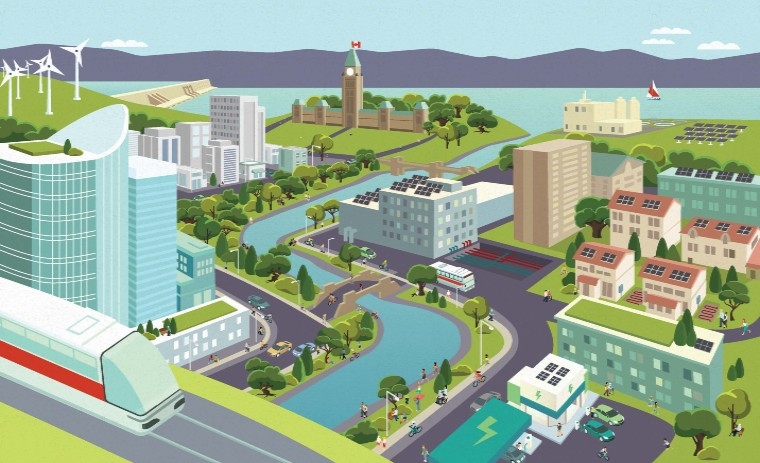
The Energy Evolution document plans $57 B of spending on climate change action–including hundreds of industrial wind turbines
In the Electricity portion of the document are statements about the need for more electricity generation and for Ottawa to do more locally, despite being part of the Ontario power grid. The forecasts are based on the Independent Electricity System Operator (IESO) predictions for demand published in 2016 (and since updated at least twice).
In specific, Energy Evolution laid out the following targets (Energy Evolution, page 45):
“The model indicates that the minimum results required to meet the 100% scenario under the electricity sector are:
Solar photovoltaic (PV) reaches 1,060 MW by 2050 (approximately 36 km2 of solar PV47 mostly on rooftops)
Wind generation reaches 3,218 MW by 2050 (approximately 710 large scale turbines)
310 MW of local energy storage by 2030 and 612 MW by 205048 (122 large shipping containers of lithium batteries) approximately”
SEVEN HUNDRED industrial wind turbines.
Later in the document is a list of suggested funding sources, all of which are ludicrous (the same, one and only hapless taxpayer) and which make no sense in today’s economic environment.
What does it say that Mr Leiper now refers to a stale, out of date, highly compromised (activist group Pollution Probe wrote part of the Electricity section for the city), preposterous and poorly referenced document for key environmental action?
Criticisms of the plan are many the outrageous requirement of 700 wind turbines, with the cost, environmental impact, and the loss of rural land, mostly farmland, is completely divorced from reality.
This suggests that Mr Leiper is more interested in farming votes from members of Ecology Ottawa and the deeply conflicted CAFES (we love trees and birds and farms but we also love noisy, tree chopping, bird-killing, farmland gobbling industrial wind turbines too!).
Ottawa’s electricity future needs an informed, measured approach. Even the Ontario energy minister Stephen Lecce says wind (and solar) are not the way to an intelligent power system. Noting the unreliability and intermittency of wind, he remarked last year that you can’t run a full-time economy on part-time power.
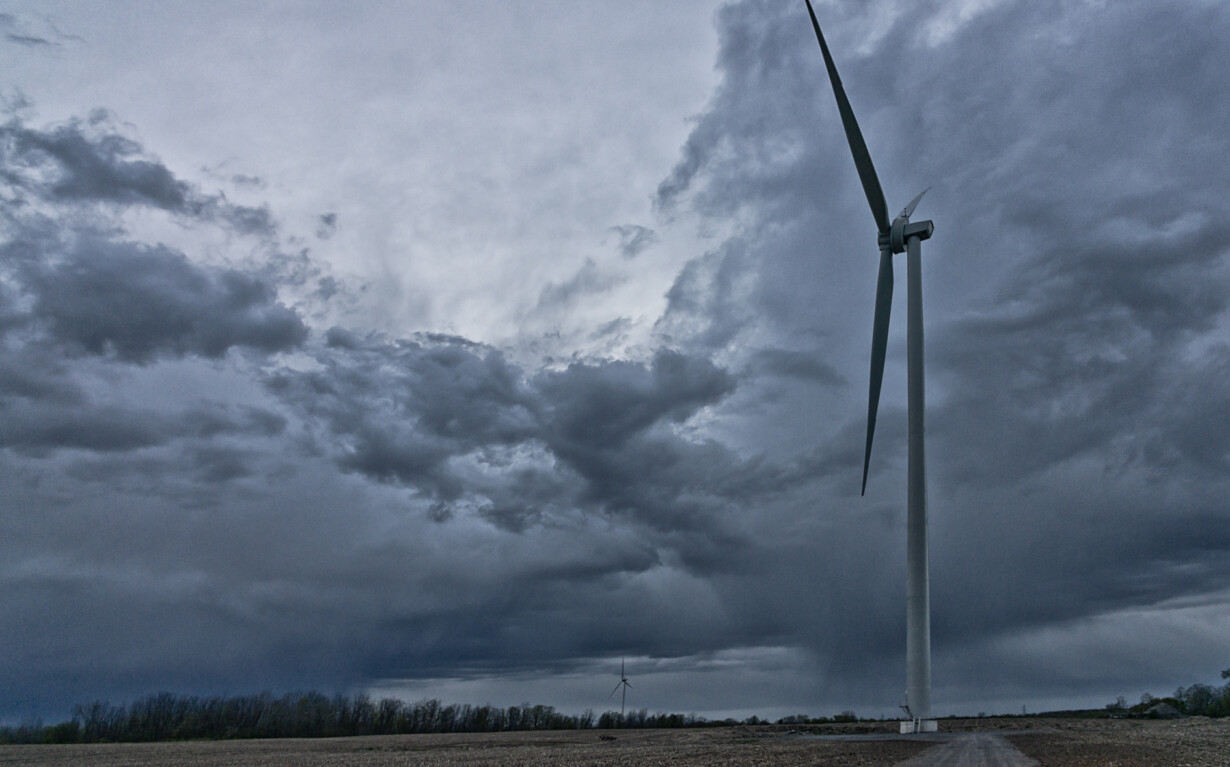
Wind turbines are an industrial land use: a low-density power source that uses up valuable farmland, and poses a risk to wildlife and groundwater. [Photo by D. Larsen for Wind Concerns Ontario]
October 7, 2026
We have plenty of organizations of different types in Ottawa who continually refer to “renewable” energy or “clean” energy as a goal for the city. Though deeply conflicted—most of them devoutly claim they love trees and birds and turtles and then in the next breath support land-gobbling, bird and bat killing industrial wind turbines—they maintain that “clean” energy will bring prosperity, jobs, and self-reliance.
Incredibly, one such group (CAFES) recently claimed that having local wind and solar would mean less reliance on “imported” power. As if electricity were avocadoes from California. The ignorance of Ontario’s electricity system is stunning.
Wind Concerns Ontario (we are a corporate community group member) recently published a summary of Ontario’s now 20-year experience with industrial wind power. What’s clear is, wind is not the solution. To anything, except more money in the pockets of developers.
Ontario’s rural municipalities are about to face the possibility of more industrial wind power proposals, when the Independent Electricity System Operator or IESO finally launches its long overdue “window 2” of its Long-Term 2 Request For Proposals (LT2-RFP),
The next RFP was meant to be released much earlier this year (after a not entirely successful 2025 which saw only two or three wind power contracts awarded out of more than 20 proposals), but Ontario’s rural opposition to being industrialized by noisy giant wind towers is such that the IESO (and probably the wind power lobbyists) declared the October municipal election a “challenge” for new proposals, and put the whole thing off.
That should tell you something right there: with 159 municipalities (out of 444 total) having declared themselves to be “Unwilling Hosts” to new industrial wind power projects, community opposition is a real force to be reckoned with.
In Ontario, wind power operators speak less about climate change and more about economic realities. That means promising cash-strapped and challenge-worn small rural municipalities cash in the form of community benefit funds (or “vibrancy” funds in the wind power lobby’s continuing adeptness at cutesy names for completely serious matters), and the prospect of multiple jobs. The community benefit funds of course are a pittance against what the wind power developers cart off to the bank and reward investors, and the local jobs always turn out to be short-lived, related to construction. Even then, actual construction of wind power sites is done by specialized teams travelling to the site, usually by highly trained teams from the United States.
As Dr. Chris Keefer of Canadians for Nuclear Energy quipped, “There are no employee parking lots at wind farms.”
It is time then to see through the magician’s smoke and look behind the mirrors at what wind power in Ontario really is.
First, it is not a reliable source of power. Ontario is a low “wind resource” area—we will never be able to produce significant power consistently from wind power, and that is that. Wind power is “part-time power”. Who said that? Only Ontario’s current Minister of Energy Stephen Lecce. Last January, while a certain Toronto-based faux environmental group was pushing to triple Ontario’s wind power capacity and abandon its nuclear ambitions, Mr. Lecce said that Ontario cannot “power a full-time economy with part-time power.”
Economist Edgardo Sepulveda undertook the first independent cost-benefit analysis of wind power in Ontario (though past Auditors General in the province have asked for one) in 2024. In his paper Chasing The Wind: the value of wind generation in a low-emission nuclear and hydro dominant grid, Mr. Sepulveda acknowledges that to keep costs artificially low, the Ontario government subsidizes 70 percent of the cost of wind. In fact, he alleges, “the costs of wind far exceed its societal and climate benefits for the 2020–23 period… Due to its nuclear and hydro dominant generation and elimination of coal, Ontario is one of the lowest-emission large grids in the world. The climate benefit from any new zero-emission generation will be limited to the extent it can displace gas generation. Relative to other areas, Ontario’s wind capacity factors are modest and out of sync with gas generation, all resulting in a relatively low wind emissions offset.”
The high cost to Ontario taxpayers was revealed recently with the release of the public accounts figure of $6.9 billion annually to subsidize electricity generation costs in Ontario. That represents more than half of Ontario’s $13-billion deficit.
So, wind power’s scorecard so far: high cost, low benefit.
But does it help with power generation to keep the province running? Again, Mr. Sepulveda: he refers to “modest” capacity factors for wind in Ontario. It’s actually much worse. This past summer, 2026, saw lengthy periods of low wind power generation simultaneously with high demand. Mr. Sepulveda: “wind generation is uncorrelated with Ontario demand … correlation data with gas shows that wind is negatively correlated with gas generation. This indicates that wind did not efficiently displace gas in Ontario.”
Energy analyst and director with Canadians for Nuclear Energy Christopher Adlam took a snapshot of wind power in January this year and provided this analysis.
“On this frigid Saturday evening Ontario is generating 21,545MW. Of that capacity: – 194MW is from 4,943MW of wind (0.9%) – 0MW is from 478MW of solar (0.0%) – 60MW is from 851MW of batteries (0.2%) – 184MW is from 287MW of bio (0.9%) – 4,639MW is from 8,866MW of hydro (21.5%) – 7,682MW is from 10,551MW of gas (35.7%) – 8,786MW is from 9,546MW of nuclear (40.8%)
We are also currently exporting 757MW to Quebec and 873MW to New York. To replace gas and nuclear with wind for this hour would require 422,256MW of wind capacity, or 122,749 of the 3.44MW wind turbines installed at Nation Rise, which, at $2.33M/MW would cost $984 billion dollars.”
In short, wind doesn’t work.
It truly is “part-time power,” and is further incapable of replacing fossil fuel power generation in periods of high demand.
Another critical factor in wind power is “energy density”, in short, how much energy can be delivered by a generation system relative to its physical size.
Here again, wind power disappoints, especially when compared to high density nuclear.
Wind turbines use up a significant amount of land, a grave concern here is Ontario where target communities for industrial wind power are also the location of successful agriculture. The Ontario Federation of Agriculture (OFA) and others have expressed grave concern about the future of farming and farmland in the province.
“Farmland is vital to our survival,” the OFA said in a statement before the last federal election in 2025. “We cannot rely on importing our food. We must remain a food sovereign nation. We cannot achieve this if we continue to develop on agricultural land that is home to reliable and arable soils.”
The wind power industry not only maintains it uses very little land (we have seen preposterous claims of perhaps a quarter of an acre—suburban housing lots are bigger than that) but the lobby also claims that farming can co-exist with the power generation facility. That conflicts with again the OFA advice to landowners to be careful about signing contracts to lease land for industrial wind turbines, as land use may be restricted by the wind power enterprise, which comes first.
Well, OK, wind is expensive and maybe doesn’t work all that well in Ontario but isn’t it good for the “environment” and climate, cry the “environmental” agencies.
No.
Wind power generation is an industrial land use and its side effects are pretty much what you’d expect from industry: noise, altered landscapes, impacts on wildlife (that means they are killed dead despite assertions of care and mitigation by the industry), and danger to aquifers as evidenced by the travesty in North Kent where wind turbine construction an operation interfered with groundwater over a fragile geology (nothing has been done to help the dozens of families now without potable well water, despite a provincial science committee recommendation).
Ontario has now had industrial wind turbine complexes since 2006. It hasn’t gone well, spurring the Unwilling Host movement which began in 2014 when a rural municipality mayor protested against the contracting process which gave local governments virtually no say in approving the industrial sites.
She wasn’t the first: on April 5, 2011, Amaranth Mayor Don McIvor wrote to then Environment Minister John Wilkinson about the effects of the large Melancthon wind power project in his municipality. The mayor was not too proud to plead with the minister to halt all wind power development in the municipality: “There is no question that the impact of wind turbines and the transformer that connects this power to the grid have negatively affected the health and wealth of neighbouring residents. The Council of Amaranth is opposed to any further wind turbine projects.”
A team of university researchers took aim at the approval process for industrial wind power projects in 2016 and found that health and environmental concerns had been “dismissed” unnecessarily. Stewart Fast (then with the University of Ottawa) and others said in their paper, “Lessons learned in Ontario wind energy disputes,” (Nature Energy, January 2016) the insistence on rigid criteria of direct causation had resulted in an approach that ignored real concerns. “Depending on the evidence cited, there is epidemiologic evidence to sustain various interpretations of wind-turbine impacts on well-being,” Fast et. al said.
The process through which developers applied for approval did not properly engage communities and left citizens feeling like “victims”. “Setting minimum engagement requirements, such as the requirement for two local public meetings, tends to be treated as the maximum requirements — a ‘tick box’ to be completed by developers.”
Ten years later, nothing has changed. In 2019 the Ontario government repealed the Green Energy Act and allowed municipalities some “say” in the siting of industrial wind power projects so that now, the IESO has municipal approval as a mandatory requirement for submissions. However, as seen in 2025, developers were acutely aware of opposition throughout the province and did not want to spend much money on impact studies and other information. As a result, they approached municipal councils with the scarcest of information, and sometimes with vague maps of a “study area” rather than precise turbine locations. In more than one location, developers said to a municipal council, if they got the council’s approval, then they would go ahead and do the complex impact studies. (That means that approval was given though and could not be taken back—councils were not fooled).
Chatham-Kent, where there are more than 500 wind turbines currently operating, had to deal with two proposals in 2025. At a crucial meeting of Council in October 2025, formerly turbine-friendly councillors voted No, citing the lack of information, and the poor process.
Councillor Alysson Storey said, “I am not comfortable” making a decision when there are so many questions and no answers. Staff confirmed upon her questioning that this meeting was the only time the issue could be brought before Council. Storey added that she was sick of the provincial government forcing “do or die” votes on Ontario municipalities.
That was 2025. Despite the IESO’s effort to avoid wind power proposals becoming an issue in the 2026 municipal election, it is one, as it should be.
In Chatham-Kent again, the topic came up at a mayoral candidate debate where most of the candidates spoke out against further wind power development. That included former mayor Randy Hope who was in the chair for much of the wind power project approvals, and who said in his view, the municipality was now “at capacity” for wind power. He added there was a need for greater community engagement.
As to the process, criticized by academics and by municipal councils, to say nothing of citizens who would be forced to live inside industrial wind power sites, nothing has changed. The IESO still only requires a minimum of one public “meeting” which isn’t a meeting at all in most cases, but rather a storyboard show with public relations hirelings representing the developer.
As professor Fast and others noted ten years ago, “Although such storyboard-style meetings can be a useful way of alleviating contentious issues, they often leave residents feeling like victims of a ‘divide-and-conquer’ strategy, in which answers and promises are given only to individuals and are not made publicly.”
So, time to come “clean” about wind power in Ontario.
Reliable affordable power? No.
Jobs and local prosperity? No.
Action on climate change and fossil-fuel use? No. Wind can’t replace anything.
As Ontarians go to the polls again this October, we must ask all candidates for their stance on the prospect of industrial wind power invading their community. And then, vote accordingly.
Wind turbines at Crysler near Ottawa: not replacing any fossil fuels today (Photo: Wind Concerns Ontario)
Wind power in the Ottawa area is outperforming IESO forecasts this hour (5 p.m. July 12).
Yes, it’s true.
The IESO forecast ONE MEGAWATT of power output from the 100-megawatt industrial wind power site at Crysler, but instead, the turbines are generating an impressive TWO megawatts.
Wind power has not had a great week in Ontario where warm summer weather has pushed up demand daily over 20,000 megawatts but Ontario’s wind turbines have struggled to produce more than a few hundred.
This is typical of wind power in our province: in periods of high demand—either hot of cold weather—wind takes off for the beach.
(Mr Sepulveda offered to address the City of Ottawa’s environment committee on this issue but as far as we know, his offer was never accepted…or even given a response.)
The influencers
Meanwhile, Ottawa’s $57-B Energy Evolution plan (sneaked by both citizens and Council during the early months of COVID) is still official city policy, and includes a plan for “investment” of $4B in unreliable, part-time, non-performing wind power. The chapter on energy was written for the City by activist Pollution Probe, and its prescription for massive amounts of wind power (3200 megawatts) goes against the City’s own preliminary research which said, There really isn’t a lot of wind here, guys, but if you want to have a showpiece demonstration turbine, go ahead. (CANMET on Timm road was suggested)
Wind power is pushed by local “environmental sustainability” group CAFES, which even told the Agricultural and Rural Affairs Committee that fewer regulations and approval requirements are needed—let’s get those multi-billion-dollar projects built, never mind the environment consequences. And Ottawa Climate Action Fund, which was launched several years ago with a $20-million grant from the federal government. Its debut was hosted by none other than Diana Fox Carney.
Clearly, the pro-wind lobby thinks Ottawa should have wind turbines. Despite the fact we have no wind.
Never mind that Ottawa’s rural residents (promised much more voice in the 2024 Rural Summit but whose voices were ignored in favour of Brookfield’s battery storage project on farmland in West Carleton) are not keen on seeing their quite farming and residential communities turned into industrial power sites. The approval of the battery storage and the amendments to zoning that allowed it to proceed is currently before the courts in legal action brought by residents.
Not great for Ontario, either
Ontario’s own energy minister Stephen Lecce has said wind power can’t do what Ontario needs: “You can’t run a full-time economy on part-time power,” he said on social media last fall.
Of 22 wind power proposals put forward in 2025, only one is proceeding to construction (one other by Enbridge got a contract but has since been withdrawn when the company and the First Nation involved could not agree to terms).
Many proposals were thwarted by refusal of local councils to grant formal approval. In Ontario, there are 159 municipalities that are formally Unwilling Hosts to new wind power, including multiple jurisdictions around this city such as Merrickville-Wolford and North Stormont (hope of the listless Crysler turbines today).
The myth of wind power needs to end, and the people of Ottawa should ensure that conversations about power generation are part of discussions with candidates in the coming municipal election.
Rural Ottawa residents waiting to be “educated” by downtown Ottawa “environmental” group [Photo Pexels Canada]
April 2, 2026
Local “environmental” coalition CAFES or Community Associations for Environmental Sustainability and OREC, the Ottawa Renewable Energy Cooperative, are teaming up this year to “educate” Ottawa’s rural residents on the positive benefits of accepting renewable energy projects.
In its most recent email newsletter, CAFES announces “Thumbs Up for Renewable Energy” program which “will focus particularly on rural areas of Ottawa, where many projects may be proposed.”
The timing is linked to the next Independent Electricity System Operator (IESO) Request For Proposals, which may include large industrial wind power installations.
CAFES says it will host “workshops, site visits, community events, and accessible information resources, the project will help residents better understand the electricity system, engage in discussions about local energy project planning with proper safeguards, and position us to maximize local benefits.”
CAFES claims that Ontario needs a “more resilient grid” without mentioning that industrial-scale or grid-scale wind power projects actually destabilize the grid, require fossil-fuel backup, and in Ontario at least, are completely out of phase with demand. Last year saw weeks when there was no wind, and wind power in Ontario was dramatically below capacity.
Hardly “resilient.”
Although not a charity because of its political bent, CAFES nonetheless receives grants from unnamed sources.
Unaudited financial statements filed for the organization for 2024 show that CAFES received $86,848 in “grant revenue” and a further $28,799 from “donations and fundraising for a total of $138,055 in revenues that year.
As written in this space before, CAFES is all about saving trees and birds and frogs but at the same time quite OK with deforestation of landscapes and the use of productive farmland for wind turbines, which are an industrial land use.
Acknowledging that municipalities have an important role in renewable energy installations (the Ontario government made municipal support a mandatory requirement for successful project applications), CAFES also says their goal is to get projects approved faster and with fewer regulations: “CAFES will be advocating for a more enabling provincial regulatory environment for renewable energy and energy storage.”
In an Open Letter to CAFES written last year following their appearance at Ottawa’s Agricultural and Rural Affairs Committee (ARAC), Ottawa Wind Concerns criticized the group for their stance to reduce regulation and simply approve projects. CAFES had told ARAC that the City of Ottawa needed to “minimize delays” and simply approve renewable energy projects.
Translation: get out of the way and approve big projects.
No matter what citizen concerns exist for the environment, loss of farmland, and money spent on an unreliable, weather-dependent power source. Or that the energy minister himself, Stephen Lecce, has said renewables, i.e., industrial wind, are not the affordable reliable solution Ontario needs.
CAFES and its partner OREC that seeks investment in power projects certainly have the money to put on workshops and events (even free lunches as they did to promote battery storage) to promote their agenda, but we’ve already seen the enthusiasm rural communities will bring to opposing industrial projects in quiet rural areas. In Ontario, 159 municipalities are now Unwilling Hosts to new wind power project, a decision they made out of experience with industrial wind, not fear of the unknown.
The patronizing nature of this campaign to “educate” rural residents on their electricity system will not go unnoticed.