
• About
  • Donate!
  • EVENTS
  • Ottawa’s “Energy Evolution”: wind turbines coming to rural communities
  • Thinking of signing a wind turbine lease?
  • Wind Concerns Ontario
  • Wind turbines: what you need to know

Ottawa Wind Concerns

~ A safe environment for everyone

Ottawa Wind Concerns

Category Archives: Renewable energy

Ontario Q1 electricity losses: selling our power off cheap

30 Thursday Apr 2015

Posted by Ottawa Wind Concerns in Renewable energy, Wind power

≈ 4 Comments

Tags

CFRA, electricity bills Ontario, hydro bills Ontario, Ontario economy, Parker Gallant, Rob Snow, surplus electricity Ontario, Wind Concerns Ontario, wind farms, wind power

Q1 ratepayer pain: electricity export costs skyrocket

Ontario's electricity customers pay and pay and pay while neighbours get our power cheap
Ontario’s electricity customers pay and pay and pay while neighbours get our power cheap

Wind almost 40% of exported power; cost of surplus export $437 million in just 3 months

The first quarter of the current year indicates Ontario is exporting record quantities of surplus electricity.

It appears to be part of the Liberal government plan as this excerpt from Finance Minister Sousa’s budget “Building Ontario Up” claims:  “Through our four-part economic plan, we are supporting greater investment in productivity and innovation, providing a renewed focus on international exports, encouraging the transition to a low-carbon economy and creating more jobs for Ontarians.”

It would be better if our surplus electricity was exported profitably, instead of a cost to ratepayers, but alas, that is not the way the Liberal Energy Ministers past and present have structured the portfolio.

The first quarter of the current year saw Ontario export a record 6.65 TWh (terawatts) — that’s enough to power 690,000 average households for a full year.

Export costs up 75% in first quarter

The 6.65 TWh sold to our neighbours was up 75% from 3.81 TWh in 2014′s first quarter. We sold that surplus at prices well below what we received.  Exports represented 17.5 % of Ontario’s demand in 2015 versus 10% in the same period in 2014. Wind (generated and curtailed) in 2014 was 2.05 TWh and 53.7% of Ontario’s exports; in 2015, wind grew to 2.61 TWh and was 39.2 % of our exports.

The concept of exporting is one that economists encourage; however, they expect it will be profitable, create jobs, and not burden the rest of the economy though subsidization.  Subsidizing exports is often referred to as “dumping” and frequently challenged under the WTO (World Trade Organization) rules.

Cost to ratepayers is shocking

Examining the cost to Ontario ratepayers for the 3.81 TWh exported in 2014 and the 6.65 TWh exported in 2015 using data from the Independent Electricity System Operator’s (IESO) “Market Summaries” is shocking.

The 2014 first Quarter exports cost (average of $102.6 million/TWh) ratepayers $391 million to produce and was sold via the HOEP (hourly Ontario electricity price) market at an average of $75.54 million/TWh. That cost Ontario’s ratepayers $103 million.  In 2015, the 6.65 TWh exported cost Ontario’s ratepayers $672 million (average cost of $101 million/TWh), and sold at an average of $35.4 million/TWh, costing Ontario ratepayers $437 million.

To put some context to the latter, the money lost exporting the 6.65 TWh  was equal to 6.6 cents per kilowatt hour.   The foregoing subsidy does not include other costs Ontario’s ratepayers pick up including: spilled hydro, steamed-off nuclear or payments to idling gas plants. The subsidies supporting exports is double what Energy Minister Bob Chiarelli suggests is needed to assist almost 600,000 “low-income” households to pay their hydro bills. Ontario’s ratepayers will start paying the latter January 1, 2015.

This analysis would not be complete without noting the cost of wind generation (two quarters) in 2014 was $252.7 million (average cost of $123.5 million per/TWh) and $322.5 million for 2015!

Perhaps our Finance Minister should “focus” on the harm to Ontario’s ratepayers instead of dumping our surplus electricity on our neighbours who are happy to take it and not raise the issue with the WTO.  If the first quarter of 2015 is indicative of the full year, ratepayers will pick up $1.8 billion in subsidies to supply our neighbours with cheap electricity, while Ontario’s citizens struggle.

Parker Gallant, April 28, 2015

The views expressed here are those of the author and do not necessarily represent Wind Concerns Ontario policy.
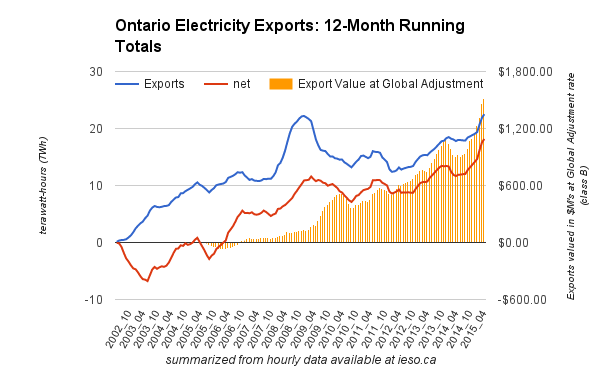
Chart courtesy Scott Luft of Cold Air Online

EDITOR’S NOTE: Parker Gallant will be on the Rob Snow show on radio CFRA, Friday May 1st, to discuss this. Listen in an AM 580 or online at cfra.com


$70-million charge on Brinston farm titles for wind farm

28 Tuesday Apr 2015

Posted by Ottawa Wind Concerns in Ottawa, Renewable energy, Wind power

≈ 10 Comments

Tags

Brinston, Charge of Lease, demand debenture, leasing land for wind turbines, Prowind, South Dundas, Stormont Dundas and Glengarry, wind farm, wind farm financing, wind farm leaseholders, wind farm leases, wind power, wind turbines


Construction of one of the 3-MW turbines at Brinston--30-50 more proposed by EDP Renewables

Construction of one of the 3-MW turbines at Brinston, now operating–30-50 more proposed by EDP Renewables

Ottawa Wind Concerns has learned that a “Charge of Lease” has been placed on the South Branch wind “farm” in the amount of $70 million. The charge is on the leasehold interest in five properties, where property owners have leased land for wind turbines, access roads, substations, and other parts of the wind power generation project.

Earlier this month, details came to light on the 140-turbine K-2 project near Goderich, Ontario, where a charge of lease has been filed on the title for 100 farm properties, in the amount of $1 billion.

The Charge of Lease is basically a financing agreement between a lender (who may represent investors in the wind power project) and the wind power developer, that can function as a line of credit. The basis for the Charge, as we understand it, is that the present value of the contract for the turbines, i.e., the Feed In Tariff contract for power with the Province of Ontario is greater than the present value of the lease agreements with the landowners; the difference between those two values is the security for the loan.

The South Branch contract with the Ontario government runs for 20 years and is worth millions to the developer, who bought the project from Germany-based Prowind.

The importance of the existence of these agreements is the effect they have for the landowner leasing land for the wind turbines. In the opinion of a lawyer advising us (who prefers the term “Demand Debenture” for this arrangement:

It’s not so much that the farmer lessors might on default lose their land (the land itself is not mortgaged, just the turbine contract on that land) but the damage it does to that farmer if he/she wants to sell or to renew an existing mortgage, or place a new one or in any way borrow money for which the lender would want security on his/her land.

Assume a binding Agreement of Purchase and Sale. The lawyer for the purchaser does a title search and discovers the Demand Debenture. The lawyer would immediately tell his/her client that the client is entitled to get out of the deal unless the registration of the Demand Debenture is removed from title, and would also insist to the farmer’s lawyer that this be done otherwise the deal cannot close. A purchaser is not expected to assume any risk of this nature nor to be in the position of “buying a law suit”.

in the case of renewing an existing mortgage or placing a new one, the lawyer for the Bank or other lending institution would take the same position – no renewal or new mortgage unless the customer sees to it that the Demand Debenture disappears from title. Period. End of story.

This is another example of the very serious questions that need to be asked by anyone considering leasing their land for a wind power generation project. There are many serious and long-lasting effects to signing these agreements that need to be properly understood.

In 2013, the Not A Willing Host group of municipalities met in Ottawa at the Association of Municipalities of Ontario convention. At that meeting, one Ontario mayor said, What people need to understand is that basically, they sold their property for the amount of the lease agreement.

** Please see also, the article from the May 5th edition of Ontario Farmer on the charge of lease issue, here.

Ontario budget: ratepayers will pay and pay and pay

28 Tuesday Apr 2015

Posted by Ottawa Wind Concerns in Renewable energy, Wind power

≈ 2 Comments

Tags

Charles Sousa, electricity bills Ontario, hydro bills Ontario, Kathleen Wynne, Ontario, Ontario budget, Ontario budget 2015, Ontario deficit, Ontario economy

Reposted from Wind Concerns Ontario

Ontario ratepayers on the hook for Ontario deficit

Ontario on the brink of the financial abyss--with electricity ratepayers on the hook for millions
Ontario on the brink of the financial abyss–with electricity ratepayers on the hook for millions [Photo: the whirlpool in Niagara Gorge]

“Building Ontario Up”…to a huge disappointment

A letter directed to Energy Minister Bob Chiarelli, dated April 1, 2015, suggesting how he might stop the climb in electricity prices remains unanswered.

The budget preview posted on the WCO site April 19, 2015, however, has been verified.  The Ontario Budget, “Building Ontario Up,” released by Finance Minister Sousa April 23, 2015 has lots of bad news for Ontario ratepayers.

Prior to the release of the budget, Sousa released a 191-page report: “Ontario’s Long-Term Report on the Economy,” which got no media attention.  The report speaks to the wonders of how the current government plans for Ontario’s future will look, but with a caveat:  “It is beyond the scope of projections of this nature to quantify the risks of global political disruptions, extreme weather due to climate change, major health emergencies such as pandemics, disruptive technologies or an increase in international conflicts. Any of these factors, in addition to other unforeseen risks, could significantly impact the long-term outlook for the Ontario economy.”

With respect to electricity, it had this to say: “This will mean pursuing lower-cost options to meet energy needs when and where they are needed and other initiatives to reduce the cost increases in electricity now and in the future. Compared to the previous plan, the 2013 LTEP is expected to reduce projected cost increases by a cumulative $16 billion in the near term (2013–17), and $70 billion by 2030.”

The take-away from the lack of a response from Energy Minister, Bob Chiarelli is that the Liberal agenda, as it relates to the electricity sector, is written in stone and ratepayers are now regarded as a “revenue tool.”  Ratepayers are needed to pay for the agenda, to help balance the budget, and eliminate the deficit, despite the dishonest comment in the preceding quote.

The budget confirmed most of the preview forecast and included areas that extracts after-tax ratepayer dollars, despite the rhetoric in the “Long-Term Report on the Economy.” Non-budget Items, Reduced Spending and Increased Revenue from Ratepayers are three categories reviewed as follows.

►Non-budget Items affecting ratepayers

The budget claims the province is making “investments” falsely by extracting monies from ratepayers as the following quote about the “Northern Industrial Electricity Rate Program” (NIER) notes: “the government is committing to ongoing support for northern industrial facilities beyond March 2016, with continued investment of up to $120 million annually.”

The $120 million referenced will be paid by ratepayers, not taxpayers. It’s just one example.  The rest include: the newly announced Ontario Electricity Support Program (OESP) for “low-income” households of $225 million (see below under “Reduced Spending”); the Class A to Class B shift for industrial consumers with peak demand of 3 Megawatts costing an estimated $200 million; the recently approved rate increase by the Ontario Energy Board for the OPG which increased electricity costs $600 million; and the anticipated increases in delivery charges for LDC (local distribution companies) of $600 million.  Collectively the foregoing represent over $1.7 billion. This additional cost to ratepayers attracts the Ontario Portion of the HST (see below under “Increased Revenue”).

►Reduced Spending

The Ontario Clean Energy Benefit will officially end December 31, 2015 meaning the forecast in the budget reduces this cost by $220 million; it will be followed in the next budget by a further reduction of $900 million.  This reduced spending will than be paid fully by ratepayers and include the HST, raising costs another $145 million putting $90 million into Ontario’s sales tax revenue slot. The budget also shows a cut of $243 million in “Social Service” spending reflecting the advent of the OESP.  Total reduced spending next year will be $450 million and in two years, will be reduced by $1.4 billion!

►Increased Revenue from ratepayers

The budget anticipates increased Payments in Lieu of Taxes (PIL) of $315 million. That means the province is anticipating huge profits being generated by LDC that will be directly taken from ratepayers’ pockets.   In addition, the province’s portion of “sales tax” (forecast to increase $1.2 billion) on HST revenues will produce another $160 million for the 2015/16 year and in excess of $230 million in 2016/17.  Increased Revenue will be $550 million.

Eliminating the double counting on LDC revenue (PIL of $315 versus forecast “Non-budget Item” of $600 million) and “Social Service” spending ($243 million) will saddle ratepayers with costs in excess of $2.1 billion for budget year 2015/16 and $3.1 billion the following year—that’s without including the costs of the additional industrial wind and solar generation now in the contracting process!

In short

The ratepayers in Ontario should be grateful the reduction in those “projected cost increases by a cumulative $16 billion in the near term (2013–17), and $70 billion by 2030” have been tackled by our incumbent government, or the excesses we have seen, past, present and future from the proliferation of industrial wind turbines and solar panels, would have driven all industry from Ontario and have us freezing in the dark and unable to buy groceries.

As it is, the budget claims:  “Ontario remains the leading destination in North America for FDI” (Foreign Direct Investment). That particular claim fails to mention that as much as $25 billion of the “FDI” came from foreign companies rushing to Ontario to sign those lucrative ratepayer-backed wind and solar contracts, guaranteeing them 20 years of subsidies!

The current Liberal government has brought Ontario to the brink of the whirlpool. Unless they change their push for more wind and solar generation “Athens-on-the-lake” (a.k.a. Queen’s Park) and  Ontario will be sucked into the abyss.

©Parker Gallant

April 25, 2015

The views expressed are those of the author and do not necessarily represent Wind Concerns Ontario policy

Massive wind farm proposed south of Ottawa

24 Friday Apr 2015

Posted by Ottawa Wind Concerns in Ottawa, Renewable energy, Wind power

≈ 2 Comments

Tags

Brinston, Eastern Ontario wind farm, EDP Renewables, Not a Willing host, Otatwa, South Dundas, surplus power Ontario, wind farm


Cornwall NewsWatch, April 21, 2015

Next South Dundas wind farm could be four-fold of South Branch: EDP

Posted on April 23, 2015 by Editor in News, South Dundas // 0 Comments

EDP Renewables Project Manager Ken Little, left, and Deputy Project Director Thomas LoTurco make a presentation to South Dundas council April 21, 2015. The company responsible for the South Branch Wind Farm is planning on building another farm east and north of Brinston, Ont. (Cornwall Newswatch/Bill Kingston)

MORRISBURG – The next wind farm in South Dundas could be up to four times the size of the South Branch Wind Farm, township officials heard Tuesday night.

EDP Renewables made a presentation to council to update the municipality on its next steps to build another wind farm in the county and ask for its support for the project through a “community support resolution.”

While no decisions were made Tuesday night, it’s unlikely that South Dundas will put pen to paper to back the wind farm as it signed a resolution in the fall of 2013 to tell the Ontario government is was a non-willing participant in wind energy.

EDP already has a 10 turbine, 30 megawatt operation – the South Branch Wind Farm – near Brinston.

Spokesman Ken Little says they will have a better idea how big the project will be when the Independent Electricity System Operator (IESO) publishes the grid connection availability, expected on May 22, 2015.

But, based on EDP calculations, they are assuming the capacity will be 50-100 megawatts, which could be serviced by 40 windmills.

Unlike the South Branch Wind Farm, this next farm is part of a competitive bid process and not under the Ontario government’s feed-in-tariff (FIT) program.

It would be east of the South Branch Wind Farm and would stretch in a northeasterly direction toward Winchester Springs.

Little says it’s likely the area would also be eligible for a community investment fund, similar to the one in Brinston, of $1,000 per megawatt per year for 20 years.

He also alluded to jobs, saying the operations are supported right now out of their New York office. “If we were to have another project in the area we would be talking about our own fully-dedicated operational staff full-time for those projects as well.”

“We’re going to start our public open houses in late May,” Little told council Tuesday night. “These will be general in format just to discuss the project and folks to ask questions.” Dates haven’t been set but they will mostly like be held at Matilda Hall or the Dixons Corners Municipal Center.

Little says there’s going to be a bigger demand for wind power in the years ahead. “With the Ontario energy surplus, it’s always a hot topic for discussion, it’s something where were closely getting to a window where that surplus will no longer be a surplus,” he said. The Pickering nuclear plant will be shut down in 2020 and 10 Bruce and Darlington nuclear plants, will be cycled off for rebuilds between 2017-2028, he explained.

For the green energy skeptics and the curious, EDP officials say the existing operation in Brinston is open for tours from the public at any time.

EDITOR’S NOTE: EDP is referring to the issue of surplus power in Ontario because that is the fact that the South Dundas unwilling host motion hinges on. The truth is, wind power–produced out-of-phase with demand, intermittent and unreliable–cannot replace the nuclear plants during their period of refurbishment. That would more likely be achieved by the natural gas plant at Lennox, and hydro.

An information evening will be held May 6th in Finch at the Lions Arena, at 7 PM.

Where is Ontario getting money for the deficit? Out of your pocket

24 Friday Apr 2015

Posted by Ottawa Wind Concerns in Renewable energy, Wind power

≈ 2 Comments

Tags

Bob Chiarelli, hydro rates Ontario, Ontario budget, Ontario deficit, Ontario electricity rates, Ontario Energy Board, Parker Gallant

New rate increase removes $635 million from electricity customers’ pockets

Ontario now has highest electricity bills in Canada

Ontario’s Minister of Energy Bob Chiarelli in a press release of March 26, 2015 announced the end of the Debt Retirement Charge December 31, 2015. In the “Quick Facts” of the release stated: “Removing the Debt Retirement Charge will save the typical residential electricity ratepayer $5.60 per month.”

Less than a month later the Ontario Energy Board (OEB) issued their semi-annual rate setting letter for the upcoming six months of May 1st to November 30th; it was full of continuing bad news for households and small businesses.   The OEB told us effective May 1st, our electricity bill would increase $5.71 a month.  So much for that savings of $5.60 a month!

Written to assuage the reader, the OEB’s letter pretends to be what it isn’t.  Rates are going up substantially and while the letter states monthly increases for the “average” consumer will be 4.6% or $5.71 per month, on the Electricity, line the truth is more daunting.  The rate increases should be annualized, but they aren’t.  If they were, the additional $70 annual increase suggested would be $143.

Off-peak rates are up 6.7% or about four times the inflation rate and the On-peak rate jumps up over 19% per annum.

By increasing on-peak rates by 19%, the OEB suggests the “ratio” shift to 2:1 between on-and off-peak prices “will benefit customers who shift their use to the cheapest time period.”  In another document the OEB released they say that about two-thirds of consumption is already in the off-peak period leaving the consumption split between mid and on-peak at 17% each.

So small businesses operating during on-peak periods, seniors living on fixed incomes, people with disabilities, the unemployed, and stay-at-home parents are locked into paying 16.1 cents per kilowatt hour.   Those who can least afford high rates are the ones expected to shoulder the burden.  This increase will simply add to the 570,000 households Energy Minister Bob Chiarelli admits are currently living in “energy poverty” in Ontario.

If one annualized the rate increases as it applies to “average” households and small businesses, the electricity sector will take approximately $635 million more from ratepayers’ pockets in pre-tax (small businesses) and after-tax dollars (households) in the next 12 months.  They will extract $281 million from on-peak, $134 million from mid-peak and $220 million from off-peak consumption from “average” ratepayers based on 4.5 million residential and small business ratepayers.

Ontario can now claim to be the highest cost electricity market in Canada, and rivals all but three or four of the U.S. states such as California, Alaska and Hawaii.

The Liberals can claim we are “green” but that green is supporting foreign investors enjoying the benefits of ratepayer dollars flowing into their pockets for wind and solar contracts obtained from the OPA under the direction of past and present Liberal Ministers of Energy.

Ontario: now “a place to groan.” No shifting of consumption will ease the burden or stop inflation of our electricity bills.

©Parker Gallant, April 21, 2015

The views expressed are those of the author and do not represent Wind Concerns Ontario policy.

Parker’s Calculations

May 2015  electricity consumer prices vs May 2014

Consumption is based on 66% off-peak, 17% mid-peak, 17% on-peak

TOU Consumption kWh Rates/kWh/cents 2015 costs $ 2014 costs $ Increase $
Off-peak 6,336 8.0 506.88 456.19 50
Mid-peak 1,632 12.2 199.10 169.73 30
On-peak 1,632 16.1 262.75 199.10 63
TOTAL 9,600 968.73 825.02 143

MPP Smith: end taxpayer support for wind farm environmental damage

24 Friday Apr 2015

Posted by Ottawa Wind Concerns in Renewable energy, Wind power

≈ 2 Comments

Tags

Blanding's Turtle, Gilead Power, Glen Murray, Ministry of the Environment, Ontario, prince Edward County, taxpayers Ontario, Todd Smith, wind farm, wind farm environmental damage, wind power

Reposted from Wind Concerns Ontario, today. Todd Smith, MPP for Prince Edward-Hastings, rose in the Ontario Legislature yesterday with a question for Environment Minister Glen Murray. In lieu of the fact that the Ontario Court of Appeal upheld the decision by the Environmental Review Tribunal to rescind approval for a wind power development that would cause serious and irreversible harm to an endangered species, Smith said, would the Minister’s department now stop development on that site and further, stop aiding the wind power developer to destroy the ecosystem on the south shore of Prince Edward County? Minister Murray said he commended the Prince Edward County Field Naturalists for their activism (saying nothing about the hundreds of thousands of after-tax dollars spent by Ontario citizens to protect the environment form thew Ministry of the Environment), and offered to meet with the MPP on this issue. See the video of the exchange here.

Ontario wind farm halted by endangered turtles

21 Tuesday Apr 2015

Posted by Ottawa Wind Concerns in Renewable energy, Wind power

≈ 1 Comment

Tags

Blanding's Turtle, endangered species Ontario, environmental damage wind farm, Eric Gillespie, Frederic Beaudry, Gilead Power, Ontario, Ontario Court of Appeal, Ontario Ministry of NAtural Resources, Ontario Ministry of the Environment, prince Edward County, Prince Edward County Field Naturalists, wind farm, wind power


Globe and Mail, April 21, 2015

A turtle that insists on crossing a road has put a stop to a massive wind-energy development in Eastern Ontario.

The Ontario Court of Appeal ruled on Monday that a 324-hectare, nine-turbine wind farm proposed for the south shore of Prince Edward County puts a population of endangered Blanding’s turtles at risk of dying out in that region’s wetland. The risk is posed not by the wind farm itself but by 5.4 kilometres of roads to and from the site. Experts said the turtles, which range widely as part of their natural life cycle, would inevitably try to cross those roads, exposing them to vehicles, predators and human poachers.

The ruling restores an environmental tribunal’s 2013 decision that the wind farm, while not posing a serious risk to human health, would cause “serious and irreversible” harm to the Blanding’s turtle. That ruling had been rejected by Ontario Divisional Court partly because the tribunal did not know how many turtles live in the provincially significant wetland.

But the Ontario Court of Appeal said the number of turtles at risk does not matter. “The number of Blanding’s turtles, no matter what that number is, satisfies the criteria” for being deemed threatened and endangered, the court said in a 3-0 ruling written by Justice Russell Juriansz. It cited testimony from Frédéric Beaudry, a wildlife ecologist at Alfred University in New York State, that the number is “likely small.”

The Court of Appeal ruling means the case now goes back to the environmental tribunal to decide what should happen with the project, including whether an alternative plan can be permitted that takes the turtles into account. The company involved, Ostrander Point Wind Energy LP, had proposed at an earlier stage to close the road to public access.

The ruling is a setback for Ontario’s multibillion-dollar wind energy business. “It will mean that, in future, wind companies are going to have to pay attention to some of these environmental effects,” said Stephen Hazell, director of conservation and a lawyer with Nature Canada, which supported the suit launched by the Prince Edward County Field Naturalists, a local conservancy group.

Mr. Hazell added that other groups with concerns about the impact of wind projects in their own jurisdictions now have “a legal test that in some cases they may be able to meet.”

During the initial hearing, conservationists argued that the wind project would have adverse effects on a number of species, including migratory birds, but the final decision came down to the Blanding’s turtle alone because of its extreme sensitivity to human activity, particularly roads.

With a bright yellow throat, a gentle disposition and an expression that resembles a perpetual smile, the species makes a tempting target for poaching, even by well-meaning individuals looking for an unusual pet. But Blanding’s turtles usually die once they are captured or released in a different location.

Ponderously slow to grow and mature, females of the species generally do not reproduce until they reach 18 years of age. Even then, they may only lay eggs every other year. The turtle’s long life span offsets its slow replacement rate – adults may live 90 years or more – but only in places when individuals have a good chance of avoiding lethal encounters along the way.

“Losing a couple of females can, in the long run, do a population in,” said Dr. Beaudry, a world expert on the species.

He added that he had no doubt the turtles would be crossing the roads if the wind project went ahead, as they typically travel for kilometres from the places where they hatch in search of food or mates.

Blanding’s turtles are considered globally endangered. Small populations are found in scattered pockets from the American Midwest to Nova Scotia.

OWC editor’s note: counsel for the Prince Edward County Field Naturalists was Eric Gillespie, environmental lawyer based in Toronto. Ottawa Wind Concerns has Mr Gillespie’s firm on retainer.

Citizens’ group: Radiation Emissions Act in force for wind farms

16 Thursday Apr 2015

Posted by Ottawa Wind Concerns in Health, Ottawa, Renewable energy, Wind power

≈ 3 Comments

Tags

acoustic emissions, CFREE, Council of Canadian Academies, environmental health, Green Energy Act Ontario, Health Canada, health impacts wind turbines, Healthy Environments and Consumer Safety Canada, Joan Morris, Ministry of Health Canada, radiation emissions, Radiation Emitting Devioces Act, Rona Ambrose, wind farm, wind industry, wind turbine noise

Here is a statement from a citizens’ group, Canadians for Radiation Emissions Enforcement (CFREE), which posits that wind turbines’ acoustic emissions are covered under federal law, the Radiation Emitting Devices Act.

The group has responded to the recently released report on wind turbine noise and health by the Council of Canadian Academies. Their full statement is available on CFREE’s weblog, available here.

An excerpt follows:

It is prescribed in the REDA [Radiation Emitting Devices Act]that if an importer or operator of a device such as a wind turbine is made aware of risk of personal injury or  impairment of health they must “forthwith notify the Minister” [of Health for Canada]. CFREE asks why wind developers did not follow this law seven years ago when people first reported problems to them about the impacts of the noise emitted from turbines operating in their vicinity.

“If developers had complied with the law and reported the complaints to Health Canada, investigations would have been carried out back then before the Green Energy Act. This could have advanced the understanding a long time ago and avoided risk of harm to those living close to these facilities” said Joan Morris, an epidemiologist and Chair of CFREE.

Economist: top 10 reasons why Ontario carbon tax is a bad idea

16 Thursday Apr 2015

Posted by Ottawa Wind Concerns in Renewable energy, Wind power

≈ 3 Comments

Tags

air pollution, cap and trade, environment, fossil fuel use, Ontario, Ontario economy, renewable energy, renewable power, Robert Lyman

Here, from energy economist Robert Lyman, a discussion of the recent announcement of a “cap and trade” arrangement for Ontario.

Various politicians and academics in Canada have recently called for the introduction of a carbon tax as a means of stimulating a reduction in greenhouses gas emissions. This is welcome news to provincial governments like that of Kathleen Wynne in Ontario that are desperate for new sources of funds. The central arguments for a carbon tax, in terms of economic theory, are that such a tax would create a price disincentive affecting the use of all fossil fuels sources of energy (i.e., oil products, coal, and natural gas) and that it would be more even-handed and economically efficient than the current complex system of subsidies, incentives, and regulatory mandates that are now used in almost every sector of the economy to discourage fossil fuel consumption and emissions. 

British Columbia, it is claimed, has already found success with a carbon tax of about seven cents per liter on gasoline. Allegedly, this caused gasoline consumption in the province to drop from 2008 to 2012, even as British Columbia economic performance overall was one of the best in Canada. 

Such arguments, in my view, are based on wishful thinking and poor understanding of the institutional context within which carbon taxes have been implemented. Here are ten reasons why imposition of a carbon tax in Ontario would be a very bad idea.


Read the full article here: THE TOP TEN REASONS WHY A CARBON TAX IS A BAD IDEA (long version)


No good reason for wind turbinesHydro One, electricity bills, wind power, wind turbines, cost of renewable, Ontario electricity bills, : says letter writer

16 Thursday Apr 2015

Posted by Ottawa Wind Concerns in Ottawa, Renewable energy, Wind power

≈ 3 Comments

Tags

Hydro One, Ontario, Ontario electricity bills, West Carleton Review, wind farm, wind power, wind turbines

Provincial government, Hydro One both to blame for the mess

West Carleton Review

To the Editor:

Your April 9 edition of the West Carleton Review contained a number of articles and letters to the editor regarding our sad state of affairs with regard to Hydro in Ontario.

Hydro in the last century has become one of our essential services, and as the ice storm of 1998 demonstrated, our lives revolve around electricity to power everything in our homes and even the gas stations that fuel our vehicles.

However, in Ontario the distribution, sale and production of hydro is treated as a political spectator sport with boondoggles, lies, smart meter errors, overpaid employees and corruption being the order of the day.

Even the Auditor-General (AG) has taken this government to task regarding hydro, but the Minister, Bob Chiarelli, tries to shame the AG by stating that it is a complicated file and she doesn’t have the knowledge required to ascertain the problems at hydro, let alone recommendations on how to fix them, a fact that was quickly debunked when we found out that the AG used to work for Manitoba Hydro.

I feel it is the minister that is “out of his league” on this file.

And now the same minister and government want to implement a low-income plan to help pay for the most expensive electricity in North America by further increasing the cost of electricity to the millions who will not qualify for this subsidy since the bar has been set so low as to be mostly ineffective and unavailable to most customers of hydro. This certainly appears to be nothing else but a PR exercise on the part of the government.

There is no good reason why we should have installed so many wind turbines or solar farms, both of which need an alternative back-up source of electrical power, since both wind and sun are unreliable sources of continuous energy available on demand.

The fact that there is no available mechanism to store surplus electrical power produced by wind or solar, Hydro One sells it on the open market at a substantial loss. Unfortunately, the current government has tied their hands for quite a few more years with multi-billion dollar contracts to foreign companies to supply either the turbines or the solar panels.

In my estimation, the only solution to the mess created by this government is to buy power from reliable and affordable sources of electricity producing jurisdictions, such as Quebec Hydro or Manitoba Hydro.

Hydro One cannot be trusted to produce the required amount of affordable power required and this government, regretably, has created most of the current (no pun intended) mess it finds itself in on the hydro file.

Richard Gaudet

Kinburn

← Older posts
Newer posts →

Recent Posts

  • High-Speed Rail opposition in Rural Eastern Ontario: a lesson for wind power developers
  • Land use conflict prompts citizen legal action over West Carleton battery storage site
  • Energy Minister Stephen Lecce speaks out on renewable power sources wind and solar; emphasizes cost, reliability
  • Open letter to CAFES Ottawa
  • Ottawa Wind Concerns supports West Carleton residents

Follow me on Twitter

My Tweets

Enter your email address to follow this blog and receive notifications of new posts by email.

Tags

Bob Chiarelli Green Energy Act IESO Ontario Ottawa Ottawa wind concerns wind energy wind farm wind power wind turbines

Contact us

PO Box 3 North Gower ON K0A 2T0

Blog at WordPress.com.

Privacy & Cookies: This site uses cookies. By continuing to use this website, you agree to their use.
To find out more, including how to control cookies, see here: Cookie Policy
  • Subscribe Subscribed
    • Ottawa Wind Concerns
    • Join 380 other subscribers
    • Already have a WordPress.com account? Log in now.
    • Ottawa Wind Concerns
    • Subscribe Subscribed
    • Sign up
    • Log in
    • Report this content
    • View site in Reader
    • Manage subscriptions
    • Collapse this bar
 

Loading Comments...