The 100-megawatt project will cost more than $400 million, while Ontario already has a surplus of power
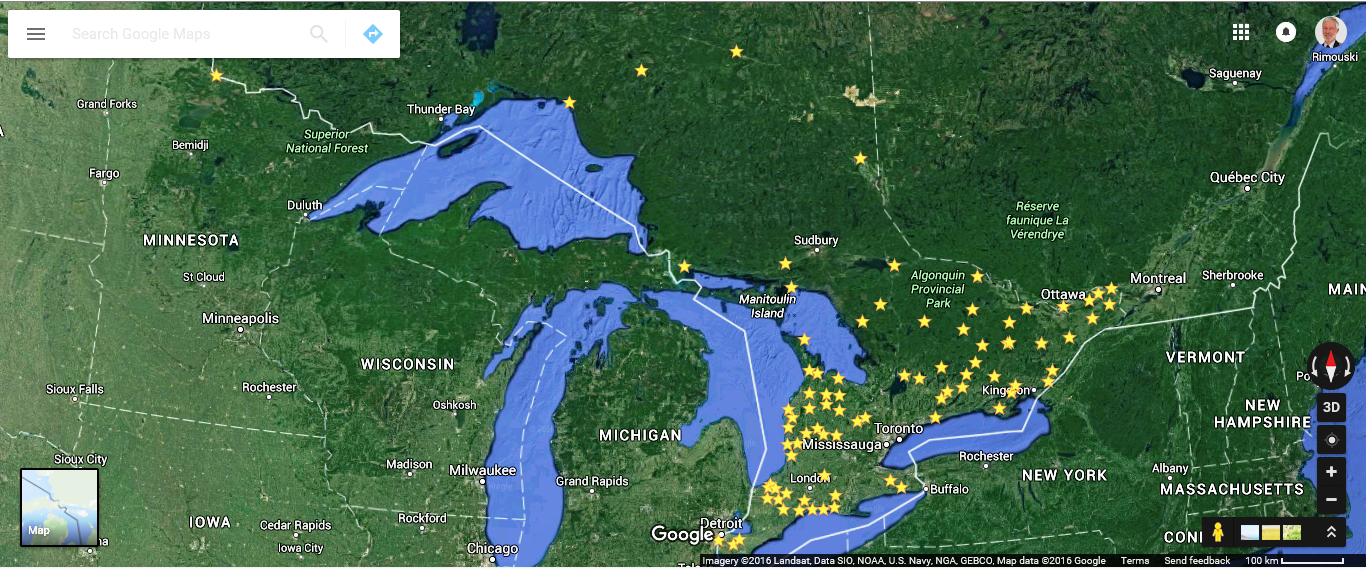
EDP Renewables, headquartered in Madrid, has posted the site plan for its 100-megawatt “Nation Rise” wind power project, in North Stormont, about 40 minutes south and east of Ottawa.
Details posted:
Project Name: Nation Rise Wind Farm
IESO Reference Number: L-006351-WIN-001-100
Project Location: The proposed Nation Rise Wind Farm will be located on private and public lands in the United Counties of Stormont, Dundas and Glengarry in the western portion of the Township of North Stormont, Ontario, and bounded to the south by the Township of South Stormont and to the west by the boundary of the Township of North Dundas. The north portion of the site is delimited by the municipality boundaries of Russell and the Nation. Courville Road and MacMillan Road are the east boundaries of the project.
Dated at: the Township of North Stormont this 17th day of March 2017.
Other project documents including the draft noise impact assessment are available on the Nation Rise wind “farm” website here.
Residents interested in learning more about the impact of the power project on the area’s homes, environment and wildlife, and in supporting the group’s activities and legal fund, should contact the Concerned Citizens of North Stormont*, whose website is here.
The 20-year contract with the Independent Electricity System Operator (IESO) will cost Ontario electricity ratepayers about $436 million.
The Minister of Energy, Glenn Thibeault, has stated, meanwhile, that Ontario currently has a surplus of power (which is being sold off at prices below what power developers are paid). The Nation Rise contract could be cancelled under a pre-construction liability clause for $600,000, according to IESO documents.
Minister Thibeault told a business audience in Toronto last year that the government’s “arbitrary” selection of wind power led to “sub-optimal siting” and “heightened community concerns.”
North Stormont is a Not A Willing Host community.
Concerned Citizens of North Stormont leader Margaret Benke, at a recent information event in Finch, Ontario
*Concerned Citizens of North Stormont is a chapter of Wind Concerns Ontario, as is Ottawa Wind Concerns.
With the Ontario government introducing a new program severing the link between the cost of power and the price of power so it can shift 25 per cent of household power bills today to future generation by way massive new debts, it seems like a good idea to know why Ontario’s power rate crisis developed.
Ontario’s power rates were relatively stable until 2008, when they started steep yearly increases. With the fastest rising rates in North America since then, Ontario’s rates surpassed the U.S. average years ago. The largest single factor driving this increase has been new generating capacity from wind and solar renewable generation.
The Ontario government and its supporters commonly report the costs of different types of generation counting only payments made directly to particular forms of generation.
But, when renewable energy costs trickle down to consumers, those costs are much more than just payments to renewable generators. While it is true that the payments to generators for wind power – 14 cents per kilowatt-hour (kWh) – is cheaper than for gas power — 17 cents/kWh – not all electricity has equal value. (For context, the average rate households pay for the commodity portion of their bill is about 11 cents/kWh.)
Why don’t we replace wind power with gas power, save money and cut emissions?
Where gas power is delivered on demand, wind is fickle. Eighty per cent of Ontario’s wind generation occurs at times and seasons so far out of phase with usage patterns that the entire output is surplus and is exported at a substantial loss or squandered with payments to generators to not generate. Gas power in Ontario backs up unreliable wind and solar, a necessary function if the lights are to stay on, but we pay twice for the same service.
Direct payments to solar generators average 48 cents/kWh, but the output is similarly low value. Except for a few days per year, Ontario’s peak usage of power is just as solar panels shut down – in the evening.
Massive losses through exports
Not only is Ontario’s renewable energy production driving massive losses to subsidize exports and payments to generators to not generate under the terms of contracts that obligate consumers to buy even useless power, but it is also driving costly but low-value “smart grid” projects required to accommodate renewables.
Rising power rates have driven down usage. Spreading rising costs over declining sales has amplified the pace of rate increases.
Again, government and its supporters have pumped their claim that using less will save us money. What has actually happened is that conservation in Ontario is indeed saving money but mostly for utilities and their customers in Michigan and New York State on the receiving end of our subsidized exports.
But didn’t renewables enable Ontario to get off coal, saving us from smog days, and slash health-care costs? Although endlessly repeated by the government and its supporters, none of these claims bear scrutiny.
Coal’s replacement in Ontario was achieved with increased output from nuclear and gas generators. Improvement in air quality in recent years has been the result of a massive conversion to gas power in the mid-western states upwind of Ontario as well as improvements in transportation fleets and industry. Most of the coal power Ontario produced in its last years came from plants with good new scrubbers, delivering effectively smog-free energy. Predicted health-care savings from the coal phaseout never materialized.
But isn’t the cost of renewable energy plunging?
Ten years ago, the average payment to Ontario wind generators was around 8.3 cents/kWh. Taking into account inflation, the average today is up 50 per cent.
Wind and solar aren’t the only renewable energy ripoff. Recent additions to Ontario’s hydro-electric capacity have added billions in new costs but no additional production. Ontario’s most costly generator is a converted coal-fired station in Thunder Bay, now fueled with a wood product imported from Norway.
Punishing contracts in place for 20 years
A bad smell emanates from renewable politics at Queen’s Park. Renewables developers who made the biggest donations to the provincial Liberals have tended to win the biggest contracts.
Ontario’s renewable energy program is not the only disaster on consumers’ bills. Excessive payroll costs and wasteful conservation programs also lurk, but no single factor has contributed more to the compounding semi-annual increases in rates since 2008 than renewables.
Most of the punishing cost consequences of Ontario’s radical renewables program are locked in with 20-year contracts. Children today will be paying these irresponsible contracts long into the future, along with current costs that the Wynne government has now decided will be added to this future burden.
Tom Adams is an independent energy and environmental advisor and researcher focused on energy consumer concerns, mostly in Eastern Canada. He has worked for several environmental organizations and served on the Ontario Independent Electricity Market Operator Board of Directors and the Ontario Centre for Excellence for Energy Board of Management.
Wind power contracts should be cancelled to control electricity costs: Mike Baggott of Ottawa Wind Concerns
Ottawa Wind Concerns was an invited guest speaker this week at a pre-budget consultation event held by Nepean-Carleton MPP Lisa MacLeod, at the Alfred Taylor Centre in North Gower.
Executive member with the group and North Gower resident Mike Baggott told the audience that while Ontario’s electricity bills are among the highest in North America, more costs, specifically expensive wind power contracts awarded to power developers, were yet to come.
“Everyone wants to do the right thing for the environment,” Baggott explained, “but has the Ontario government done the right thing?” Two Auditors General said there was never any cost-benefit or impact analysis for the province’s green energy plan, and the Wynne government pays twice as much for renewable energy as other jurisdictions do. The expensive wind contracts are among the factors pushing electricity bills up.
“As high as our bills are now,” Baggott said, “they will get worse if projects in Ontario recently awarded contracts are allowed to proceed.”
He noted the power projects in La Nation, east of Ottawa, and North Stormont –both opposed by the local communities — will cost Ontario ratepayers over $600 million for the 20-year contracts.
In all, Ontario is facing $5 billion in new wind power contracts, at a time when the province has a surplus of power. Wind power also cannot demonstrate any benefits to the environment, Baggott said.
“It’s time to stop digging the hole,” Baggott concluded.
The main speaker at the event was Parker Gallant, a former banker whose energy sector analysis is frequently published in The Financial Post, who explained line by line, “What’s in Your Hydro Bill.”
MPP MacLeod outlined steps that can be taken to control electricity costs, and answered questions from the audience.
“It’s hard not to get depressed when you hear, line by line, how we got here with our electricity bills,” commented Rideau-Goulbourn councilor Scott Moffatt.
Parker Gallant: what’s in your hydro bill? A lot of government mistakes
This past week, Zoomer Media hosted a panel discussion on Ontario’s growing electricity rates which the media organization (affiliated with the Canadian Association of Retired Persons/CARP) says is adversely affecting seniors and others on fixed incomes.
Energy analyst Tom Adams was one of the panel members, who called on the government to rescind the Green Energy Act, which he says is at the core of the problems today. Wind power produces only 6 percent of the Ontario supply, he said, but at 30 percent of the cost.
McMaster University professor Marvin Ryder agreed that expensive contracts were a problem but he said the damage has been done, and it will be 10 years before Ontario can climb out of the hole.
NDP leader Andrea Horwath said she still supports the Green Energy Act, but suggested creating subsidies for everyone having problems paying their electricity bills. (The cost of that would be …. added to the bills…)
The Ontario government awarded five contracts for new wind power generation in 2016, including two in the Ottawa area. The cost of these projects is about $1.3 billion. If the projects proceed (they do not yet have Renewable Energy Approvals/REA), the cost will be a further addition to Ontario electricity ratepayers’ bills.
Ontario’s electricity bills are the fastest rising in North America, with rates increasing year over year. While the government talks about “relief,” it is not doing anything substantial to help.
Here is the news from Eastern Ontario, as reported in the Brockville Recorder and Times.
Leeds-Grenville councillors say rural electricity rates are negatively impacting their constituents, farmers and businesses, although Burnbrae Farms – one business cited by council members as a victim of high rates – says electricity costs were not behind its recent decision to expand its operations out of province. The Burnbrae operation near Lyn is shown on Tuesday morning, Feb. 7, 2017. (Ronald Zajac/The Recorder and Times)
Frustration at Ontario’s high hydro rates boiled over at a United Counties meeting Tuesday as mayors railed against an “out-of-touch” provincial government that is indifferent to the plight of rural Ontarians.
“Seniors are losing their homes, seniors are going to food kitchens,” said Mayor David Gordon of North Grenville, who said he knows of 89- and 90-year-old farmers in his township who have to continue to work because they can’t afford their electricity bills.
Gordon said that if Americans were experiencing the same increasing power rates as in Ontario they would be demonstrating and rioting in the streets.
“Up here it’s just ‘deary, deary me’,” he said. “What’s going to happen when somebody dies because they don’t have any heat?”
Augusta Mayor Doug Malanka said the government has failed to consider the unintended consequences of high hydro rates.
As an example, Malanka cited the Prescott Curling Club, which has complained to the Ministry of Sport, Tourism and Culture that its escalating power bills put the future of the club in doubt.
Malanka said the club did extensive energy-saving upgrades to its rink several years ago. Despite this, the club’s power bill increased by $13,000 over an 18-month-period, bringing it to $25,000 annually, he said, noting that the rink operates only six months a year.
Club president Ron Whitehorne said the hydro bill now accounts for half of the club’s budget, and the rates continue to rise despite the $120,000 spent on renovations to make the rink more energy-efficient.
The rising rates, coupled with the depletion of the club’s capital reserves to pay for the improvements, has put a real squeeze on the volunteer-run club, Whitehorne said.
Malanka said counties mayors raised the hydro issues with Liberal MPP Bob Delaney, parliamentary assistant to the energy minister, at a meeting during last week’s Rural Ontario Municipal Association conference. Delaney was initially defensive about the mayors’ complaints, Malanka said, but he later agreed to a followup meeting with counties’ representatives. Warden Robin Jones agreed to contact Delaney to arrange a followup meeting.
Gordon said that the Liberal government has lost touch with the average Ontarian.
“These people living in Toronto don’t care because they are living in their fancy condo on the 27th floor,” he said.
Rideau Lakes Mayor Ron Holman, who chairs ROMA, said the Ontario government needs to set “predictable, prudent, long-term” hydro rates so that businesses and residents can plan for the future. Instead, the government seems to be taking an ad-hoc approach to hydro by fiddling with rates in response to the “flavour of the day,” he said.
Holman said Ontario Premier Kathleen Wynne is continuing to promise “adjustments” to hydro rates in the next budget.
“What does that mean? I have no idea. What assurance does that give to individuals or businesses that want to come to our community? It doesn’t,” he said.
Several mayors pointed to Burnbrae Farm’s decision to build new hen houses in Quebec, instead of Ontario, as a consequence of high energy costs. They were basing their comments on a news report that said the egg producer, which is centred in the United Counties of Leeds and Grenville, was expanding to Quebec to escape Ontario’s hydro rates.
But Margaret Hudson, president of Burnbrae Farms Ltd., flatly denied that hydro rates played a part in the decision.
“The cost of electricity was never a factor in our decision on where to locate our new farm,” Hudson said in a statement Tuesday.
Special guest will be Parker Gallant. Mr Gallant’s commentary on energy issues is regularly published in The Financial Post and other media; he is a former international banker and vice-president at Toronto Dominion Bank. He is vice-president of Wind Concerns Ontario.
Parker Gallant
The second event will be in early March, location TBA.
Public declaration demands cancellation of wind power procurement, and re-focus of energy policy by the Wynne government
Mayor Ron Higgins: representing 25% of Ontario municipalities in fight against Green Energy Act (Photo CBC)
January 9, 2017
The Ontario Multi Municipal Group has issued a public declaration stating it wants the “exploitation” of rural Ontario by the wind power industry, aided by the Ontario government, to end.
“The implementation and expansion of renewable energy (industrial-scale wind turbines and large solar power projects) has developed to the point that it has caused hydro costs to increase, caused a division between rural and urban municipalities, and caused the citizens of Ontario to lose faith in democracy,” says Ron Higgins, Mayor of North Frontenac, in the document.
The municipal group was formed at the last meeting of the Association of Municipalities of Ontario (AMO) after 115 municipalities, or 25 percent of all municipalities in Ontario, passed resolutions demanding that municipalities get final say in the siting of renewable power projects.
“We are now speaking out on behalf of all those communities,” Higgins says.
Rights of communities ‘neutralized’
The Green Energy Act of 2009 removed the right to carry out local land-use planning for power projects –the Multi Municipal Group says that’s wrong. “It neutralizes the rights of residents of rural Ontario to advocate for, rely on and claim the benefit of sound land-use planning principles,” Higgins says. “It amounts to a form of discrimination.”
In the public declaration document, the group lists the impact of Ontario’s wind power program, saying it has not brought the economic benefits promised by the McGuinty government and in fact has resulted in an economic burden and energy poverty. They also say that no environmental benefit has been demonstrated and that “the natural world is suffering” because of large-scale turbines which are disrupting the natural environment and harming wildlife such as migratory birds and endangered species of bats.
Wind power a ‘false hope’ for the environment
Wind power has created “false hope” of steps to be taken to combat climate change and protect the environment, says the Multi Municipal Group. And, the Government of Ontario has ignored knowledge of the negative impacts of invasive wind power technology.
The group demands that all procurement of wind power be stopped, and the Green Energy Act repealed. They also recommend that the government base future policies on generation capacity and conservation, and use current energy supply assets.
“Our rural communities are unprotected against the exploitation [by] renewable energy,” Higgins concludes. The municipalities have no choice but to declare their position to the government and the public formally.
Former banker and now energy analyst Parker Gallant has prepared a summary of submissions to the Ontario Ministry of Energy, which last fall asked for input to a new Long-Term Energy Plan (LTEP).
Aside from the vested interests in wind power, the stakeholder groups like the Canadian Federation of Independent Business, Canadian Manufacturers and Exporters, and the Ontario Society of Professional Engineers all recommended the government act now to get costs down. And that includes, getting rid of wind power.
From the article, an excerpt on two of the submissions made to the government.
Strategic Policy Economics – Marc Brouillette’s excellent submission on behalf of Bruce Nuclear also carries some sane observations such as “Wind generation has not matched demand since its introduction in Ontario” and, “Over 70% of wind generation does not benefit Ontario’s supply capability.” And this one, which is becoming more evident as ratepayers are forced to pay for curtailed generation: “Wind generation will not match demand in the OPO Outlook future projections as 50% of the forecasted production is expected to be surplus.”
The recommendation that will cause the most handwringing will be: “The LTEP should integrate the objectives of Ontario’s environmental, energy, industrial, and economic policies for the long-term future benefit of Ontarians.”
Wind Concerns Ontario – The coalition of community groups and individuals throughout Ontario had this to say by way of advice to the Ministry: “The government policy to promote “renewables” such as wind and solar have been a critical factor in the grave economic situation today. Wind power for example, now represents 22% of electricity cost, while providing only 5.9% of the power. Worse, that power is produced out-of-phase with demand, as has been detailed by two Auditors General; so much of it is wasted. This is unsustainable.
“Clearly,” WCO continued, “the direction for the Ministry of Energy is to formulate a new Long-Term Energy Plan that will take immediate action on reducing electricity costs. Those actions must include a review of all contractual obligations for power generation from wind, and action to mitigate further costs to the system, and the over-burdened people of Ontario.”
WCO called for cancellation of all the wind power contracts given in 2016, the FIT 5.0 program, and further, cancellation of all contracts for projects not yet built or which are not going to make a critical commercial operation date. In fact, all wind power contracts should be reviewed and paid out, as Ontario can save money by eliminating the need to dispose of the surplus electricity.
WCO vice-president Parker Gallant and president Jane Wilson speak on Ontario’s mismanaged electricity sector, energy poverty, wind turbine noise regulation, and what’s ahead for 2017
(C) Wind Concerns Ontario
YEAR-END INTERVIEW
Q:You’ve been telling people about the impact of renewables, specifically wind power, on Ontario’s electricity or hydro bills. How much of our electricity bills is due to the wind power/renewables program in Ontario?
Parker Gallant: I recently reviewed the cost of wind and solar generation relative to its contribution to Ontario’s demand for electricity and its impact on our electricity costs is shocking. Wind and solar in the first six months of 2016 delivered 8% of our generated power and represented 35% of the Global Adjustment which appears set to average over $1 billion per month. That represents a cost of over 36 cents a kilowatt hour (kWh), including the hourly Ontario energy price (HOEP).
Parker Gallant at a recent event in Kanata, Ontario: shocking mismanagement. [Photo: Metroland Media]
Q: Parker, you’ve also been telling people about the Global Adjustment or GA, which is where a lot of charges are hidden. Do you think these charges should be detailed on our bills, or is that even possible?Parker Gallant: While I believe in principle the GA should be revealed on our monthly bills, in practice, that would require reams of paper. How will the local distribution company explain how much you are billed for curtailed wind generation or the meteorological stations that measure the amount of curtailed wind that might have been generated? How to explain, say, the cost of spilled hydro or steamed off nuclear or the water fuel fee, or how to tell the ratepayer how much they are subsidizing the rates for large industrial clients, or what it is costing under the rural and remote rate plan (RRRP) that transports diesel fuel to remote First Nations, among dozens of other items included in our monthly bills?
Q: The Premier and Energy Minister are now saying that parts of their policies have been a “mistake” and that they need to get bills down. Wind Concerns is saying that canceling wind power contracts is necessary for that to happen. Can you explain? How much are the 2016 contracts worth?
Parker Gallant: Interesting they are now admitting a “mistake,” but when George Smitherman was Energy Minister he was provided with a long-term energy plan that had been carefully developed by “experts” within the crown agencies. He chose to cancel the plan and instead, impose one developed in conjunction with outsiders who were NOT experts. Previous Energy Ministers (Dwight Duncan comes to mind for his “smart meter” for every ratepayer) made mistakes, as did those who followed such as Brad Duguid and were roundly criticized by both the media and by ratepayers. The canceling of wind power projects not yet built or even contracted is only “step one” and will slow the climb in our bills. The current Minister, Glenn Thibeault has only suspended Large Renewable Procurement or LRP ll, and needs to cancel it, as well as LRP I and any of those contracts now past their agreed-to start date. There are ways to reduce costs almost immediately.
Jane Wilson: Wind Concerns Ontario prepared a detailed document for the IESO on the Long-Term Energy Plan, suggesting ways they could save $1.7 billion annually. That would have an immediate cost reduction impact.
Q: The Energy Minister says that now, Ontario is a “net exporter” of electricity like that’s a good thing. He claims we’re making money: is that true?
Parker Gallant: Being a “net exporter” of 16.8 terawatts (TWh) in 2015 is simply a demonstration of being a bad planner and manager of the system. If one adds the spilled hydro and curtailed wind to the net exports, the 21.2 TWh could have provided over half of all average Ontario households with power for a full year, yet we sold it 2.36 cents/kWh while we paid 10.14 cents/kWh for its generation. Ontario contracted for far too much intermittent and unreliable wind and solar power creating a domino effect the increased our costs of generation. Paradoxically, if Ontario ratepayers consumed more of the annual excess power (15.5% in 2015) it would help reduce our per kWh cost.
Q: What is WCO’s stance on climate change?
Jane Wilson: Our position is that everyone wants to do the right thing for the environment, whether that is preventing air pollution or using the most efficient forms of power generation — but that isn’t industrial-scale wind. For example, the Ontario Society of Professional Engineers or OSPE says that the proliferation of large-scale wind will actually increase greenhouse gas emissions, therefore not achieving the government’s stated goals. In the OSPE’s most recent report, they say “Wind generation offers less GHG reduction value in Ontario because base-load generation is already carbon-free and wind generation often displaces hydroelectric and nuclear base-load generation.”
Q: Why does the Ontario government continue to force wind turbines on communities that don’t want them?
Jane Wilson: The government is acting on an ideology that is not supported by fact and to do that, it erased communities’ right to local land-use planning with the Green Energy Act. We think that’s wrong, and are supporting the now 116 municipal governments that have demanded a return of that control and also that community support be mandatory for wind power contracts. There is a concern too about communities in the North where there may not be elected municipal governments, where contracts can be awarded for wind power projects that have a significant negative impact on the natural environment, for little or no benefit.
WCO worked with Ontario municipalities on the mandatory support resolution.
Q:Can the government really cancel wind power contracts? Can a new government cancel the subsidy programs?
Jane Wilson: Yes. There are clauses in the contracts under LRP I that are “off-ramps” in the case of cancellation, and which set out the financial steps needed to do that. For example, the contract with EDP for the “Nation Rise” project south of Ottawa in North Stormont, worth $430 million over 20 years, would cost $250,000 plus reimbursement for development costs that must be justified, to a maximum of $600,000. And yes, government can cancel subsidy programs. The LRP II, now “suspended”, should be cancelled outright.
The other opportunity is to cancel wind power projects that do not have a “Notice-to-Proceed”: this is straightforward. WCO has also suggested to the IESO that the government look seriously at all contracts and review them for opportunities to cancel. Even costly negotiated buy-outs will reduce hydro costs significantly, due to the high cost of disposing of surplus power.
Q: What is WCO doing to help people already living with wind turbines, and the noise they produce?
Jane Wilson: We support the public health investigation being done by the Huron County Health Unit, and hope that other municipalities will take similar action. We are also looking at how research can be done to help change the Ontario regulations on noise –which are not based on current science and in fact, are completely inadequate to protect health. We prepared a detailed document on how to revise noise enforcement regulations, another on how the approval process must be changed to protect health, and we submitted a document to the World Health Organization which is preparing global noise regulations for wind turbines. In short, we take every opportunity possible to explain the situation for people living in communities where wind turbines and their noise emissions have been forced, without consent, on the people of Ontario, with the goal of having regulations and processes changed.
Jane Wilson: Wind Concerns Ontario is not stopping [Photo: Julie Oliver, Ottawa Citizen]
Q: What’s ahead in 2017?Jane Wilson: It’s a very different world for wind power now, than in 2009 when the Green Energy Act was passed. People are genuinely questioning the benefit of high-impact, large-scale wind power development, especially when there seem to be few, if any, benefits, and we are seeing the shocking results of the government’s complete mismanagement of the electricity sector such as lost jobs and rising energy poverty. We believe the government will have to take dramatic action if it is serious about getting electricity bills down. The fact that Ontario municipalities are speaking out on this issue and taking action will also have results, we believe. We are hoping for a complete halt to the ongoing damage of the government’s policies, and that there will be help for people already living with the noise and other impacts of industrial-scale wind turbines.
As for Wind Concerns Ontario, we are not stopping our work.
Wind turbine noise adversely affects people and the environment
Here is a paper from the Energy Collective, which includes a summary of noise regulations and setbacks. The writer’s conclusion is that worldwide regulation is needed, otherwise local regulation of noise is developed, with heavy influence from the wind power industry.
3-MW turbine south of Ottawa at Brinston: Ontario. Worldwide regulation needed to prevent wind industry influence [Photo by Ray Pilon, Ottawa]
December 19, 2016
Willem Post
Europe and the US have been building onshore wind turbine plants in rural areas for more than 25 years. Anyone living within about 1.0 mile of such plants would hear the noises year-round, year after year. Those nearby people would be experiencing:
Decreasing property values.
Damage to their health, due to lack of sleep and peace of mind.
Living with closed windows and doors, due to year-round noises.
Exposure to infrasound.
The wind turbine noise problem is worldwide. Due to a lack of worldwide guidelines, various political entities have been developing their own codes for the past 30 years. The World Health Organization is finally addressing the lack of detailed guidelines regarding such noises.
World Health Organization Noise Guidelines: WHO, publishes detailed guidelines regarding various, everyday noises, such as near highways and airports, within urban communities and in work places. The guidelines serve as input to local noise codes.
In general, wind turbines are located in rural areas. When they had low rated outputs, say about 500 kW in the 1960s and 1970s, they made little audible noise, and the infrasound was weak. However, when rated outputs increased to 1000 kW or greater, the audible and infrasound noises became excessive and complaints were made by nearby people all over the world.
Worldwide guidelines regarding wind turbine noises are needed to protect nearby rural people, such as regarding:
The maximum outdoor dBA value, how that value is arrived at, such as by averaging over one hour, where that value is measured, such as near a residence, or at the resident property line to enable that resident to continue to enjoy his entire property.
How to measure, or calculate the outdoor-to-indoor sound attenuation of a residence.
How much setback is needed, such as one mile to minimize infrasound impacts on nearby residents.
The maximum dB value of infrasound, how that value is arrived at, where that value is measured.
How to determine the need for a 5 dB annoyance penalty.
The lack of such guidelines has resulted in various political jurisdictions creating their own codes. That process has been heavily influenced by well-financed, pro-wind interests, which aim to have the least possible regulation to maximize profits.
Comparison of Wind Turbine Codes: Below are some highlights from the noise codes of various political entities to illustrate their diversity:
1) DENMARK: Because Denmark was an early developer of wind turbine plants, its noise code is more detailed than of most political entities. It has a buffer zone of 4 times total height of a wind turbine, about 4 x 500 = 2,000 ft, about 0.61 km (no exceptions), and it also has the following requirements regarding outdoor and indoor noise:
OUTDOOR
For dwellings, summer cottages, etc.: 39 dBA (wind speeds of 8 m/s, 18 mph) and 37 dBA (wind speeds of 6 m/s, 13 mph)
For dwellings in open country: 44 dBA (wind speeds of 8 m/s) and 42 dBA (wind speeds of 6 m/s)
The belowregulations describe the methods and time periods over which sounds are to be measured:
Page 4, par 5.1.1 mentions averaging over various periods. Only the worst average readings of a period are to be considered for compliance.
Page 4, par 5.1.2 mentions a 5 dB annoyance penalty must be added to the worst average readings for a period for clearly audible tonal and impulse sounds with frequencies greater than 160 Hz, which would apply to wind turbine sounds.
Page 6, par 5.4 mentions limits for indoor A-weighted low frequency noise 10 – 160 Hz, and G-weighted infrasound 5 – 20 Hz.
“If the perceived noise contains either clearly audible tones, or clearly audible impulses, a 5 dB annoyance penalty shall be added to the measured equivalent sound pressure level” That means, if a measured outdoor reading is 40 dBA (open country, wind speed 6 m/s), and annoyance is present, the reading is increased to 45 dBA, which would not be in compliance with the above-required 42 dBA limit.
In some cases, a proposed wind turbine plant would not be approved, because of the 5 dB annoyance penalties. The noise of wind turbines varies up and down. The annoyance conditions associated with wind turbines occur year-round. The annoyance conditions associated with other noise sources usually occur much less frequently.
NOTE: The 5 dB penalty does not apply to indoor and outdoor low frequency and infrasound noises, i.e., 160 Hz or less.
INDOOR
– For both categories (dwellings, summer cottages, etc.; open country), the mandatory limit for low frequency noise is 20 dBA (Vermont’s limit is 30 dBA), which applies to the calculated indoor noise level in the 1/3-octave bands 10 – 160 Hz, at both 6 and 8 m/s wind speed. The purpose of the regulation is to ensure neither the usual noise, nor the low frequency noise, will annoy nearby people when the wind turbines are in operation.
Denmark’s Controversial Noise Attenuation Calculations: The controversy in Denmark is regarding the Danish EPA assuming high attenuation factors for calculating attenuation from 44 dBA (outdoor) to 20 dBA (indoor, windows closed) for frequencies above 63 Hz, which yield calculated indoor noise levels less than 20 dBA. The Danish EPA prefers assuming high factors, because they result in compliance, which is favorable for wind turbines.
However, acousticsengineers have made indoor field measurements (supposedly “too difficult to measure”, according to the Danish EPA), which indicate many houses near wind turbine plants have lower than assumed attenuation factors, which results in indoor noise levels greater than 20 dBA, i.e., non-compliance, which is not favorable for wind turbines.
However, the final arbiters should not be government personnel using assumptions, but the nearby people. Increasingly, those people are venting their frustrations at public hearings and in public demonstrations.
2) POLAND is considering a proposed a law with a 2.0 km (1.24 mile) buffer zone between a wind turbine and any building. That means at least 65% of Poland would be off limits to wind turbines. Future wind turbine plants likely would be offshore. …






![Parker Gallant at a recent event in Kanata, Ontario: shocking mismanagement. [Photo: Metroland Media]](http://www.windconcernsontario.ca/wp-content/uploads/2016/12/ParkerGallantTownHall-MetrolandPic.jpg)
![Jane Wilson: Wind Concerns Ontario is not stopping [Photo: Julie Oliver, Ottawa Citizen]](http://www.windconcernsontario.ca/wp-content/uploads/2016/12/002.jpg)
![3-MW turbine south of Ottawa at Brinston: Ontario. Worldwide regulation needed to prevent wind industry influence [Photo by Ray Pilon, Ottawa]](https://ottawawindconcerns.com/wp-content/uploads/2015/12/brinstoniwt-raypilon.jpg)

