• About
  • Donate!
  • EVENTS
  • Ottawa’s “Energy Evolution”: wind turbines coming to rural communities
  • Thinking of signing a wind turbine lease?
  • Wind Concerns Ontario
  • Wind turbines: what you need to know

Ottawa Wind Concerns

~ A safe environment for everyone

Ottawa Wind Concerns

Tag Archives: wind farms

Ontario power system mismanagement affects you

25 Monday Jan 2016

Posted by Ottawa Wind Concerns in Renewable energy, Wind power

≈ 2 Comments

Tags

Ontario, Parker Gallant, surplus power, Wind Concerns Ontario, wind energy, wind farm contracts, wind farms, wind power, Wynne government

What would your family have done with the money you paid--and the government wasted on its green energy policy last year?

What would your family have done with the money you paid–and the government wasted on its green energy policy last year?

January 23, 2016

This “Op-Ed” appears in the current edition of Ontario Farmer. It is not available online.

Good money after bad: how mismanagement of Ontario’s power system affects you

By Parker Gallant

It’s been several months now since the Auditor General of Ontario released her 2015 report, in which she levelled scathing criticism of how the Ontario government has mismanaged the electricity sector. In what will be her last report to include the management of Hydro One because the government has partially privatized the electricity distributor, Auditor General Bonnie Lysyk condemned the planning and policy implementation processes that have resulted in Ontario’s electricity consumers paying too much for power.

The report made specific mention of the fact that Ontario has a surplus of power, a situation that is likely to continue, if the government continues to give out expensive contracts for “renewable” power sources wind and solar, which provide only a small amount of Ontario’s power and then only intermittently.

The Auditor General said, “The Ministry’s attractive guaranteed prices program has been one of the main contributors to the surplus power situation Ontario has faced since 2009, in that it has procured too many renewable projects, too quickly, and at too high a cost.” The Auditor General’s office also found that Ontario paid “double the current average cost” in North America for wind power.

Her estimate was that Ontario’s electricity customers paid out $9.2 billion just for wind and solar contracts. Worst of all, perhaps, is the fact that Ontario is paying top dollar for renewables –and then selling the power at bargain bin prices—because of the power surplus.

Readers may recall that in most parts of Ontario, we had a very windy Christmas Eve. That breezy situation cost us plenty; because we are forced to buy wind power even when we don’t need it, wind power makes up a substantial portion of the surplus power we sell off. On Christmas Eve, that was about $9.4 million, which is not counting what we paid Bruce Nuclear to “steam off” power, or what we paid some wind power producers to limit or “curtail” power production.

What would your local hospital have done with even a small part of that $9.4 million?

What could Ontario have done with the $339 million the Auditor General says we paid for curtailing surplus electricity between 2009 and 2014?

What would you have done with the $360 extra you paid last year (assuming you use only 800 KwH per month of power)?

Read the full article here. Good money after bad-January7

Parker Gallant is a former vice-president with TD Bank. He resides in Prince Edward County, and is vice-president of Wind Concerns Ontario.

Who pays for turbine take down? Not clear says lawyer

14 Thursday Jan 2016

Posted by Ottawa Wind Concerns in Renewable energy, Wind power

≈ 3 Comments

Tags

Eric Gillespie, Farmers Forum, municipal liability wind farms, wind farm leases, wind farm liability, wind farms, wind power, wind turbine leases, wind turbines

Who pays for wind turbine teardown? Not clear, says lawyer

"No pocket to go to in 20 years": wind turbine teardown can cost thousands
What goes up must come down

“No pocket you can go to in 20 years”: Environmental lawyer says taxpayers and landowners could be responsible for costs

Farmersforum.com , January 2016

By Brandy Harrison

Toronto- With more wind turbines coming to Eastern Ontario, there has been a lot of talk about what happens when it comes time to take down the towers. While the provincial government may put the onus on wind project developers to pay for teardown, it’s far from certain they’ll be able to collect if a company goes bankrupt — which could mean taxpayers are on the hook, says a Toronto-based environment and municipal lawyer.

“Many of these companies are relatively small, or based outside of Canada, and that creates what appears to be a real risk as there will be no pocket you can go to 20 years from now when a cleanup is actually required,” says Eric Gillespie, who has represented landowners and municipalities with wind turbine concerns.

It’s anybody’s guess who would end up paying for decommissioning — the landowner, the municipality, or provincial taxpayers, he says.

Farmers shouldn’t underestimate what it takes to remove a single turbine, Gillespie warns. The nacelle — the central hub containing the generator — is 80 to 100 metres in the air and weighs as much as 70 tonnes. “It’s not something where you just call your neighbor and ask him to bring his tractor over.”

While Ontario costs are yet unknown, world-wide decommissioning has ranged from $30,000 to $80,000 per turbine.

But the worst case scenario can be avoided if funds are set aside as part of the approval process, suggests Gillespie.

Decommissioning plans are required to get renewable energy approval but they don’t have financial strings attached.

There is already a good model in place, says Gillespie. Under the Environmental Protection Act, the government will ask for financial assurance if there is a risk of adverse effects that could require remedial work. A letter of credit or security is required up front.

“Anything other than that might keep lawyers busy for a long time but won’t help communities. It’s about addressing the issue now rather than waiting for the end and crossing your fingers. It should be the companies that are earning the profits that have to pay the bill.”

Don’t repeat Ontario’s wind farm mistakes: Den Tandt to Liberals

01 Tuesday Dec 2015

Posted by Ottawa Wind Concerns in Health, Renewable energy, Wind power

≈ 1 Comment

Tags

green energy, Green Energy Act, Michael Den Tandt, wind farm noise, wind farms, wind power, wind power cost, Wynne government Ontario

3-MW turbine south of Ottawa at Brinston: Ontario not protecting citizens or economy [Photo by Ray Pilon, Ottawa]

3-MW turbine south of Ottawa at Brinston: Ontario not protecting citizens or economy [Photo by Ray Pilon, Ottawa]

From Wind Concerns Ontario http://www.windconcernsontario.ca

Writing in yesterday’s National Post and for Postmedia, Michael Den Tandt puts the climate change discussion into perspective and in particular, has some advice for the new federal government on “clean” energy:

The Liberals will also need to take pains to avoid the multi-billion-dollar waste and anti-democratic outrages of Ontario’s Green Energy Act, which foisted inefficient, hugely expensive and environmentally harmful wind turbines on rural communities that in many cases did and do not want them.

Expensive.

Inefficient.

Actually harm the environment they are supposed to be saving—that’s the lesson to be learned from Ontario about wind turbines. Only Ontario hasn’t learned it, as the government contracts for 300 more megawatts of wind in 2015 (well, turns out we have to wait now until 2016 to learn which communities are on the chopping block), and another 200 megawatts in 2016.

Worse, Big Wind has convinced the Ontario government that the 3-megawatt machines are actually “quieter” and so, new regulations for turbine noise, to be released shortly, will have zero mention of low-frequency noise or infrasound, because Big Wind says it isn’t a problem. Meanwhile, anecdotal reports out of communities where the 3-megawatt behemoths have begun operating show that people are getting sicker, faster.

Analysts such as Tom Adams, Scott Luft and Parker Gallant repeatedly offer data that shows wind power is not only high impact on the environment it is for very little benefit, and is costing Ontario in terms of competitiveness, and standard of living.

Ontario has a lot to learn, not the least of which is how to protect its citizens.

Reasons for Nov 1 hydro rate increase not transparent

17 Saturday Oct 2015

Posted by Ottawa Wind Concerns in Renewable energy, Wind power

≈ 1 Comment

Tags

electricity bills Ontario, green energy, hydro bills Ontario, Ontario, Ontario economy, Ontario Energy Board, Parker Gallant, power exports Ontario, surplus electricity Ontario, Wind Concerns Ontario, wind farms, wind power, Wynne government

Wind? You pay. No wind? You pay. And pay.

Wind? You pay. No wind? You pay. And pay.

Reposted from Wind Concerns Ontario

The OEB hides the truth on rate increases

The Ontario Energy Board (OEB) reported their semi-annual bad news via the News Release that always contains depressing announcements about upcoming rate increases.   Couched in words meant to assuage the reader, is this statement: “The price is increasing by approximately $4.42 per month on the ‘Electricity’ line, and about 3.4% on the total bill, for a household that consumes 800 kWh per month.”

The OEB doesn’t issue a press release when your local distribution company increases their rates, part of the “total bill,” so that reference is meaningless.

If you look at the actual price rise from November 1, 2014 to November 1, 2015 the increase is considerably more than 3.4%.   In fact the increase on the charge for the “Electricity” line is 12.8% excluding the HST applied on that increase.   The charge for electricity for the “household that consumes 800 kWh per month” increased by a total of $130.31, not the $53.04 that the OEB infers.   Even using the “average” RPP (regulated price plan) posted on their site and comparing November 1, 2014 to November 1, 2015, you get an increase of 12.5%!

Costs from renewables are one-third of the increase

Looking further that what’s in the OEB News Release, we find that they attribute the increase as follows: “Increased costs from Ontario Power Generation’s (OPG) nuclear and hydro-electric power plants make up about 40% of this increase. Costs from renewable generation sources are another driver, representing about one-third of the increase.” I emphasized the last sentence as it doesn’t reflect certain facts about renewable generation (principally wind and solar), including the need to pay OPG for spilled (unused) hydro power, payments to gas plants to idle (ensuring power is available when the wind dies down or the clouds cover the skies), or directions to complete marginal generation (Mattagami’s project cost was $2.6 billion) which produces power when it’s not needed, in the Spring and Fall periods when Ontario’s demand is low.

Millions lost in one day

You need only look back to October 13, 2015, a windy day when the industrial wind turbines were cranking out unneeded power. The reported 3,450 MW of wind capacity was spitting out an average of 2,200 MW per hour, at a cost for the whole day of $6.5 million. Ontario was busy exporting 2,228 MW every hour that day, being paid 1.8 cents a kWh and at the same time, paying wind developers an average of 12.3 cents per kWh—we lost more than $5.5 million. That’s just one day!

Now if the OEB were really transparent, they would bring these issues to the forefront.   At a minimum, the people who write news releases for the OEB should also be required to take some remedial math courses!

Ontario electricity customers should demand that the Ontario Energy Board, whose mission is to “regulate prices in the public interest,” demonstrate factual reporting and provide consumers with the truth about rate increases.

© Parker Gallant,

October 16, 2015

Fixing a bad law: lawyers collaborate to fight Green Energy Act

24 Thursday Sep 2015

Posted by Ottawa Wind Concerns in Renewable energy, Wind power

≈ Leave a comment

Tags

Environmental Review Tribunal, Green Energy Act, legal action wind farms, opposition to wind farms, prince Edward County, Renewable Energy Approvals Ontario, wind farms, wind power, wind power developer profits, windmills, WPD Canada


Wellington Times, September 23, 2015

Legal minds collaborate to restore rights and safeguards diminished by the Green Energy Act

The Green Energy Act (GEA) is the target of a proposed judicial review to be launched this fall. CCSAGE Naturally Green, a not-for-profit public interest corporation led by its directors Anne Dumbrille, Alison Walker and Garth Manning, believe the GEA is a fundamentally flawed piece of legislation. They argue the GEA tramples rights and freedoms, punishes rural Ontarians, contravenes statutes and conventions the province is bound to uphold, and, at its core, is fundamentally unjust.

One example: Currently, wind developer wpd Canada is appealing a decision, made under the provisions of the GEA, permitting it to build 27 of 29 industrial wind turbines it proposes in South Marysburgh. In making this appeal, the developer is allowed to make a wide range of arguments and present evidence in its favour. It will certainly argue that the decision will impair its ability to make money from the project. It may argue that the heritage value of the nearby properties has been overstated. It is likely to argue many things. Because it can.

Meanwhile, opponents of the project are permitted only to object on the basis that the project will cause serious harm to humans or serious and irreversible harm to plant life, animal life or the natural environment.

The developer is granted unlimited scope to argue in favour of its profit, while residents are restricted to just two near-impossible tests. The province designed the GEA this way.

Alan Whiteley, a lawyer acting for CCSAGE, considers the GEA a fundamental assault on the rights, freedoms and statutes that have been constructed to protect citizens and the environment from this kind of overreach by government. It is something, he argues, we must all resist.

Specifically he is asking the courts to examine the process by which the province reviewed and ultimately granted the renewable energy approval (REA) to wpd Canada for its White Pines project in South Marysburgh.

“We believe there is a reasonable apprehension of bias in the process,” said Whiteley. “The GEA has created a minority—residents of rural Ontario—and has taken away our right to object except for the narrowest of grounds.”

He argues that the Environmental Review Tribunal (ERT), as the sole appeal mechanism of an REA is a product of this bias.

He explains that under administrative law, the Ministry of Environment’s director plays a quasijudicial role—examining and weighing evidence and reaching a decision, for example, to grant a wind developer an approval, which could include a permit to “harm, harass and kill” an endangered species. But as citizens, we are precluded from knowing how that decision was reached— or whether it was fair.

To assist CCSAGE scale this legal mountain, the group has enlisted the assistance of York University professor Stepan Wood and five of his law students at Osgoode Hall Law School. Together, they are working to accumulate evidence and legal arguments to buttress the group’s claim that the GEA violates natural justice, prevailing statutes and individual rights in at least two dozen ways.

PREJUDICIAL AND UNFAIR
Whiteley returns to the inequity of the ERT appeal mechanism that enables the developer a wide scope of arguments, but restricts opponents to just two—human health and animals, plants and habitat destruction.

“Only the proponent may argue matters of heritage, economics or property rights,” explained Whiteley. “We are precluded by the act from showing how this project will impact heritage, the local tourism economy or property values. The ERT is part of the unfairness.”

He points to the divide created by the GEA in Ontario between rural and urban communities.

“In Toronto, you can rely on your official plan to protect you from industrial wind turbines from diminishing the value of your property,” said Whiteley. “In rural Ontario, local decisionmaking has been taken away. Our mayor has said clearly that this community is not a willing host to these projects. Yet the GEA permits it over the objections of the community.

“The GEA has created a minority in rural Ontario and taken away our right to object to development that fundamentally alters our landscape, economic prospects and heritage value—with no recourse,” said Whiteley. “This is prejudicial and unfair.”

He says the province is signatory to statutes and memorandums of understanding with other governments to protect endangered species and species at risk. Yet it grants wind and solar developers permits to ‘harm, harass and kill’ these animals and destroy habitat— without knowing how, or on what evidence, the province reached its conclusion.

This is a particularly acute question since a ministry expert on turtles testified earlier this month in an ERT hearing in Demorestville that he recommended against granting a developer the permit to ‘harm, harass and kill’ the Blanding’s turtle.

The group hopes to commence court proceedings shortly after Thanksgiving. They expect muscular response from the Ontario government and from the developer and the Canadian wind industry. If successful, they expect, the decision will be appealed—likely landing at the Supreme Court of Canada.

Another measure of the significance of the challenge is the participation by the Osgoode Law School’s Wood and students Stephen Gray, Sabrina Molinari, Timon Sisic, Amanda Spitzig and Imelda Lo.

“Each of them comes to the project with a remarkable CV,” noted Garth Manning. “They have taken to this challenge like ducks to water. It is such an important issue, with a great many powerful adversaries. We are fortunate to have them working with us.”

Manning notes that a judicial review is being funded initially by the group internally. Much of the legal work will be done on a pro bono basis by Whiteley and the law school students, with research and evidence-gathering assisted by Anne Dumbrille and Allison Walker among others. He notes as well that this effort is not meant to conflict or compete with other appeals— but rather it is a parallel examination of the impact the GEA has had in upending justice, diminishing basic rights and contravening statutes the province is obligated to uphold.

SHOW YOUR SUPPORT
The Alliance to Protect Prince Edward County (APPEC) is hosting a major rally in Milford on Sunday, which they hope will be a large and impressive statement about the prospect of as many as 29 50-storey industrial wind turbines erected around that community.

From 11 a.m. to 4 p.m. at the Milford Fairground, there will be music, food and inspiring words. Participants are encouraged to don their anti-wind turbine kit. At 12:30 p.m. participants will be asked to join hands to form a protective circle around Mount Tabor.

“We encourage everyone from across the County to join together to say that this is the wrong place for industrial wind turbines,” said Gord Gibbins, APPEC chair.

Wind power no-show means more CO-2 emissions for Ontario

31 Friday Jul 2015

Posted by Ottawa Wind Concerns in Renewable energy, Wind power

≈ 6 Comments

Tags

air quality Ontario, Bob Chiarelli, CO2 emissions, electricity Ontario, green energy, green power, heat wave Ontario, IESO, natural gas power Ontario, Ontario power system, Parker Gallant, power supply Ontario, wind farms, wind power

Ontario's gas plants ran at near full tilt during heat wave; wind was a no-show
Ontario’s gas plants ran at near full tilt during heat wave; wind was a no-show

 Wind Concerns Ontario, July 30, 2015

Wind power slump causes CO2 spike

by Parker Gallant

The Independent Electricity System Operator’s (IESO) summary report for July 28, 2015 demonstrated how it was an atypical day for Ontario’s industrial wind generators.   The Toronto temperature reached 33 degrees Celsius meaning Ontario’s electricity demand was high.  Demand averaged 19,515 MWs per hour and peaked at 22,471 MWh.

Wind generators were playing in the sandbox for the whole 24 hours, producing a miserly 2,180 MWh which equaled 2.9% of their (IESO posted) capacity and less than a half percent (½ %) of total Ontario demand of 462,144 MWh.  For two of those hours (9 and 10) wind produced less than 10 MWh — that probably meant they were drawing more power than they produced.

Picking up the slack for wind generators fell to Ontario’s 9,200 MW capacity of the gas plants.  For several hours those gas plants were running close to their maximums, and in the 24 hours produced 94,386 MWh. That’s slightly more than 20% of Ontario’s total demand.

What this all means is that, on most high-demand, hot summer days, wind can’t be counted on to reduce emissions as wind power advocates claim it does.  Those 94,386 MWh of gas generated electricity cranked up Ontario’s CO2  emissions on July 28, 2015 by approximately 47,000 tons, thanks to wind’s absence!

Simply put, this confirms the inability of wind to generate electricity when it is needed.

The time has arrived for the Energy Minister, Bob Chiarelli, to recognize the facts and cancel any further additions to Ontario’s wind turbine fleet.   Electricity generated from industrial wind turbines should be recognized as 130-year old technology that simply can’t be counted on when needed.

Pull the plug!

©Parker Gallant,

July 30, 2015

Ontario Mayor accuses Ontario of extortion over wind farm deals

30 Thursday Jul 2015

Posted by Ottawa Wind Concerns in Renewable energy, Wind power

≈ 2 Comments

Tags

community opposition wind farms, green energy, local land use planning, NextEra, Suncor, Warwick, wind farm contract process, wind farms, wind farms Eastern Ontario, wind power

wind turbines and lines

Developers offer money for councils to say yes; if the answer is no, no compensation

The process stinks, Warwick Mayor says

Petrolia Independent, July 29, 2015

Warwick Mayor Todd Case says the latest process to bid for wind energy projects amounts to extortion and his municipality won’t be part of it.

Four wind energy companies are in the process of bidding for industrial projects in Warwick, Brooke-Alvinston and Enniskillen. As part of the process, the companies are approaching municipalities to talk about what is going on and hoping to gain some form of support to improve their chances of approval.

Under the new process approved in June, companies receive bonus points for some forms of municipal approval. There is a form to say they have met with the municipal government which bears no points. If a company signs an Community Commitment Agreement with a municipality, it receives points which make the project more likely to be approved. Municipalities can also endorse projects; those projects are mostly likely to be approved.

Suncor Energy and NextEra, which are both preparing bids for projects in Warwick, are pressing the community to sign Community Commitment Agreements which include compensation for having the turbines in the community.

But Mayor Case says Warwick is not about to sign anything and shouldn’t be penalized financially because of it.

“The process, in my opinion, stinks,” he tells The Independent. “The province says it now gives municipalities a chance to weigh in but there are points for the companies if you sign (for compensation). That’s extortion in my point of view.”

Case says it is clear Warwick is not a willing host but because of the way the process is not structured, it can only get compensation for the projects if it helps the companies by signing the required forms making the project more likely.

“Wind turbine companies come in and say ‘sign on the dotted line if were approved you’ll get this huge amount of cash. If you don’t sign and we’re approved, you get nothing.”

So Case says Warwick is getting creative – and political – to point out the flaws in the new system. It’s had lawyers draft a letter which has been sent to the companies outlining what the municipality expects for compensation should the projects be approved. There is about $45,000 to reimburse the municipality for legal costs, $6,000 for every turbine they put up and flat fee of $200,000 among other things.

“They like to put things in front of us to sign…if you really want to talk the talk, walk the walk,” says Case. “We could sit back and do what were doing,…but let’s throw something back at these guys…this is what you’ll be paying if it’s approved against our wishes.

“If the process is going to disrespect our community we feel you should pay compensation anyway.”

So far, Case says one of the companies has refused to talk about the letter, the other has spoken to them but made no commitments.

The municipality is hoping to catch the province’s eye with the move hoping to change the process. “The Green Energy Act where everything is laid out and it’s mucked up.”

Case has asked for a meeting with the Energy Minister during the annual Association of Municipalities conference in mid-August. He’s just been told that won’t happen and he’ll be meeting with the parliamentary assistant instead.

“This is a big enough issue for rural Ontario right now, you’d think the minister would meet with us,” says Case. “We’ll take the meeting …but I’m totally disappointed of the total disrespect for rural Ontario.”

Bob Chiarelli cost you $135–and it’s going to get worse

27 Wednesday May 2015

Posted by Ottawa Wind Concerns in Renewable energy, Wind power

≈ 1 Comment

Tags

Bob Chiarelli, electricity exports, Ontario, Ontario economy, Ontario electricity bills, Ontario hydro bills, Parker Gallant, wind farms, wind power


April 2015: surplus wind power costs Ontario millions

Energy Minister hiding his head over consumer losses due to surplus power, lots of it windEnergy Minister hiding his head over consumer losses due to surplus power, lots of it wind

Electricity exports cost heading for $2 billion in 2015

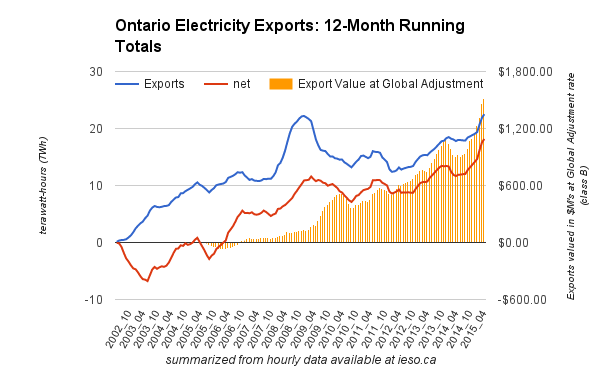
The continued costs to Ontario’s ratepayers for the oversupply of electricity generation in Ontario continued in April 2015; we exported another 2 terawatts (TWh) of power to our neighbours.  April’s exported TWh brings exports for the first four months of 2015 to 8.65 TWh — that’s enough to supply 900,000 average Ontario ratepayers with power for a full year.

Surplus exports represented over 19% of Ontario’s total demand for the month; that figure doesn’t include curtailed wind, steamed-off nuclear or spilled hydro.

The cost (Hourly Ontario Electricity Price + Global Adjustment) to ratepayers for exported power in April was $223 million. We sold it for 1.57 cents per kilowatt hour, thereby generating only $32 million. Ontario’s electricity ratepayers had to eat $191 million in losses that will find their way to the Global Adjustment pot and the “electricity” line on our bills.

As noted in a prior article, the first quarter of the current year generated losses (costs to ratepayers) of $437 million. So now, with the April figures, those costs to date are $608 million or $135 per ratepayer.

We still have eight months left in the year: at the current pace, our bill to support surplus exports will amount to over $400 for the average ratepayer.

Wind power generation for April represented 39% of the exported volume as it produced about 850,000 MWh (megawatt hours) at an average of $123.50 per/MWh, meaning its cost of $104 million represented almost 50% of total export costs.

Energy Minister Bob Chiarelli doesn’t seem to notice our growing surplus*; however, he has directed the IESO to acquire another 500 MW of renewable energy from wind and solar in 2015, and mandated conservation of another 7 TWh by 2020.

Time to stop digging the hole.

© Parker Gallant

May 27, 2015

The views expressed are those of the author and do not represent Wind Concerns Ontario policy.

 Editor’s note: speaking at a wind power information evening in Finch, Ontario, on May 6th, Ontario Federation of Agriculture president Don McCabe said there is no surplus of power in Ontario. This is a lot of lost power and a lot of losses to electricity consumers—including farmers—to deny.

Ontario Q1 electricity losses: selling our power off cheap

30 Thursday Apr 2015

Posted by Ottawa Wind Concerns in Renewable energy, Wind power

≈ 4 Comments

Tags

CFRA, electricity bills Ontario, hydro bills Ontario, Ontario economy, Parker Gallant, Rob Snow, surplus electricity Ontario, Wind Concerns Ontario, wind farms, wind power

Q1 ratepayer pain: electricity export costs skyrocket

Ontario's electricity customers pay and pay and pay while neighbours get our power cheap
Ontario’s electricity customers pay and pay and pay while neighbours get our power cheap

Wind almost 40% of exported power; cost of surplus export $437 million in just 3 months

The first quarter of the current year indicates Ontario is exporting record quantities of surplus electricity.

It appears to be part of the Liberal government plan as this excerpt from Finance Minister Sousa’s budget “Building Ontario Up” claims:  “Through our four-part economic plan, we are supporting greater investment in productivity and innovation, providing a renewed focus on international exports, encouraging the transition to a low-carbon economy and creating more jobs for Ontarians.”

It would be better if our surplus electricity was exported profitably, instead of a cost to ratepayers, but alas, that is not the way the Liberal Energy Ministers past and present have structured the portfolio.

The first quarter of the current year saw Ontario export a record 6.65 TWh (terawatts) — that’s enough to power 690,000 average households for a full year.

Export costs up 75% in first quarter

The 6.65 TWh sold to our neighbours was up 75% from 3.81 TWh in 2014′s first quarter. We sold that surplus at prices well below what we received.  Exports represented 17.5 % of Ontario’s demand in 2015 versus 10% in the same period in 2014. Wind (generated and curtailed) in 2014 was 2.05 TWh and 53.7% of Ontario’s exports; in 2015, wind grew to 2.61 TWh and was 39.2 % of our exports.

The concept of exporting is one that economists encourage; however, they expect it will be profitable, create jobs, and not burden the rest of the economy though subsidization.  Subsidizing exports is often referred to as “dumping” and frequently challenged under the WTO (World Trade Organization) rules.

Cost to ratepayers is shocking

Examining the cost to Ontario ratepayers for the 3.81 TWh exported in 2014 and the 6.65 TWh exported in 2015 using data from the Independent Electricity System Operator’s (IESO) “Market Summaries” is shocking.

The 2014 first Quarter exports cost (average of $102.6 million/TWh) ratepayers $391 million to produce and was sold via the HOEP (hourly Ontario electricity price) market at an average of $75.54 million/TWh. That cost Ontario’s ratepayers $103 million.  In 2015, the 6.65 TWh exported cost Ontario’s ratepayers $672 million (average cost of $101 million/TWh), and sold at an average of $35.4 million/TWh, costing Ontario ratepayers $437 million.

To put some context to the latter, the money lost exporting the 6.65 TWh  was equal to 6.6 cents per kilowatt hour.   The foregoing subsidy does not include other costs Ontario’s ratepayers pick up including: spilled hydro, steamed-off nuclear or payments to idling gas plants. The subsidies supporting exports is double what Energy Minister Bob Chiarelli suggests is needed to assist almost 600,000 “low-income” households to pay their hydro bills. Ontario’s ratepayers will start paying the latter January 1, 2015.

This analysis would not be complete without noting the cost of wind generation (two quarters) in 2014 was $252.7 million (average cost of $123.5 million per/TWh) and $322.5 million for 2015!

Perhaps our Finance Minister should “focus” on the harm to Ontario’s ratepayers instead of dumping our surplus electricity on our neighbours who are happy to take it and not raise the issue with the WTO.  If the first quarter of 2015 is indicative of the full year, ratepayers will pick up $1.8 billion in subsidies to supply our neighbours with cheap electricity, while Ontario’s citizens struggle.

Parker Gallant, April 28, 2015

The views expressed here are those of the author and do not necessarily represent Wind Concerns Ontario policy.

Chart courtesy Scott Luft of Cold Air Online

EDITOR’S NOTE: Parker Gallant will be on the Rob Snow show on radio CFRA, Friday May 1st, to discuss this. Listen in an AM 580 or online at cfra.com


Ontario needs to learn from Europe’s green energy debacle, says policy advisor

16 Thursday Apr 2015

Posted by Ottawa Wind Concerns in Renewable energy, Wind power

≈ 3 Comments

Tags

climate change, electricity bills, EU climate policy, Europe, forms of energy, hydro bills, Ontario, Ontario economy, renewable energy, subsidies renewables, wind farms, wind power

Financial Post, April 14

Ontario will follow the EU at its peril — power rates will soar while industries depart

As the Ontario government announces new unilateral climate policies, Canadian policymakers would be well advised to heed the lessons of Europe’s self-defeating green energy debacle.

The European Union has long been committed to unilateral efforts to tackle climate change. For the last 20 years, Europe has felt a duty to set an example through radical climate policy-making at home. Political leaders were convinced that the development of a low-carbon economy based on renewables would give Europe a competitive advantage.

European governments have advanced the most expensive forms of energy generation at the expense of the least expensive kinds. No other major emitter has followed the EU’s aggressive climate policy and targets. As a result, electricity prices in Europe are now more than double those in North America and Europe’s remaining and struggling manufacturers are rapidly losing ground to international competition. European companies and investors are pouring money into the U.S., where energy prices have fallen to less than half those in the EU, thanks to the shale gas revolution.

Although EU policy has managed to reduce CO2 emissions domestically, this was only achieved by shifting energy-intensive industries to overseas locations without stringent emission limits, where energy and labour is cheap and which are now growing much faster than the EU.

Most products consumed in the EU today are imported from countries without binding CO2 targets. While the EU’s domestic CO2 emissions have fallen, if you factor in CO2 emissions embedded in goods imported into EU, the figure remains substantially higher.

Of all the unintended consequences of EU climate policy perhaps the most bizarre is the detrimental effect of wind and solar schemes on the price of electricity generated by natural gas. Many gas power plants can no longer operate enough hours. They incur big costs as they have to be switched on and off to back-up renewables.

Most products consumed in the EU today are imported from countries without binding CO2 targets

This week, Germany’s energy industry association warned that more than half of all power plants in planning are about to fold: Even the most efficient gas-fired power plants can no longer be operated profitably.

Every 10 new units worth of wind power installation has to be backed up with some eight units worth of fossil fuel generation. This is because fossil fuel plants have to power up suddenly to meet the deficiencies of intermittent renewables. In short, renewables do not provide an escape route from fossil fuel use without which they are unsustainable.

Read more here: http://business.financialpost.com/fp-comment/eus-green-energy-debacle-shows-the-futility-of-climate-change-policies

← Older posts
Newer posts →

Recent Posts

  • Open letter to CAFES Ottawa
  • Ottawa Wind Concerns supports West Carleton residents
  • What does wind ‘farm’ construction really look like?
  • Unwilling Host communities surround Ottawa
  • How many birds do wind turbines kill?

Follow me on Twitter

My Tweets

Enter your email address to follow this blog and receive notifications of new posts by email.

Tags

Bob Chiarelli Green Energy Act IESO Ontario Ottawa Ottawa wind concerns wind energy wind farm wind power wind turbines

Contact us

PO Box 3 North Gower ON K0A 2T0

Create a free website or blog at WordPress.com.

Privacy & Cookies: This site uses cookies. By continuing to use this website, you agree to their use.
To find out more, including how to control cookies, see here: Cookie Policy
  • Subscribe Subscribed
    • Ottawa Wind Concerns
    • Join 379 other subscribers
    • Already have a WordPress.com account? Log in now.
    • Ottawa Wind Concerns
    • Subscribe Subscribed
    • Sign up
    • Log in
    • Report this content
    • View site in Reader
    • Manage subscriptions
    • Collapse this bar
 

Loading Comments...