• About
  • Donate!
  • EVENTS
  • Ottawa’s “Energy Evolution”: wind turbines coming to rural communities
  • Thinking of signing a wind turbine lease?
  • Wind Concerns Ontario
  • Wind turbines: what you need to know

Ottawa Wind Concerns

~ A safe environment for everyone

Ottawa Wind Concerns

Tag Archives: wind energy

Natural Resources Canada funds study of “large penetration” for wind power in Canada

04 Wednesday Feb 2015

Posted by Ottawa Wind Concerns in Ottawa, Renewable energy, Wind power

≈ 1 Comment

Tags

Canada, Government of Canada, Minister of Finance, Natural Resources Canada, Natural Resources Canada study, Pan-Canadian Wind Integration Study, Parker Gallant, wind energy, wind power

Check out the video and photos below!

Looking to put chicken coops right across Canada?

Reprinted from Wind Concerns Ontario

Industry association “lead proponent” in Natural Resources Canada study

Last week, in researching his series on the Canadian Wind Energy Association’s campaign to influence Ontario citizen attitudes toward wind power, and recommendations for the lobby group’s “Ontario campaign,” Parker Gallant discovered via the Ontario Lobbyist Registry that CanWEA disclosed publicly it has received funding  of $663,000 from the federal government.

The funding is presumably for CanWEA’s role as lead proponent of a $1.7-million Natural Resources Canada project called the Pan-Canadian Wind Integration Study,  “that will evaluate how large penetration of wind energy could be integrated on the provincially run Canadian electric grid and show the challenges and opportunities in doing so. “

In the first paragraph of the NRCan page on this study, which names CanWEA as the lead proponent, is a significant error. CanWEA’s mandate is most decidedly NOT “to promote the responsible and sustainable growth of wind energy in Canada.” CanWEA itself says its mission is “to ensure Canada fully realizes its abundant wind energy potential on behalf of its members.”

In other words, as any specialized industry group does, CanWEA’s goal is to represent and promote the interests of its members.

It is not an environmental organization.

Why, we ask, is an industry group, with some very well-financed members, that states outright its goal is to act in the best interests of its members, receiving government financing to further its members’ fortunes?

A question for your Member of Parliament. And the Minister of Natural Resources, and the Minister of Finance (Joe.Oliver@fin.gc.ca ).

Wind farm Constitutional challenge now before the judges

21 Friday Nov 2014

Posted by Ottawa Wind Concerns in Renewable energy, Wind power

≈ 1 Comment

Tags

adverse health effects, Environmental Review Tribunal, Health Canada, Health Canada wind turbine noise and health study, Julian Falconer, wind energy, wind farm, wind farm appeals, wind farm legal action, wind farms, wind turbine noise, wind turbines

Wind farm legal decision expected before January

Turbines near Ridgetown: environmental review tribunals ignore evidence of adverse health effects

Big money on one side, families on the other

Jonathan Sher, London Free Press, November 20, 2014

A judicial fight over the future of wind turbines in Ontario wrapped up Thursday with the fate of the province’s green energy law in the hands of judges.

On one side is big money, wind energy giants like Samsung and a Liberal government intent on becoming a world leader in creating green energy.

On the other are four families in Huron and Bruce counties whose homes are close to dozens of proposed turbines.

But while it seems a David and Goliath affair, the underdogs have enlisted a legal pugilist who Thursday seemed to dance circles around the arguments of his adversaries, wrapping up a four-day hearing in London with an emotionally-loaded challenge to three Superior Court justices.

“The system has utterly broken down,” said Julian Falconer. “You have been tasked with keeping these people safe.”

Falconer was the most dynamic of lawyers representing four families in Southwestern Ontario battling the building of wind farms.

It’s not the first time lawyers have challenged the Green Energy Act in court. Three years ago, wind opponents lost in court fighting a decision by an environmental review tribunal to allow a wind farm. But the 2011 effort had a handicap this one does not — it was a judicial review, in which judges must give deference to the tribunal.

This time, Falconer wants the three-judge panel to:

  • Halt, by issuing what’s called a stay, wind farms that are expected to be tested in January.
  • Rule the environmental tribunal violated the constitutional rights of wind opponents when it refused to allow new evidence from a Health Canada study.
  • Allow wind opponents to stop wind farms by showing they might be seriously harmed rather than proving they had been harmed.

The judges expect to issue a decision on the stay soon, and while they didn’t specify a date, it’s likely they’ll act by January.

Environmental review tribunals shield their eyes to contrary evidence, Falconer said.

“They keep the blinders on. They’re not interested in new information. They’re interested in getting the turbines up,” he said.

But lawyers for the government and wind companies disagreed, one arguing the Health Canada study only showed a link between turbines and annoyance and the early results hadn’t yet been peer-reviewed.

“It’s a work in progress,” said Darryl Cruz, who represents St. Columban Energy.

The decision by the environmental tribunal was correct and wind companies should be allowed to complete their wind farms, he said.

That’s a position one Niagara wind opponent has been fighting for about four years, moving from her Welland home to keep away from planned turbines.

“It’s just wrong,” Catherine Mitchell said.

Wind opponents say turbines cause dizziness, headaches, heart palpitations and other illness.

The government says that’s wrong and that neighbours are protected because turbines are placed at least 550 metres from homes.

Ontario has more than 6,000 wind turbines built, planned or proposed, mostly in the southwest. Turbines account for about 4% of Ontario’s power.

Read the full article here.

Green energy fleecing Ontario consumers

30 Thursday Oct 2014

Posted by Ottawa Wind Concerns in Renewable energy, Wind power

≈ 1 Comment

Tags

electricity rates Ontario, green energy, Green Energy Act, hydro bills Ontario, Ontario, Premier Kathleen Wynne, renewable energy, renewables, Ross McKitrick, Tom Adams, wind energy, wind farm, wind farm contracts, wind power

Green energy and wind farms fleecing Ontario consumers

New study explains why Ontario has gone from affordable electricity rates to among the highest in N America. Photo: Bloomberg

Ross McKitrick and Tom Adams, The Financial Post, October 30, 2014

Adding renewable generating capacity triggers changes throughout the system that multiply costs for consumers

Ontario’s green energy transformation – initiated a decade ago under then-Premier Dalton McGuinty – is now hitting consumers. The Nov 1 increase for households is the next twist of that screw. As Ontario consumers know all too well, the province has gone from having affordable electricity to having some of the highest and fastest-increasing rates in Canada.

Last year, in a report for the Fraser Institute called “Environmental and Economic Consequences of Ontario’s Green Energy Act,” one of us (McKitrick) explained how the Green Energy Act, passed in 2009, yielded at best tiny environmental benefits that cost at least ten times more than conventional pollution control methods, and was directly harming growth by driving down rates of return in key sectors like manufacturing.

Related

  • Ontario’s Power Trip: Province lost $1.2-billion this year exporting power
  • Ontario’s Power Trip: Retirement deficit coming to your hydro bill
  • Ontario’s Power Trip: McGuinty’s bigger debacle

But complex financial structures and a lack of official disclosure around large embedded costs have let supporters of the green energy act deny that green power is responsible for the price hikes. Green industry advocates, including the consulting firm Power Advisory and advocacy group Environmental Defense, have added up the direct payments to new renewable generators, and concluded that since those costs are relatively small, the impact of renewables on the total cost of power is likewise small.

However, such analyses ignore the indirect costs that arise from the way renewables interact with the rest of the power system. Adding renewable generating capacity triggers changes throughout the system that multiply costs for consumers through a mechanism called the Global Adjustment. Our new study, released Wednesday by the Fraser Institute, quantifies the impacts of different types of new generators on the Global Adjustment. The analysis pinpoints what causes the raw deal for consumers.

Here’s how it works: over the last decade, Ontario closed its coal-fired power plants and built a rapidly expanding portfolio of contracts with other generators including renewable energy companies producing power from hydro, wind, solar and biomass. These companies charge the Ontario Power Authority (OPA) higher-than-market-value prices for energy. To make up the difference, the OPA slaps an extra charge – called the Global Adjustment – on the electricity bills of Ontarians.

The Global Adjustment adds to the commodity portion of rates, which combined with charges for delivery, debt recovery, and regulatory factors constitute the overall rate. Elements of the Global Adjustment that are not disclosed include payments to generators to not generate, rates paid to historic non-utility generators, and costs for new hydro-electric developments.

Since 2007, the Global Adjustment has risen six cents per kilowatt-hour in inflation-adjusted terms, pushing up the commodity portion of bills by 50%. Not long ago, Ontario’s total industrial rate was less than six cents per kilowatt-hour. The rising Global Adjustment is by far the biggest driver of the resulting 21% increase in the overall average cost of power in the province over the period 2007-2013. The Global Adjustment’s upward path is a direct consequence of government intervention in the electricity market. Our analysis unpacking the costs of different types of generation shows that the consumer impact of new renewables substantially exceeds the direct payments to those generators by as much as 3 to 1. And renewables are a big part of the problem: Wind and solar systems provided less than 4% of Ontario’s power in 2013 but accounted for 20% of the commodity cost paid by Ontarians.

Getting to the bottom of the rate implications of adding renewables gained new urgency when Premier Wynne declared last month that the 2013 fleet of wind and solar will almost triple by 2021. This is an incredibly reckless decision. In his National Post column recently on the 2014 Ontario Economic Summit, co-chair Kevin Lynch, Vice-Chair of BMO Financial Group, stated bluntly “That Ontario has a serious growth problem is rather difficult to deny, or debate.”

What’s the solution? If the Province wants to contain electricity rate increases it needs to halt new hydroelectric, wind and solar projects. In order to reverse rate increases, the province should seek opportunities to terminate existing contracts between renewable energy companies and the OPA. Alas, as the Premier has indicated, that’s not where they’re headed.

Alternatives to costly new renewables include using some imported electricity from Quebec while Ontario refurbishes its nuclear power plants and maintaining 4 of 12 coal-fired power units at Lambton and Nanticoke that had been outfitted with advanced air pollution control equipment just prior to their closure, making them effectively as clean to operate as natural gas plants. Costly conservation programs encouraging consumers to use less electricity make particularly little sense these days in Ontario. Right now, Ontario is exporting vast amounts of electricity at prices that yield only pennies on the dollar, and also paying vast but undisclosed sums to generators to not generate.

Many European countries made costly commitments to renewable energy but are now winding them back. Germany is investing in new smog-free coal power generation. Environmentalists often suggested that following Europe is the way to go. Perhaps Ontario should consider following them now.

Ross McKitrick is a Professor of Economics at the University of Guelph and Senior Fellow of the Fraser Institute. Tom Adams is an independent energy consultant and advisor.

Wind farms expensive, unreliable, inefficient: UK science research

28 Tuesday Oct 2014

Posted by Ottawa Wind Concerns in Renewable energy, Wind power

≈ 1 Comment

Tags

renewable energy, Renewable Energy Roadmap, Scientific Alliance, wind energy, wind farms, wind power, wind power and environment, wind power backup, wind power cost, wind power reliability, wind power UK, wind turbine efficiency

Wolfe Island: destruction of a pretty place and for what?

Wolfe Island: destruction of a pretty place and for what?

Donna Rachel Edmunds, Breitbart News, October 27, 2014

Wind power is too variable and too unpredictable to provide a serious alternative to fossil fuels, a new study by the Scientific Alliance and the Adam Smith Institute has confirmed. The researchers concluded that, although it is true that the wind is always blowing somewhere, the base line is only around 2 percent of capacity, assuming a network capacity of 10GW.

The majority of the time, wind will only deliver 8 percent of total capacity in the system, whilst the chances of the wind network running at full capacity is “vanishingly small”. As a consequence, fossil fuel plants capable of delivering the same amount of energy will always be required as backup.

The report was undertaken by the Scientific Alliance and the Adam Smith Institute. Using data on wind speed and direction gathered hourly from 22 sites around the UK over the last nine years, the researchers were able to build a comprehensive picture of how much the wind blows in the UK, where it blows, and how variable it is.

They found that, contrary to popular opinion, variability was a significant factor as “swings of around 10 percent are normal” across the whole system within 30 – 90 minute timeframes. “This observation contradicts the claim that a widespread wind fleet installation will smooth variability,” the authors write.

Likewise, and again contrary to popular assumptions, wind does not follow daily or even seasonal outputs. There were long periods in which the wind was not blowing even in winter, making it difficult to match generation of wind power to demand. The report concludes that covering these low periods would either need 15 storage plants the size of Dinorwig (a pumped storage hydroelectric power station in Wales with a 1.7GW capacity), or preserving and renewing our fossil plants as a reserve.

Most significantly, it found that the system would be only running at 90 percent of capacity or higher for 17 hours a year, and at 80 percent or higher for less than one week a year; conversely, total output was at less than 20 percent of capacity for 20 weeks of the year, and below 10 percent during nine weeks a year. “The most common power output of this 10GW model wind fleet is approximately 800MW. The probability that the wind fleet will produce full output is vanishingly small,” the authors note. The consequence is that many more wind turbines will have to be built than is often assumed, as the capacity of the fleet can’t be assumed to be synonymous with actual output.

The findings will deliver a body blow to governmental claims that their current target of generating 27 percent of energy from renewable sources – mostly wind and solar – by 2030 is credible.

“If there were no arbitrary renewable energy target, governments would be free to focus on what most voters expect: providing a framework in which a secure and affordable energy supply can be delivered,” commented Martin Livermore, director of the Scientific Alliance.

“If emissions are also to be reduced, the most effective measures currently would be a move from coal to gas and a programme of nuclear new build. In the meantime, the renewables industry continues to grow on a diet of subsidies, and we all pick up the tab. Getting out of this hole is not going to be easy, but it’s time the government started the process rather than continuing to dig deeper.”

According to the 2013 Renewable Energy Roadmap (the most recent to date), offshore wind capacity reached 3.5GW by June 2013, and onshore capacity reached 7GW in the same month. Governmental modelling suggests that offshore wind capacity will hit 16GW by 2020, and 39GW by 2030.

In the introduction to the Roadmap, the ministerial team headed by Ed Davey, secretary of state for energy and climate change wrote “The Government’s commitment to cost effective renewable energy as part of a diverse, low-carbon and secure energy mix, is as strong as ever. Alongside gas and low-carbon transport fuels, nuclear power and carbon capture and storage, renewable energy provides energy security, helps us meet our decarbonisation objectives and brings green growth to all parts of the UK.”

Read the full report here.

Canadian Nuclear Association: wind is not ‘green”

14 Tuesday Oct 2014

Posted by Ottawa Wind Concerns in Uncategorized

≈ 1 Comment

Tags

air pollution Ontario, Canadian Nuclear Association, Canadian Wind Energy Association, GHGs, green wind power, Ontario, power sources Ontario, Southwestern Ontario, Wind Concerns Ontario, wind energy, wind farm, wind farms, wind power

Wind’s dirty little secret: fossil fuel back up essential

JOHN MINER | QMI AGENCY

October 13, 2014

LONDON, Ont. — I’m green, you’re not.The battle to be embraced as the best environmental choice for Ontario’s power supply is getting down and dirty.

Fed up with the wind-farm sector enjoying what it considers an undeserved reputation as a pristine energy supplier, Canada’s nuclear industry — it generates the lion’s share of electricity in Ontario — has launched a public relations assault against wind.

Both nuclear and wind are major players in the power mix of Southwestern Ontario, home to one of the world’s largest nuclear plants — Bruce Power, near Kincardine — and many of Ontario’s biggest wind farms.

“Wind power isn’t as clean as its supporters have claimed. It performs unreliably and needs backup from gas, which emits far more greenhouse gas than either wind or nuclear power,” said Dr. John Barrett, president and chief executive of the Canadian Nuclear Association, in an e-mail to QMI Agency.

The Canadian Nuclear Association hired Toronto-based Hatch Ltd., a global consulting and engineering firm, to compare wind farm and nuclear energy.

Hatch reviewed 246 studies, mostly from North America and Europe. Its 91-page report concludes wind energy over the lifetime of an installation produces slightly less greenhouse gas — implicated in climate change — than nuclear and both produce a lot less than gas-fired generating plants.

But Hatch says it’s an entirely different picture when wind energy’s reliance on other generating sources is considered.

The engineering firm calculates wind turbines only generate 20% of their electrical capacity because of down time when no wind blows.

When gas-fired generating stations are added into the equation to pick up the slack, nuclear produces much less greenhouse gases, the Hatch study concludes.

Its analysis is that for every kilowatt-hour of electricity produced, nuclear power emits 18.5 grams of greenhouse gases. Wind backed by natural gas produces more than 20 times more — 385 grams per kilowatt hour.

The nuclear industry attack on wind might not be a welcome message for the Ontario Liberal government that has justified its multibillion-dollar investment in Southwestern Ontario wind farms on the basis it’s providing green energy.

But its a position that resonates with Ontario’s anti-wind farm movement.

“We share their concerns on this issue and have been speaking about this for years. We have taken advice from engineers in the power industry, who say that wind power cannot fulfill any of the environmental benefit promises made for it, because it needs fossil-fuel backup.,” said Jane Wilson, president of Wind Concerns Ontario.

On the other side of the debate, the Canadian Wind Energy Association said it has had an opportunity to review the Hatch study.

It said there’s no surprise that when wind and natural gas generation are paired that the mix creates more greenhouse gases than nuclear. But when wind is paired with other potential electricity suppliers, the results are different.

“Unfortunately, by choosing to focus on only one scenario, the study failed to consider a broad range of equally or more plausible scenarios for the evolution of Canada’s electricity grid,” the Canadian Wind Energy Association said.
WHERE ONTARIO’S POWER COMES FROM

For the year 2013:
Nuclear: 59.2%
Hydro: 23.4%
Gas: 11.1%
Wind: 3.4%
Coal: 2.1%
Other: 0.8%

For one minute in time:
(Oct. 13, 2014, 8 a.m.)
Nuclear: 65.8%
Hydro: 24.6%
Wind: 5.9%
Gas: 2.7%”

Source: Ontario Independent Electricity System Operator

Read the original article and reader comments here.

Wind farm still a concern in Ottawa

20 Wednesday Aug 2014

Posted by Ottawa Wind Concerns in Ottawa, Renewable energy, Wind power

≈ 1 Comment

Tags

Dan Scharf, EDP Renewables, municipal election Ontario, Ontario Power Authority, OPA, Ottawa wind concerns, Scott Moffatt, South Branch, South Branch wind farm, wind energy, wind farm, wind farm North Gower, wind farm Richmond

People attending a community meeting in North Gower last evening expressed continuing concern about the wind power project that was proposed in 2008 for North Gower-Richmond. The project application has been suspended pending a new application under the Request for Proposal process, which will open in a few weeks.

According to documents obtained by Ottawa Wind Concerns via the Freedom of Information process (thanks to donations from the community) the wind power developer Prowind, was informed of the application suspension in June, 2013, but advised to keep in touch with their contact at the Ontario Power Authority (OPA) about the new opportunity to apply. Prowind maintains a listing for the project on its website.

At that time, Prowind’s documents were “deemed complete” by the OPA, and the company was waiting for a connection to the grid, before the approval process could continue.

Prowind advised The Ottawa Citizen in August 2013, that the company would review the terms of the new process, and re-apply, if appropriate.

In October of 2013, a legal petition bearing more than 1,200 signatures from area residents was presented to the City of Ottawa; council passed a motion that recognized the petition and further, asked the province for a return of local land-use planning powers.

Statements to the effect that the project is now dead are not correct; the OPA has not yet defined its “community engagement” requirement under the new process.

Meanwhile, the OPA has designated Eastern Ontario as a “green light” area for wind power development.

It is expected that the wind power project will be an issue in the upcoming municipal election; incumbent councillor Scott Moffatt wrote a report on the project in last week’s Manotick Messenger, and candidate Dan Scharf has stated he is opposed to it.

The South Branch project, also developed by Prowind and sold to US-based EDP Renewables, has been operating south of Ottawa since March; the turbines are the first 3-megawatt power generators in Ontario.

Email us at ottawawindconcerns@gmail.com 

Brinston wind farm noise prompts MoE investigation

11 Monday Aug 2014

Posted by Ottawa Wind Concerns in Renewable energy, Wind power

≈ 1 Comment

Tags

Brinston wind farm, EDP, EDP Renewables, infrasound, Leslie Disheau, Ontario Ministry of the Environment, sleep disturbance, South Branch wind farm, South Dundas, wind energy, wind farm, wind farm noise, wind power, wind turbines

Turbine neighbour prompts noise probe by ministry

By Nelson Zandbergen – AgriNews Staff Writer, August, 2014

Ontarios Ministry of Environment and Climate Change installed the basketball-sized microphone atop a temporary 30-foot listening post in her backyard, along with a smaller meteorological tower.BRINSTON Leslie Disheau has her ear to the ground in South Dundas, and for 10 days last month, a very powerful ear trained on the sky around her Brinston home as well.

The ministrys move was prompted by Disheau and partner Glen Baldwins complaints about nighttime noise emanating from two industrial wind turbines on either side of their place, one to their immediate northwest, the other to the southeast. Comprising part of the 10-turbine South Branch project that went into serviceearlier this year, both of the nearest units are less than one kilometre away from the home the couple shares with their two teenaged children.

But Disheau, candidate for deputy mayor in the municipal election and a fierce critic of the turbine industry, feared that developer EDP Renewables was intentionally slowing the two windmills to quiet them down while the ministry data-collection and audio-recording effort was underway with her participation.

The Houston-based firm almost immediately learned about the microphone on the day of the install, she said with some frustration.

Located just down the road from the projects main depot, it wasnt more than three hours after the arrival of two ministry trucks in her driveway that EDP called the same ministry to question the presence of those vehicles, according to Disheau.

She says the audio technician putting up the equipment learned of EDPs inquiry while talking to his office bycell phone, then told her about it.

Wind developer has not filed a compliance report yet

Disheau expressed unhappiness that a mandatory post-construction noise report had yet to be publicly filed by the company itself, after putting the project into service in March.

In the meantime, over a 10-day period in July, the ministry captured its own sound data with Disheaus help. During those times she considered the turbines to be noisiest, she pressed a button inside her home, triggering the recording process via the outdoor microphone, which was tethered to audio equipment in a locked box.

Comparing the sound to that of a rumbling plane or jet, she got up at night when she couldnt sleep to push the audio recording button located at the end of a long cord connected to the stuff outside. She also kept an accompanying log as part of the initiative.

The noise is most acute, she said, when the direction of the wind causes the blades to swivel toward her home in perpendicular fashion.

Effect of multiple turbines not considered by government

She scoffed at regulations that mandate 500-meter setbacks to neighbouring homes, pointing out the rule doesnt take into account the cumulative, “overlapping” impact of multiple turbines that surround. Nor does the regulation change with the actual size of a turbine, she adds, asserting that, at 3-megawatts apiece, “these are the largest turbines in Ontario.”

Ultimately, the ministry will use the data collected by Disheau to create a report, which could potentially form the basis of ministry orders against the two offending turbines. “To shut them down at night so that people can sleep,” she said with a hopeful tone, though she also acknowledged the ministry may not issue orders. And even if it does, she expects the developer to appeal and appeal.

Disheau also said there are measures that municipal governments can undertake to curtail the noise, including a nuisance noise bylaw of 32 decibels, which recently survived a court challenge in another Ontario municipality. She espouses such a policy in South Dundas and will push for it at the council table if elected.

Read the full story here.

Email us at ottawawindconcerns@gmail.com

Wind power: a “wolf in green clothing”

28 Monday Jul 2014

Posted by Ottawa Wind Concerns in Uncategorized

≈ 1 Comment

Tags

cost-benefit renewables, Feed In Tariff subsidy, FIT, green energy, PTC, renewable energy, renewable power, subsidies wind power, The Hill, Warren Buffett, wind energy, wind farm, wind farms environment, wind power

It’s clean, it’s “green,” and it wants your land and your money too

Here from The Hill, a US blog for policy-makers, a posting on wind power and the US form of subsidy, the Production Tax Credit.

July 25, 2014, 10:00 am

Wind power production tax credit: Wall St. wolf in green clothing

By Curtis Ellis, The Hill, July 25, 2014

The tax incentive for wind power expired last year, and the battle over its extension is now underway. Opponents say the wind power production tax credit, PTC, is a wasteful boondoggle while supporters say it’s crucial for renewable energy and jobs. The Sierra Club calls it “one of the best bets we’ve made on clean, domestic energy.”

But it’s a misplaced bet.  The PTC actually blocks the green energy technologies that hold the most promise.  Rather than helping an infant industry, the PTC is a handout to Wall Street.

Congress created the PTC in 1992, a tax credit of roughly 2 cents per kilowatt-hour of wind electricity, to nurture the infant wind energy industry. Government incentives to promote crucial industries are time-honored. That’s not the problem with the PTC.What’s important is that only big investors who want to offset tax liabilities on other investments need apply. The PTC can only be taken against “passive income” – income from other investments. Private equity firms put together investors who need a tax write-off courtesy of the PTC. Warren Buffett admits he uses the PTC to lower his Berkshire taxes: “we get a tax credit if we build a lot of wind farms. That’s the only reason to build them.”

The PTC doesn’t help the average Joe who wants to put a small wind turbine on his ranch to generate electricity and reduce the taxes he pays on his farm income.

But while the PTC boosts Wall Street investment schemes in large-scale wind farms, the fact is small-scale, individually owned generation facilities hold the most promise for renewable energy.

Noted environmentalist Bill McKibben writes, “One of the great side effects of moving to renewable power is that we will replace vulnerable, brittle centralized systems that are too big to fail with spread out democratic energy sources.” Unfortunately, the PTC only encourages more “brittle centralized systems.”

California’s Local Clean Energy Alliance (which includes the San Francisco Bay Area chapter of the Sierra Club) concurs. It’s report, Community Power, states “local, decentralized generation of electricity offers many benefits to California’s communities relative to large central-station solar or wind power plants in remote areas.”

The Institute for Local Self Reliance, a green energy cheerleader, says renewables work best “at small scales across the country,” what’s known as distributed generation, “a network of independently-owned and widely dispersed renewable energy generators” rather than “a 20th century grid dominated by large, centralized utilities.”

In fact the Institute explicitly says the PTC is a significant barrier to greater investment in renewable energy. Removing this barrier “makes smaller projects more accessible to the local community, and draws local investors back into the process,” says John Farrell of the Institute for Local Self-Reliance.

Utilities are also taking local-scale renewable energy seriously.  A report by the Edison Electric Institute, Disruptive Challenges expects small-scale solar and wind “to challenge and transform the electric utility industry” with “adverse impacts on revenues, as well as on investor returns.”

David Crane, CEO of NRG Energy, a wholesale power company that operates coal-fired plants, told Blooomberg Businessweek  “the grid will become increasingly irrelevant as customers move toward decentralized homegrown green energy.”

So, if local-scale wind and solar generated close to the end user makes the most sense, why do we have a PTC pushing large-scale wind farms? It’s a Wall Street play.

Environmentalists supporting the PTC mean well, but they fail to see the wolf of Wall Street hiding beneath the green clothes. Ironically, the national green organizations are fighting for the kind of massive generating stations and power lines their local chapters often fight against.

The PTC is an anachronism and an obstacle to developing the decentralized, independently owned power generation system appropriate for wind, solar and other renewables.

Anyone who believes in renewable energy should be happy to see the PTC expire. It’s time to replace this tax write-off for the financial services cabal with something that benefits everyone.

Ellis is executive director of the American Jobs Alliance.

Read more: http://thehill.com/blogs/congress-blog/energy-environment/213183-wind-power-production-tax-credit-wall-st-wolf-in-green#ixzz38c15D4Uf

Transport Canada demands removal of airport turbines for safety

07 Monday Jul 2014

Posted by Ottawa Wind Concerns in Health, Renewable energy, Wind power

≈ 1 Comment

Tags

aviation safety, Chatham airport, Chatham-Kent, GDF Suez, Randy Hope, Transport Canada, wind energy, wind farm, wind farm safety, wind power, wind turbine, wind turbines

CTV Windsor
Published Sunday, July 6, 2014 6:14PM EDT 
Last Updated Monday, July 7, 2014 9:03AM EDT

Pro-wind power Mayor says “there is no safety issue”

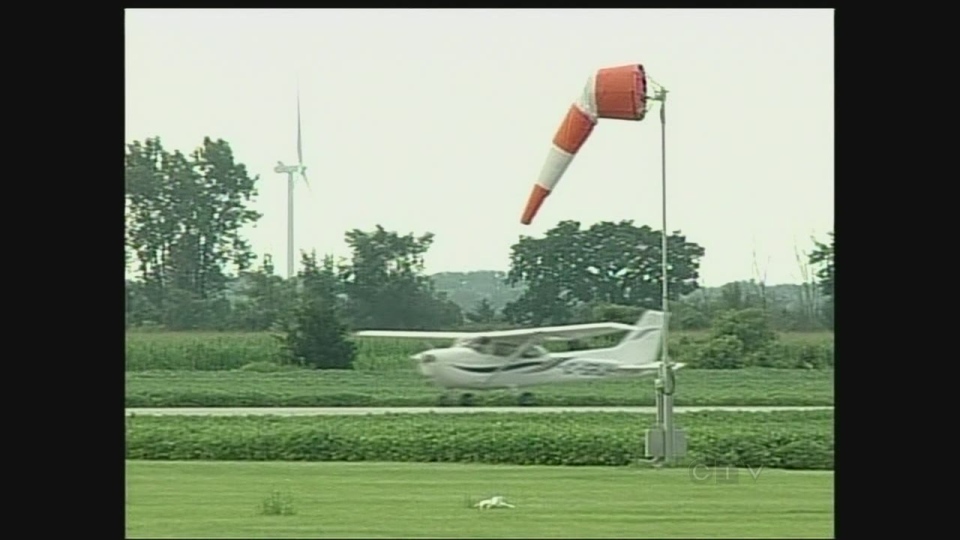
Transport Canada has issued an order requiring the eight wind turbines near Cedar Springs be removed by the end of this year.

The organization originally issued a letter requesting “voluntary compliance” last year.

In a release sent out by the municipality, Chatham-Kent mayor Randy Hope, says,“there is no safety issue so we need to change the regulation rather than force the removal of the turbines.”

RELATED STORIES

  • Questions surround wind turbine removal near Chatham airport
  • Angry pilot speaks out at Chatham airport ceremony
  • Fuel siphoned from planes at Chatham airport

PHOTOS

CTV Windsor: Pilot voices Chatham airport concerns

The municipality had been waiting for a reply from Transport Canada on this proposal and was surprised this week to learn that Transport Canada had taken this new step of issuing letters demanding that the turbines be removed by Dec. 31.

The affected wind turbines are in a “no fly zone” south of the airport.

It is expected that GDF SUEZ, the owner of the affected turbines, will formally object to the order from Transport Canada and seek a hearing before the Minister of Transport through the process laid out in the Aeronautics Act.

Read more: http://windsor.ctvnews.ca/transport-canada-demanding-wind-turbines-be-removed-near-chatham-airport-1.1901446#ixzz36n9X6XXM

Read the full story and see photos here.

The Toronto wind turbine: green energy symbol

05 Saturday Jul 2014

Posted by Ottawa Wind Concerns in Renewable energy, Wind power

≈ Leave a comment

Tags

Exhibition Place, Exhibition Place turbine, Exhibition Place wind mill, green energy, investment wind power, Parker Gallant, Toronto, Toronto windmill, wind energy, wind power, wind turbine

Not as advertised?

It’s hard to visit Toronto and NOT see the single wind turbine at Exhibition Place. Today, at about 600 kW and 90 meters tall, that turbine is very small compared to what is being built and approved all over Ontario—and yet, the people of Toronto and visitors to that city, believe it is a symbol of all that is good about “green” power developed from wind energy.

The truth is a little more complicated.

Former bank vice-president Parker Gallant has written an examination of the Exhibition Place turbine: all is not what it seems. His article is in two parts.

Part 1: http://www.windconcernsontario.ca/torontos-ex-place-wind-turbine-icon-or-mirage/

Part 2: http://www.windconcernsontario.ca/the-ex-place-toronto-turbine-disappointing-investment/

A note: whenever wind power developer executives are asked by small town residents whether THEY live anywhere near a turbine, many of them (including Prowind’s president for 5 minutes, Jeffrey Segal, speaking in South Dundas) respond, yes. They mean they live in downtown Toronto, and can see the Ex Place turbine. Not quite the same thing, is it?

Email us at ottawawindconcerns@gmail.com


← Older posts
Newer posts →

Recent Posts

  • Open letter to CAFES Ottawa
  • Ottawa Wind Concerns supports West Carleton residents
  • What does wind ‘farm’ construction really look like?
  • Unwilling Host communities surround Ottawa
  • How many birds do wind turbines kill?

Follow me on Twitter

My Tweets

Enter your email address to follow this blog and receive notifications of new posts by email.

Tags

Bob Chiarelli Green Energy Act IESO Ontario Ottawa Ottawa wind concerns wind energy wind farm wind power wind turbines

Contact us

PO Box 3 North Gower ON K0A 2T0

Create a free website or blog at WordPress.com.

Privacy & Cookies: This site uses cookies. By continuing to use this website, you agree to their use.
To find out more, including how to control cookies, see here: Cookie Policy
  • Subscribe Subscribed
    • Ottawa Wind Concerns
    • Join 379 other subscribers
    • Already have a WordPress.com account? Log in now.
    • Ottawa Wind Concerns
    • Subscribe Subscribed
    • Sign up
    • Log in
    • Report this content
    • View site in Reader
    • Manage subscriptions
    • Collapse this bar
 

Loading Comments...