• About
  • Donate!
  • EVENTS
  • Ottawa’s “Energy Evolution”: wind turbines coming to rural communities
  • Thinking of signing a wind turbine lease?
  • Wind Concerns Ontario
  • Wind turbines: what you need to know

Ottawa Wind Concerns

~ A safe environment for everyone

Ottawa Wind Concerns

Tag Archives: Ottawa

Ottawa renewable energy future “predominately wind and solar” says city staff

10 Thursday Mar 2022

Posted by Ottawa Wind Concerns in Uncategorized

≈ 3 Comments

Tags

noise environment, Ottawa, Ottawa wind concerns, setbacks, wind turbines

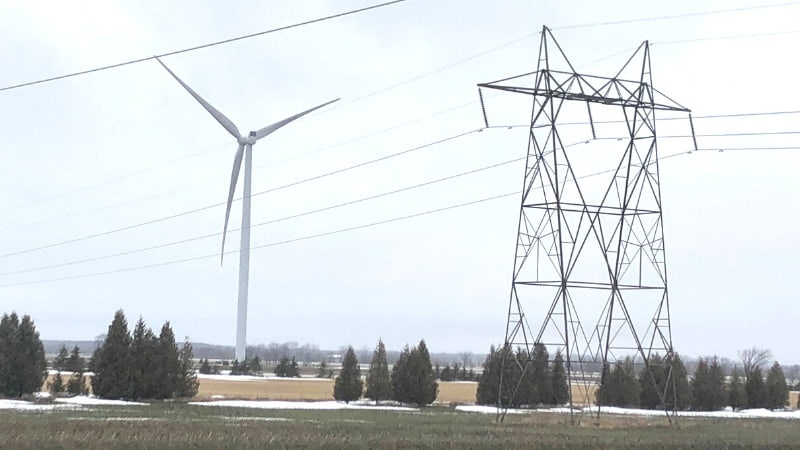
Photo of Nation Rise turbines: equal to 60-storey office towers. Wind turbines are an industrial use of the land

March 10, 2022

Last November, after STOP THE OTTAWA WIND TURBINES signs dotted rural Ottawa from Navan to Dunrobin, and south to North Gower and Manotick, Ward 21 councillor Scott Moffatt said that Ottawa was not planning industrial-scale wind turbines. He also suggested in one of his podcasts that the signs, put up by Ottawa Wind Concerns and Carleton Landowners,were just frightening people.

Where did the idea come from? The city’s Energy Evolution document contains a model for 3,200 megawatts of renewable power generation, which could mean 710 wind turbines. The document was passed by Council in the fall of 2020 to very little fanfare.

As to a coming rush of huge, noisy wind turbines, Mr. Moffatt wrote in the Manotick Messenger on November 5: “That could not be farther from the truth.”

He went on to say that wind turbines built in other areas would count toward Ottawa’s Net Zero goal. Councillors El-Chantiry and Darouze agreed, stating during the last meeting for the City’s Official Plan that people were confused about wind turbines.

The fact is, there is a conflict between what City staff are saying, and councillors’ public statements.

On March 7, a hearing was held before the Ontario Energy Board, with regard to the City of Ottawa objecting to a proposal by Enbridge Gas to replace a pipeline for natural gas along St. Laurent Blvd in order to serve its customers.

The City’s objection, they say, is based on the idea that we won’t need natural gas in the coming years because we will rely on power from renewable sources instead.

In answering a question from Energy Probe at the hearing as to whether and where wind turbines might go, Climate Change manager Mike Fletcher answered:

“The city’s plan does not propose to install 710 large scale wind turbines in the City of Ottawa.”

But…

“Any Ottawa wind turbines of any size that were built would be located in appropriately zoned areas of community respecting required setbacks.”

So, no, or…yes?

Mr. Fletcher then went on to say that the city has consulted with a planner with regard to setbacks to determine siting for wind turbines. From the transcript, Mr. Fletcher said:

So a land use planner was involved in looking at this issue and considered guidance on setbacks and a setback is — as I recall it being described, a setback is the distance from mostly from buildings where people are living or working.

And there are zoning considerations as to where — where turbines could be located. So prime agricultural land would not be a non-associated use for a wind turbine.

So, the city is involved in developing setbacks “as to where turbines could be located”. That’s reasonable; it is good to be prepared, but are they actually planning for wind power?

Later, answering a question put from Enbridge Gas’ lawyer, Mr. Fletcher confirmed the sources of renewable energy:

[Enbridge Gas lawyer] And the next line is 4.3 gigawatts of other planned renewable capacity. And is that roughly the accurate figure?

MR. FLETCHER: That’s correct.

MR. ELSON: And I understand that that renewable capacity includes some wind and some solar?

MR. FLETCHER: Well, it is predominantly those two, actually.

Again, we ask the City of Ottawa to be transparent with the residents of our rural communities.

It is worth noting that counsel for the parties objecting to the pipeline replacement would not allow the city staff to answer a more definitive question on wind turbines:

ENERGY PROBE: I am trying to understand what will be considered. It is appropriate uses — okay. So if the farm is not using power from the wind turbine, then the turbine cannot be located there. I asked couldn’t it be located in a farm that is not in that category, but is — in fact there is opposition from the farmer?

[COUNSEL FOR OBJECTORS]: We are objecting to the question; we will not answer it. I am instructing the witness not to answer it.

Everyone wants the best for our environment, and to take action that will be effective against climate change, but we also know that industrial-scale wind turbines are inefficient and unreliable, and cannot be used as baseload power.

Moreover, they use up a lot of land and are considered a “low-density” power source.

Because of the subsidies required, electricity bills will increase as will “energy poverty.” That will harm people and businesses. Industrial-scale wind turbines emit noise which can be pollution at certain levels; stringent setbacks are required to protect health and safety. Ontario’s current setbacks are only 550 meters and have not been changed since 2009.

Is this the right choice for Ottawa?

People deserve to know what the city is planning.

ottawawindconcerns@gmail.com


Ottawa Wind Concerns is an incorporated, not-for-profit group, with a membership list of several hundred residents of rural Ottawa communities and other stakeholders. We are a community group member of the Wind Concerns Ontario coalition.


Response to questions on wind turbines: slander

07 Monday Mar 2022

Posted by Ottawa Wind Concerns in Uncategorized

≈ 1 Comment

Tags

Energy Evolution, Ontario Energy Board, Ottawa, slander, wind turbines

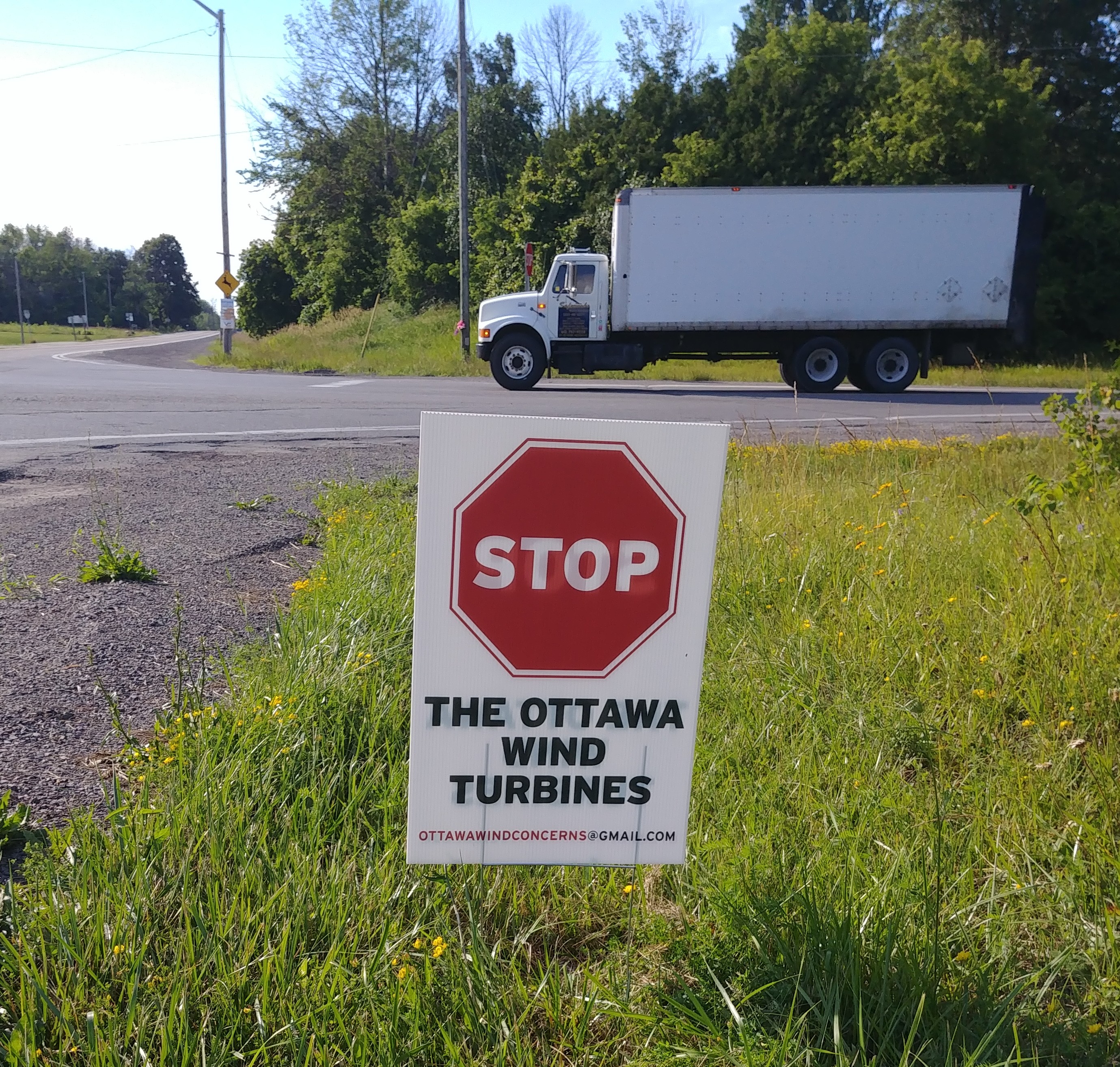
A roadside sign in rural Ottawa: wanting the best for the environment, not harm to people and wildlife

March 7, 2022

We listened in on a “virtual” Technical Conference at the Ontario Energy Board this morning, and we are glad we did.

The consultant acting for Energy Probe appeared to ask questions about application 2022-0293, in which the City of Ottawa objects to a natural gas pipeline replacement on St Laurent because, according to the Energy Evolution document which they offer as evidence, Ottawa will be using 90-percent less natural gas.

Instead, the plan proposes, the City will be using electricity from various sources including, a model for 710 wind turbines.

We have been clear: we think Energy Evolution is a deeply flawed document that does NOT do what people want it to—fight climate change.

The proposal of hundreds of wind turbines is choosing an intermittent, unreliable energy source that will cause electricity bills to rise, will harm the environment and people, and will NOT help the environment.

That’s clear.

So the Energy Probe consultant chose to use a posting on our website that makes reference to a document by the ICSC, critical of the Energy Evolution plan.

Instead of answering questions about our concerns about wind turbines and the Energy Evolution plan, counsel for one witness, the School Energy Coalition , responded with the claim that Ottawa Wind Concerns is a “climate change denier organization.”

That is demonstrably untrue.

It’s also slander.

We have filed a letter of complaint with the Ontario Energy Board demanding that the comments be struck from the record.

Our position is that we want the best for the environment.

We want energy sources that work, not harm.

This is an egregious tactic employed to silence communities and citizens. It may be worth noting that the lawyer in question, Mr Jay Shepherd, is a former member of the Board of Directors for the Canadian Wind Energy Association (CanWEA).

ottawawindconcerns@gmail.com

Who’s boss in city planning? Ottawa’s new Official Plan? Or the energy strategy document, community group asks

24 Thursday Feb 2022

Posted by Ottawa Wind Concerns in Uncategorized

≈ 1 Comment

Tags

electricity bills, Official Plan, Ontario, Ottawa, Randall Denley, wind farm, wind turbines

Community group files request for review with Municipal Affairs ministry


Official Plan says no industrial wind turbines permitted on valuable agricultural land but it also says its Energy Evolution document drives city actions. That document calls for hundreds of turbines. [Illustration: City of Ottawa Climate Change newsletter]

February 24, 2022

Community group Ottawa Wind Concerns has filed a comment on the city’s Official Plan with the Ministry of Municipal Affairs over concerns about where the document ranks in Ottawa’s planning structure.

“Our worry is that Ottawa’s expressed view that the Energy Evolution document and climate change plan overrides all policies and action means statements in the Official Plan could be subject to amendment at any time,” chairperson Jane Wilson wrote in the group’s submission, filed yesterday.

“What we have is an Official Plan that looks like an Official Plan, but it also appears to have a back door through which the City can make changes and take action by using another plan—one that did not go through any public engagement process.”

The intent of an Official Plan in Ontario is that it is the single document which outlines the direction for the city, Wilson says. In the case of the City of Ottawa, this direction may actually be subordinate to the Climate Change Strategy and the Energy Evolution document.

The community group comment referred to page 23 of Ottawa’s new Official Plan where the city asserts: “The policies of this [Official] Plan should be read as supportive of the Climate Change Master Plan.”

And, on page 26, the City states, “The Climate Change Master Plan and associated Energy Evolution and Climate Resiliency strategies provide the analysis and action plans for City-wide action.”

Ottawa Wind Concerns said the group is worried about how this affects policy on renewable power generation facilities, specifically large or industrial-scale wind turbines.

The Energy Evolution document calls for the possibility of hundreds of wind turbines in the city’s rural areas in a model of how Net Zero might be achieved, while the Official Plan makes statements about industrial-scale wind turbines not being permitted on valuable agricultural land.

“Essentially, it looks like the City is saying, its Energy Evolution document trumps everything. We’re saying, that’s not how a municipality is supposed to use an Official Plan.”

The contents of the Energy Evolution document, approved by Council in 2020 with no public input, are not widely known among Ottawa’s citizens.

There has been criticism from media and analysts who have read it.

Local media branded the strategy document “an expensive pipe dream,” with its $57B (estimated) price tag. Political commentator Randall Denley said the Energy Evolution report was “only the beginning,” and promoted “unachievable goals.”

“How high are they prepared to raise taxes,” he asked, “and what existing services will they cut to fund their quixotic effort to save the planet?”

The City of Ottawa has a history of passing zoning amendments that result in public concern. For example, a zoning amendment was passed without the knowledge of even the local councillor for a large warehouse and truck depot in Barrhaven. That move caused newspaper columnist Kelly Egan to remark, “You know who doesn’t get what they want at city hall anymore? Ordinary people.”

Ordinary people in Ottawa’s rural communities sent emails and made telephone calls to councillors when the wind turbine model in Energy Evolution became known, and STOP THE OTTAWA WIND TURBINES signs went up from Kinburn to Navan, and south to North Gower and Manotick.

City councillors maintained that the Energy Evolution statements were just a “model” but the motion of wind power is present in many City documents and wind turbines are prominent in City banners and graphics. A recent submission to the Ontario Energy Board dated January 17th contained the whole Energy Evolution document, including the wind turbine model, as supporting evidence for the City’s objection to replacement of a natural gas pipeline.

“Everyone wants what’s best for the environment,” says Ottawa Wind Concerns Chair Wilson, “but the fact is, we should be making choices about what is shown to be effective and successful. Ontario is an example of how intermittent weather-dependent wind power doesn’t do anything for the environment, but it does have a huge impact on electricity bills and on communities. Giving the Energy Evolution strategy importance over the Official Plan means decisions can be made on what looks good, not what really is good.”

The community group has asked the Ministry of Municipal Affairs to look at both the Energy Evolution document and the draft Official Plan together, to make sure provincial directives are being followed.

Ottawa Wind Concerns filed its comment with the Ministry and was advised Thursday that the comments were accepted and reviewed, and will be posted publicly.

More analysis on the Energy Evolution document, coming soon.


ottawawindconcerns@gmail.com


Ontario definition of an Official Plan

An official plan describes your upper, lower or single tier municipal council or planning board’s policies on how land in your community should be used. It is prepared with input from your community and helps to ensure that future planning and development will meet the specific needs of your community.

An official plan deals mainly with issues such as:

where new housing, industry, offices and shops will be located

what services like roads, watermains, sewers, parks and schools will be needed

when, and in what order, parts of your community will grow

community improvement initiatives

Source: Government of Ontario: Citizen’s guide to land use planning: Official plans | Ontario.ca


City documents still say YES to wind turbines

12 Wednesday Jan 2022

Posted by Ottawa Wind Concerns in Uncategorized

≈ 3 Comments

Tags

Ottawa, Ottawa wind concerns, renewables, wind energy, wind turbines

The Ottawa Energy Evolution strategy official banner: with turbines. [Source: City of Ottawa]

January 12, 2022

Although Ottawa City councillors are saying that the City is not planning wind turbines, is not looking for locations to site turbines, and is not talking to developers, a look at various City documents would persuade you otherwise.

For example, several illustrations that are used for City newsletters and pages on its website clearly depict wind turbines as does, for example, the graphic that accompanies the Energy Evolution strategy document (see above).

And then there is the little matter of the Official Plan Open House virtual presentation held back in June last year in which Manager of Planning Policy Alain Miguelez declared that Ottawa was going to be incorporating renewable energy including wind turbines which would be “directed” he said to Ottawa’s rural areas.

When a citizen participant voiced concern at that event, he responded, “The energy [we need] has to come from somewhere.”

Somewhere indeed.

Almost a year ago, a City staff manager wrote to the Ontario Energy Board as followup to consultation on Distributed Energy Resources (DER) and objected to the fact that the OEB consultant had not mentioned wind power.

“The DER mandate should include all forms of zero-emission DER’s [sic] including wind and hydropower. The ICF paper only discussed solar and battery storage,” Mike Fletcher, Project Manager Climate Change and Resiliency wrote in his letter of February 21, 2021.

“Ottawa has vast rural areas and Energy Evolution requires that we consider wind and hydropower opportunities to meet our renewable energy generation targets,” he said. (Note he said targets, not “models” as is now being claimed.)

So, which is it? Ottawa is not at all considering unreliable, intermittent wind power—which is completely inappropriate in low-wind Eastern Ontario as evidenced by recent poor performance during a cold snap—or, wind power is a key component in the City’s renewable energy plans?

The citizens of Ottawa’s rural areas deserve to know.

ottawawindconcerns@gmail.com

Coldest day of the winter so far and wind power is NOWHERE

11 Tuesday Jan 2022

Posted by Ottawa Wind Concerns in Uncategorized

≈ 1 Comment

Tags

Ottawa, wind energy, wind power

Not working. [Photo: D. Larsen for Wind Concerns Ontario]

January 11, 2022

Ottawa’s Energy Evolution Wishbook puts forward the idea that the City can subsist on renewables going forward, and calls for 3200 megawatts of new power generation—wind, solar, hydro, and battery storage–by 2050 to achieve “Net Zero.”

Today is a good lesson in why that proposal is wishful thinking and not based on reality.

It is the coldest day of the winter so far. Ontario demand for power as at 11 a.m. is 20,169 megawatts.

Wind throughout the entire province is supplying 983 megawatts.

Here in “low wind resource” Eastern Ontario, the 100-megawatt capacity Nation Rise power project at Crysler (Crysler-Finch-Berwick) is providing TWO megawatts of power.

TWO.

It stands to reason that any wind turbines operating just 40 minutes north inside the rural areas of Ottawa would not be faring any better.

In short, wind power is a no-show, exactly when you need it.

This is a simple fact of Ontario’s climate and the fact that we have very little wind during the summer and winter which, incidentally, is when we have extremes of temperature. (See Wind: Ontario’s High-Cost Millstone)

Ottawa’s Energy Evolution document needs a re-think and a rewrite, now, with a dose of reality added.

ottawawindconcerns@gmail.com

#ottawa #energyevolution #Winddoesntwork

Ottawa planning docs show wind turbines for City

09 Thursday Dec 2021

Posted by Ottawa Wind Concerns in Uncategorized

≈ 4 Comments

Tags

environment, noise, Official Plan, Ottawa, renewable energy, wind farm, wind turbines

City Councillors say no, no, no, but illustrations on City publications say yes, yes, yes

That’s a turbine, right? [Ottawa Climate Action newsletter]

December 9, 2021

After emails and telephone calls to their offices during the development of the new Official Plan this fall, which allowed wind turbines on prime agricultural land, Ottawa City Councillors claimed that the City has “no plans” for wind turbines.

Ward 21 Councillor Scott Moffatt, also the Chair of the Environmental Protection Committee, wrote in his constituent column in the Manotick Messenger that:

“A big part of that [the city’s climate action plan] will be renewable energy One of our Modelling documents shows what that looks like and includes mention of 700 industrial wind turbines. This has led some to believe that the City is planning on developing that many wind turbines in rural Ottawa. That could not be farther from the truth.”

But then, there is this: an illustration from the City’s Climate Action newsletter, which clearly depicts a wind turbine.

And, the City’s Planning department has this illustration on slide 10 of a recent public presentation, designed to show its various functions. It includes wind turbines as an example of land use planning.

illustrationplanningprimer-ii-december-2021Download

Mr. Moffatt also said that the City was not “finding locations where wind development could occur.”

An email from staff, however, says this:

“Staff are currently undertaking a preliminary assessment of renewable energy generation potential within the rural areas identified in the new Official Plan to better understand how the potential compares to the Energy Evolution model requirements.  This study is expected to be complete this summer …”

It is also worth noting that an illustration of the site plan for the Tewin development also features a depiction of wind turbines. (Apologies for the size of the image.)

The debut of Official Plan discussions shocked more than a few people back in July when Manager of Planning Policy Alain Miguelez revealed in an online public meeting that wind turbines were coming to Ottawa’s rural area—being “directed” there, he said. Because, he said, Ottawa was estimating an increase in population and as power demand rose, “that energy has to come from somewhere.” In other words, the rural communities.

In subsequent presentations staff tried to assure residents that they would “get it right” by developing protective zoning bylaws for wind turbines.

But councillors still say that’s not happening, and anyone who says it is, is fear mongering. The City did revise the renewable energy part of the Official Plan so that it now says “large-scale” wind turbines will not be permitted on “agricultural resource areas,” but that does not prevent applications for Official Plan amendments.

Councillors also say that while Ottawa is not actively planning wind turbines (in spite of Planning staff public comments and various illustrations that indicate the City is open to wind power), if proposals were to come along, Ottawa cannot say “No.” This is not correct, but more on that later.

Why the concern? Wind turbines are a highly invasive form of power generation, using a significant amount of land , creating noise pollution, and posing a serious risk to wildlife including birds and bats. Ottawa’s Energy Evolution plan does not include any mention of developing new nuclear, despite the fact that the federal government has spent millions on new nuclear, and Canada is a global leader in clean, reliable, emissions-free nuclear energy.

So, which is it, Ottawa?

ottawawindconcerns@gmail.com

Prepare for battle: Ottawa residents get opportunity to learn about city planning processes next week

25 Thursday Nov 2021

Posted by Ottawa Wind Concerns in Uncategorized

≈ Leave a comment

Tags

city planning, Ottawa, wind power, wind turbines, zoning

Mega-warehouses, truck centres, new subdivisions approved: it’s time Ottawa residents, especially rural citizens, knew more about the planning process in Ottawa. Here’s your chance…

A large distribution centre was the subject of a zoning amendment in Ottawa. Citizens appealed. What do we need to know about this process?

November 25, 2021

The news in Ottawa is full of reports about new developments that may, or may not, be what citizens want. A new truck distribution centre was approved just off the south end of Merivale, despite a jam-packed road system and nearby homes; a developer wanted to remove trees from a site near Hunt Club and Riverside to accommodate a new car dealership; the quiet village of North Gower might see a huge truck distribution centre and warehouse in an area people thought was “highway commercial” off the 416, and might only see a gas station and convenience store.

In all these cases, the proposed developments went through the planning process at City Hall. Citizens learned about the approvals afterward (in one case, the Merivale area truck centre, the City councillor was sandbagged, too) and were told, it’s done.

The new Official Plan was recently approved in Ottawa but most people had no idea what was in it, particularly not the echoes from the City’s “Energy Evolution” strategy, which called for massive amounts of wind power in one of its “models.” (And still has a target of 2025 for 20 megawatts of wind power.)

The City is now sponsoring a “primer” on planning to be held December 2nd and 6th via Zoom presentation.

It’s time we were better informed, more aware of what changes are being proposed at City Hall, and how to get involved in the process because surely, there is more to come.

See the details and registration information here.

Because, you can fight City Hall.

Join our mailing list: ottawawindconcerns@gmail.com


Ottawa Official Plan amendment now protects prime farm land

01 Monday Nov 2021

Posted by Ottawa Wind Concerns in Uncategorized

≈ 1 Comment

Tags

farm, farmland, noise, Official Plan, Ottawa, Ottawa wind concerns, Ottawa wind turbines, wind energy

farmnotfarm

Earlier draft failed to include statement on protecting prime farmland from industrial uses like wind turbines

November 1,1021

Ottawa City Council approved the draft Official Plan last week, on October 27th, and included a new paragraph relevant to wind power development in the rural areas of the City.

Ward 21 Councillor Scott Moffatt acknowledged last week in his constituent newsletter that the change had been made. The new paragraph in Section 4.11 of the Official Plan reads:

“6)  Large-scale provincially regulated wind turbines are not permitted on lands designated Agricultural Resource Area.  This policy does not apply to small-scale wind generation associated with a permitted principal use.”

Ottawa Wind Concerns (OWC) noted previously that there appeared to be no express intent to protect prime agricultural land in the Plan, dealing with “renewable energy facilities” which would include large-scale wind power. The community group had consulted a municipal law specialist lawyer who confirmed the group’s concern.

OWC filed a 30-page submission to the Joint Planning and Agricultural Affairs Committee, of which Councillor Moffatt was Co-chair, in advance of the Official Plan being submitted to Council. A motion requested that protection of prime agricultural land be expressed in the Plan (as is directed by Ontario’s Provincial Policy Statement).

When Councillor Moffatt put forward the new paragraph at the Joint Committee meeting reviewing the Official Plan, other councillors said they had had many calls and emails about wind turbines, and welcomed the new addition.

“This is an important step forward,” says Jane Wilson, chair of Ottawa Wind Concerns. “The previous version of Ottawa’s Official Plan stated that large-scale wind turbines could go in Ottawa’s rural areas, including our best farm land. Power generation from wind is an industrial land use, and not appropriate for valuable food-producing land.”

But it’s not the end of the fight for Ottawa’s rural communities.

“Turbines or wind power generators are not an appropriate land use near homes, either,” Wilson said. “That will be addressed next.”

The community group has asked specifically that the Plan include a requirement that any form of renewable energy generation undergo a full cost-benefit and impact analysis. That was not included in the addition to the Official Plan but will be important in the development of zoning bylaws, Wilson said.

Councillor Moffatt claimed in his newsletter that

“… there are no planned industrial wind turbines within the boundaries of the City of Ottawa at this time.”

In the Ottawa climate action strategy focused on energy use, however, there is a list of 20 projects to be worked on before 2025—Table 7 in the document states that the City must install 20 megawatts of wind as well as new hydro, solar, and electricity storage.

Also in the document is a statement that the energy “model” should include 3,218 megawatts of wind power as part of “minimum results” to achieve Net Zero by 2050.

ottawawindconcerns@gmail.com


Why wind power is not the right choice for Ottawa

19 Tuesday Oct 2021

Posted by Ottawa Wind Concerns in Uncategorized

≈ 1 Comment

Tags

climate change, Ottawa, renewables, wind energy, wind turbines

Wind turbines: not efficient, not effective against climate change or to help the environment [Photo: D. Larsen for Wind Concerns Ontario]

Intermittent, unreliable, weather-dependent wind power is not the best idea for a city that says it is serious about acting to help the environment

Below is an excerpt from our submission to the City of Ottawa for its new Official Plan on why industrial-scale or grid-scale wind power is not a good choice. Our chief concerns are: reliability of the power source; cost; safety; and, impact on the environment.

Reliability of power source

We are unaware of any review of the Ontario experience with wind power as part of the electricity supply since 2006 and, significantly, since the Green Energy Act in 2009. This is an important omission as the experience has been problematic, and resulted in multiple recommendations from Auditors General as to the sort of analysis that ought to have been done, but was not.

As part of the necessary review of the Ontario experience with wind power since 2006, it is essential to do a cost-benefit analysis for wind power, and to prepare a full and honest estimate of what the costs would be for the people of Ottawa, and the taxpayers of Canada who are apparently going to be asked to help pay for these plans.

The fact is, wind is not a reliable source of power. In a Commentary prepared for the Council for Clean & Reliable Energy, author Marc Brouillette said this:

“Wind generation output is inherently intermittent as it depends on Mother Nature. For example, in 2015 Ontario’s wind farms operated at less than one-third capacity more than half (58%) the time. That means 70 per cent of wind energy was produced in the remaining 42 per cent of the time…Indeed, wind output over any three-day period can vary between zero and 90 per cent of capacity.”

He went on:

“Seasonally, Ontarians’ energy use is highest in winter and summer and lowest in spring and late fall. This is almost a mirror image of wind [power] production patterns”.

In short, wind might be somewhat useful as part of a mix of power supply, but it cannot be relied upon. Although there is a popular statement that wind replaced coal as a power source in Ontario, that is completely false: coal was replaced by the refurbishment of nuclear plants with natural gas being used to meet short-term, peak power needs.

Wind turbines are intermittent sources of power that are not aligned with grid requirements.

Again, a cost-benefit analysis that justifies this in terms of actual effectiveness in climate action will be mandatory.

We ask, has the City carried out any investigation that would allow it to plan for power outages and power shortages? This situation is occurring now in jurisdictions in Europe and the UK, where a move to mostly wind and solar has resulted in a severe shortage of power, such that the outlook for the coming winter is nothing short of grim. Can Ottawa not learn from these situations and conduct proper planning so as not to endanger its citizens?

Ontario’s power grid is designed for a stable supply of power, not intermittent surges and shortages.

A recent court decision in the State of Minnesota was the result of a cost-benefit analysis. In ruling that the proposed wind power project should not proceed. In her decision, Judge Louise Dovre Borkman relied on information from the state’s public utilities analyst coordinator, who said that “wind and solar capacity does not always translate into available energy because those resources are unpredictable and uncontrollable—the wind is not always blowing and the sun is not always shining.”

A critical factor in the decision was a statement in Minnesota Statute §216B.2422, subsection 4(3)  saying that due to the “intermittent nature of renewable energy facilities” there could be an impact on the cost of energy.

“In fact,” the Judge wrote, “as Minnesota Power illustrated in its EnergyForward , the output from those resources can ebb significantly even over the course of a single day. When that happens, or customer demand increases, Minnesota Power must increase output from more reliable resources, like coal or natural gas generators, or purchase power on the regional market.”

The Judge noted testimony from a consulting expert on energy who said that adding more wind power would leave the power company “doubly vulnerable to market pricing, both to sell surplus energy into the market when prices are low and to buy energy when prices are high.”

The final conclusion was that a “wind or solar alternative is not in the public interest” because the costs are higher.

In short, Ottawa’s choice of large-scale, or grid-scale wind power will be a high impact on the environment and electricity consumers for little benefit.

Cost

In a recent article in the Financial Post, economist Dr. Jack M. Mintz emphasized the need for honest accounting of the costs of climate policy, and he used the Ontario example:

“Despite implementing various cost-reduction measures the Wynne government was saddled with expensive sole-sourced contracts for wind and solar electricity awarded by the McGuinty government. Those subsidies were put on the backs of Ontario ratepayers who saw their electricity bills jump.”

As for the choice of wind power, Dr. Mintz noted:

“Governments generally do not understand and certainly cannot predict the evolution of technology so should not try to pick the ‘winning’ technologies themselves. They should instead put a price on environmental damage”.

In the Pathway Study on Wind Power in Ottawa, the author stated that because the Ottawa-area is a low wind power resource, financial encouragement would be needed to attract wind power developers. That means subsidies; that means higher electricity bills.

In a Commentary for the Council for Clean & Reliable Energy on energy costs, author Marc Brouillette stated that “Renewables-based DER systems in Ontario could cost 60-percent to 230-percent more than an alternative nuclear-based DES option. These higher costs have the potential to increase ratepayer bills by 10 percent to 20 percent.”

In its 2016 annual report, the Ontario Association of Food Banks wrote about energy poverty and connected poverty to Ontario’s electricity bills:

“Since 2006, hydro rates have increased at a rate of 3.5 times inflation for peak hours, and at a rate of 8 times inflation for off-peak hours. Households across Ontario are finding it hard to keep up with these expenses, as exemplified by the $172.5 million in outstanding hydro bills, or the 60,000  homes that were disconnected last year for failing to pay. In rural Ontario, the effects of the rising cost of hydro can be felt even more acutely. According to a recent report, rural Ontarians can expect current hydro bills to increase by 11.5 per cent by 2017, on top of their current hydro costs, which are already higher than those in cities or larger urban areas.”


…

In short, wind power generation cannot withstand any cost-benefit or impact analysis (which is why the developer proponents never want them done). If Ottawa wants to take action against climate change and to benefit all aspects of the environment, fostering wind turbines throughout our countryside is not the right choice.

OTTAWA WIND CONCERNS

ottawawindconcerns@gmail.com


Public health investigation launched into noise, health effects at Nation Rise wind farm

08 Friday Oct 2021

Posted by Ottawa Wind Concerns in Uncategorized

≈ 3 Comments

Tags

environment, Ford Nation, Health, Nation Rise, noise, Ottawa, wind turbines

Turbines at Nation Rise: despite their size and power rating, they were approved under old rules by the Wynne government [Photo: D. Larsen for Wind Concerns Ontario]

October 8, 2021

The complaints started even before the wind “farm” did.

While turbines were being constructed and tested, residents of North Stormont filed complaints with the Ministry of Environment, Conservation and Parks about construction noise, dust, vibration and then, the noise from the actual turbines once they were running.

By the time the project was formally commissioned—despite dozens of citizen complaints—there were many indications that the Nation Rise wind power project was causing problems for some people.

Now, the Ontario government is conducting an investigation into the noise complaints and allegations of adverse health effects, according to a news report yesterday. In Ontario, it is a violation of the Environmental Protection Act to cause adverse effects including disturbing quiet enjoyment of property and causing health to be affected.

The problem is, the “investigation” will likely (we hope not) follow Ontario’s outdated and flawed noise protocol for wind turbines. Prescribed measurement use only dBA and calculates the averages, but doesn’t punish exceedances for individual days or nights, or even a small range of dates.

Complaints from residents include reports of not being able to sleep, which as anyone knows, will cause long-term health effects.

The people of Nation Rise were shocked when the Wynne government awarded the Renewable Energy Approval days before the 2018 election began, and surprised again when it got a Notice To Proceed (the last step) after concerns about the environment, wildlife and health.

Now this.

Ontario needs to conduct a complete overhaul of all the regulatory processes related to wind power. With the City of Ottawa proclaiming its wish to have industrial-scale wind, the same old rules and lack of enforcement will not do.

ottawawindconcerns@gmail.com

← Older posts
Newer posts →

Recent Posts

  • Open letter to CAFES Ottawa
  • Ottawa Wind Concerns supports West Carleton residents
  • What does wind ‘farm’ construction really look like?
  • Unwilling Host communities surround Ottawa
  • How many birds do wind turbines kill?

Follow me on Twitter

My Tweets

Enter your email address to follow this blog and receive notifications of new posts by email.

Tags

Bob Chiarelli Green Energy Act IESO Ontario Ottawa Ottawa wind concerns wind energy wind farm wind power wind turbines

Contact us

PO Box 3 North Gower ON K0A 2T0

Create a free website or blog at WordPress.com.

Privacy & Cookies: This site uses cookies. By continuing to use this website, you agree to their use.
To find out more, including how to control cookies, see here: Cookie Policy
  • Subscribe Subscribed
    • Ottawa Wind Concerns
    • Join 379 other subscribers
    • Already have a WordPress.com account? Log in now.
    • Ottawa Wind Concerns
    • Subscribe Subscribed
    • Sign up
    • Log in
    • Report this content
    • View site in Reader
    • Manage subscriptions
    • Collapse this bar
 

Loading Comments...