• About
  • Donate!
  • EVENTS
  • Ottawa’s “Energy Evolution”: wind turbines coming to rural communities
  • Thinking of signing a wind turbine lease?
  • Wind Concerns Ontario
  • Wind turbines: what you need to know

Ottawa Wind Concerns

~ A safe environment for everyone

Ottawa Wind Concerns

Tag Archives: Ontario

Citizen opposition to wind farms results in ratepayer savings

25 Monday Aug 2014

Posted by Ottawa Wind Concerns in Ottawa, Renewable energy, Wind power

≈ 1 Comment

Tags

NIMBY, Ontario, Ontario Power Authority, Robert Lyman, Scott Luft, Wind Concerns Ontario, wind farm opposition, wind farms, wind power Ontario, wind power projects

Here is a comment from Ottawa economist Robert Lyman, who is reflecting on a recent post by energy blogger Scott Luft.

Luft believes that citizen opposition to giant wind power projects has resulted in substantial savings for Ontario.

http://coldairings.luftonline.net/post/91257093641/against-the-wind-one-more-1-billion-estimate-plus
I thought I might extract a few of the more salient points that would be of interest to Wind Concerns Ontario.
The article is intended as a status report on industrial wind in Ontario, measured three years after the last batch of feed-in tariff contracts were awarded.  Three years ago, the contracted capacity from wind generators increased from around 4000 MW to around 5800 MW, according to the Ontario Power Authority (OPA). The OPA showed 1958 MW “in service” in 2011.
The Independent Electricity System Operator (IESO), in contrast, currently reports that “installed generation capacity” for wind is 1824 MW, well below the OPA’s figure for 30 months ago. The discrepancy between the two agencies is unexplained. Scott Luft’s interpretation is that actual generation from wind sites has been only about 12.5 % of the grid-connected wind sites. He also estimates, based on OPA data, that Ontario currently has about 2800 MW of generation capacity from industrial wind turbine generators. This is less than half the capacity that was contracted for three years ago.
He believes that the delays in construction of the contracted capacity is clearly the result of “rural NIMBYism”; in other words, the strong efforts of rural communities to push back against wind developers.
How much has this saved Ontario ratepayers?
The feed-in tariff contracts were to pay $135 per MWh. At 2850 MW, a delay of one year in construction pushes back about $1 billion in contract payments. However, the savings to be realized from wind opposition go further. Contracting, which was planned to go to about 8000 MW of capacity, was curtailed below 6000 MW three years ago, and the 2013 Long Term Energy Plan rolled back wind plans by an additional 1200 MW. The deferral on contracting 2000 MW of wind for three years is worth about $2.5 billion, and cancelling 1200 MW altogether could be worth another $8.5 billion over the 20 years of the contract term.

Tough questions on spending for Energy Minister Chiarelli from Parker Gallant

13 Wednesday Aug 2014

Posted by Ottawa Wind Concerns in Renewable energy, Uncategorized

≈ 1 Comment

Tags

Bob Chiarelli, electricity bills, Energy Bob Chiarelli, energy poverty, government spending, hydro bills, Ontario, Ontario economy, Ontario government grants, Ontario Power Authority, Parker Gallant, Tesla cars

Stipula_fountain_pen

Parker Gallant has written a letter to Ontario Minister of Energy Bob Chiarelli, as a concerned citizen of Ontario. He has included a series of pointed questions on the energy portfolio in Ontario, specifically what value there is for taxpayers and ratepayers, and what the effect will be on the Ontario economy.

Sample questions:

Why does the Ontario Power Authority claim it will pick up old refrigerators for “free” when the truth is, everyone is paying for that service?

Why does Ontario list “conservation” as a source of power when you can’t exactly plug a toaster into it.

Why does Ontario hand out grants of $650 to people buying energy-efficient air conditioners but only give $400 to less than 1% of Ontario’s citizens who are suffering from “energy poverty” and can’t pay their electricity bills? (And don’t get him started on the huge grants to people buying expensive Tesla electric cars…)

Read the full letter here! Letter to Energy Minister with questions

(Originally posted at http://www.windconcernsontario.ca )

Achtung Ontario! Renewables are a money pit

12 Tuesday Aug 2014

Posted by Ottawa Wind Concerns in Renewable energy, Wind power

≈ 1 Comment

Tags

electricity prices Ontario, Feed In Tariff, Germany renewables, Green Energy Act, Ontario, Ontario economy, renewable energy, renewable power, renewables subsidies, wind farms, wind power

Germany, the model for Ontario’s wind and solar developments, now regrets its spending spree

Brady Yauch, Financial Post, August 12, 2014

Germany – the country on which Ontario modelled its approach to renewable energy development – has a $412-billion lesson for Ontario. That’s the amount the country has spent on subsidies in support of solar and wind energy, among other renewables, over the past 20 years, all in the push to wean the country off fossil fuel and nuclear generation.

On the surface – and according to many news sites – the program has been a success, and not just because of the 378,000 people renewables now employ.

By the end of 2012 (the most recent year for data), wind and solar provided about 13% of all German electricity consumption. Adding in hydro and biomass, renewables provided more than 23%. And in May, headline writers around the world proudly trumpeted that renewable energy provided 75% of the country’s total electricity consumption.

Not what it seems

But scratch a bit below the surface and an entirely different picture emerges – one with households being pushed into “energy poverty” as renewable subsidies lead to soaring power bills, handouts to the country’s big businesses and exporters so they can avoid paying for those subsidies and a systematic bankrupting of traditional utilities. As for that one day in May when headlines celebrated that 75% of power generation came from renewables, well, it was a Sunday when demand for power is at its lowest level.

Germany’s decision to support renewable energy at all costs has, ultimately, cost the country’s ratepayers billions of dollars and led to a doubling of monthly electricity bills over the past decade. Households now pay the second highest rates for electricity in the EU – second only to Denmark, the world leader in wind turbines. The country’s feed-in tariff program – which offers renewable energy producers a guaranteed rate for their power – has already cost $412-billion, but could, according to one estimate from the former Minister of the Environment Peter, produce an $884-billion price tag by 2022. Germany will hand out $31.1-billion of renewable energy subsidies in this year alone.

The price of electricity paid by German households has increased from 14 cents (euro) per kilowatt hour in 2000 to 29 cents per kilowatt hour last year – marking a 107% increase, while inflation over that time period was about 22%. The biggest reason for that increase is the renewable energy subsidy, which amounted to 1.4% of the total bill when it was first introduced in 2000, but now accounts for 18%. That renewable levy now costs the average household in Germany more than $320 a year.

Electricity now a luxury

Rising electricity prices for households led Der Spiegel, one of the country’s most respected magazines, to warn that electricity was becoming a “luxury good.” More than 300,000 households each year are being left in the dark because they can’t afford electricity.

German households are being hit particularly hard by the cost of renewable subsidies because the country’s largest businesses – many of them exporters and in energy-intensive sectors – have been exempt from paying for them. Regulators and politicians – fearing that that high electricity prices would hurt the economy and result in job losses or plant closures – gave big business a free pass and instead shifted the costs to households.

The renewable subsidies have distorted Germany’s power market to such an extent that traditional utilities are being pushed to the brink of collapse. Electricity generated from solar and wind has no relationship with the market. Because the price the producers receive is guaranteed and is not based on demand, they dump their output whenever it is produced. This glut of power has, at times, pushed the price of wholesale power below zero – meaning the utilities need to pay someone to use it. This has skewed the price to such an extent that traditional generators can’t economically produce power – they simply stop producing when the price goes too low.

While the answer would seem to be to close those uneconomic generators, that’s not possible since renewable energy is intermittent – at times it will produce no power, while at others it will produce too much – and traditional generators are needed to provide a secure, reliable source of power. Utilities are being asked to keep producing power even though the economics of it don’t make sense anymore. To prevent utilities in Germany from pulling out of the business of generation, the government now offers more than billion dollars in “balancing payments” – sometimes 400 times the price of power – to stabilize the grid.

Renewable producers still can’t survive without subsidies

The rise of renewable power has also led to coal making a comeback. The amount of generation from coal actually increased from 43% of all output in 2011 to nearly 45% in 2012. Electricity generation from lignite, a cheaper and dirtier form of coal, has also been on the rise because, according to one Germany utility, it’s the only thing that can compete with subsidized renewable energy.

The energy situation in Germany has become so disruptive and politically untenable that the government has recently done everything it can to pull back on subsidies and other support for renewable energy, much to the dismay of renewable producers that still can’t survive on their own.

Far from being a success, Germany’s rush into renewable energy has crushed households, taxpayers and utilities. Ontario needs a better model.

Brady Yauch is an economist and the executive director of Consumer Policy Institute.

Read the full article here.

Ontario to allow pollution of streams, rivers from wind farm: at-risk fish species in danger

31 Thursday Jul 2014

Posted by Ottawa Wind Concerns in Renewable energy, Wind power

≈ 1 Comment

Tags

at-risk species Ontario, fish habitat, Fisheries and Oceans Canada, NextEra, Ontario, Ontario fisheries, Ontario Ministry of Natural Resources and Forestry, Ontario Ministry of the Environment, Redside Dace, Streams Ontario, water pollution, wind farm, wind farm environment

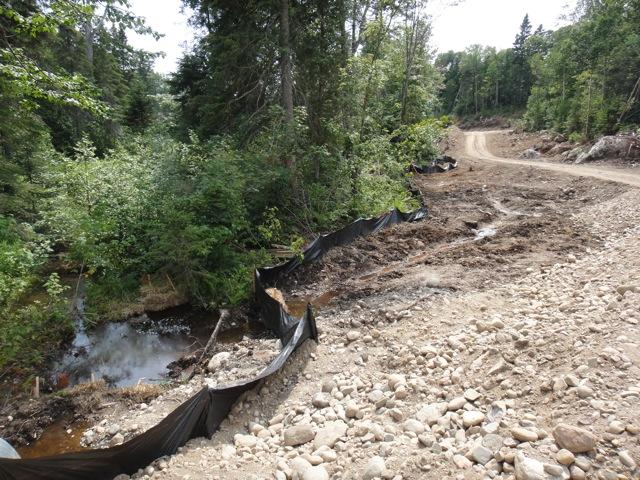
Ontario says OK for East Durham wind farm to kill at-risk fish

Embedded image permalink

Photo courtesy LSARC: devastation of landscape and erosion into streams from Northern Ontario wind farm construction

What’s a Redside Dace? Well, if you don’t know, don’t worry–it won’t matter for too much longer.

One of the principal points made by the Appellant in the recent appeal of the East Durham wind power project  by NextEra, was the damage that would be done by construction and the alteration of natural waterways. The prime witness testimony was:

[1]           He [Wren] also reviewed the 2004-2005 survey by Streams Ontario for the MNR.  In Dr. Wren’s opinion, the MOE “did not demonstrate due diligence in considering or evaluating sensitive fish and fish habitat in the project study area, with particular reference to the fish species Redside Dace”.

[2]           In Dr. Wren’s view, the sampling of the Saugeen River for Redside Dace was inadequate largely because too few samples were taken over too large an area.  It is his opinion that the MNR should have required the Approval Holder to conduct field investigations for Redside Dace in the Project Study Area to confirm their status.  He relied upon an email from the MNR to the Approval Holder’s ecologist which stated:

The absence of a species at risk occurrence does not mean that they are not present and as a result due diligence is still required … .  It should be noted that from a species at risk perspective this is an understudied area and as a result the MNR will be looking to ensure appropriate due diligence as it relates to field work was conducted to consider these species in further NHA reports for this site.

[3]           Dr. Wren’s opinion is that: “the Upper Saugeen Subwatershed contains an abundance of coldwater fisheries habitat that is unique in Southern Ontario.  Furthermore, the subwatershed is known to contain redside dace, an endangered species, which have a very specialized habitat.”

[4]           Dr. Wren also gave evidence about directional drilling and “fracking”, and soil erosion and sediment, and their likely effects on fish habitat and fish.  “Fracking” in this context is the accidental release of fluids toxic to fish that can occur during drilling to place transmission lines underground at water-crossings.  It is Dr. Wren’s view that a “frack out” could cause serious and irreversible harm to an endangered species such as the Redside Dace.

(Info on the Reside Dace here)

So, once again, the “overall benefit” of wind power supercedes damage to the environment, and to species of wildlife the Ontario government has already committed itself to protect? Ministry of the Environment lawyer Sylvia Davis, speaking in Toronto at the Ostrander Point appeal: “So a few animals get killed…”

The Minister of the Environment and Climate Change is Glen Murray, whose ministry is supposed to “ensure healthy communities, ecological protection…”

Reposted from Wind Concerns Ontario

Ontario’s massive debt: what voters didn’t want to hear

02 Wednesday Jul 2014

Posted by Ottawa Wind Concerns in Uncategorized

≈ 2 Comments

Tags

Kathleen Wynne, Ontario, Ontario bond rating, Ontario debt, Ontario economy, Ontario election 2014, Ontario Financing Authority, Ontario government spending, Ontario Liberal government, provincial debt, Robert Lyman

Here from Ottawa economist Robert Lyman, a review of Ontario’s debt situation: it isn’t pretty.

ONTARIO’S DEBT – THE STORY ONTARIO VOTERS REFUSED TO BELIEVE 

Several pundits have commented on the reasons for the major victory by the Liberal Party in the Ontario provincial elections held on June 12. Many have judged that voters were simply unwilling to believe the Progressive Conservative message that fiscal responsibility required reductions in spending, including where necessary reductions in the number of public service positions and programs. Voters said that the debt was not a problem that they wanted to worry about.

Even after the event, it is may be a good idea to examine exactly what the facts are with respect to the financial situation of the provincial government and what this may mean to the people who live in Ontario in future.

  • According to the Ontario Financing Authority, the consolidated provincial debt as of June 14, 2014 is $295.8 billion.
  • The debt has grown significantly over the past generation. In 1990, Ontario’s debt was $38.4 billion. It grew to $115 billion by 1998, and has almost doubled again since then.
  • Ontario has only been able to sustain this increase in debt because of interest rates that are at all-time historic lows. Even so, in 2013-2014, annual debt service costs to the provincial treasury were about $10.6 billion, the fourth largest expenditure item after health, education and social services.
  • The 2014 budget that was defeated projected that debt service costs would rise to $12 billion by 2015-16 and $13.3 billion by 2016-17. This is by far the fastest growing item in the provincial budget, growing twice as fast as the health budget.
  • The Liberals are committed to increasing program spending for at least the next four years. This year the $3 billion increase in program spending will increase the annual deficit to $12.5 billion from $11.3 billion last year. The deficit will be much higher if the Liberals’ projection of a 4 % annual economic growth rate turns out to be too optimistic.
  • There are very few reasons to believe the optimistic growth forecasts. Ontario’s productivity growth lags behind that of the United States, as does business investment. The province’s cost competitiveness has eroded, due to higher taxes and fees and much higher energy costs.
  • In the short term, the debt service cost could be increased further if the various investors’ services downgrade the province’s credit rating. Ontario has $250 billion worth of bonds rated by Moody’s Investor Services. The province’s ability to pay back those bonds, known as the debt-to-revenue ratio, is 237.7 %, the worst rating among all Canadian provinces.

Read the full paper here: ONTARIO’S DEBT

Email us at Ottawawindconcerns@gmail.com

Wind power to be election issue in October?

27 Friday Jun 2014

Posted by Ottawa Wind Concerns in Ottawa, Renewable energy, Wind power

≈ 1 Comment

Tags

election Ontario 2014, Mayor City of Ottawa, Mike Maguire, municipal election, North Gower, Not a Willing host, Ontario, Prowind, wind farm, wind power

Turbine and home in Ontario

Turbine and home in Ontario

We would say, yes.

Mayoral candidate Mike Maguire had his formal launch last evening and after saying that hydro bills were his number one issue (and the number one concern for citizens), Mr Maguire mentioned the proposed wind power project in North Gower. He said, I will stand with the citizens there and fight against this “not environmental, fiscally irresponsible” project.

He went on to say that the “monstrous” turbines would change the community forever, for no benefit.

Residents of North Gower and Richmond already sent a petition (as a form of referendum) to Ottawa City Hall last fall, stating that the community is Not A Willing Host; the petition was accepted by Council and a motion passed unanimously noting the community’s declaration, and demanding that the province return local land use planning powers to the municipalities.

It is looking like wind power is going to be a critical issue in this year’s municipal election, to be held October 27th.

There are currently 84 communities in Ontario that have passed a resolution at Council to declare they are an unwilling host or Not A Willing Host, out of a probable 100 or so that could be vulnerable to wind power generation projects.

Email us at ottawawindconcerns@gmail.com

Leaders’ debate: making the government record stick

04 Wednesday Jun 2014

Posted by Ottawa Wind Concerns in Uncategorized

≈ 1 Comment

Tags

Andrea Horwath, gas plants, Kathleen Wynne, leaders debate, Ontario, Ontario election, Ontario election debate, Scott Stinson, Tim Hudak

Ontario election debate: Hudak and Horwath try to make ‘corrupt’ Liberal record stick

Scott Stinson | June 3, 2014 9:29 PM ET

More from Scott Stinson | @scott_stinson

Premier Kathleen Wynne spent the early part of the Ontario leaders’ debate apologizing for her party’s “mistakes” in the billion-dollar gas-plant scandal, as an election issue that has largely been overlooked in the month-long campaign quickly returned to the forefront.

Responding to the first of six questions submitted by viewers in the only debate of the six-week campaign, one that asked how the Liberals could be trusted, Ms. Wynne said the decisions made “were wrong” and “public money was wasted.” Rather than pivot away, the Premier said that there had been “a breach of trust,” but “I have apologized for that.”

It was a perfect opening for NDP leader Andrea Horwath, who was able to begin her remarks in the 90-minute televised debate by saying “the Liberals have betrayed you.” How the Liberals could be trusted, she said, was “the actual question of the evening.”

Ms. Horwath, as did PC leader Tim Hudak later, pushed Ms. Wynne to explain why, as a member of Dalton McGuinty’s cabinet, she didn’t “say no” to the decision to cancel two gas-fired power plants at what turned out to be a $1.1-billion cost to the public.

“I am so sorry that public funds were wasted,” the Premier replied. “I have taken responsibility for being a part of a government that made mistakes.”

It was an impossible start for Ms. Wynne, and a subject for which there is no good answer, but even still she struggled to not sound guilty. “I’ve said that the decisions weren’t right,” she said. Mr. Hudak responded by saying that if the Liberals are re-elected after having apologized for getting caught, “they’re going to do it again.”…

Read the full story here.

10 years of “irrational” energy planning in Ontario

03 Tuesday Jun 2014

Posted by Ottawa Wind Concerns in Renewable energy, Wind power

≈ 1 Comment

Tags

Auditor General Ontario, cost-benefit analysis renewables, Dalton McGuinty, electricity bills Ontario, Green Energy Act, Ontario, Ontario Hydro, Ontario Power Authority, Parker Gallant, power costs Ontario, wind energy

Here from former banker Parker Gallant, an analysis of what has gone wrong on the energy file in Ontario over the last 10 years.

Ontario’s Power Trip: Irrational energy planning has tripled power rates under the Liberals’ direction

Parker Gallant, Special to Financial Post | June 2, 2014 | Last Updated:Jun 3 8:17 AM ET

Dalton McGuinty's Liberals claimed the province’s electricity sector was in a mess when they took over in 2003. Look at it today.

Ontario Hydro may well have been a mess. But it was a mess that produced less expensive electricity

In the summer of 2003, just before Dalton McGuinty’s Liberals gained power in Ontario, 50 million people in the U.S. Eastern Seaboard and Ontario suffered an electricity blackout caused “when a tree branch in Ohio started an outage that cascaded across a broad swath from Michigan to New England and Canada.” Back in 2003 Ontario’s electricity prices were 4.3 cents a kilowatt hour (kWh) and delivery costs added 1.5 cents per kWh. An additional charge of 0.7 cents — known as the debt retirement charge to pay back Ontario Hydro’s legacy debt of $7.8-billion — brought all-in costs to the average consumer to 6.5 cents per kWh.

The McGuinty Liberals claimed the province’s electricity sector was in a mess when they took over in 2003. The Liberals’ first Energy minister, Dwight Duncan, said then that he rejected the old Ontario Hydro model. “It didn’t work. We’re fixing it. We’re cleaning up the mess.”

Fast forward 11 years. Today, Ontario electricity costs average over 9 cents per kWh, delivery costs 3 cents per kWh or more, the 0.7-cent debt retirement charge is still being charged, plus a new 8% provincial sales tax. Additional regulatory charges take all-in costs to well over 15 cents per kWh.. The increase in the past 10 years averaged over 11% annually. Recently, the Energy Minister forecast the final consumer electricity bill will jump another 33% over the next three years and 42% in the next 5 years.

Summing up: Whatever mess existed in 2003 is billions of dollars worse today. The cost of electricity for the average Ontario consumer went from $780 on the day Dalton McGuinty’s Liberals took power to more than $1,800, with more increases to come. The additional $1,020 in after-tax dollars extracted from the province’s 4.5 million ratepayers is $4.6 billion – per year!

Why?

First, the Liberal Party fell under the influence of the Green Energy Act Alliance (GEAA), a green activist group that evolved into a corporate industry lobby group that adopted anthropogenic global warming as a business strategy. The strategy: Get government subsidies for renewable energy. The GEAA convinced the McGuinty Liberals to follow the European model. That model was: Replace fossil-fuel-generated electricity with renewable energy from wind, solar and biomass (wood chips to zoo poo). In the minds of those who framed the Liberal’s energy policies, electricity generated from wind, solar, biomass – green energy – was the way of the future.

The plan was implemented through the 2009 Green Energy and Green Economy Act (GEA), a sweeping, even draconian, legislative intervention that included conservation spending and massive subsidies for wind, solar and biomass via a euro-style feed-in-tariff scheme. The GEA created a rush to Ontario by international companies seeking above market prices, a rush that pushed the price of electricity higher. The greater the increase in green energy investment, the higher prices would go.

At the same time, Liberals forced installation of smart meters, a measure that added $2-billion to distribution costs. Billions more were needed for transmission lines to hook up the new wind and solar generators. At the same time, wind and solar generation – being unstable – needed back-up generation, which forced the construction of new gas plants. The gas plants themselves became the target of further government intervention, leading to the $1-billion gas plant scandal.

Advertisement

To force adoption of often unpopular wind and solar plants, the GEA took away municipal rights relating to all generation projects, stripping rural communities of their authority to accept or reject them.

To pay for the rising subsidies to wind and solar, the Liberals adopted an accounting device that would spread the cost over all electricity consumers. The device was called the “Global Adjustment.” The Global Adjustment draw on consumers grew fast and will continue its upward movement. In effect, the Global Adjustment is a dump on ratepayers for energy costs that are above market rates. During 2013, the total global adjustment was $7.8-billion. Of that, 52% went to gas/wind/solar/biomass.

The GA for 2014 is expected to rise to $8.6-billion, adding another 2.9 cents per kWh for each electricity consumer.

To oversee all this, the Liberals established the Ontario Power Authority to do long-term energy planning (LTEP) and to contract renewable generation under the feed-in tariff (FIT) program that guaranteed wind and solar generators above-market prices for 20 years or more. In 10 years Ontarians have seen four versions of the so-called long-term plan, suggesting there is nothing long-term or planned. The Auditor General’s report of Dec 5, 2011, disclosed that no cost/benefit analysis was completed in respect to those feed-in tariff contracts.

Whatever mess existed in 2003 is billions of dollars worse today

The numerous Liberals who have sat in the Energy Minister’s chair have had a penchant for believing how the sector should function, issuing “directives” from the cabinet. The directives created the most complex and expensive electricity sector in North America. The Association of Major Power Consumers issued a “Benchmarking” report in which they stated: “Our analysis shows that Ontario has the highest industrial rates in North America. Ontario not only has the highest delivered rates of all these jurisdictions; the disparity in rates also is growing.”

The almost 100 directives over the past 11 years from Liberal energy ministers have instructed the OPA, the Ontario Energy Board, Ontario Power Generation and Hydro One on a wide variety of issues from building a tunnel under Niagara Falls to paying producers for not generating power, subsidizing industrial clients for conservation while subsidizing other industrial clients for consumption. Numerous new programs have been created that support clients in Northern Ontario, urban clients for purchasing EVs (electric vehicles), homeowners for purchasing CFL light bulbs and a host of other concepts without weighing the effect on employers or taxpayers.
Aside from the burden on consumers, Ontario’s Power Trip has cost jobs as companies – Caterpillar, Heinz, Unilever and others – closed Ontario operations while others, such as Magna, failed to invest in Ontario due to high electricity prices and high taxes that would have created private sector jobs.

Were “green energy” jobs created? Government claims hit 31,000 in a press release in June 2013 but since then no mention of green job claims appears in releases. The recent budget of Finance Minister Charles Sousa reported 10,100 jobs in the “clean tech” sector, a far cry from earlier claims.

Ontario Hydro may well have been a mess a decade ago. But it was a mess that produced electricity priced to consumers at 6.5 cents a kWh. Current prices of 15 cents a kWh will rise to over 20 cents a kWh by 2018/19, forcing the average Ontario ratepayer to pay an additional $700 annually. By that date the cost of “renewable energy” to Ontario’s 4.5 million ratepayers will result in an annual extraction of $8-billion to satisfy the perceived benefits of wind, solar and biomass. Over the 20 years of the FIT contracts, $160-billion in disposable income will be removed from ratepayer’s pockets to access a basic commodity, all in the name of “global warming” and renewable power without use of a cost/benefit analysis.

Perhaps it is time for a change in the governing of Ontario and particularly the way the electricity sector is overseen.

Parker Gallant is a former Canadian banker who looked at his local electricity bill and didn’t like what he saw.

Read the full opinion and comments here.

Email us at ottawawindconcerns@gmail.com

Advance polls now open

02 Monday Jun 2014

Posted by Ottawa Wind Concerns in Uncategorized

≈ 1 Comment

Tags

Elections Ontario, Ontario, polling stations

Advance polls are now open across Ontario: vote when it is convenient for you!

In many locations advance polls are  open until June 6th, with another date or two available.

To find out where advance polling stations are near you, check your voter’s card (should have arrived by mail last week) or check Elections Ontario online at :
http://wemakevotingeasy.ca/en/more-ways.aspx

There are other voting options available, too; details on the Elections Ontario website.

Nepean-Carleton Libertarian candidate statement

02 Monday Jun 2014

Posted by Ottawa Wind Concerns in Health, Ottawa, Renewable energy, Wind power

≈ 1 Comment

Tags

Coreen Corcoran, government subsidies, Libertarian Party, Ontario, Ontario election, Ontario Libertarian Party, Ontario Progressive Conservative and Green parties, wind farm North Gower, wind farm Ottawa, wind farm Richmond, wind power, wind power generation

We have already published the statements from candidates for the Ontario election from the Liberal, NDP, Ontario Progressive Conservative and Green parties; we contacted Libertarian Party candidate Coreen Corcoran, who provided us with the following, as relates to large-scale wind power generation in Ontario and in specific, the only project currently proposed for the Ottawa area, in North Gower-Richmond.

Ms Corcoran writes:

Ontario Libertarian point of view
We do not believe that any industry should be given preferential treatment by the government over another industry, to the extent that the government should be out of the subsidy business all together. There are no private companies willing to stick their necks out to fund and own the risk of running wind farms 100%. They are relying on government subsidies to create an industry that is not wanted or even viable at this point in time. We would stop risky energy programs and leave it to the market to test unproven technologies. If it could survive in a free-market, let it, but it is doubtful the current technology would have any support. If a free-market wouldn’t support it, why should the taxpayers of Ontario?

My personal point of view
I saw the documentary Windfall a couple of years ago, and after seeing that film, I knew that wind power in its current form wasn’t sustainable. The physical impacts on the people who live near the turbines, the many birds and bats that are killed by the blades, and the huge government grants required to sustain this industry are all reasons why we need to stop it in its tracks. Maybe someday there will be a way to harness wind power on a large scale, but giant turbines covering our landscape and taking people out of their homes is not the way to do it.

You have my support.

Thank You,
Coreen Corcoran


Email us at ottawawindconcerns@gmail.com or write to us at PO Box 3, North Gower K0A 2T0

← Older posts
Newer posts →

Recent Posts

  • Land use conflict prompts citizen legal action over West Carleton battery storage site
  • Energy Minister Stephen Lecce speaks out on renewable power sources wind and solar; emphasizes cost, reliability
  • Open letter to CAFES Ottawa
  • Ottawa Wind Concerns supports West Carleton residents
  • What does wind ‘farm’ construction really look like?

Follow me on Twitter

My Tweets

Enter your email address to follow this blog and receive notifications of new posts by email.

Tags

Bob Chiarelli Green Energy Act IESO Ontario Ottawa Ottawa wind concerns wind energy wind farm wind power wind turbines

Contact us

PO Box 3 North Gower ON K0A 2T0

Create a free website or blog at WordPress.com.

Privacy & Cookies: This site uses cookies. By continuing to use this website, you agree to their use.
To find out more, including how to control cookies, see here: Cookie Policy
  • Subscribe Subscribed
    • Ottawa Wind Concerns
    • Join 379 other subscribers
    • Already have a WordPress.com account? Log in now.
    • Ottawa Wind Concerns
    • Subscribe Subscribed
    • Sign up
    • Log in
    • Report this content
    • View site in Reader
    • Manage subscriptions
    • Collapse this bar
 

Loading Comments...