Tags
CFRA, cost of renewables, cost of wind power, online poll, Ontario, Ontario economy, poll, wind power
Radio station CFRA is holding an online poll on the economics of renewable power–wind and solar–take the poll here

02 Thursday Apr 2015
Posted in Ottawa, Renewable energy, Wind power
Tags
CFRA, cost of renewables, cost of wind power, online poll, Ontario, Ontario economy, poll, wind power
Radio station CFRA is holding an online poll on the economics of renewable power–wind and solar–take the poll here
02 Thursday Apr 2015
Posted in Renewable energy, Wind power
Tags
Bob Chiarelli, electricity bills Ontario, electricity prices, Energy Minister Bob Chiarelli, energy poverty, Feed In Tariff program, HOEP, Ontario, Ontario deficit, Ontario economy, Ontario hydro bills, Parker Gallant, wind farms, wind power, wind power contracts
Financial Post, 2015
Parker Gallant, the former banker who several years ago launched FP Comment’s prophetic Ontario’s Power Trip campaign against the province’s expensive and pointless electricity industry reforms, has some new advice for the government. As the price of electricity soars, Ontario industries and consumers are being hammered by rate increases that seem never-ending. In an open letter today to Energy Minister Bob Chiarelli, Mr. Gallant lists a few easy initiatives the government could undertake to stop some of the madness and save consumers billions of dollars. Terence Corcoran
LETTER FROM PARKER GALLANT
April 1, 2015
The Honourable Bob Chiarelli, Minister of Energy,
Legislative Building, Queen’s Park, Toronto ON, M7A 1A1
Dear Minister Chiarelli:
Re: Dropping Ontario’s Price for Electricity
I have noted the difficulty you have experienced over the past several months trying to convince the media and the general population of Ontario they should simply bite the bullet and accept the fact that electricity prices will continue their above inflation climb. Having studied the situation I believe I have come up with some suggestions that would allow you to move things in the opposite direction.
First I suspect that Premier Wynne and Finance Minister Sousa exerted considerable pressure on you to come up with a scheme to help out the 500,000 to 700,000 “low-income” households in the province experiencing what is generally referred to as “energy poverty.” While the plan recommended came from the Ontario Energy Board and was altered somewhat by yourself I believe I have a better plan.
More on that later in this letter.
I also suspect that the Premier and Finance Minister told you unequivocally the OCEB was finished at the end of the year as they wish to wave better deficit numbers in front of those pesky credit rating agencies. The $1.2 billion that went to keep electricity rates down, a little bit, would no longer be available and they made that clear to you.
While you did your best to dance around the issue associated with the upcoming big jump in our electricity bills I could see the criticism was troublesome for you. As a result I believe my suggestions on what you should do will put some spring back in your step.
Here they are:
Recommendations to reduce future ratepayer bills
Conservation spending for the period 2015 to 2020 is forecast and budgeted at $1,835 million so drop it and that will provide close to $400 million annually that can go to reduce electricity prices.
Next, cancel the acquisition of the 500 MW of renewable wind and solar that you instructed IESO to acquire. That will save an estimated $200 million annually in future costs that would increase our rates.
I note there are 510 MW of wind generation contracts awarded that have not yet obtained their REA from the MoE and I recommend you also cancel those. I estimate that would provide relief from future increases of another $200 million per annum. I would suspect the costs of exiting these will be nominal.
Needless to say the cancellation of the above 1,010 MW of renewable energy will reduce future power surpluses meaning the HOEP might show some upward movement. That would allow all the dispatched wind and solar, spilled hydro, steamed off nuclear and idled gas to be sold via the market place to our neighbours. I estimate we could sell anywhere from 10/15 TWh annually at a price of somewhere around $40 million per TWh which would earn revenue of $400/600 million annually.
I would also cancel the new OESP plan which is estimated to cost $200 million (including a new administrative bureaucracy costing $20 million) annually.
Now if you do the math on the above the amount of money your portfolio would save in the future and also generate new income it totals $1.7 billion.
You could than use some of that $1.7 billion to both decrease electricity prices and provide relief for those suffering from “energy poverty.”
My recommendations on those two issues follow:
Recommendations to relieve “energy poverty”
First you should instruct the OEB that the .12% allocated to the LEAP program be increased immediately (providing you have completed the other recommendations) to 1% which will immediately make over $30 million available to the social agencies for relief purposes. You should also increase the maximums per household to $1,000 and instruct the OEB that the Return on Equity and/or Return on Assets for the LDC are to reflect a reduction to accommodate this.
Second you should drop the TOU off-peak rate from 7.7 cents per kWh to 5 cents per kWh. The cost of this would be about $350 million. It would also benefit many of those “low-income” households meaning they would no longer suffer from “energy poverty.” The other benefit is that the ratio of offpeak to on-peak would be much closer to the 3 : 1 ratio that the Auditor General suggested it should be and get more people to shift their use. It would also benefit our business community.
The cost of the two above recommendations are less than $400 million meaning ratepayers will be better off by avoiding future rate hikes and seeing some relief on existing rates. At the same time the TOU pricing will provide a clear signal that usage should shift preserving the “conservation” theme.
I certainly hope you will give my suggestions some serious thought and I do look forward to your response.
Yours truly,
Parker Gallant
05 Thursday Mar 2015
Posted in Renewable energy, Wind power
Tags
Algonquin Pikwakanagan, Antoine First Nation, Duty to Consult, First Nations land claims, First Nations land rights, Government of Ontario, Innergex, Innergex and Ontario, North bay wind farm, Ontario, Ontario Ministry of NAtural Resources, Ontario Ministry of the Environment, power development, Transport Canada, Vic Fedeli, wind farm, wind power generation
It wasn’t enough that the Government of Ontario, by encouraging and supporting development of high-impact wind power generation projects in rural Ontario destroyed small-town and rural communities, now its “green energy” policy has set First Nations against each other.
In a proposal for a 150-megawatt wind “farm” in the Mattawa area, near North Bay, Quebec-based Innergex and Ontario has not only placed a power development in a scenic area valued for tourism and wildlife preservation, it is also endangering North Bay’s airport operation and attendant economic growth—part of which just happens to be a NORAD base. (Transport Canada? Will THIS wind power project get a rise out of you?)
Ontario’s new Large Renewable Procurement process is expected to encourage power development on Crown land and in partnerships with First Nations. When it comes to Mattawa, however, the First Nation participating for profits doesn’t even live anywhere near there.
A news conference will be held tomorrow by the First Nations who do, and who have been involved in negotiations with the government over rights for years. Should be very interesting.
Here’s the story from North Bay-Nipissing.
04 Wednesday Feb 2015
Posted in Renewable energy, Wind power
Tags
Consumer Policy Institute, FIT, George Smitherman, North Gower wind farm, Ontario, Ontario government, Ontario Power Authority, Pierre Poilievre, Prowind, subsidies for wind power, wind farm subsidies, wind farms Ontario, wind power, wind power subsidies
From the Financial Post Comment, February 4, by Brady Yauch, executive director the Consumer Policy Institute
When the Ontario government launched its Green Energy Act (GEA ) in 2009, it promised “new green economy jobs” and ” a wide range of economic opportunities.” Then Minister of Energy George Smitherman argued that the GEA would be a boon to Ontarians of all stripes: “We see opportunities in our rural communities for farmers, not just to lease their land for big companies that are the proponents of wind farms, but indeed for clusters of farmers to see themselves as investors in projects…. the emergence of thousands of smaller green energy projects—microgeneration—in urban as well as rural areas.”
Yes, everyone would need to pay a little more for renewable power, the public was told, but the benefits would be widely shared, for the ultimate benefit of all. As it turned out, power rates didn’t go up a little – they soared. And the subsidies weren’t widely shared among the folk – a handful of billion dollar companies pocketed most of them, most of them outside the province.
According to an analysis by the Consumer Policy Institute and Energy Probe, 90% of the wind subsidies went to just 11 companies, 80% of the subsidies went to nine companies with annual revenues over $1-billion, 60% of the subsidies went to six companies with more than $10-billion in annual revenue.
As for the province’s claim that it wants to create an Ontario-based “green economy,” less than 10% of subsidies to wind generators went to small-scale or local owners.
Since 2006, when the province first started subsidizing wind turbines, the province has provided more than $1.92 billion in subsidies. This act of corporate welfare is far from over.
According to the Ontario Power Authority (OPA) – the provincial agency in charge of energy planning and contracting – the province has signed deals for another 2,630 MW of wind energy to come on stream in the coming years, on top of the 3,065 MW already in commercial operation. All of that generation will receive above market rates courtesy of ratepayers for their output. In total, the amount of subsidies to wind producers could hit $8-billion over the next decade and $13-billion over the next 20 years.
The list of companies receiving the lion’s share of subsidies reads like a “who’s who” in Canada’s energy sector and corporate heavyweights. Brookfield Renewable Energy (a subsidiary of Brookfield Asset Management), Enbridge and Transalta alone accounted for about 38 percent of all subsidies handed out to wind generators. Those companies combined brought in $54-billion in total revenue in 2013.
Samsung, which posted $217-billion in revenue last year, is expected to triple its wind capacity in Ontario – and the subsidies that go along with it – in the next couple of years.
The damage to ratepayers for such policies has been significant. Since 2009 – when the GEA was introduced – ratepayers in Ontario have seen the commodity cost on their energy bills climb dramatically, with the regulated price of power over that time having increased on average by 56%, or just over 9% annually – more than five times the rate of inflation, making electricity price increases worse in Ontario than elsewhere in Canada.
To make matters worse, the high rates being pushed onto ratepayers has lowered demand for electricity across the province in recent years. That means Ontario now has a significant surplus of power, which it then exports to neighbouring jurisdictions at a loss. Ontario ratepayers are now subsidizing the energy consumption of households in America and other provinces.
Nearly everyone is losing when it comes to renewable energy in Ontario – except for those few companies that planted industrial wind turbines across the province and are receiving billions in subsidies for their effort.
Brady Yauch is an economist and the executive director of Consumer Policy Institute. bradyyauch@consumerpolicyinstitute.org
NOTE from Ottawa Wind Concerns: The Library of Parliament, on request from MP Pierre Poilievre, estimated that IF the wind power project proposed for the North Gower-Richmond area of Ottawa by Germany-based Prowind had gone ahead (it almost reached approval), the 20-MW project would have cost Ontario ratepayers $4.8 million per year.
21 Wednesday Jan 2015
Posted in Renewable energy, Wind power
Tags
Bob Chiarelli, electricity bills Ontario, hydro bills Ontario, Ontario, Ontario economy, Parker Gallant, surplus power Ontario, Wind Concerns Ontario
Here from former bank VP Parker Gallant, now VP of Wind Concerns Ontario, a review of Ontario’s green energy policy which has resulted in a surplus of power produced when we don’t need it, and the government’s sell off to neighbouring jurisdictions.

Anyone reading an excerpt from the November 18, 2014 Standing Committee on Estimates text of Energy Minister Bob Chiarelli might have trouble discerning what his message was. And, specifically, what his answer had to do with MPPRandy Hillier‘s question on whether Ontario loses money exporting surplus electricity.
Chiarelli had danced around the question, claiming Ontario needed “surplus generation,” but Hillier kept hounding him and finally, Chiarelli responded.
Mr. Randy Hillier: “Listen, I understand that we want to have a margin of surplus. We all can understand that, because you don’t know specifically and exactly how much is going to be needed at any particular point in time. But let’s get back to the question. What are our estimated losses—do you have an estimate—for this year and next year, cumulatively, in our losses of trades?”
Hon. Bob Chiarelli: “Can I ask you to give me 30 seconds without interruption? Just a few seconds, okay?”
Mr. Randy Hillier: “Well, if you can answer the question—60 seconds.”
Hon. Bob Chiarelli: “Walmart buys snow blowers. They expect to sell X number of snow blowers in a winter. At the end of the winter, if they haven’t sold those snow blowers, they sell them at a discount. They’re selling them for less than their costs. That’s part of doing business.
The electricity system is exactly the same as Walmart. Why do they have sales? Why do they sell a product that is worth X number of dollars in November for less when they’re selling it in March or April? Why do they do it? They’re giving it away. They’re losing money. How much have they lost?”
Walmart. Ontario’s electricity system is “exactly the same” as Walmart.
Here’s what the Ontario Auditor General’s report for 2011 said about what Ontario lost by exporting electricity surpluses.
“Based on our analysis of net exports and pricing data from the IESO, we estimated that from 2005 to the end of our audit in 2011, Ontario received $1.8 billion less for its electricity exports than what it actually cost electricity ratepayers of Ontario.”
The losses highlighted in the AG’s report are related to the creation of the Global Adjustment or GA. The buyers of our surplus electricity only pay the HOEP (hourly Ontario electricity price) and Ontario’s consumers pick up the difference between the contracted price for generation and the HOEP. It was that difference, the GA, that the AG’s report highlighted.
Ontario has seen three more years of generation since that report and each one has meant increasing costs to Ontario’s electricity consumers. For 2012, IESO reported our exports were 14.6 terawatt hours (TWh) and generated an average price of $24.1 million/TWh, but the costs to Ontario’s consumers for that generation included the GA which was an additional $49.6 million/TWh—that resulted in a cost of $724 million. 2013 was worse: Ontario exported 18.3 TWh generating $26.5 million/TWh with the GA cost at $59.0 million/TWh for a cost of $1.007 billion. 2014 was slightly worse again, with exports of 19.1 TWh generating $36.0 million/TWh, costing ratepayers $53.5 million/TWh for the GA, creating a loss of $1.022 billion.
So, those three years cost ratepayers $2.75 billion for the 52 TWh (11.3% of total generation of 459.8 TWh) of exported power we didn’t need, bringing losses since creation of the GA to $4.550 billion.
Ontario’s ratepayers might be much better off if Walmart really was running the electricity system in Ontario. At least Walmart isn’t continually running at a loss.
©Parker Gallant January 21, 2015
16 Friday Jan 2015
Posted in Renewable energy, Wind power
Tags
Bob Chiarelli, conservation power Ontario, electricity bills Ontario, electricity consumption, electricity distribution companies, hydro bills Ontario, Independent Electricity Systems Operator, Ontario, Ontario economy, Ontario government, Parker Gallant, Robert Lyman, wind power
Here is a precis of an analysis of the Ontario government’s conservation efforts prepared by local economist Robert Lyman, based on research by Parker Gallant.
Here are the numbers.
In 2009, local electricity distribution companies in Ontario provided 124,206,032 megawatt-hours (MWh) for 4,748,577 households, a monthly average of 2,180 kilowatt hours (kWh).
In 2013, they provided 125,306,563 MWh for 4,944,488 households, a monthly average of 2,112 kWh. Average consumption fell by 3.3%, or 875 kilowatts annually between 2009 and 2013. For the average home, that is a monthly reduction from 800 kWh to 774 kWh (317 kWh per year).
In 2009, the cost of a kWh of electricity delivered averaged 6.15 cents and the “commodity” cost (just the electricity portion) for the full year was $590. By reducing annual consumption by 317 kWh, the savings should have been $19.50.
In 2013, the commodity cost had risen to 9.2 cents per kWh, or $854 per year. Not only did the $19.50 savings disappear, but also, the average household paid an additional $264 annually. That represents an additional cost to all ratepayers in the province of $1.2 billion annually. That does not include the $2 billion cost of installing smart meters.
The average household would have had to reduce its annual consumption by 33%, or 3,200 kWh, in order to have simply matched its cost for electricity consumption in 2009.
The Independent Electricity Systems Operator (IESO) is required to maintain an operating reserve of generating capacity of between 1,300 and 1,600 MW for contingencies. Since 2009 the available surplus has been between 4,000 MW and 5,900 MW. The IESO expects these surpluses will continue until at least the later part of this decade. Thus, while the official rationale for smart meters, time-of-use pricing and “conservation” programs is to avoid the addition of expensive new generation capacity, the province has continued to add that capacity even in the face of a substantial surplus.
What’s next? Current Energy Minister Bob Chiarelli has set new targets for both reductions in peak demand and “conservation” in his long-term energy plan. The target set for reducing peak demand is 10% (2,400 MW by 2025) and for “conservation” is 16% (30 TWh) by 2032. These will be combined with continuing large additions in industrial wind turbine and solar power generators at substantial premiums above most current generation. As a result, despite the lower consumption, ratepayers will be expected to dig deeper into their pockets.
31 Wednesday Dec 2014
Posted in Uncategorized
Tags
Algoma, Blanding's Turtle, Drennan case, Environmental and Lands Review Tribunal, Eric K Gillespie, Julian Falconer, legal actions wind farms, Northland Power, Not a Willing host, Ontario, Ontario government, prince Edward County, Rebecca Thompson, Sun News, Wind Concerns Ontario, wind farm appeals, wind farm lawsuits, wind farm property values
From Wind Concerns Ontario
A spokesperson for Northland Power, whose Grand Bend wind power project can now proceed following decision in an appeal, told a London Free Pressreporter that “One would think the people opposed would lose their appetite for this fight, but they haven’t yet.”
Indeed not. And 2015 will be more of the same as almost every wind power project in Ontario has been appealed, and several are headed for judicial review. Plus, countless private individuals have lodged or plan to take legal actions related to noise nuisance and property value loss.
The truth will stand, eventually.
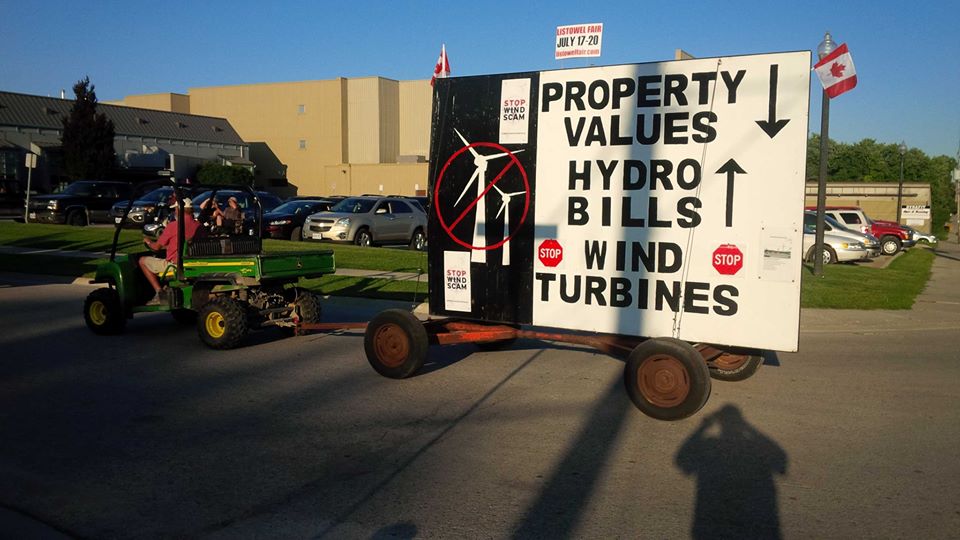
Here’s a look back in pictures at the year that was.




31 Wednesday Dec 2014
Posted in Renewable energy, Wind power
Tags
Bob Chiarelli, Dale Goldhawk, electricity bills, hydro bills Ontario, Ontario, Ontario economy, Ontario power exports, Ontario surplus power, Parker Gallant, Wind Concerns Ontario, wind power
Wind power half of surplus power sold off cheap

Christmas was great day for Michigan and New York, courtesy of Santa Claus Ontario and wind power: Ontario exported 16.5 % (about 66,000 MWh) of our total demand for power on Christmas Day, and those two neighbours got $500,000 in cash along with the 56,000 MWh of power we gave them. Power generated from wind energy was 36,000 MWh or 51% of total exports—if the curtailed wind production was included that would be 77% of the surplus power exported, so the wind power developers must be happy with their Christmas presents from Ontario, too.
In fact, Ontario’s electricity ratepayers picked up the cost of the cash payments to Michigan and New York, along with the actual cost of the production which was $7 million. And, we paid about $2 million for “curtailed” wind (17,000 MWh), close to $3 million for “steamed off” nuclear (49,000 MWh) and more than $3 million to the gas plant generators for their “net revenue requirement” while the gas power plants idled. That’s $16 million… and it doesn’t include the cost of Christmas Day “hydro spillage” as the Independent Electricity Systems Operator or IESO doesn’t report on it.
Total demand for power in Ontario Christmas Day was only 325,000 MWh, perhaps due to mild weather or maybe everyone barbecued their turkeys. The hourly Ontario energy price (HOEP) value of the total demand of 390,000 MWh was negative (-$2,900,000) based on the average negative price of $7.45/MWh, but Ontario ratepayers still paid the $40 million needed to produce that power.
So our Premier and her chief Elf in the Energy portfolio, Bob Chiarelli, rewarded Ontario’s ratepayers with lumps of coal on Christmas day while doling out goodies to our neighbours!
©Parker Gallant
December 26, 2014
Contact Wind Concerns Ontario at 1-855-517-0446 or
windconcerns@gmail.com
Reprinted from Wind Concerns Ontario
You may also listen to a 45-minute podcast of Parker Gallant on the Dale Goldhawk radio show here.
31 Wednesday Dec 2014
Posted in Renewable energy, Wind power
Tags
Auditor General Ontario, Auditor General Report, Bob Chiarelli, energy issues, Ontario, Ontario consumers, Ontario economy, Ontario electricity bills, Ontario power rates, Robert Lyman, smart meters
Ottawa-based economist Robert Lyman, who specializes in energy issues, has provided us with a summary of the highlights of the recently released Auditor General report, on the energy sector in Ontario. The government’s handling of this portfolio is astounding for its mismanagement, and wasted taxpayer and ratepayer dollars.
Read the summary from Mr Lyman Here: Ontario Auditor General Report on the Smart Metering Initiative
05 Wednesday Nov 2014
Posted in Ottawa, Renewable energy, Wind power
Tags
cost of electricity Ontario, electricity bills Ontario, electricity surplus Ontario, Global Adjustment, hydro bills Ontario, IESO, Independent Electricity System Operator, Ontario, Ontario economy, Ontario Electricity Costs, Ontario government, Wind Concerns Ontario, Wind Concerns Ontario executive Parker Gallant, wind power

Cost to consumers of government energy policies for one month reaches $1 billion
TORONTO, Nov. 5, 2014 /CNW/ – The Ontario government’s policy of pursuing “renewable” sources of power at a premium and selling off surplus at a loss has resulted in a record-breaking month of expenses and losses for Ontario’spower consumers.
In a document prepared by former bank vice-president and Wind Concerns Ontario executive Parker Gallant and energy analyst Scott Luft, figures from the Independent Electricity System Operator (IESO) show that the Global Adjustment for Ontario power customers hit $1 billion.
The Global Adjustment is the difference between market rates for electricity, and what the government pays power generators. In the case of wind power, which has first right to the grid in Ontario, Ontario is buying high and selling low, says Gallant. “In the spring and fall every year, demand for power is low, but wind production is at a high—that is the problem with wind power: it is produced out-of-phase with demand. Because of the contracts the government has with the developers, we pay top dollar for the power and when we don’t need it, sell for bargain-basement prices. We pay about 13.5 cents per kilowatt hour for wind, and sell it off far below that; in October it was below 0.7 cents.
“This is economic disaster for Ontario,” Gallant adds.
Consumer power bills rose again on November 1st, and the government will also launch its new procurement process for wind and solar this month.
Wind Concerns Ontario has been opposed to the development of large-scale wind power in Ontario’s communities in part because it is an expensive yet unreliable source of power. The record-breaking October figures should spur the government to halt its wind power program, says president Jane Wilson. “Any decision to approve one more wind farm, or to launch the new procurement process for more contracts this month as planned, is completely unsupportable,” she says. “Wind power doesn’t work, and Ontario can’t afford this experiment any longer.”
Ontario has contracts for 43 wind power projects not currently operational, which will cost consumers $16 billion over the next 20 years.
http://www.windconcernsontario.ca/october-2014-breaking-ontarios-record-for-electricity-costs/
SOURCE Wind Concerns Ontario
Canada News Wire November 5, 2014, 1:21 PM
 Ottawa Wind Concerns