The 100-megawatt project will cost more than $400 million, while Ontario already has a surplus of power
EDP Renewables, headquartered in Madrid, has posted the site plan for its 100-megawatt “Nation Rise” wind power project, in North Stormont, about 40 minutes south and east of Ottawa.
Details posted:
Project Name: Nation Rise Wind Farm
IESO Reference Number: L-006351-WIN-001-100
Project Location: The proposed Nation Rise Wind Farm will be located on private and public lands in the United Counties of Stormont, Dundas and Glengarry in the western portion of the Township of North Stormont, Ontario, and bounded to the south by the Township of South Stormont and to the west by the boundary of the Township of North Dundas. The north portion of the site is delimited by the municipality boundaries of Russell and the Nation. Courville Road and MacMillan Road are the east boundaries of the project.
Dated at: the Township of North Stormont this 17th day of March 2017.
Other project documents including the draft noise impact assessment are available on the Nation Rise wind “farm” website here.
Residents interested in learning more about the impact of the power project on the area’s homes, environment and wildlife, and in supporting the group’s activities and legal fund, should contact the Concerned Citizens of North Stormont*, whose website is here.
The 20-year contract with the Independent Electricity System Operator (IESO) will cost Ontario electricity ratepayers about $436 million.
The Minister of Energy, Glenn Thibeault, has stated, meanwhile, that Ontario currently has a surplus of power (which is being sold off at prices below what power developers are paid). The Nation Rise contract could be cancelled under a pre-construction liability clause for $600,000, according to IESO documents.
Minister Thibeault told a business audience in Toronto last year that the government’s “arbitrary” selection of wind power led to “sub-optimal siting” and “heightened community concerns.”
North Stormont is a Not A Willing Host community.
Concerned Citizens of North Stormont leader Margaret Benke, at a recent information event in Finch, Ontario
*Concerned Citizens of North Stormont is a chapter of Wind Concerns Ontario, as is Ottawa Wind Concerns.
Public declaration demands cancellation of wind power procurement, and re-focus of energy policy by the Wynne government
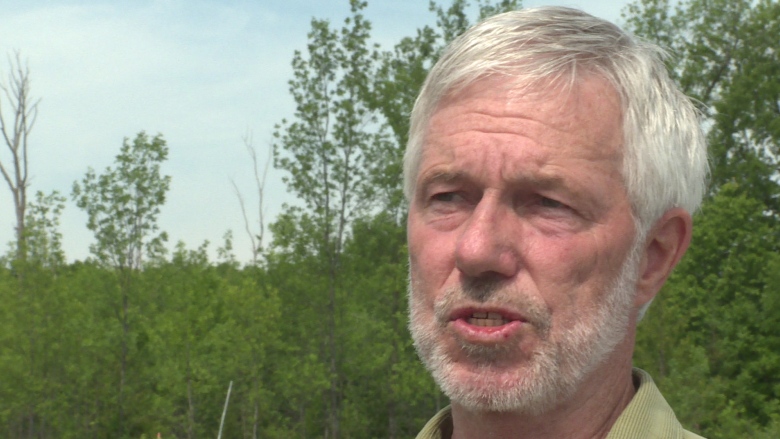
Mayor Ron Higgins: representing 25% of Ontario municipalities in fight against Green Energy Act (Photo CBC)
January 9, 2017
The Ontario Multi Municipal Group has issued a public declaration stating it wants the “exploitation” of rural Ontario by the wind power industry, aided by the Ontario government, to end.
“The implementation and expansion of renewable energy (industrial-scale wind turbines and large solar power projects) has developed to the point that it has caused hydro costs to increase, caused a division between rural and urban municipalities, and caused the citizens of Ontario to lose faith in democracy,” says Ron Higgins, Mayor of North Frontenac, in the document.
The municipal group was formed at the last meeting of the Association of Municipalities of Ontario (AMO) after 115 municipalities, or 25 percent of all municipalities in Ontario, passed resolutions demanding that municipalities get final say in the siting of renewable power projects.
“We are now speaking out on behalf of all those communities,” Higgins says.
Rights of communities ‘neutralized’
The Green Energy Act of 2009 removed the right to carry out local land-use planning for power projects –the Multi Municipal Group says that’s wrong. “It neutralizes the rights of residents of rural Ontario to advocate for, rely on and claim the benefit of sound land-use planning principles,” Higgins says. “It amounts to a form of discrimination.”
In the public declaration document, the group lists the impact of Ontario’s wind power program, saying it has not brought the economic benefits promised by the McGuinty government and in fact has resulted in an economic burden and energy poverty. They also say that no environmental benefit has been demonstrated and that “the natural world is suffering” because of large-scale turbines which are disrupting the natural environment and harming wildlife such as migratory birds and endangered species of bats.
Wind power a ‘false hope’ for the environment
Wind power has created “false hope” of steps to be taken to combat climate change and protect the environment, says the Multi Municipal Group. And, the Government of Ontario has ignored knowledge of the negative impacts of invasive wind power technology.
The group demands that all procurement of wind power be stopped, and the Green Energy Act repealed. They also recommend that the government base future policies on generation capacity and conservation, and use current energy supply assets.
“Our rural communities are unprotected against the exploitation [by] renewable energy,” Higgins concludes. The municipalities have no choice but to declare their position to the government and the public formally.
WCO vice-president Parker Gallant and president Jane Wilson speak on Ontario’s mismanaged electricity sector, energy poverty, wind turbine noise regulation, and what’s ahead for 2017
(C) Wind Concerns Ontario
YEAR-END INTERVIEW
Q:You’ve been telling people about the impact of renewables, specifically wind power, on Ontario’s electricity or hydro bills. How much of our electricity bills is due to the wind power/renewables program in Ontario?
Parker Gallant: I recently reviewed the cost of wind and solar generation relative to its contribution to Ontario’s demand for electricity and its impact on our electricity costs is shocking. Wind and solar in the first six months of 2016 delivered 8% of our generated power and represented 35% of the Global Adjustment which appears set to average over $1 billion per month. That represents a cost of over 36 cents a kilowatt hour (kWh), including the hourly Ontario energy price (HOEP).
Parker Gallant at a recent event in Kanata, Ontario: shocking mismanagement. [Photo: Metroland Media]
Q: Parker, you’ve also been telling people about the Global Adjustment or GA, which is where a lot of charges are hidden. Do you think these charges should be detailed on our bills, or is that even possible?Parker Gallant: While I believe in principle the GA should be revealed on our monthly bills, in practice, that would require reams of paper. How will the local distribution company explain how much you are billed for curtailed wind generation or the meteorological stations that measure the amount of curtailed wind that might have been generated? How to explain, say, the cost of spilled hydro or steamed off nuclear or the water fuel fee, or how to tell the ratepayer how much they are subsidizing the rates for large industrial clients, or what it is costing under the rural and remote rate plan (RRRP) that transports diesel fuel to remote First Nations, among dozens of other items included in our monthly bills?
Q: The Premier and Energy Minister are now saying that parts of their policies have been a “mistake” and that they need to get bills down. Wind Concerns is saying that canceling wind power contracts is necessary for that to happen. Can you explain? How much are the 2016 contracts worth?
Parker Gallant: Interesting they are now admitting a “mistake,” but when George Smitherman was Energy Minister he was provided with a long-term energy plan that had been carefully developed by “experts” within the crown agencies. He chose to cancel the plan and instead, impose one developed in conjunction with outsiders who were NOT experts. Previous Energy Ministers (Dwight Duncan comes to mind for his “smart meter” for every ratepayer) made mistakes, as did those who followed such as Brad Duguid and were roundly criticized by both the media and by ratepayers. The canceling of wind power projects not yet built or even contracted is only “step one” and will slow the climb in our bills. The current Minister, Glenn Thibeault has only suspended Large Renewable Procurement or LRP ll, and needs to cancel it, as well as LRP I and any of those contracts now past their agreed-to start date. There are ways to reduce costs almost immediately.
Jane Wilson: Wind Concerns Ontario prepared a detailed document for the IESO on the Long-Term Energy Plan, suggesting ways they could save $1.7 billion annually. That would have an immediate cost reduction impact.
Q: The Energy Minister says that now, Ontario is a “net exporter” of electricity like that’s a good thing. He claims we’re making money: is that true?
Parker Gallant: Being a “net exporter” of 16.8 terawatts (TWh) in 2015 is simply a demonstration of being a bad planner and manager of the system. If one adds the spilled hydro and curtailed wind to the net exports, the 21.2 TWh could have provided over half of all average Ontario households with power for a full year, yet we sold it 2.36 cents/kWh while we paid 10.14 cents/kWh for its generation. Ontario contracted for far too much intermittent and unreliable wind and solar power creating a domino effect the increased our costs of generation. Paradoxically, if Ontario ratepayers consumed more of the annual excess power (15.5% in 2015) it would help reduce our per kWh cost.
Q: What is WCO’s stance on climate change?
Jane Wilson: Our position is that everyone wants to do the right thing for the environment, whether that is preventing air pollution or using the most efficient forms of power generation — but that isn’t industrial-scale wind. For example, the Ontario Society of Professional Engineers or OSPE says that the proliferation of large-scale wind will actually increase greenhouse gas emissions, therefore not achieving the government’s stated goals. In the OSPE’s most recent report, they say “Wind generation offers less GHG reduction value in Ontario because base-load generation is already carbon-free and wind generation often displaces hydroelectric and nuclear base-load generation.”
Q: Why does the Ontario government continue to force wind turbines on communities that don’t want them?
Jane Wilson: The government is acting on an ideology that is not supported by fact and to do that, it erased communities’ right to local land-use planning with the Green Energy Act. We think that’s wrong, and are supporting the now 116 municipal governments that have demanded a return of that control and also that community support be mandatory for wind power contracts. There is a concern too about communities in the North where there may not be elected municipal governments, where contracts can be awarded for wind power projects that have a significant negative impact on the natural environment, for little or no benefit.
WCO worked with Ontario municipalities on the mandatory support resolution.
Q:Can the government really cancel wind power contracts? Can a new government cancel the subsidy programs?
Jane Wilson: Yes. There are clauses in the contracts under LRP I that are “off-ramps” in the case of cancellation, and which set out the financial steps needed to do that. For example, the contract with EDP for the “Nation Rise” project south of Ottawa in North Stormont, worth $430 million over 20 years, would cost $250,000 plus reimbursement for development costs that must be justified, to a maximum of $600,000. And yes, government can cancel subsidy programs. The LRP II, now “suspended”, should be cancelled outright.
The other opportunity is to cancel wind power projects that do not have a “Notice-to-Proceed”: this is straightforward. WCO has also suggested to the IESO that the government look seriously at all contracts and review them for opportunities to cancel. Even costly negotiated buy-outs will reduce hydro costs significantly, due to the high cost of disposing of surplus power.
Q: What is WCO doing to help people already living with wind turbines, and the noise they produce?
Jane Wilson: We support the public health investigation being done by the Huron County Health Unit, and hope that other municipalities will take similar action. We are also looking at how research can be done to help change the Ontario regulations on noise –which are not based on current science and in fact, are completely inadequate to protect health. We prepared a detailed document on how to revise noise enforcement regulations, another on how the approval process must be changed to protect health, and we submitted a document to the World Health Organization which is preparing global noise regulations for wind turbines. In short, we take every opportunity possible to explain the situation for people living in communities where wind turbines and their noise emissions have been forced, without consent, on the people of Ontario, with the goal of having regulations and processes changed.
Jane Wilson: Wind Concerns Ontario is not stopping [Photo: Julie Oliver, Ottawa Citizen]
Q: What’s ahead in 2017?Jane Wilson: It’s a very different world for wind power now, than in 2009 when the Green Energy Act was passed. People are genuinely questioning the benefit of high-impact, large-scale wind power development, especially when there seem to be few, if any, benefits, and we are seeing the shocking results of the government’s complete mismanagement of the electricity sector such as lost jobs and rising energy poverty. We believe the government will have to take dramatic action if it is serious about getting electricity bills down. The fact that Ontario municipalities are speaking out on this issue and taking action will also have results, we believe. We are hoping for a complete halt to the ongoing damage of the government’s policies, and that there will be help for people already living with the noise and other impacts of industrial-scale wind turbines.
As for Wind Concerns Ontario, we are not stopping our work.
Wind power developer EDP Renewables, based in Portugal, will be holding an Open House information session on the 100-megawatt, 30+-turbine, $430-million wind power development they have called “Nation Rise” on December 13 in the arena in Finch.
Last week, MPPs Jim McDonell and Grant Crack took letters and petitions containing more than 1200 signatures from citizens of North Stormont and Nation Twp to the Legislature at Queen’s Park, demanding that the contracts for the two Ottawa-area power projects be cancelled.
The Open House information sessions are typically just poster sessions with developer staff available to answer any questions.
The site plan for the project has not yet been made available although proposed turbine locations are usually part of the application to the IESO for a power contract. The lack of a site plan means there are community members who may yet be unaware that they will have an industrial-scale wind turbine generating power near them.
Wind turbines emit a wide range of noise including low-frequency or inaudible noise which has been linked to adverse health effects. Wind turbines have also been implicated in disturbances to the water table and drinking water (Dover Twp, Ontario) via seismic vibration, and wind turbines are responsible for the deaths of migratory birds and endangered species of bats.
A few weeks ago, Ontario Premier Kathleen Wynne admitted that her government’s electricity policies have been “a mistake” and that they need to work to get consumer bills down. Last week, Energy Minister Glenn Thibeault admitted that an “arbitrary” choice of wind power as a source of power generation had led to “sub-optimal siting” and community concerns.
The Nation Rise power project will cost Ontario as much as $430 million over the 20-year life of the contract.
The Open House will be held from 3:30-7:30 PM.
EDP wind turbine and home at South Branch project, Brinston, Ontario. Photo by Ray Pilon.
Former bank vice-president and vice-president of Wind Concerns Ontario was in Ottawa this past weekend, speaking at a Town Hall in Kanata on the details of Ontario’s electricity bills.
Today, he published an analysis of how much wind power is really costing us, on his Energy Perspectivesblog. When the well-financed wind power lobby claims wind power prices are low, they don’t factor in other costs such as wasted hydro, gas, and nuclear, he says.
This is really shocking, given the rise in energy poverty in Ontario.
For the cost to provide a small portion of Ontario’s power, wind is no bargain
Not a chance …
Most electricity ratepayers in Ontario are aware that contracts awarded to wind power developers following the Green Energy Act gave them 13.5 cents per kilowatt (kWh) for power generation, no matter when that power was delivered. Last year, the Ontario Auditor General’s report noted that renewable contracts (wind and solar) were handed out at above market prices; as a result, Ontario ratepayers overpaid by billions.
The Auditor General’s findings were vigorously disputed by the wind power lobbyist the Canadian Wind Energy Association or CanWEA, and the Energy Minister of the day, Bob Chiarelli.
Here are some cogent facts about wind power. The U.K. president for German energy giant E.ON stated wind power requires 90% backup from gas or coal plants due to its unreliable and intermittent nature. The average efficiency of onshore wind power generation, accepted by Ontario’s Independent Electricity System Operator (IESO) and other grid operators, is 30% of their rated capacity; the Ontario Society of Professional Engineers (OSPE) supports that claim. OSPE also note the actual value of a kWh of wind is 3 cents a kWh (fuel costs) as all it does is displace gas generators when it is generating during high demand periods. On occasion, wind turbines will generate power at levels over 90% and other times at 0% of capacity. When wind power is generated during low demand hours, the IESO is forced to spill hydro, steam off nuclear or curtail power from the wind turbines, in order to manage the grid. When wind turbines operate at lower capacity levels during peak demand times, other suppliers such as gas plants are called on for what is needed to meet demand.
Bearing all that in mind, it is worth looking at wind generation’s effect on costs in the first six months of 2016 and ask, are the costs are reflective of the $135/MWh (+ up to 20% COL [cost of living] increases) 20 year contracts IESO, and the Ontario Power Authority awarded?
As of June 30, 2016, Ontario had 3,823 MW grid-connected wind turbines and 515 MW distributor-connected. The Ontario Energy Reports for the 1st two quarters of 2016 indicate that wind turbines contributed 4.6 terawatts (TWh) of power, which represented 5.9% of Ontario’s consumption of 69.3 TWh.
Missing something important
Not mentioned in those reports is the “curtailed” wind. The cost of curtailed wind (estimated at $120 per/MWh) is part of the electricity line on our bills via the Global Adjustment, or GA. Estimates by energy analyst Scott Luft have curtailed wind in the first six months of 2016 at 1.228 TWh.
So, based on the foregoing, the GA cost of grid-accepted and curtailed IWT generation in the first six months of 2016 was $759.2 million, made up of a cost of $611.8 million for grid-delivered generation (estimated at $133 million per TWh) and $147.4 million for curtailed generation. Those two costs on their own mean the per kWh cost of wind was 16.5 cents/kWh (3.2 cents about the average of 13.3 cents/kWh). The $759.2 million was 12% of the GA costs ($6.3 billion) for the six months for 5.9% of the power contributed.
But hold on, that’s not all. We know that wind turbines need gas plant backup, so those costs should be included, too. Those costs (due to the peaking abilities of gas plants) currently are approximately $160/MWh (at 20% of capacity utilization) meaning payments to idling plants for the 4.6 TWh backup was about $662 million. That brings the overall cost of the wind power contribution to the GA to about $1.421 billion, for a per kWh rate of 30.9 cents. If you add in costs of spilled or wasted hydro power to make way for wind (3.4 TWh in the first six months) and steamed off nuclear generation at Bruce Power (unknown and unreported) the cost per/kWh would be higher still.
So when the moneyed corporate wind power lobbyist CanWEA claims that the latest procurement of IWT is priced at 8.59 cents per kWh, they are purposely ignoring the costs of curtailed wind and the costs of gas plant backup.
22% of the costs for 5.9% of the power
Effectively, for the first six months of 2016 the $1.421 billion in costs to deliver 4.6 TWh of wind-generated power represented 22.5% of the total GA of $6.3 billion but delivered only 5.9% of the power. Each of the kWh delivered by IWT, at a cost of 30.9 cents/kWh was 2.8 times the average cost set by the OEB and billed to the ratepayer. As more wind turbines are added to the grid (Ontario signed contracts for more in April 2016), the costs described here will grow and be billed to Ontario’s consumers.
CanWEA recently claimed “Ontario’s decision to nurture a clean energy economy was a smart investment and additional investments in wind energy will provide an increasingly good news story for the province’s electricity customers.”
There is plenty of evidence to counter the claim that wind power is “a smart investment.” But it is true that this is a “good news story” — for the wind power developers, that is. They rushed to Ontario to obtain the generous above-market rates handed out at the expense of Ontario’s residents and businesses. And we’re all paying for it.
No community support for greed in Nation Twp [Photo: Ontario Farmer]
December 6, 2016
Residents of Nation Township and North Stormont recently gathered signatures on a petition and letters demanding the Ontario government halt the Large Renewable Procurement (LRP) process permanently (it is currently “suspended”), cancel the LRP I contracts awarded for five wind power projects earlier this year, and cancel contracts for wind power projects that have not yet been built.
The Premier of Ontario recently admitted that her government’s energy policies were a “mistake” that resulted in higher costs for Ontario citizens.
The Ontario Association of Food Banks recently released its Hunger report, placing the blame for Ontario’s “shockingly high levels of food bank use” on the electricity bills, and other factors. Hydro rates have increased 3.5 times and “off-peak” rates are now eight times what they were. Remedies proposed by the Wynne government, the association says, are a “drop in the bucket.”
The petitions filed at Queen’s Park yesterday refer to the high electricity rates and growing poverty and also to the fact that the Wynne government, specifically Energy Minister Glenn Thibeault, says it now has a “robust supply of power” for the years ahead.
So why pay out the millions for these new contracts, for power we don’t need, say the residents.
MPPs Jim McDonell and Grant Crack (the LIBERAL MPP for Glengarry-Prescott-Russell) read the petitions in the Legislature yesterday, while representatives of Save The Nation/Sauvons La Nation and Concerned Citizens of North Stormont watched from the Gallery.
EDP wind turbine and home at South Branch project, Brinston, Ontario. Photo by Ray Pilon.
October 21, 2016
Portugal-based power developer EDP Renewables is holding an Open House for its Nation Rise wind power project on Tuesday, October 25, from 4-8 PM in Finch Ontario, at the Finch arena.
The 100-megawatt power project is located completely in the Township of North Stormont; it was one of five to receive a contract from the Independent Electricity System Operator (IESO) earlier this year, and one of three projects to win a contract despite being proposed in an unwilling host community.
The contract is worth $436 million over 20 years.
In September, the IESO announced that Ontario has a surplus of power and that the new contract process scheduled for 2017 is now suspended. The IESO did not announce plans to cancel any of the contracts for more unneeded wind power announced a few months previous, despite IESO representative statements that the contracts are contributing to Ontario’s electricity bills.
Citizens of the area have formed a community group Concerned Citizens of North Stormont, and vowed to fight approval of the project, including legal action in future if necessary.
People gather at EDP Renewables open house in August, 2015
The Mayor of North Frontenac has written to Energy Minister Glenn Thibeault on behalf of all the 115 municipalities demanding change to the Large Renewable Procurement process. While relieved the next round of bids is “suspended,” he says, the municipalities say more can be done to stop the dramatic rise of Ontario electricity bills.
October 5, 2016
Mayors across Ontario who united together as a result of a resolution being supported to have municipal support mandatory for industrial wind turbines are relieved that procurement of future wind power has been cancelled for now. The Mayors still feel however that the government needs to take very aggressive actions to address the ongoing crisis caused by high electricity costs in this province. Taking steps to not add $2.45 per month in 2020 does not address the real hardship being felt by our residents now. It is also not clear that the other measures announced by the government will even offset the ongoing increases in hydro rates that can be expected in the short term unless additional changes are made.
It was important that the Minster of Energy’s statement confirmed that the province has a “robust” supply of electricity and the procurement process could be cancelled without increasing greenhouse gas emissions. This provides room for more aggressive actions that will address increasing costs. Our tracking of wind turbine contracts shows that there are still many wind turbine projects in the pipeline that will add at least another $7.9 billion to electricity generating costs. This is equivalent to another $82 per annum for each Ontario electricity user. Seven of these projects are under construction but will not be connected to the grid until sometime this fall or in 2017. Another five have not been issued ‘Notices to Proceed’ as they are, or have been until recently, involved in Environmental Review Tribunal proceedings or other legal appeals of Renewable Energy Approvals. The final six projects are in the pre-MOECC submission stage. These include the five contracts issued in early 2016 plus one outstanding project from earlier FIT offers.
In all of these cases, the IESO has the option of terminating the agreement for any reason with very limited cost liabilities relative to the 20 year commitment to electricity that is not required. We respectively ask that all industrial and solar wind projects be cancelled to avoid ongoing costs to our residents.
Bids were to be accepted beginning early in 2017. But Ontario now says it has enough power and wants to take steps to reduce electricity bills, so it doesn’t need the new renewable power capacity.
September 27, 2016
Moments ago, the Wynne government announced it is suspending its controversial Large Renewable Procurement program for sources of power such as wind and solar.
“Ontario will immediately suspend the second round of its Large Renewable Procurement (LRP II) process and the Energy-from-Waste Standard Offer Program, halting procurement of over 1,000 megawatts (MW) of solar, wind, hydroelectric, bioenergy and energy from waste projects. …
On September 1, 2016, the Independent Electricity System Operator (IESO) provided the Minister of Energy with the Ontario Planning Outlook, an independent report analyzing a variety of planning scenarios for the future of Ontario’s energy system. The IESO has advised that Ontario will benefit from a robust supply of electricity over the coming decade to meet projected demand.”
Wind Concerns Ontario(and two Auditors General for Ontario) has been saying for years that a cost-benefit analysis of the renewable energy program was never done, and should have been.
“Now, the impacts of this program are clear,” says President Jane Wilson.”We have unsustainable and punishing rises in electricity bills for the people of Ontario, with a corresponding rise in rates of energy poverty, while there is no evidence of any environmental benefit. In fact, there are widespread concerns about the damage being done to the environment from this high-impact form of power generation.”
Wind Concerns Ontario says that in addition to suspending the Large Renewable Procurement program, contracts for power projects not yet under construction need to be cancelled immediately.
“The government admits it has adequate power,” Wilson says. “There is no need to continue this assault on Ontario citizens, on our economy, and on the natural environment for little or no benefit.”
Wind turbines near SS Marie: power supply saturated but Ontario buying more wind. (National Post photo)
Worthy of a repost, from the National Post, this opinion from a renewable energy insider.
September 2, 2016
Ontario set an all-time peak electricity demand of 27,005 megawatts (MW) 10 years ago this summer. At the time, rising demand and plans to retire its coal-fired power plants dominated provincial energy policy. What followed was optimism for a new energy policy, focused on the ambitious procurement of large wind and solar installations. I felt great pride in helping to lead an industry that would make Ontario’s power system clean, responsive and cutting edge.
What a difference a decade makes. Intrusive policy and poor implementation are largely responsible for the energy market debacle Ontarians face today. But there is no excuse now for buying more mega-projects when our power supply is saturated and hydro bills are skyrocketing.
Coal-fired power generation effectively disappeared after 2010, by which time Ontario’s electricity demand had already started to plummet. Demand has fallen 13 per cent in the past 10 years, including consecutive reductions in each of the past five years. In 2016, Ontario will consume less electricity than in 1997.
Peak demand exceeded 23,000 MW only one day this summer, despite parts of the province seeing 35 days with temperatures above 30 C. Yet our installed capacity approaches 40,000 MW. The system will have reserves above extreme summer peaks well into the 2020s. The Independent Electricity System Operator (IESO) reinforced this point recently when it confirmed “Ontario will have sufficient supply for the next several years.”
Against this troubling background, the Ontario government is procuring an additional 1,300 MW of large wind and solar generation under the Large Renewable Procurement (LRP) program. This decision is indefensible. It makes the frequency of negative pricing (paying our U.S. neighbours to take Ontario energy during periods of low demand) and curtailment (paying wind developers for energy production even when the grid can’t use the power) even worse. These problems have become billion-dollar burdens for Ontario electricity customers.
Sweet contracts, painful electricity bills
Offering sweet contracts to large renewable energy developers while demand stagnates has helped push hydro bills higher. Electricity prices have increased by seven per cent a year since 2009. Costs have risen faster than Ontario’s inflation rate in each of the past several years. The province’s electricity rates are increasing faster than any other jurisdiction in North America.
It’s clear that change must begin with the renewable industry, since our industry alone benefits from the continued overprocurement of electricity. The fact is large wind and solar developers have been pampered by Queen’s Park for far too long. Although solar installation costs dropped 70 per cent in the past decade, the government froze prices for years at a time. When permitting delays enabled projects to be built as much as five years after contracts were awarded, multi-millionaires were created overnight.
Today, with no logical reason to build more wind and solar mega-projects in Ontario, renewable developers must confront the economic damage they are doing to their families, friends and neighbours, and to the next generation of citizens who will bear the brunt of this green corporate welfare.
Renewable energy companies must confront the economic damage they are doing.
We need to make four changes. First, Ontarians must demand a return to basic electricity policy principles: safety, reliability and cost effectiveness. Second, the government should revisit the IESO’s legal obligations associated with the current LRP process and exit this procurement process without paying the ransoms that characterized Ontario’s gas plant debacles. Third, the IESO should restrict renewable procurement to the smaller rooftop and distributed energy projects that actually benefit customers. Fourth, Ontario renewable energy firms must learn to export their pioneering expertise and target new domestic and international markets.
The global renewable energy revolution has just started. Solar energy is increasingly the cleanest, cheapest and most environmentally sustainable option. The advent of battery storage, smart grids and the Internet of Things will catalyze innovative economies that embrace change. Renewables have a bright future in this world, but we need to regain control of Ontario’s failing electricity policies — and do it soon — to ensure we seize the energy opportunities of the 21st century.
National Post
Jon Kieran is a Toronto-based renewable energy consultant. He is a member of the Canadian Solar Industries Association’s board of directors. He declines LRP work from clients.



![Parker Gallant at a recent event in Kanata, Ontario: shocking mismanagement. [Photo: Metroland Media]](http://www.windconcernsontario.ca/wp-content/uploads/2016/12/ParkerGallantTownHall-MetrolandPic.jpg)
![Jane Wilson: Wind Concerns Ontario is not stopping [Photo: Julie Oliver, Ottawa Citizen]](http://www.windconcernsontario.ca/wp-content/uploads/2016/12/002.jpg)


![No community support for greed in Nation Twp [Photo: Ontario Farmer]](https://ottawawindconcerns.com/wp-content/uploads/2015/09/savethenation-001-2.jpg)