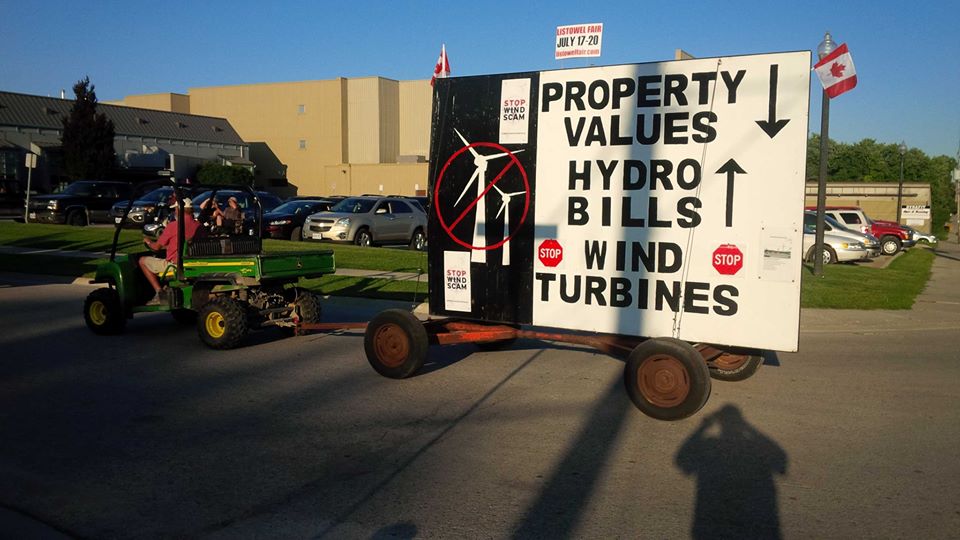
Big Wind’s “Big Bonanza” in Ontario: subsidies benefit a few corporations, not ratepayers

Tags

, , , , , , , , , , , , ,

From the Financial Post Comment, February 4, by Brady Yauch, executive director the Consumer Policy Institute

When the Ontario government launched its Green Energy Act (GEA ) in 2009, it promised “new green economy jobs” and ” a wide range of economic opportunities.” Then Minister of Energy George Smitherman argued that the GEA would be a boon to Ontarians of all stripes: “We see opportunities in our rural communities for farmers, not just to lease their land for big companies that are the proponents of wind farms, but indeed for clusters of farmers to see themselves as investors in projects…. the emergence of thousands of smaller green energy projects—microgeneration—in urban as well as rural areas.”

Yes, everyone would need to pay a little more for renewable power, the public was told, but the benefits would be widely shared, for the ultimate benefit of all. As it turned out, power rates didn’t go up a little – they soared. And the subsidies weren’t widely shared among the folk – a handful of billion dollar companies pocketed most of them, most of them outside the province.

According to an analysis by the Consumer Policy Institute and Energy Probe, 90% of the wind subsidies went to just 11 companies, 80% of the subsidies went to nine companies with annual revenues over $1-billion, 60% of the subsidies went to six companies with more than $10-billion in annual revenue.

As for the province’s claim that it wants to create an Ontario-based “green economy,” less than 10% of subsidies to wind generators went to small-scale or local owners.

Since 2006, when the province first started subsidizing wind turbines, the province has provided more than $1.92 billion in subsidies. This act of corporate welfare is far from over.

According to the Ontario Power Authority (OPA) – the provincial agency in charge of energy planning and contracting – the province has signed deals for another 2,630 MW of wind energy to come on stream in the coming years, on top of the 3,065 MW already in commercial operation. All of that generation will receive above market rates courtesy of ratepayers for their output. In total, the amount of subsidies to wind producers could hit $8-billion over the next decade and $13-billion over the next 20 years.

The list of companies receiving the lion’s share of subsidies reads like a “who’s who” in Canada’s energy sector and corporate heavyweights. Brookfield Renewable Energy (a subsidiary of Brookfield Asset Management), Enbridge and Transalta alone accounted for about 38 percent of all subsidies handed out to wind generators. Those companies combined brought in $54-billion in total revenue in 2013.

Samsung, which posted $217-billion in revenue last year, is expected to triple its wind capacity in Ontario – and the subsidies that go along with it – in the next couple of years.

The damage to ratepayers for such policies has been significant. Since 2009 – when the GEA was introduced – ratepayers in Ontario have seen the commodity cost on their energy bills climb dramatically, with the regulated price of power over that time having increased on average by 56%, or just over 9% annually – more than five times the rate of inflation, making electricity price increases worse in Ontario than elsewhere in Canada.

To make matters worse, the high rates being pushed onto ratepayers has lowered demand for electricity across the province in recent years. That means Ontario now has a significant surplus of power, which it then exports to neighbouring jurisdictions at a loss. Ontario ratepayers are now subsidizing the energy consumption of households in America and other provinces.

Nearly everyone is losing when it comes to renewable energy in Ontario – except for those few companies that planted industrial wind turbines across the province and are receiving billions in subsidies for their effort.

Brady Yauch is an economist and the executive director of Consumer Policy Institute. bradyyauch@consumerpolicyinstitute.org

NOTE from Ottawa Wind Concerns: The Library of Parliament, on request from MP Pierre Poilievre, estimated that IF the wind power project proposed for the North Gower-Richmond area of Ottawa by Germany-based Prowind had gone ahead (it almost reached approval), the 20-MW project would have cost Ontario ratepayers $4.8 million per year.

Wind farm noise study “ground-breaking” acoustician colleagues say

Tags

, , , , , , , , , , , , , ,

Wind farm noise study firm congratulated by acoustics professionals

New study explains why Ontario has gone from affordable electricity rates to among the highest in N America. Photo: Bloomberg
New study from Australia called ground-breaking and unique. Big Wind says it’s meaningless. As they would.

The wind turbine noise study completed by acoustics specialist Steven Cooper in Australia has had a resounding effect around the world: using a new methodology and working with the cooperation of the wind power company (who now is rushing to clarify it was not a “health” study), the results showing that wind “farm” neighbours are at greater risk for adverse health effects has been of great interest.

While the wind power industry has been denying the study’s relevance, news comes of congratulations from fellow acoustics professionals for Mr Cooper’s study.

We attach a copy of a letter of congratulations from another noise measurement firm in Australia, calling the Cooper study “a benchmark.” Use of the term “sensation” rather than noise, is “ground-breaking and unique,” writes Bob Thorne, PhD.

The letter may be read here: Thorne-B.-Cape-Bridgewater-study-NMS-congrats

Australian wind farm noise study shows neighbours at risk for health problems

Tags

, , , , , , , , , , ,

This is a story provided by Wind Watch, which has access to a subscriber-only report from The Australian.

Turbines may well blow an ill wind over locals, ‘first’ study shows

Credit:  By: GRAHAM LLOYD. From: The Australian. January 21, 2015. ~~

People living near wind farms face a greater risk of suffering health complaints caused by the low-frequency noise generated by turbines, a groundbreaking study has found. The study by acoustics expert Steven Cooper is the first in the world in which a wind turbine ­operator had fully co-operated and turned wind turbines off completely during the testing. It opens the way for a full-scale medical trail that may resolve the contentious debate about the health impact of wind farms.

Funded by wind farm operator Pacific Hydro, the study was conducted at Cape Bridgewater in southwest Victoria where residents have long complained about headaches, chest pains and sleep loss but have been told it was all in their minds.

As part of the study, residents living between 650m and 1.6km of the wind turbines were asked to ­diarise what they were experiencing, including headaches, pressure in the head, ears or chest, ringing in the ears, heart racing or a sensation of heaviness. Their observations were separated into noise, vibration and sensation using a one to five severity scale.

“The resident observations and identification of sensation indicates that the major source of complaint from the operation of the turbines would appear to be related to sensation rather than noise or vibration,” the report says. “For some residents experiencing adverse sensation effects, the impact can be exacerbated by bending over rather than standing, with the effect in some cases being reported as extremely severe and lasting a few hours.”

Mr Cooper said it was the first time that sensation rather than audible noise had been used as an indicator of residents’ perception of nearby wind turbines.

The report found offending sound pressure was present at four distinct phases of turbine operation: starting, maximum power and changing load by more than 20 per cent either up or down. Mr Cooper said the findings were consistent with research into health impacts from early model wind turbines conducted in the US more than 20 years ago.

The relationship between turbine operation and sensation demonstrated a “cause and effect”, something Pacific Hydro was not prepared to concede, he said.

Survey participant Sonja Crisp, 75, said the first time she experience discomfort from the wind turbines, “it was like a thump in the middle of the chest.

“It is an absolute relief, like an epiphany to have him (Mr Cooper) say I was not crazy (that) when I am doing the dishes I feel nausea and have to get out of the house.”

David Brooks, from Gullen Range near Goulburn, NSW, said health concerns from wind farm developments were not confined to Cape Bridgewater. The findings should be used as the basis for a thorough health study of the impacts from low frequency noise, he said. “Until this is done, there should be a moratorium on further wind farm developments,” he said.

Pacific Hydro and Mr Cooper agree that more widespread testing is needed. Andrew Richards, executive manager external affairs at Pacific Hydro, said: “While we acknowledge the preliminary findings of this report, what they mean at this time is largely unclear.

“In our view, the results presented in the report do not demonstrate a correlation that leads to the conclusion that there is a causal link between the existence of ­infrasound frequencies and the ‘sensations’ experienced by the residents.” Mr Cooper said the findings had totally discounted the so-called “nocebo” effect put forward by some public health ­officials, who said symptoms were the result of concerns about the possibility of experiencing them.

The Cape Bridgewater study included six residents over eight weeks in three houses. One hearing-impaired participant had been able to identify with 100 per cent accuracy the performance of wind turbines despite not being able to see them.

Another Cape Bridgewater resident Jo Kermond said the findings had been “both disturbing and confirmation of the level of severity we were and are enduring while being ridiculed by our own community and society.”

Mr Cooper said residents’ threshold of sensations were experienced at narrow band sound pressure levels of four to five hertz at above 50 decibels. The nominal audible threshold for frequencies of four to five hertz is more than 100 decibels. Mr ­Cooper said an earlier investi­gation into health impacts of wind farms by the South Australian EPA had been flawed by limiting the study to only one-third octave bands and not looking at narrow band analysis.

“By looking at high sensation and narrow band I have developed a methodology to undertake assessments using narrow band infrasound,” he said. “We now have a basis on how to start the medical studies,”

Mr Cooper was not engaged to establish whether there was a link between wind turbine operation and health impacts, “but the findings of my work show there is something there,” he said.

Mr Cooper said Pacific Hydro should be commended for allowing the work to proceed. “It is the first time ever in the world that a wind farm has co-­operated with a study including shutting down its operations completely,” he said.

Mr Cooper has coined the term Wind Turbine Signature as the basis of the narrow band infrasound components that are evident in other studies. He said the work at Cape Bridgewater had established a methodology that could be repeated very easily all over the world.

Pacific Hydro said it had conducted the study to see whether it could establish any link between certain wind conditions or sound levels at Cape Bridgewater and the concerns of the individuals involved in the study.

“Steven Cooper shows in his report, for the limited data set, that there is a trend line between discrete infrasound components of the blade pass frequency (and harmonics of the blade pass frequency) and the residents’ sensation observations, based on his narrow band analysis of the results,” Pacific Hydro said.

“However, we do not believe the data as it currently stands supports such a strong conclusion.”

The report has been sent to a range of stakeholders, including government departments, members of parliament, environmental organisations and health bodies.

The report may be downloaded from the following links:

The Results of an Acoustic Testing Program – Cape Bridgewater Wind Farm
Appendices A to H
Appendices I to J
Appendices K to M
Appendices N to P
Appendices Q to S
Appendices T to V

Source:  By: GRAHAM LLOYD. From: The Australian. January 21, 2015.

See also a story from January 21 in The Standard, here.

Ontario’s “Rollback” surplus power sale: $4B in 3 years

Tags

, , , , , , ,

Here from former bank VP Parker Gallant, now VP of Wind Concerns Ontario, a review of Ontario’s green energy policy which has resulted in a surplus of power produced when we don’t need it, and the government’s sell off to neighbouring jurisdictions.

Ontario’s power system is “exactly like Walmart” Bob Chiarelli says

Electricity: on sale every day, cheap, in Ontario

Anyone reading an excerpt from the November 18, 2014 Standing Committee on Estimates text of Energy Minister Bob Chiarelli might have trouble discerning what his message was.  And, specifically, what his answer had to do with MPPRandy Hillier‘s question on whether Ontario loses money exporting surplus electricity.

Chiarelli had danced around the question, claiming Ontario needed “surplus generation,” but Hillier kept hounding him and finally, Chiarelli responded.

Mr. Randy Hillier: “Listen, I understand that we want to have a margin of surplus. We all can understand that, because you don’t know specifically and exactly how much is going to be needed at any particular point in time. But let’s get back to the question. What are our estimated losses—do you have an estimate—for this year and next year, cumulatively, in our losses of trades?”

Hon. Bob Chiarelli: “Can I ask you to give me 30 seconds without interruption? Just a few seconds, okay?”

Mr. Randy Hillier: “Well, if you can answer the question—60 seconds.”

Hon. Bob Chiarelli: “Walmart buys snow blowers. They expect to sell X number of snow blowers in a winter. At the end of the winter, if they haven’t sold those snow blowers, they sell them at a discount. They’re selling them for less than their costs. That’s part of doing business.

The electricity system is exactly the same as Walmart. Why do they have sales? Why do they sell a product that is worth X number of dollars in November for less when they’re selling it in March or April? Why do they do it? They’re giving it away. They’re losing money. How much have they lost?”

Walmart. Ontario’s electricity system is “exactly the same” as Walmart.

Here’s what the Ontario Auditor General’s report for 2011 said about what Ontario lost by exporting electricity surpluses.

 “Based on our analysis of net exports and pricing data from the IESO, we estimated that from 2005 to the end of our audit in 2011, Ontario received $1.8 billion less for its electricity exports than what it actually cost electricity ratepayers of Ontario.”

The losses highlighted in the AG’s report are related to the creation of the Global Adjustment or GA.  The buyers of our surplus electricity only pay the HOEP (hourly Ontario electricity price) and Ontario’s consumers pick up the difference between the contracted price for generation and the HOEP.  It was that difference, the GA, that the AG’s report highlighted.

Ontario has seen three more years of generation since that report and each one has meant increasing costs to Ontario’s electricity consumers.  For 2012, IESO reported our exports were 14.6 terawatt hours (TWh) and generated an average price of $24.1 million/TWh, but the costs to Ontario’s consumers for that generation included the GA which was an additional $49.6 million/TWh—that resulted in a cost of $724 million.  2013 was worse: Ontario exported 18.3 TWh generating $26.5 million/TWh with  the GA cost at $59.0 million/TWh for a cost of $1.007 billion. 2014 was slightly worse again, with exports of 19.1 TWh generating $36.0 million/TWh, costing ratepayers $53.5 million/TWh for the GA, creating a loss of $1.022 billion.

So, those three years cost ratepayers $2.75 billion for the 52 TWh (11.3% of total generation of 459.8 TWh) of exported power we didn’t need, bringing losses since creation of the GA to $4.550 billion.

Ontario’s ratepayers might be much better off if Walmart really was running the electricity system in Ontario. At least Walmart isn’t continually running at a loss.

©Parker Gallant                                                                                                            January 21, 2015

When wind farms fail, farm owners can be liable

Tags

, , , , , , ,

This should be shared with anyone you know who owns agricultural acreage and might consider a wind turbine lease…

More Wind Power Outfits Go Bust: “Farmer-Investors” Lose their Shirts in the US

american-farmer-425x282

In Australia, the wind industry is in total melt-down, with many of its “BIG” players on the brink of financial collapse.

And the dreadful “uncertainty” about the willingness of governments to continue fleecing power consumers and taxpayers – in order to keep throwing massive subsidies at the greatest rort of all time (which, on the wind industry’s pitch will be needed until kingdom come) – has resulted in the collapse of more than 120 wind industry suppliers in the past two years, “including 88 from Asia, 23 from Europe and 18 from North America” (see our post here).

In Germany – despite the fact the the wind industry there has pocketed the lion’s share of at “least half a trillion € in subsidies” – German investors are taking a flogging: “37 percent of wind farms are losing investors’ money” and “two thirds are in deficit or just about cover their running costs” (see our post here).

Around the world, wind farm investors are being fleeced by the same types of hucksters and weasels that run outfits like near-bankrupt Infigen (aka Babcock and Brown); and the smarmy gits that set up so-called “community wind farms” – praying on greed and gullibility in their efforts to pocket $billions in REC Tax/Subsidies.

The scam is the same the world over: pitch numbers that show returns that are too good to be true (they are) and watch the suckers beat a path to your door: greed trumps common sense often enough.

As PT Barnum said: “every crowd has a silver lining” – an adage put to great effect by wholesale fraudsters like Bernie Madoff in scams often tagged “Ponzi” schemes; named after Charles Ponzi – who would have taken to the wind industry like a duck to water.

Madoff – who ended up with a 150 year stretch in stir for his share-market shenanigans – would, no doubt, be pleased to know that the wind industry has followed his “model” and is keeping the Ponzi “dream” alive.

Wind power outfits routinely base their expected returns on pumped up wind forecasts – thereby way overstating their anticipated gross returns (see our posts here and here and here and here).

While, at the same time, lying about their true operating costs (see our post here), which start to tack up pretty quickly when it’s revealed that turbines last less than half the time claimed: with an ‘economic’ lifespan of 10-12 years, as opposed to the 25 years wildly claimed by fan makers (see our posts here and here).

Or, in the case of top-flight German manufacturer, Siemens – less than 2 years – one of it’s latest batches required wholesale blade and bearing replacement, starting almost as soon as they cranked them into gear (seeour post here) – Siemens blaming “harsh weather conditions both onshore and offshore” – as if its fans had been designed to run inside aircraft hangars ….

Like all inevitable financial collapses, the dread-disease is spreading fast: a bunch of Minnesota farmers have just lost their shirts – having thrown their hard-earned at a pair of wind power outfits that have just hit the wall; and gone completely ‘belly-up’ on the prairie.

Owners of two Minnesota wind farms file for bankruptcy court protection
Star Tribune
David Shaffer
7 January 2015

Power to people on the prairie — it’s the idea, born in Minnesota, that farmers should own some of the wind turbines spinning above their fields.

But that idea has turned into a financial loser for about 360 farmers and other landowners who invested in two small wind farms more than a decade ago near Luverne, Minn., in the windy southwest corner of the state.

The companies that collectively own the two Minwind Energy projects filed for reorganization this week in U.S. Bankruptcy Court in Minnesota. The owners stand to lose their investment, and the wind farms eventually may have to shut down, according to regulatory filings.

It is the first of the state’s approximately 100 operating wind power projects to seek bankruptcy protection, and the case is raising questions about whether the small-scale wind farm model still works in an era of ever-larger wind-generating projects.

“The wind business is not for the faint of heart,” Beth Soholt, director of the St. Paul-based trade group Wind on the Wires, said in an interview. “These are big energy facilities … It is a long-term contract with utilities that expect you to produce. A lot of things can go wrong.”

The Minwind wind farms, with 11 turbines that went on line in 2002 and 2004, made a profit until 2012, and are still operating, according to its financial reports. The electricity is sold to Minneapolis-based Xcel Energy and Cedar Rapids, Iowa-based Alliant Energy under long-term deals. Some of Minwind’s power is fed into a giant battery built by Xcel near Luverne to store electricity for when the wind doesn’t blow.

Minwind has told federal regulators that the turbines have needed extensive repairs, including main bearings, and the company no longer can afford the upkeep. To make things worse, Minwind got into a jam with the Federal Energy Regulatory Commission for not filing certain paperwork since 2006. The result is a $1.9 million regulatory liability that has left a potential buyer uneasy about signing a deal to acquire the wind farms.

Minwind’s attorneys have told the government that the owners were “unsophisticated” in regulatory matters, and should be excused from the filing lapse. Some of the owners also had invested in the former Agri-Energy ethanol plant in Luverne, which was sold in 2010 to another biofuel company.

“None of the owners has had any experience in the power sector, except through ownership and operation of the facilities,” the company’s Washington-based legal team led by Margaret Moore said in a regulatory filing.

But federal regulators didn’t buy the lack-of-sophistication argument. Indeed, the company led by President Mark Willers, Luverne businessman and farmer, has long been credited with creating an innovative business structure with nine separate limited-liability companies allowing investors to take advantage of federal wind energy tax credits, a now-discontinued state assistance program for small wind projects and USDA grants.

Willers declined to comment in detail, but acknowledged that the company was tripped up by a rule change that FERC made eight years ago — a time when the company didn’t have a Washington attorney on retainer to watch for such things.

In its bankruptcy case, the Minwind companies filed for reorganization, a process that allows companies to shed liabilities. That potentially could clear the way for a sale to a turbine repair company. Under a proposed deal, the wind farms would be sold for the cost of the remaining debt with no additional return to investors, Moore told regulators.

It is unclear how much individual investors will lose.

State support for small wind

Minnesota has long supported community-owned wind farms, and more than 30 of them have been built, according to state data. Most have less than 20 turbines, a fraction of the size of large wind farms built by major energy developers.

Soholt of Wind on the Wires said there have been long-standing concerns about whether small, community-owned wind farms have set aside enough funds to maintain wind generators for the typical 25-year operating agreements. But she said Minwind’s case is the first she heard of a small wind power company facing those troubles.

Michael Bull, who had a top state energy post during the Pawlenty administration, said that in the mid-2000s, Minnesota policy on small wind farms changed. The direct state subsidies ended, and state officials paid more attention to whether small companies could sustain the long-term maintenance needs of wind farms.

“My sense is that the industry got pretty sophisticated — a lot of more sophisticated as the projects got larger,” said Bull, who is now policy and communications director for the Center for Energy and Environment, a nonprofit that promotes energy efficiency.

Carol Overland, a utility attorney based in Red Wing, Minn., who was not involved in Minwind, said it’s possible that other small wind power producers could get caught in similar regulatory, maintenance and financial struggles as the Luverne-area wind farms.

“Small wind development is a good thing, but it developed in Minnesota in a way that was not in the public interest or the interest of the people developing it,” said Overland, who has challenged transmission and wind power projects on behalf of affected landowners.
Star Tribune

Continue reading

Australian noise study: wind farm neighbours at risk

Tags

, , , , , , , , ,

This is a story provided by Wind Watch, which has access to a subscriber-only report from The Australian. [Re-posted from Wind Concerns Ontario.]

Turbines may well blow an ill wind over locals, ‘first’ study shows

Credit:  By: GRAHAM LLOYD. From: The Australian. January 21, 2015. ~~

People living near wind farms face a greater risk of suffering health complaints caused by the low-frequency noise generated by turbines, a groundbreaking study has found.

The study by acoustics expert Steven Cooper is the first in the world in which a wind turbine ­operator had fully co-operated and turned wind turbines off completely during the testing.

It opens the way for a full-scale medical trail that may resolve the contentious debate about the health impact of wind farms.

Funded by wind farm operator Pacific Hydro, the study was conducted at Cape Bridgewater in southwest Victoria where residents have long complained about headaches, chest pains and sleep loss but have been told it was all in their minds.

As part of the study, residents living between 650m and 1.6km of the wind turbines were asked to ­diarise what they were experiencing, including headaches, pressure in the head, ears or chest, ringing in the ears, heart racing or a sensation of heaviness.

Their observations were separated into noise, vibration and sensation using a one to five severity scale.

“The resident observations and identification of sensation indicates that the major source of complaint from the operation of the turbines would appear to be related to sensation rather than noise or vibration,” the report says. “For some residents experiencing adverse sensation effects, the impact can be exacerbated by bending over rather than standing, with the effect in some cases being reported as extremely severe and lasting a few hours.”

Mr Cooper said it was the first time that sensation rather than audible noise had been used as an indicator of residents’ perception of nearby wind turbines.

The report found offending sound pressure was present at four distinct phases of turbine operation: starting, maximum power and changing load by more than 20 per cent either up or down.

Mr Cooper said the findings were consistent with research into health impacts from early model wind turbines conducted in the US more than 20 years ago.

The relationship between turbine operation and sensation demonstrated a “cause and effect”, something Pacific Hydro was not prepared to concede, he said.

Survey participant Sonja Crisp, 75, said the first time she experience discomfort from the wind turbines, “it was like a thump in the middle of the chest.

“It is an absolute relief, like an epiphany to have him (Mr Cooper) say I was not crazy (that) when I am doing the dishes I feel nausea and have to get out of the house.”

David Brooks, from Gullen Range near Goulburn, NSW, said health concerns from wind farm developments were not confined to Cape Bridgewater.

The findings should be used as the basis for a thorough health study of the impacts from low frequency noise, he said. “Until this is done, there should be a moratorium on further wind farm developments,” he said.

Pacific Hydro and Mr Cooper agree that more widespread testing is needed. Andrew Richards, executive manager external affairs at Pacific Hydro, said: “While we acknowledge the preliminary findings of this report, what they mean at this time is largely unclear.

“In our view, the results presented in the report do not demonstrate a correlation that leads to the conclusion that there is a causal link between the existence of ­infrasound frequencies and the ‘sensations’ experienced by the residents.” Mr Cooper said the findings had totally discounted the so-called “nocebo” effect put forward by some public health ­officials, who said symptoms were the result of concerns about the possibility of experiencing them.

The Cape Bridgewater study included six residents over eight weeks in three houses.

One hearing-impaired participant had been able to identify with 100 per cent accuracy the performance of wind turbines despite not being able to see them.

Another Cape Bridgewater resident Jo Kermond said the findings had been “both disturbing and confirmation of the level of severity we were and are enduring while being ridiculed by our own community and society.”

Mr Cooper said residents’ threshold of sensations were experienced at narrow band sound pressure levels of four to five hertz at above 50 decibels.

The nominal audible threshold for frequencies of four to five hertz is more than 100 decibels. Mr ­Cooper said an earlier investi­gation into health impacts of wind farms by the South Australian EPA had been flawed by limiting the study to only one-third octave bands and not looking at narrow band analysis.

“By looking at high sensation and narrow band I have developed a methodology to undertake assessments using narrow band infrasound,” he said.

“We now have a basis on how to start the medical studies,”

Mr Cooper was not engaged to establish whether there was a link between wind turbine operation and health impacts, “but the findings of my work show there is something there,” he said.

Mr Cooper said Pacific Hydro should be commended for allowing the work to proceed.

“It is the first time ever in the world that a wind farm has co-­operated with a study including shutting down its operations completely,” he said.

Mr Cooper has coined the term Wind Turbine Signature as the basis of the narrow band infrasound components that are evident in other studies. He said the work at Cape Bridgewater had established a methodology that could be repeated very easily all over the world.

Pacific Hydro said it had conducted the study to see whether it could establish any link between certain wind conditions or sound levels at Cape Bridgewater and the concerns of the individuals involved in the study.

“Steven Cooper shows in his report, for the limited data set, that there is a trend line between discrete infrasound components of the blade pass frequency (and harmonics of the blade pass frequency) and the residents’ sensation observations, based on his narrow band analysis of the results,” Pacific Hydro said.

“However, we do not believe the data as it currently stands supports such a strong conclusion.”

The report has been sent to a range of stakeholders, including government departments, members of parliament, environmental organisations and health bodies.

The report may be downloaded from the following links:

The Results of an Acoustic Testing Program – Cape Bridgewater Wind Farm
Appendices A to H
Appendices I to J
Appendices K to M
Appendices N to P
Appendices Q to S
Appendices T to V

Source:  By: GRAHAM LLOYD. From: The Australian. January 21, 2015.

See also a story from January 21 in The Standard, here.

Wind farm areas forced “industrial zones,” says scientist

Tags

, , , , , , , ,

A “boutique solution to a mega-mall problem”

This is from this week’s edition of Inside Ottawa Valley, in the Kemptville Advance,written by retired scientist David G. Stephenson. Part 2 appears next week.

An excerpt pertaining to wind power generation follows:

Across the province advancing wind turbines are changing the wind swept countryside into a scene from H.G Well’s “War of the Worlds”. Wind power is clean and cost competitive, but the turbines are very large, unsightly, noisy industrial installations. A wind turbine will immediately zone everywhere within eyeshot as industrial, and people prefer not to live or conduct their recreational pursuits in an industrial zone. Consequently large wind farms are now being built over water.

A wind farm filling all of this country’s portion of the great lakes might just, when the wind was blowing, generate enough power to replace our use of fossil fuels.

But the output of wind farms is unpredictable and only available a quarter of the time. Wind power, like geothermal and tidal power is a boutique solution to a Mega-mall sized problem. Their contributions can only be useful supplements to a robust anchoring source of non-polluting energy.

Does conserving power in Ontario save us money? (No.)

Tags

, , , , , , , , , , , ,

Here is a precis of an analysis of the Ontario government’s conservation efforts prepared by local economist Robert Lyman, based on research by Parker Gallant.

Here are the numbers.

In 2009, local electricity distribution companies in Ontario provided 124,206,032 megawatt-hours (MWh) for 4,748,577 households, a monthly average of 2,180 kilowatt hours (kWh).

In 2013, they provided 125,306,563 MWh for 4,944,488 households, a monthly average of 2,112 kWh. Average consumption fell by 3.3%, or 875 kilowatts annually between 2009 and 2013. For the average home, that is a monthly reduction from 800 kWh to 774 kWh (317 kWh per year).

In 2009, the cost of a kWh of electricity delivered averaged 6.15 cents and the “commodity” cost (just the electricity portion) for the full year was $590. By reducing annual consumption by 317 kWh, the savings should have been $19.50.

In 2013, the commodity cost had risen to 9.2 cents per kWh, or $854 per year. Not only did the $19.50 savings disappear, but also, the average household paid an additional $264 annually. That represents an additional cost to all ratepayers in the province of $1.2 billion annually. That does not include the $2 billion cost of installing smart meters.

The average household would have had to reduce its annual consumption by 33%, or 3,200 kWh, in order to have simply matched its cost for electricity consumption in 2009.

The Independent Electricity Systems Operator (IESO) is required to maintain an operating reserve of generating capacity of between 1,300 and 1,600 MW for contingencies. Since 2009 the available surplus has been between 4,000 MW and 5,900 MW. The IESO expects these surpluses will continue until at least the later part of this decade. Thus, while the official rationale for smart meters, time-of-use pricing and “conservation” programs is to avoid the addition of expensive new generation capacity, the province has continued to add that capacity even in the face of a substantial surplus.

What’s next? Current Energy Minister Bob Chiarelli has set new targets for both reductions in peak demand and “conservation” in his long-term energy plan. The target set for reducing peak demand is 10% (2,400 MW by 2025) and for “conservation” is 16% (30 TWh) by 2032. These will be combined with continuing large additions in industrial wind turbine and solar power generators at substantial premiums above most current generation. As a result, despite the lower consumption, ratepayers will be expected to dig deeper into their pockets.

Wind farm fight in Ontario 2014: no giving up

Tags

, , , , , , , , , , , , , , , , ,

From Wind Concerns Ontario

Ontario wind farms in 2014: a look back

A spokesperson for Northland Power, whose Grand Bend wind power project can now proceed following decision in an appeal, told a London Free Pressreporter that “One would think the people opposed would lose their appetite for this fight, but they haven’t yet.”

Indeed not. And 2015 will be more of the same as almost every wind power project in Ontario has been appealed, and several are headed for judicial review. Plus, countless private individuals have lodged or plan to take legal actions related to noise nuisance and property value loss.

The truth will stand, eventually.

Here’s a look back in pictures at the year that was.

Parker Gallant (R) on the Dale Goldhawk consumer radio show for one hour on the $16-million Christmas Day power giveaway in Ontario. Wind Concerns Ontario documented the millions lost over 2014 through Ontario's mismanaged energy sector
Parker Gallant (R) on the Dale Goldhawk consumer radio show for one hour on the $16-million Christmas Day power giveaway in Ontario. Wind Concerns Ontario documented the millions lost over 2014 through Ontario’s mismanaged energy sector
Julian Falconer represented four families in a legal challenge; while many points about the appeal process were made, the appeal was lost
Lawyer Eric Gillespie continues to represent Ontario communities and appeals against wind power projects; more to come
Auditor General Lysyk becomes the 2nd A G in a row to lambaste the Ontario government for its incompetence in the energy file, and wasted money on green energy
Transport Canada bends to pressure from Big Wind and rescinds order to remove Chatham-Kent wind turbines for safety. (2015 is an election year!)
Invenergy pulls out of Listowel-area wind project
Health Canada releases non-peer-reviewed summary of noise and health study; shows that 16.5% of people within 1 km of turbines experience distress. Media misses this. (2015 is an election year!)
Energy Minister Bob Chiarelli tries to explain that Ontario's electricity bill increases are insignificant, thereby demonstrating his opinion of the intelligence of Ontario citizens
Energy Minister Bob Chiarelli tries to explain that Ontario’s electricity bill increases are insignificant, thereby demonstrating his opinion of the intelligence of Ontario citizens
Two wind power projecst approved for Ontario's world-famous Algoma region, showing the Ontario government has no regard for the environment, whatsoever
Two wind power projects are approved for Ontario’s world-famous Algoma region, showing the Ontario government has no regard for the environment, whatsoever
None so blind as those who will not see. Or listen. Toronto-based Ontario Premier Kathleen Wynne ignores rural and small-town communities. New procurement process for large-scale power projects still does not allow municipalities to say "No" to Big Wind.
None so blind as those who will not see. Or listen. Toronto-based Ontario Premier Kathleen Wynne ignores rural and small-town communities. New procurement process for large-scale power projects still does not allow municipalities to say “No” to Big Wind.
Rallies and protests continue throughout the province; this one to Save the Nor'Westers
Rallies and protests continue throughout the province; this one to Save the Nor’Westers
Dr Robert McMurtry, officer of the Order of Canada, publishes a case definition for adverse health effects associated with wind turbine noise, with health researcher Carmen Krogh
87 communities have now passed Not A Willing Host resolutions
Fund-raising events occur throughout the province: here Stephana Johnston attends a supper for SWEAR and the Drennan case
One of Tim Hudak's election promises was to end the Green Energy Act and enact new regulations; the PCs lose the election for various reasons, disappointing rural/small-town Ontario
One of Tim Hudak’s election promises was to end the Green Energy Act and enact new regulations; the PCs lose the election for various reasons, disappointing rural/small-town Ontario. The Liberals win a majority and vow to continue their (money-losing) green energy policies.
Sun Media's Down Wind doc film with Rebecca Thompson attracts $30,000 in crowd-funding in days
Sun Media’s Down Wind doc film with Rebecca Thompson attracts $30,000 in crowd-funding in days
The Blandings Turtle is in and out of court as Prince Edward County citizens fight the Ontario Ministry of the Environment to save the environment. CanWEA lawyer announces in Toronto court that no appeal was ever supposed to be successful, and the Environmental Review Tribunal needs "direction" so a successful appeal never happens again.
The Blandings Turtle is in and out of court as Prince Edward County citizens fight the Ontario Ministry of the Environment to save the environment. CanWEA lawyer announces in Toronto court that no appeal was ever supposed to be successful, and the Environmental Review Tribunal needs “direction” so a successful appeal never happens again.
Drs Ian Arra and Hazel Lynn publish a review that says there is evidence of an association between wind turbine noise and distress
After taking on Big Wind for years and NextEra in specific, members of the members of the Wrightman family of Middlesex-Lambton decamp to Nova Scotia (but continue to fight)
After taking on Big Wind for years and NextEra in specific,  members of the Wrightman family of Middlesex-Lambton decamp to Nova Scotia (but continue to fight)
Big Wind continues its indoctrination of schoolchildren with support of the Ontario government. In this case, distribution of the T-shirts was halted when parents complained
Ontario communities fight against the Big Wind "scam": wind power cannot deliver on its promises of reducing GHGs, creating jobs, protecting the environment
Ontario communities fight against the Big Wind “scam”: wind power cannot deliver on its promises of reducing GHGs, creating jobs, protecting the environment

Ontario’s $16-million Christmas power giveaway

Tags

, , , , , , , , , ,

Ontario’s $16-million Christmas power giveaway

Wind power half of surplus power sold off cheap

Ontario's energy policy: gifts for somebody---just not you

Christmas was great day for Michigan and New York, courtesy of Santa Claus Ontario and wind power: Ontario exported 16.5 % (about 66,000 MWh) of our total demand for power on Christmas Day, and those two neighbours got $500,000 in cash along with the 56,000 MWh of power we gave them.  Power generated from wind energy was 36,000 MWh or 51% of total exports—if the curtailed wind production was included that would be 77% of the surplus power exported, so the wind power developers must be happy with their Christmas presents from Ontario, too.

In fact, Ontario’s electricity ratepayers picked up the cost of the cash payments to Michigan and New York, along with the actual cost of the production which was $7 million.  And, we paid about $2 million for “curtailed” wind (17,000 MWh), close to $3 million for “steamed off” nuclear (49,000 MWh) and more than $3 million to the gas plant generators for their “net revenue requirement” while the gas power plants idled.  That’s $16 million… and it doesn’t include the cost of Christmas Day “hydro spillage” as the Independent Electricity Systems Operator or IESO doesn’t report on it.

Total demand for power in Ontario Christmas Day was only 325,000 MWh, perhaps due to mild weather or maybe everyone barbecued their turkeys.  The hourly Ontario energy price (HOEP) value of the total demand of 390,000 MWh was negative (-$2,900,000) based on the average negative price of $7.45/MWh, but Ontario ratepayers still paid the $40 million needed to produce that power.

So our Premier and her chief Elf in the Energy portfolio, Bob Chiarelli, rewarded Ontario’s ratepayers with lumps of coal on Christmas day while doling out goodies to our neighbours!

©Parker Gallant

December 26, 2014

Contact Wind Concerns Ontario at 1-855-517-0446 or

windconcerns@gmail.com

Reprinted from Wind Concerns Ontario

You may also listen to a 45-minute podcast of Parker Gallant on the Dale Goldhawk radio show here.