• About
  • Donate!
  • EVENTS
  • Ottawa’s “Energy Evolution”: wind turbines coming to rural communities
  • Thinking of signing a wind turbine lease?
  • Wind Concerns Ontario
  • Wind turbines: what you need to know

Ottawa Wind Concerns

~ A safe environment for everyone

Ottawa Wind Concerns

Tag Archives: wind turbines

Renewable energy amendment passed by Ottawa City Council

12 Wednesday Jul 2023

Posted by Ottawa Wind Concerns in Health, Ottawa, Renewable energy, Wind power

≈ 1 Comment

Tags

Health, noise, noise pollution, Ottawa, Ottawa wind concerns, rural, safety, wind turbines

user
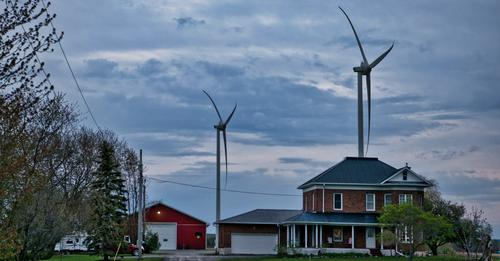
Renewable energy projects are an industrial land use, and people must be protected from noise and other impacts, says Ottawa Wind Concerns [Photo: D. Larsen for Wind Concerns Ontario]
July 12, 2023

Ottawa City Council today passed an amendment to the Official Plan, that will not allow for new renewable energy projects to get municipal approval until after the City has new zoning bylaws appropriate to that land use.

Municipal approval is now mandatory for successful proposals to the Independent Electricity System Operator (IESO). The IESO is launching another Request for Proposals in a few months, and will begin another RFP in 2025, as Ontario plans to double its power supply with “clean” emissions–free sources of generation.

“This is a step forward,” says Ottawa Wind Concerns Chair Jane Wilson. “We were concerned that proposals might come forward in the 2023 RFPs and there would be no protection for rural residents from noise emissions and other impacts of wind and solar power projects, which are an industrial land use. The City of Ottawa has clearly shown that they are aware of the need to protect health and safety as they move forward with new zoning bylaws.”

Municipal approval is mandatory and with the repeal of the Green Energy Act in 2018, planning powers removed by the McGuinty government were returned to municipalities—that means they can determine setback distances, noise limits, and other regulations to control development. A key concern for Ottawa is the protection of valuable agricultural land.

As regards the risk of noise pollution and other impacts such as danger from fires, turbine collapse and ice throw, City staff have said they want to “do the right thing.”

Following approval of the proposed amendment at last week’s meeting of the Agricultural and Rural Affairs Committee, a spokesperson for a local group spoke out against it, saying there was no reason to slow down renewable energy proposals. Angela Keller-Herzog of Community Associations for Environmental Sustainability was quoted by the CBC as saying we need battery energy storage systems for example during power outages so “our kids” can do their homework.

According the hydro authorities, the major cause of power outages is damage to transmission lines, which prevents power from any source reaching homes.

“It is interesting when ‘environmental’ groups appear not to actually care about protecting the environment,” says Ottawa Wind Concerns’ Wilson, who is a Registered Nurse.

“Our concern is to ensure that health and safety are protected so that families can live in peace and safety in Ottawa’s rural communities.”

The amendment states in part:

This report is an interim step towards regulating renewable energy generation facilities in accordance with policies in the Official Plan which direct renewable energy generation facilities that require provincial approval to certain rural designations. Once the amendments proposed in this report come into effect, renewable energy generation facilities will not be permitted in any zone until such time as a subsequent report is approved with appropriate provisions to regulate such facilities.

Ottawa Wind Concerns’ input was noted in the report, with the statement that we will be kept informed of any developments.

Also on the Agenda at Ottawa City Council was the submission of the petitions sponsored by Ottawa Wind Concerns, asking for a minimum 2-km setback between any wind turbines proposed, and homes, as well as other land uses where people might be affected.

City staff noted that there are no proposals known for power development (but a battery storage project is in development  https://evolugen.com/facilities/rabbit-battery/   in Cumberland) but with a series of Requests for Proposal coming from the IESO, anything is possible.

Ontario’s Energy Minister Todd Smith recently made several announcements, namely new nuclear at Bruce and Darlington, and a new plan called Powering Ontario’s Growth. (Read the news release and see links here: https://news.ontario.ca/en/release/1003253/province-launches-plan-to-power-ontarios-growth)

ottawawindconcerns@gmail.com

Ottawa Wind Concerns is an incorporated, not-for-profit group, with a membership list of several hundred residents of rural Ottawa communities and other stakeholders. We are a community group member of the Wind Concerns Ontario coalition.Our goal: a safe environment…for everyone

Sign our online petition for 2 km turbine setbacks, now

09 Friday Jun 2023

Posted by Ottawa Wind Concerns in Health, Ottawa, Renewable energy, Wind power

≈ Leave a comment

Tags

noise, Official Plan, Ottawa, pollution, setbacks, wind turbines, zoning

June 9,2023

We’ve added an online petition to our campaign to ask the City of Ottawa to create safe, protective setbacks between industrial wind turbines and homes in Ottawa’s “rural countryside.”

Sign today.

Share the link with friends, neighbours and family!

The petition is available here: https://chng.it/YnSQrWJW

Ottawa’s $57B Energy Evolution plan hits the farm papers

04 Thursday May 2023

Posted by Ottawa Wind Concerns in Ottawa, Renewable energy, Wind power

≈ 3 Comments

Tags

Energy Evolution, Ottawa, rural, wind turbines

Launched in the early days of the pandemic in 2020 and with little coverage since, Ottawa’s massive climate plan that calls for as many as 700 wind turbines in the city’s rural areas is still unknown to most. Farmers Forum has the story.

May 4, 2023

Ottawa’s climate action plan, Energy Evolution and its $57B price tag, is largely unknown to most citizens, but this month’s edition of Farmers Forum covers the story.

The Energy Evolution plan passed through the city’s environmental committee and went to City Council in the fall of 2020, when most people in Ottawa were struggling with other issues—like the pandemic that had gripped the world for several months.

In an interview with editor Patrick Meagher, Wind Concerns Ontario president and Ottawa Wind Concerns Chair Jane Wilson said that the plan is “unimaginable” with its proposal for 3,200 megawatts of wind power (equivalent to 32 Nation Rise wind “farms”) which the plan authors translate to more than 700 wind turbines, and dozens of acres of solar panels, some of which would be on rooftops. Battery storage is also proposed, which the plan authors estimate will be the size of 122 shipping containers, also on rural land.

The problem with wind power, Wilson says, “It doesn’t work. It’s intermittent, and will industrialize the rural areas.”

Wilson recalled the municipal election campaign of October last year and said when it came up in several all-candidates meetings in the rural wards, all the candidates said they were not in favour.

Wilson noted that wind turbines change a community, pitting residents against each other. When you erect a wind turbine your neighbours may not be happy, she said, adding that she has heard that some property owners with wind turbines have lamented that it was not worth up to the $15,000 a year in revenue and have found it too difficult to get out of a contract.

“With the degree of public resistance I don’t see 700 wind turbines coming, honestly,” Wilson said. “But that is still the city’s plan and people need to be aware of it and to let the city know what their feelings are.”

Ottawa Wind Concerns has launched a petition asking the City for a 2-km setback between wind turbines and homeowners’ property lines. The current setback is only 550 metres, unchanged since 2009.

Ontario has received thousands of complaints about noise and vibration since wind turbines first started going up in 2006, and many jurisdictions around the world are now moving to longer distances between wind turbines and homes. In Poland, the setback distance is 10 times the blade tip height of a turbine, equivalent to 2 km roughly. The originator of the term “Wind Turbine Syndrome” New York State Dr. Nina Pierpont has also suggested a setback of 1.25 miles.

The OWC petition may be found here: Petition-Mailer

The City of Ottawa’s engagement link on the new zoning bylaws is here: https://engage.ottawa.ca/zoning#:~:text=The%20City%20of%20Ottawa%20is,Housing%20on%20November%2004%2C%202022.

The page includes Discussion papers including one on “Rural Zoning Issues,” one-page summaries, and a survey (which only allows for a 160-character response) and is prefaced by questions about gender identification and citizen status.

ottawawindconcerns@gmail.com 

Crowd turns out to sign petition in Kinburn!

28 Friday Apr 2023

Posted by Ottawa Wind Concerns in Ottawa, Renewable energy, Wind power

≈ 2 Comments

Tags

environment, noise, Ottawa, pollution, wind turbines

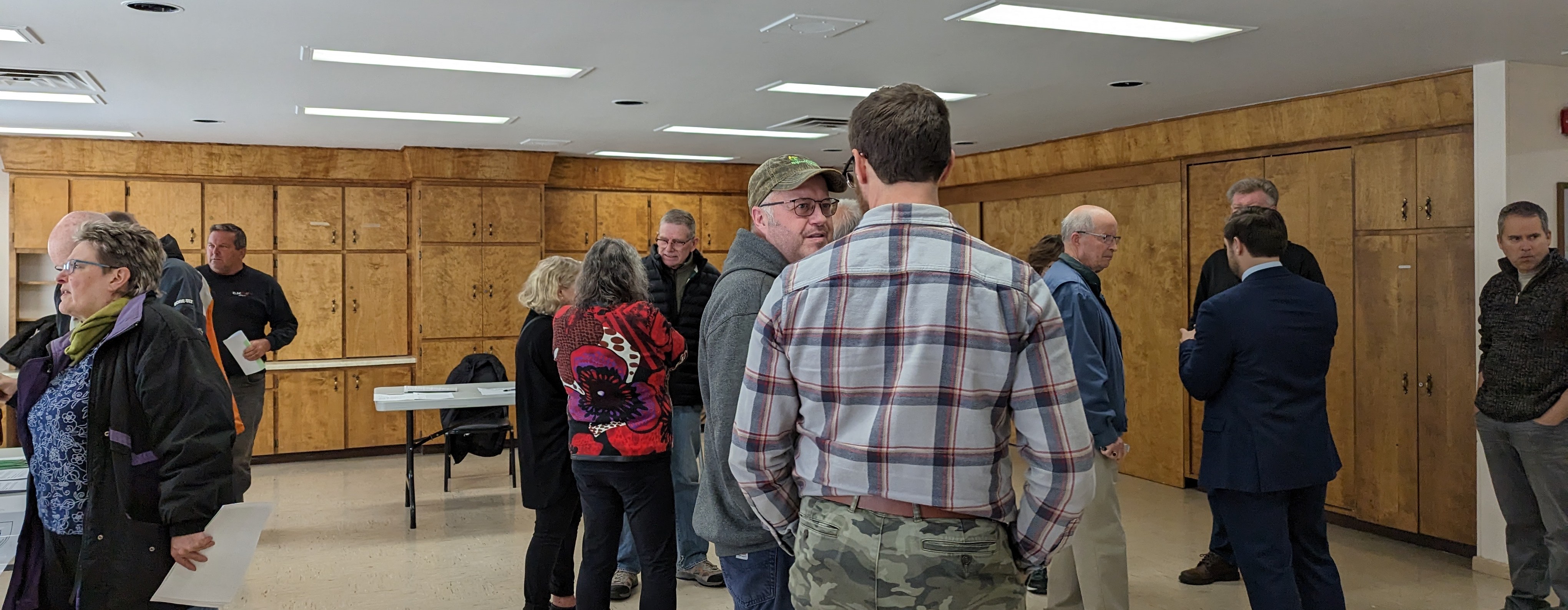
Dozens of people turned out Wednesday at the Kinburn CC to view the Official Plan map, sign a petition for better setbacks from wind turbines, and help butter tarts vanish! [Photo: Ottawa Wind Concerns]

April 28, 2023

Dozens of people from West Carleton-March and beyond turned out to an drop-in information event held in Kinburn by Ottawa Wind Concerns. The goal of the event was to help people understand the new Ottawa Official Plan and its designated areas for renewable energy projects, as the city is now working on zoning bylaws.

Ottawa Wind Concerns is promoting safe setback distances between industrial-scale wind turbines and homes, and has a petition requesting a 2-km setback, minimum, to property lines.

Information kits were available, plus large copies of the Official Plan maps for viewing.

The new Official Plan allows renewable energy projects on “Rural Countryside,” “Greenbelt,” and “environmental lands.”

Both West Carleton and Rideau-Jock wards have significant land areas branded “rural countryside” as well as prime agricultural land.

People attending were concerned about the environmental impacts should wind power projects be built and many recalled a proposal made 14 years ago that was extremely unpopular. It did not proceed but a large solar power project was built near Galetta. Questions were asked about the success and usefulness of that power project today.

“People are very well informed on the issue of environmental impacts of large-scale wind and solar power projects,” says Ottawa Wind Concerns president Jane Wilson, “and they’re asking questions about battery storage systems, too. It’s great to see people come out like this to get more information, and to participate the City’s engagement process on the new zoning bylaws.”

The trend is for greater setback distances now between wind turbines and homes, Wilson says. “Former energy minister Glenn Thibeault in the Wynne government admitted that mistakes were made in siting wind turbines years ago. We’re saying, we know a lot more about wind turbines now—let’s not make those mistakes again.”

Wind turbines are an industrial use of the land, Wilson adds.

Residents attending also spoke of concerns about wind turbines and effectiveness as a power source. “Ontario is just not a windy place,” said one. “Why are we doing this?”

Councillor Clarke Kelly dropped in and spoke with residents, and West Carleton Online editor/publisher Jake Davies spoke with people as they viewed the maps.

Other organizations with a pro-wind power view sent representatives to the event, including CAFES and the Ottawa Renewable Energy Cooperative (OREC), a group that invests in wind and solar power projects.

Free butter tarts were on offer from Sweet & Sassy Bakery in nearby Arnprior.

The petition is available petition-1

Signed copies may be mailed to Wind Concerns PO BOX 91047  RPO SIGNATURE CTR KANATA ON  K2T 0A3

ottawawindconcerns@gmail.com

Petition launched for wind turbine setbacks

22 Saturday Apr 2023

Posted by Ottawa Wind Concerns in Ottawa, Renewable energy, Wind power

≈ 1 Comment

Tags

Energy Evolution, environment, noise, Ottawa, setbacks, wind turbines

house2turbines

Wind turbines near Crysler, Ontario, 40 minutes south of Ottawa: protective bylaws needed [Photo: D. Larsen for Wind Concerns Ontario(C)]

April 22, 2023

“Earth Day”

A petition asking the City of Ottawa to develop new, protective bylaws that include a setback between industrial-scale or grid-scale wind turbines was launched at an event held in North Gower Last Thursday.

Dozens of people attended, coming from West Carleton, Carlsbad Springs, Navan, Greely, Richmond and North Gower to learn more about the City’s background documents for the new zoning bylaw process, and to see maps depicting where renewable energy projects—including wind turbines—could be located  according to Ottawa’s new RuralMapOttawa.

People attending were concerned about the environmental impacts of large wind turbines including the introduction of noise and vibration (low frequency noise), the impacts on wildlife and aquifers, loss of land used to produce food, and the effect on property values.

Ward 21 Rideau-Jock councillor David Brown dropped in to hear resident concerns.

The petition asks for a 2-km setback which, as community group Ottawa Wind Concerns chair Jane Wilson explains, is in line with many countries in Europe and follows the trend in the United States to longer setback distances. “Just recently, a jurisdiction in Nebraska, which has plenty of experience with wind turbines, installed a setback of two miles,” she says.

The group consulted U.S. acoustics expert Robert Rand who said the setback distance was “a reasonable compromise.”

The City of Ottawa has acknowledged that there could be significant environmental impacts on rural residents should wind turbines be erected, and staff has said in public meetings and correspondence that they want to “do the right thing.”

Many people attending Thursday’s launch event said they were eager to see protective setbacks but they were not persuaded that the City should be open to expensive, intermittent wind power to support widespread electrification. The City’s $57-B Energy Evolution climate action plan proposes 3200 megawatts of wind power, which the report translates as 700 wind turbines.

Environmental impacts are high for little return with grid-scale wind turbines.

Another drop-in information event will be held in Kinburn at the Community Centre on April 26th between 5-7 PM. (Locally made butter tarts will be served again!)

Anyone wishing to sign the petition can download the document here petition-1

Signed copies can be picked up, just email ottawawindconcerns@gmail.com , or mailed to:

Wind Concerns

PO BOX 91047, RPO SIGNATURE CTR KANATA ON   K2T 0A3

Treat wind turbines as industrial land use in creating new zoning bylaws, community group says

18 Tuesday Apr 2023

Posted by Ottawa Wind Concerns in Ottawa, Renewable energy, Wind power

≈ 1 Comment

Tags

noise, Ottawa, wind turbines, zoning

April 18, 2023

Wind turbines create environmental noise and pose risks to safety, wildlife, and our water supply. New bylaws must protect people and the environment, says Ottawa Wind Concerns.

The City of Ottawa is in the process of developing new zoning bylaws as a follow-up to approval of the city’s new Official Plan.

As the Official Plan allows for renewable energy (power) projects to be built on

  • “Rural Countryside”
  • Greenbelt and Greenbelt Facility
  • Environmental lands.

it will be important to have appropriate and effective protective zoning bylaws, especially for the residents of rural Ottawa who will likely be living near any sort of power generation or storage project.

The City has posted a series of Discussion Papers and is accepting comments on these documents; there are surveys available for each of the six Discussion Papers but the open-ended comment portion accepts only a limited number of characters as a response.

Ottawa Wind Concerns has filed a comment with the new zoning team at the City. Here are a few of our comments.

On the Equity, Diversion and Inclusion paper, we wrote:

The expressed goal is to discuss “tradeoffs and compromises between competing goals and interests in the hopes of producing a safe, functional and liveable city for everyone.”

The City’s goal of generating power from “renewable” sources includes large-scale wind power projects according to the Energy Evolution document. That will result in industrialization of rural communities, with significant impact on the quality of life including the danger to aquifers, the introduction of noise pollution to the environment, and the reduction of property values which will affect the economic well-being of residents. In short, large-scale wind power development will work against the goal of “environmental health equity”, as described on page 1 of this paper.

Separation distances are mentioned in the paper (page 5) as a way to “prohibit land uses within a certain distance of each other.” The examples mentioned however are “group homes” and shelters. Again, any sort of power generation will be an industrial land use, and in the case of larger scale development will almost certainly be located in the rural areas. For wind turbines in particular, noise emissions and vibration/sound pressure have been demonstrated around the world as a serious impact on people forced to live nearby. Not only do the turbines create noise emissions, but so does power infrastructure such as transformer substations, which can emit harmful low frequency noise or infrasound. Solar power installations have similar infrastructure that can produce noise pollution, as do Battery Energy Storage Systems or BESS, which emit noise, and represent other risks such as fire.

Noted U.S. acoustics expert Robert Rand has said,

“Unlike other power plant technologies which have numerous noise control options, the only reliable noise control for wind turbines is distance.” —Robert Rand, Health Impacts of Industrial Wind Turbines, presentation September 10, 2019.

The setback distances in Ontario in effect today were created prior to widespread wind power development in 2009 and are widely regarded as inadequate. They are not supported by current scientific literature, nor do they align with the trend among many jurisdictions, particularly in the U.S. to establish greater setback distances for health and safety.

Ottawa Wind Concerns has already recommended a setback distance of 2 km between wind turbine zones and residential areas. Acoustician Robert Rand, quoted above, says the 2-km setback is a “reasonable compromise.”

“It isn’t hard to design facilities to be good acoustic neighbours,” Rand says.

Interestingly, the detailed discussion of “pollution” occurs not in the paper on public health but in the Equity paper. We noted:

While this area of the paper focuses on traffic and pollution, the city policy of promoting power generation from “renewable” sources such as wind and solar also represents a risk of pollution, specifically noise pollution. There are many documents supporting this including the Health Canada wind turbine noise study, and the Council of Canadian Academies report, “Understanding the evidence”.

Canadian researchers examined the public health approach to wind turbine noise and concluded:

“Based on our analysis of clinical, biological, and experimental evidence and its concordance with the nine BH criteria, we conclude that there is a high probability that emissions from IWTs, including infrasound and LFN, result in serious harm to health in susceptible individuals living and/or working in their proximity. These effects can be attributed to IWTrelated events such as recurring sleep disturbance, anxiety and stress, and likely others.”

They called upon public health authorities to take a precautionary approach to preventing adverse health effects, and act now:

“With the growing weight of evidence indicating this causation and the rapid proliferation of IWT installations globally, preventative actions should be taken, and policies implemented that are more cautiously protective of public health, safety, and welfare rather than wait for absolute certainty. … Our findings provide compelling evidence that there is a pressing need for risk assessment before deployment of IWT into rural community settings that consider more effective and precautionary setback distances. A margin of safety sufficient to prevent pathogenic LFN from being detected by the human vestibular system is paramount before proceeding with political or economic policies.”

While the introduction of noise to the environment is a serious and likely impact, one that will affect public health, there is another issue: safety. Grid-scale wind turbines operate under enormous stresses; around the world the number of “catastrophic failures” of wind turbines is rising. Some blame poor workmanship, or too speedy installation—whatever the cause, it will be important to have setbacks that ensure safety for people on public lands and roadways. The current setbacks, established in 2009, are not adequate.

Another Discussion Paper is devoted to Land Use Strategy. Our comment:

Our only comment here is that among the land uses listed on page 1, under “Industrial land uses”, power generation is not mentioned. When the city is planning massive power generation development as per Energy Evolution (page 45), such as 36 sq km of solar panels, 3200 megawatts or 700+ wind turbines (each turbine requiring as much as 5 acres of land), and 122 shipping container-sized battery storage systems, that is a significant industrial land use.

The amount of land needed for this adventure appears not to have been considered; it is certainly not discussed. World renowned environmental and energy expert Canadian professor Vaclav Smil noted in his book Power Density that industrial-scale wind is a low-density power source with several negative characteristics including the need for a lot of land: “disfiguration of landscapes is not the only consequence of the limited power densities of wind power. The need to install large numbers of machines tends to reduce the width of noise exclusion corridors, to increase the chances of large-scale bird fatalities, and to affect many terrestrial species as a consequence of the fragmentation of their habitat. In windy and sparsely populated Scotland, the rule is to allow 2 km between wind farms and the edge of cities and villages”.

Smil’s discussion of power density brings up another point: Ottawa’s insistence on wind and solar, both acknowledged intermittent power sources, is not based on any comparative analysis of power generation technologies. Wind power is a low density power source, i.e., it needs a lot of land to produce a small amount of power. Capacity is another concern; wind turbines do not generate power 100 percent of the time. Often we hear wind power developers boast that a wind power project will power X thousands of homes, when the truthful version of that statement would add, “30 percent of the time.”

Similarly, we try to make the point that any kind of power generation is in fact an industrial use of the land. So, in response to the paper on Neighbourhood Character, we made the following comment.

This Discussion Paper deals with building height and type of structures such as low-, mid-rise, and high-rise buildings but nothing approaches what would be happening to Ottawa’s rural villages and homeowners, should grid-scale or industrial-scale wind turbines be installed.

The impact is so severe that property value loss is a significant concern. Some studies have shown that property value loss in other areas of Ontario where wind turbines were built was as much as 50 percent or, in worst cases, house did not sell at all, indicating they had literally no value to prospective buyers in an open market.

When a wind power project was being contemplated nearby, the Town of Henderson NY contracted with Nanos Research and Clarkson University to do a study on the impact on property values. The study states:

“We see that parcels with a view of the turbines sell for a positive premium (approximately 10%) before the turbines are built, but that this premium is more than eroded by a strong negative impact after turbine construction. 

The estimated coefficient of -0.164 that describes this effect implies a 15% decrease in property values for homes with a view after the turbines are built. We also calculate a 95% confidence interval for this effect, which tells us that, given the observed data, there is a 95% chance that the true effect is a decrease of between 5.1% and 23.9%.

So, while we can’t be confident that the effect is exactly negative 15%, we are reasonably confident that there was a negative impact.”

We must ask, what homeowner can tolerate a drop of more than 20 percent in the value of their home? Particularly for young families already struggling with the cost of home ownership, or people on fixed incomes who are relying on the value of their homes to support them in later years? What kind of zoning bylaw policy proceeds with this type of dramatic economic impact?

In response to the Rural Zoning Issues paper, we again focus on the nature of land use, and also refer to the potential for effects on groundwater.

The paper also refers to the Energy Evolution plan, and states that “Renewable electricity projects will need to contribute an estimated 8.5% of our electricity sources in Ottawa” (page 6). There is no reference provided for this figure, and to the best of our knowledge, the 8.5 percent figure does not appear in the public Energy Evolution document. Where did that come from? What is the basis for this “requirement”? Is there any input from Hydro Ottawa or Hydro One?

Another statement is puzzling: “Local energy production and storage … can help reduce the impact of power outages from the large producers, which are occurring more frequently due to more extreme weather events.” With all due respect, this is preposterous. When there are “weather events” such as freezing rain or tornadoes or whatever, the power from “large producers” such as Ontario’s nuclear power generating stations or hydro facilities is not absent—it simply cannot be transmitted because of problems with the transmission system, usually, broken or downed power lines.

Under Environmental Protection is a brief discussion of the need for protection of natural environment areas and wetlands, and a previous paragraph deals with surface water. The risk to aquifers is not mentioned anywhere yet this is a major concern whenever wind and solar power projects are proposed. The foundations for wind turbines are huge, as you can imagine for 60-storey, vibrating structures. The risk to aquifers has been the subject of appeals of other wind power project approvals, notably the Nation Rise project south of Ottawa, which is located on a provincially designated fragile aquifer. In the North Kent area of Ontario, a wind power project proceeded over citizen concerns and today, dozens of families are without potable water. A provincial health review study found that there was a link to the construction and operation of the wind turbines on the fragile aquifer, and more study is currently underway.

The Ontario Ground Water Association has expressed concern about wind turbines and put out this statement: “Proper environmental analysis is necessary before choosing an appropriate location for wind turbines to ensure there’s no impact on #groundwater resources.”

The comment was filed with the engagement team at newzoning@ottawa.ca

While citizens can use the surveys attached to each grouping of Discussion Papers, people might want to create their own, longer comments and file them, using the email referenced above.

Sign the petition

Ottawa Wind Concerns has also launched a petition to formally ask for a 2-km setback for wind turbines and homes. You may download it here: Petition

You can fold it into a mailer and send to: Wind Concerns, PO Box 91047 RPO SIGNATURE CTR  KANATA ON  K2T 0A3

ottawawindconcerns@gmail.com

Rural Issues and new City bylaws: citizens need to comment, says Ottawa Wind Concerns

12 Wednesday Apr 2023

Posted by Ottawa Wind Concerns in Ottawa, Renewable energy, Wind power

≈ 2 Comments

Tags

new zoning, Ottawa, wind turbines

The City’s “engagement” process can only work if people know about the Discussion Papers, and take advantage of opportunities to comment

Renewable energy development will be permitted in “Rural Countryside” and greenbelt. What does that mean? [Photo: Dorothea Larsen]

April 12, 2023

Are you OK with renewable energy facilities, including wind turbines, solar “farms” and battery storage systems, being built in Ottawa on “Rural Countryside” and greenbelt land?

Are you OK with every interchange on the 416 or 417 in Ottawa being rezoned to accept “industrial” and “logistics” (trucking distribution centres) buildings?

These are just two of the ideas in the City of Ottawa’s background documents or “Discussion Papers” that have been released for public engagement, while City staff write new zoning bylaws.

“People need to know about these discussion papers,” says Jane Wilson, chair of Ottawa Wind Concerns, “and the whole engagement process will be better if everyone, including rural residents, can comment.”

“The fact is, even the so-called ‘Rural’ Issues paper, the content is decidedly urban in focus,” Wilson says. “The paper calls for renewable power projects in the rural areas but says nothing about the risks of industrializing rural communities that way. There is no acknowledgement of the noise that would come from power projects, the loss of woodlands and farmland, the danger to groundwater sources, and the loss of property value when quiet communities literally become power plants.”

For wind turbines, the City will be looking at setback distances and noise limits. The City is allowed to create its own regulations for this, following the repeal of the Green Energy Act in Ontario, which took away municipal land use planning power for renewable energy projects. However, all that exists are the Ontario regulations which are unchanged since 2009—a lot of turbines (and noise complaints) have happened since then!

The goal is to help with the process

Ottawa Wind Concerns is hosting several informal drop-in events where residents can get copies of the Discussion Paper summaries, see a map of the zoning in Ottawa’s new Official Plan (where is the “Rural Countryside” anyway? You might be surprised.), pick up fact sheets, and fill out the City of Ottawa survey in response to the Discussion Papers. The survey only allows 160 characters in the online version, but people are free to add detailed comments by using a paper copy, or attaching a letter.

The goal is to help City staff be aware of resident—rural resident—concerns.

Ottawa Wind Concerns is also sponsoring a petition to ask that the City institute a 2-km setback between industrial-scale or grid-scale wind turbines. It will be available for signatures at the drop-in events.

The first date is April 20th at Alfred Taylor Recreation Centre in North Gower, drop in anytime between 5-7 PM.

Next is a drop-in April 26th at the Kinburn Community Centre, Kinburn, 5-7 PM.

ottawawindconcerns@gmail.com


Net Zero, renewables, natural gas ban a hot issue in Eastern Ontario

02 Thursday Mar 2023

Posted by Ottawa Wind Concerns in Renewable energy, Wind power

≈ 1 Comment

Tags

wind turbines

So-called “greens” keep saying going all “renewables” wind and solar will mean prosperity and jobs. Are they right?


turbinemaststairsdark

Wind turbine at the Nation Rise installation in Finch-Crysler-Berwick: no employee parking lots [Photo: D. Larsen for Wind Concerns Ontario]

March 2, 2023

In the February 25th edition of The North Grenville Times is an Op-Ed promoting the notion of 100-percent “renewables” and criticizing the use of natural gas, which the writer, Steve Gabell, calls “methane” for extra punch.

But there is more to consider in the whole “Net Zero” approach. We wrote a response to the column but unfortunately, the editor advised us and several other letter writers that the topic is too hot for them to give any more space to it. In an email to us, editor Brandon Mayer said if he ran all the letters on this topic, they will fill the entire paper!

Here is our response to the original column.

Letter to the Editor, North Grenville Times

February 24, 2023

Re: OpEd Methane and Renewables, February 23

If writer Steve Gabell had honestly identified himself as president of the local Green Party Constituency Association, readers would have understood that he was writing from the Green Party playbook, not as a result of research and organized thinking.

He trots out the old anti-Ford government statement that the Ontario government “recklessly” cancelled “hundreds of renewable energy contracts” which is false: what got cancelled were over-priced contracts inked by the Wynne government for small projects that would have cost Ontario ratepayer millions for more intermittent unreliable power. Several large unnecessary wind power projects were also cancelled, saving Ontario hundreds of millions in weather-dependent, out of phase with demand power.

Mr. Gabell rages against natural gas which is really used in Ontario only to meet peak demand, and he proposes instead—Green Party policy—100-percent renewables. He says renewable wind and solar are lower in cost. Not true: an independent cost analysis by Power Advisory published in 2021 shows that the costs of wind and solar power were much higher than nuclear or hydro.

If Mr. Gabell were to take off his Green Party hat and do his own research he might come across eminent Canadian environmentalist professor Vaclav Smil who wrote that the notion of 100-percent renewables is “unbounded science and engineering fiction”. It is worth exploring what it would take to create an increasingly non-fossil global energy system, but rushing headlong into part-time power wind and solar won’t help.

One solution proposed is N2N, Natural Gas to Nuclear, but again, Green Party policy will not allow Mr. Gabell to even use the word “nuclear” despite Canada’s long and storied success with clean, reliable, emissions-free nuclear power technology.

The dream of “tens of thousands of jobs”? Wind power has been described as a “workerless” form of power generation. Just drive a few minutes down to the wind turbines in Crysler and look for an employee parking lot.

There isn’t one.

The dream I have is that political leaders could put aside their propaganda messaging on electricity issues and instead promote honest analysis of the best way forward. What we need is a reliable, affordable, emissions-free power grid that will improve life for everyone.

Jane Wilson

North Gower

Jane Wilson is chair of Ottawa Wind Concerns; the community group is fighting a proposal by the City of Ottawa to build as many as 700 industrial-scale wind turbines in the city’s rural areas.

What do we know about Battery Energy Storage? Not much

01 Wednesday Mar 2023

Posted by Ottawa Wind Concerns in Ottawa, Renewable energy, Uncategorized, Wind power

≈ 3 Comments

Tags

Battery storage, Evolugen, IESO, Ottawa, renewables, Wind ConcernsOntario, wind power, wind turbines

And we better learn, fast.

Overhead_View_of_Tehachapi_Energy_Storage_Project,_Tehachapi,_CA

Overhead view of 8-megawatt battery storage facility in Tehachapi, USA-Wikipedia image

March 1, 2023

Green energy’s newest fad is Battery Energy Storage Systems or BESS, which is being promoted as an add-on to existing renewable power generation facilities to counteract intermittency and unreliability.

Lobbyist the former Canadian Wind Energy Association, now the Canadian Renewable Energy Association or CanREA is actively pushing BESS, and has even gone so far as to add storage to its corporate banner as in, Wind- Solar- Storage.

CanREA is pushing for TEN TIMES the amount of wind and solar we already have in Canada (won’t that look pretty? And cost us all, too) which they say will work with storage.

However, even the influential lobbyist points to concerns. First, there is a need to develop technical requirements for connecting and operating battery storage facilities CanREA says in its document, Laying the Foundation:

“In many jurisdictions, the technical details may be included in the operating documents of the crown owned utility. However, there are other elements, such as the scope of safety and environmental reviews, that will need legislated descriptions or will need to be included in the regulatory documents of the relevant ministry or government department.” (Page 10)

And, CanREA says, regulating authorities may need to get ready for BESS and develop new competencies:

“In most jurisdictions, the mandate and/or rules of the regulating authority (for example the Alberta Utilities Commission) may need to be enhanced. Regulatory authorities will need sufficient expertise to fairly evaluate proposed energy-storage installations.”

Most people don’t know what they are

In response to inquiries from members and the public, and because BESS is being proposed as an add-on to existing wind power installations, Wind Concerns Ontario undertook a review of experiences with BESS around the world, and reports of citizen concerns, as well as the current regulatory environment.

As one Ontario mayor said, most people don’t even know what they are.

Wind Concerns Ontario prepared a report, with the following conclusions:

  • Standards needed for emergencies – As BESS technology is relatively new, standards are rapidly changing in response to emergency situations encountered. Even projects developed by companies with extensive battery experience have experienced serious emergency situations.
  • Not enough information – The requirements for submissions to the IESO and to municipalities when requesting support for the project include few, if any, details on the actual project. The process appears to assume that once a company is awarded an IESO contract based largely on price, it will then proceed to develop the real proposal which will be submitted into an undefined permitting process or processes. Based on information submitted, it is not clear how the IESO will be able to distinguish between proposals with higher prices because they meet high standards for development and those with lower prices because the proposal includes the minimal safety standards.
  • Renewable energy or not? – BESS systems are neither defined as a Renewable Energy project by Regulation 359/09, nor are they included in the list of excluded projects. The intention may be to omit further provincial review of these projects and to proceed directly to the municipal permitting process but this would be a recipe for substantial delay as the building officials in each host municipality (many of which are small rural municipalities) individually develop the expertise needed to assess and approve these projects.
  • Safety regulations? – While Ontario Hydro has defined setbacks from BESS installations to protect their infrastructure, there are no setbacks for BESS installations established in Regulation 359/09 to protect other buildings and activities. Similarly, there are no noise standards for these systems which could create a new enforcement challenge for Ministry of Environment, Conservation and Parks field staff.
  • Potential for support to be withdrawn – As the submissions to municipalities have included minimal information, there is potential for municipalities to rescind their support resolution once they learn the risks associated with these projects and the municipal resources that will be potentially required to deal with emergency situations.

Clearly, there are significant issues to be addressed.

Ottawa area BESS

Here in Ottawa, a BESS facility was proposed for the recent Independent Electricity System Operator (IESO) Request for Proposals for new power generation. Located on Upper Dwyer Hill Road in the West Carleton-March ward of the city, the project is unheard of for most people. The company proposing the project held a public meeting in December but no one showed up. The IESO allows proponents to simply post a notice on their project website. If you don’t even know about the project, how do you know to check for announcements?

Here are the minutes for the “public” meeting:

MINUTES OF PUBLIC COMMUNITY ENGAGEMENT City of Ottawa Public Meeting Location: Alexander Community Centre, 960 Silver St, Ottawa, ON K1Z 6H5 Time: 6-7 pm, January 12th, 2023

Long-Term Reliability Project Name: 548

Site Address: 650 Upper Dwyer Hill Road, Ottawa, ON K0A 1A0

Facility: Battery Energy Storage Systems (BESS)

Size: 4.99-megawatt/19.96-megawatt hour


Proponents Name: 1000234763 Ontario Inc.

Attendance: • 0 community members •

Proponent – 1000234763 Ontario Inc., representative: o John Kozak, COO • Proponent’s Contractor, SolarBank Corporation (previously, Abundant Solar Energy Inc.) o Tracy Zheng, CAO o Mila Simon, Project Coordinator 6ii

6:00 PM: meeting called to order. Proponent and SolarBank waited for 45 minutes for attendees. No community members showed.

6:45 PM: Meeting adjourned.

Another BESS proposal is in development in Cumberland, that would be ten times the capacity of the Upper Dwyer Hill Rd facility. In response an email inquiry, developer Evolugen (a division of huge power developer Brookfield) replied:

We are still in the process of assessing potential sites for a battery storage energy system in the Cumberland area to respond to two announced procurements (expedited and long-term RFP). The two public meetings were held to gauge at a high level the type of reaction that this type of project would receive in this area. We don’t record public meetings because they are drop-in format rather than a presentation with a Q and A. But we are always available for one-on-one meetings. The IESO released the final RFP document in early December, but had released a series of documents (including a draft RFP) in preceding months to provide project proponents with a general idea of what public outreach requirements were required.  

As we have more information – we will continue to update our project specific website: Rabbit Battery Energy Storage Project – Brookfield Renewable (evolugen.com)

Nick Best, Director, Public Affairs

Another inquiry, this time to the Cumberland Community Association, revealed the association knew nothing about the proposal. Or the public meetings that were held.

Time to ask questions

Doubtless, still more BESS proposals are coming with the IESO set to open up yet another RFP later this year, this time for almost twice as much new power generation.

We need to learn more to be able to ask questions about the impact of these installations on our communities, the environment, and our economy.

ottawawindconcerns@gmail.com


Rural councillors propose motion to protect health, safety

09 Thursday Feb 2023

Posted by Ottawa Wind Concerns in Health, Ottawa, Renewable energy, Wind power

≈ 3 Comments

Tags

Energy Evolution, Ottawa, wind turbines

Ottawa has no new zoning bylaws to protect rural residents from environmental impacts from new power projects

View of a street in Crysler, south of Ottawa, with wind turbine 2 km away. There have been so many noise complaints that the local board of health is conducting a review. [Photo: D. Larsen for Wind Concerns Ontario]

Two Ottawa city councillors have put forward a motion regarding new power generation facilities, demanding that municipal support be mandatory, and that any power projects be in the best interests of the people who must live near them.

Because Ottawa will not have new zoning bylaws until 2025, what the two rural ward councillors are saying is, rural area residents need up-to-date protection in terms of setback distances and noise limits from power projects, which are an industrial use of the land.

Ontario’s regulations for wind turbines, for example, were created in 2009 and remain unchanged, despite advances in knowledge about such negative environmental impacts as noise pollution, strobe effect, risk to wildlife, and danger from fire, ice throw or catastrophic equipment failures.

Community interests foremost, councillor says

Councillor David Brown submitted a notice of motion on February 1st, seconded by Ward 5 Councillor Clarke Kelly.

Here is what Councillor Brown wrote in the current edition of the Manotick Messenger about the motion.

“At issue is the Independent Electricity System Operator or IESO and its ongoing efforts to procure energy projects across the province. Though energy projects generally receive support from municipal councils before proceeding, the authority is unclear; IESO could attempt to work with a project proponent without the approval of Council.

This means that an LNG power plant, a wind turbine, a solar farm, or any other project could arise without the support of the community.

Additionally, Ottawa is in the process of updating its by-laws. Once completed, these updated by-laws will hep future development better conform to the objectives of the city’s Official Plan. This includes energy infrastructure in general and wind turbines in particular. It is essential that new by-laws be finalized and approved before wind turbines are brought to Council’s attention for consideration and approval.

These are the issues that my motion seeks to address. The goals of this motion are to ensure that Council is able to act as the final authority on energy generation in our City and that new generating infrastructure respects our City’s soon-to-be-updated by-laws.

As new energy generation capacity is likely to be placed in the rural areas of Ottawa, it is vital that new facilities be well considered and respect residents’ needs and our communities’ interests.

No project should be advanced without being in the clear interest of those who live close to it.

By advancing this motion I am hoping to better protect our communities against potentially harmful overreach.

David Brown

Ward21@ottawa.ca“

As of last December, the IESO process appeared not to allow municipalities final say in power project approvals, and energy minister Todd Smith recently wrote the IESO a letter asking them to be specific. Early in the current RFP process, municipal support could be “evidenced” by a letter from a planner, or by the issuing of building permits. Issuing building permits is an administrative process, and not an indication of Council support.

Ottawa lags in regulations for safety, health

Ottawa Wind Concerns has called for greater transparency on new power projects, and made several presentations in the past to the previous Agricultural and Rural Affairs Committee. Last year, the then councillor for Ward 21 said there was no need for Ottawa to act because there was no RFP process for new power projects, and sent emails in September to members of both the agricultural/rural and environmental protection committees. The truth was, at that point, the IESO documents were already in the engagement and revision phase, and well known to other jurisdictions.

The RFP commenced December 7, 2022.

Ottawa Wind Concerns has recommended a setback of 2 km from wind turbines to residential areas, based on the recommendation from Wind Concerns Ontario.

The City of Ottawa has expressed interest in promoting wind turbines. Ottawa’s $57B Energy Evolution plan calls for 3,200 megawatts of wind power, or more than 700 industrial scale wind turbines in the rural areas of the city.

During the 2022 municipal election campaign, all candidates in Ward 21 pledged to work for a review of that plan.

New motion to be presented soon

The motion set for February 8th has been deferred to next Council meeting because of technicalities with the local power utility, but will be presented again February 22nd.


ottawawindconcerns@gmail.com

← Older posts
Newer posts →

Recent Posts

  • Open letter to CAFES Ottawa
  • Ottawa Wind Concerns supports West Carleton residents
  • What does wind ‘farm’ construction really look like?
  • Unwilling Host communities surround Ottawa
  • How many birds do wind turbines kill?

Follow me on Twitter

My Tweets

Enter your email address to follow this blog and receive notifications of new posts by email.

Tags

Bob Chiarelli Green Energy Act IESO Ontario Ottawa Ottawa wind concerns wind energy wind farm wind power wind turbines

Contact us

PO Box 3 North Gower ON K0A 2T0

Blog at WordPress.com.

Privacy & Cookies: This site uses cookies. By continuing to use this website, you agree to their use.
To find out more, including how to control cookies, see here: Cookie Policy
  • Subscribe Subscribed
    • Ottawa Wind Concerns
    • Join 379 other subscribers
    • Already have a WordPress.com account? Log in now.
    • Ottawa Wind Concerns
    • Subscribe Subscribed
    • Sign up
    • Log in
    • Report this content
    • View site in Reader
    • Manage subscriptions
    • Collapse this bar
 

Loading Comments...