• About
  • Donate!
  • EVENTS
  • Ottawa’s “Energy Evolution”: wind turbines coming to rural communities
  • Thinking of signing a wind turbine lease?
  • Wind Concerns Ontario
  • Wind turbines: what you need to know

Ottawa Wind Concerns

~ A safe environment for everyone

Ottawa Wind Concerns

Tag Archives: wind turbine

Legal actions against wind farms continue

18 Thursday Dec 2014

Posted by Ottawa Wind Concerns in Ottawa, Renewable energy, Wind power

≈ 1 Comment

Tags

City of Kawarth Lakes, environmental appeal, Environmental Review Tribunal, Eric Gillespie, Health Canada, Health Canada noise study, Healthy Environments and Consumer Safety Canada, Julian Falconer, legal action, Manvers Wind Concerns, Mothers Against Wind Turbines, North Gower, Ottawa wind concerns, Plympton-Wyoming, Renewable power projects, Sunco, wind farm, wind power, wind power generation, wind power project, wind turbine, WPD Canada

This is a heavy duty week as Ontario communities fight back against the unwanted incursion of huge wind power generation facilities. As you know, the Green Energy Act removed local land-use planning powers for renewable power projects, so the environmental appeal process and ultimately the courts, along with a noise nuisance bylaw, is the only way communities can act to protect their residents.

(The new procurement process for large-scale renewable power projects still does not allow for a return of municipal planning powers; communities can have a say, as long as it’s not “no” and in fact, the regional energy plans are pre-designed by the province—in other words, if the province decides you’re getting a wind “farm” then you are. But we digress…)

This week:

Manvers/Pontypool: last few days of the appeal of the Sumac Ridge wind power project, part of which is on the Oak Ridges Moraine, a fragile and (formerly) protected environment. The Green Energy Act over-rode the Oak Ridges Moraine Protection Act, along with 20 other pieces of legislation.) The City of Kawartha Lakes is involved.

Plympton-Wyoming: again, the municipality is involved with the appeal of the Suncor Cedar Point wind power generation project. Today, the Environmental Review Tribunal hears a motion for a stay of proceedings, until experts can review the raw data from the Health Canada Wind Turbine Noise and Health study. (No report or article has yet been published from this study; there is only a brief summary and PowerPoint presentation.) The Health Canada study showed that 16.5% of people living within 2 km of a wind turbine were experiencing distress.

Niagara Region: Mothers Against Wind Turbines is a appealing the 77, 3-megawatt turbine Niagara Region wind power project, which will affect over 4,000 homes. Preliminary hearing is tomorrow in Wellandport.

Other appeals have been filed and several judicial reviews are in various stages, as well as private legal actions on property value loss and nuisance. Decisions are expected on the Ostrander Point appeal (lawyer Eric Gillespie), and the Drennan/Dixon appeal (the Constitutional challenge, lawyer Julian Falconer).

Ottawa Wind Concerns has retained a legal firm and is prepared to enact legal actions should another proposal come forward for a wind power project.

Contact us at ottawawindconcerns@gmail.com Donations welcome at PO Box 3, North Gower K0A 2T0

MPP MacLeod: return local land-use planning control

02 Tuesday Dec 2014

Posted by Ottawa Wind Concerns in Ottawa, Renewable energy, Wind power

≈ 1 Comment

Tags

green energy, Green Energy Act, land use plannin, Liberal government, Lisa MacLeod, Lisa MacLeod MPP, Nepean-Carleton, Queen’s Park, wind farm, wind power, wind power developers, wind turbine

LISA MACLEOD MPP-NEPEAN-CARLETON
NEWS RELEASE
December 2, 2014
END THE RURAL-URBAN DIVIDE, RESTORE LOCAL DECISION MAKING: MACLEOD
(Queen’s Park)- Nepean- Carleton PC MPP Lisa MacLeod brought the fight against wind turbine developments once again to Queen’s Park today.
“One of the big challenges the government has is credibility in rural and remote communities across the province because of the Green Energy Act.  The government should restore local decision making to municipalities in an effort to signal they respect those communities”, said MacLeod
The Green Energy Act overrides 21 different pieces of legislation, including the Heritage Act and the Planning Act, so wind turbine developers can build projects without any push back from municipalities or their residents.
“The rural-urban divide in Ontario is very real as a result of disastrous policies like the Green Energy Act.  It is never too late for the Liberal Government to admit it is wrong and make wind turbine developers go through the same processes any other developer would have to in the Province of Ontario”, concluded MacLeod.
-30-
For More Information Contact Jordan Milks
1-416-352-6351


What the Health Canada noise study means for North Gower

29 Saturday Nov 2014

Posted by Ottawa Wind Concerns in Health, Ottawa, Wind power

≈ Leave a comment

Tags

Canadian Wind Energy Association, CanWEA, Health, Health Canada, Health Canada wind turbine noise and health study, Marlborough wind power project, North Gower, North Gower wind farm, Ottawa, Prowind, wind farm, wind farms and health, wind turbine, wind turbines

Health Canada study results show North Gower wind farm would have made more than 100 people sick

Many people were disappointed in the results contained in the summary of the Health Canada Wind Turbine Noise and Health study, which was released in a hurry on November 6th.

While the mainstream media picked up on the message as being “there is no association between wind turbine noise and health effects” what Health Canada actually said in its news release was this:

No evidence was found to support a link between exposure to wind turbine noise and any of the self-reported or measured health endpoints examined. However, the study did demonstrate a relationship between increasing levels of wind turbine noise and annoyance towards several features (including noise, vibration, shadow flicker, and the aircraft warning lights on top of the turbines) associated with wind turbines.

In fact, the study found that an average of 16.5% of people within 2 km of wind turbines, or a wind turbine (whether multiples were considered is not clear), had severe distress or “annoyance”. The closer people lived, the worse that result was: 25% of people at 550 meters or less (some people waived the setback as part of their contract with the wind power developers) had adverse health effects related to the distress or annoyance, annoyance being a medical term.

The adverse health effects from the annoyance listed by Health Canada were:migraine, tinnitus (chronic ringing in the ears), dizziness, sleep disturbance or disorder, and cardiovascular effects such as elevated blood pressure.

So, what would that mean for North Gower, if the wind power generation project proposed by Prowind in 2008 gone ahead (remember, it got as close as one could to a Feed In Tariff contract, before the government paused the subsidy program in the spring of 2013–it is NOT true that it would never have been approved, it was virtually there).

Thanks to volunteers who have mapped the area, using a schematic of the turbine locations which was leaked to us, we know this:

Number of homes within 800 meters of a turbine: 43

Number of homes within 1.6 km of a turbine: 234

TOTAL number of homes that would be most affected: 277

At an average of 2.5 people/home, that would be 692 people, and at an average of 16.5% affected by distress/annoyance, that would be 114 people.

This is considered to be a conservative figure as Health Canada did not do any follow up on the significant number of houses it discovered vacant or demolished in the study. These were “mature” turbine projects and as we know from the experience of people living in areas like Chatham-Kent, Clear Creek, Ripley and Kincardine, the people most affected leave within six months to a year.

114 people.

At least some of them children.

And yet the Ontario government continues to approve these power projects, despite evidence of harm to health, and the fact that Ontario does not need the power. And the wind power lobby group, the Canadian Wind Energy Association (CanWEA) persists in the mythology that wind power is clean and good for the environment.

Health Canada is taking no action, despite these results, and has no intention of studying wind turbine noise further*. The people of North Gower have a right to expect more from the federal government, and from Health Canada, which is supposed to used sound science principles to protect citizens.

Our Member of Parliament is Pierre Poilievre at pierre.poilievre@parl.gc.ca if you have any comments on what the Health Canada study means to you and our community.

Ottawa Wind Concerns

PO Box 3, North Gower ON  K0A 2T0

ottawawindconcerns@gmail.com

*As per a personal meeting with the study team representatives, Ottawa, November 7.

Health Canada needs to take action on wind farms: noise study “too little, too late”

29 Saturday Nov 2014

Posted by Ottawa Wind Concerns in Health, Ottawa, Wind power

≈ 1 Comment

Tags

adverse health effects, annoyance, CanWEA, Carmen Krogh, Dr Robert McMurtry, Health Canada, Health Canada wind turbine noise and health study, Healthy Environments and Consumer Safety, infrasound, IWTs, low frequency noise, National Resources Canada, Rona Ambrose, turbine noise, wind farm, wind farm noise, wind power, wind power lobby, wind turbine, wind turbines

November 28, 2014 Canadian Medical Association Journal blog

Carmen Krogh, BScPharm (retired), is a peer reviewed IWT health researcher and formerDirector of Publications and Editor-in-Chief of the CPS.

R Y McMurtry is Professor Emeritus (Surgery) of Western University (formerly University of Western Ontario). Dr. McMurtry was also anADM at Health Canada 2000-02

Industrial wind turbines (IWTs) are being erected at rapid pace around the world. Coinciding with the introduction of IWTs, some individuals living in proximity to IWTs report adverse health effects including annoyance, sleep disturbance, stress-related health impacts and reduced quality of life. [i],[ii],[iii],[iv],[v],[vi],[vii],[viii],[ix],[x],[xi],[xii] In some cases Canadian families reporting adverse health effects have abandoned their homes, been billeted away from their homes or hired legal counsel to successfully reach a financial agreement with the wind energy developer.[xiii]

To help address public concern over these health effects Health Canada (HC) announced the Health Canada Wind Turbine Noise and Health Study (HC Study) 2 years ago and brought forth preliminary results November 6, 2014.

Here we briefly comment on the HC Study results and provide some historical context.

Acknowledgement of IWT adverse health effects is not new. The term “annoyance” frequently appears when discussing IWT health effects.

In a 2009 letter the Honourable Rona Ambrose, disclosed:

“Health Canada provides advice on the health effect of noise and low-frequency electric and magnetic fields from proposed wind turbine projects…To date, their examination of the scientific literature on wind turbine noise is that the only health effect conclusively demonstrated from exposure to wind turbine noise is an increase of self-reported general annoyance and complaints (i.e., headaches, nausea, tinnitus, vertigo).” [xiv]

In 2009, the Canadian Wind Energy Association (CanWEA) sponsored a literature review which acknowledges the reported symptoms such as headaches, nausea, tinnitus, vertigo and state they “… are not new and have been published previously in the context of “annoyance”…” and are the “… well-known stress effects of exposure to noise …”[xv]

In 2011, a health survey of people exposed to IWTs in Ontario reported altered quality of life, sleep disturbance, excessive tiredness, headaches, stress and distress. [xvi]

In the same year, CanWEA posted a media release which advised those impacted by wind turbine annoyance stating “The association has always acknowledged that a small percentage of people can be annoyed by wind turbines in their vicinity. … When annoyance has a significant impact on an individual’s quality of life, it is important that they consult their doctor.”[xvii]

It turns out it’s not a small percentage of people annoyed by wind turbines. An Ontario Government report concluded a non-trivial percentage of persons are expected to be highly annoyed.

The December 2011 report prepared by a member of CanWEA for the Ontario Ministry of Environment states in the conclusions:

“The audible sound from wind turbines, at the levels experienced at typical receptor distances in Ontario, is nonetheless expected to result in a non-trivial percentage of persons being highly annoyed. As with sounds from many sources, research has shown that annoyance associated with sound from wind turbines can be expected to contribute to stress related health impacts in some persons.”[xviii]

The World Health Organization (WHO) acknowledges noise induced annoyance to be a health effect [xix] and the results of WHO research “…confirmed, on an epidemiological level, an increased health risk from chronic noise annoyance…”[xx]

HC also acknowledges noise induced annoyance to be an adverse health effect. [xxi],[xxii] The Principal Investigator of the recent HC Study also states “noise-induced annoyance is an adverse health effect”. [xxiii]

Canadian Government sponsored research has found statistically significant relationships from IWT noise exposure.

A 2014 review article in the Canadian Journal of Rural Medicine reports:

“In 2013, research funded by the Ontario Ministry of the Environment indicated a statistically significant relation between residents’ distance from the turbine and the symptoms of disturbed sleep, vertigo and tinnitus, and recommended that future research focus on the effects of wind turbine noise on sleep disturbance and symptoms of inner ear problems.” [xxiv]

Recently on November 6, 2014, HC posted on its website preliminary results of its HC Study[xxv]. Wind turbine noise “…. annoyance was found to be statistically related to several self-reporting health effects including, but not limited to, blood pressure, migraines, tinnitus, dizziness, scores on the PSQI, and perceived stress” as well as related to “measured hair cortisol, systolic and diastolic blood pressure.”

These troubling results come as no surprise. Since at least 2007 HC employees including the Principal Investigator of the HC Study recommended wind turbine noise criteria which they predict will result in adverse health effects. (i.e. result in an increase percentage highly annoyed).[xxvi],[xxvii],[xxviii]

Then turbines were built and HC spent 2.1 million dollars to find out it appears to have under predicted the impact of IWT noise. HC’s IWT noise criteria does not use a dose response based on IWT noise but rather road noise. But of course IWTs are not cars and peer-reviewed studies consistently document that IWTs produce sound that is perceived to be more annoying than transportation or industrial noise at comparable sound pressure levels. [xxix],[xxx]

IWT noise annoyance starts at dBA sound pressure levels in the low 30s and rises sharply at 35 dBA as compared to road noise which starts at 55 dBA. These findings are further supported by the HC Study’s preliminary results.[xxxi]

IWT noise characteristics that are identified as plausible causes for reported health effects include amplitude modulation, audible low- frequency noise (LFN), infrasound, tonal noise, impulse noise and night-time noise. [xxxii]

The logical solution would be to develop IWT noise criteria which will protect human health but that would present a barrier to wind energy development. Noise limits impacts IWT siting, cost of energy produced [xxxiii] and by extension corporate profits. The wind energy industry has actively lobbied governments to be granted IWT noise exposure limits which benefit their industry.

Canadians trying to understand this should be mindful the Government of Canada has invested and distributed significant amounts of public money to attract and support the wind energy industry. [xxxiv],[xxxv],[xxxvi],[xxxvii],[xxxviii],[xxxix],[xl],[xli] In addition to providing funding, the Government of Canada in collaboration with wind industry stakeholders has developed the Wind Technology Road Map (Wind TRM) [xlii] which Natural Resources Canada defined to be an “…industry-led, government supported initiative that has developed a long-term vision for the Canadian wind energy industry …”.[xliii]

Canada’s Wind TRM states “Members of the Steering Committee, government and our industry will be using this roadmap to direct the actions that are necessary for Canada to develop its vast wind resources.”[xliv] HC is a member of the Interdepartmental Wind Technology Road Map Committee [xlv] which was created to assist in the implementation of Canada’s Wind TRM. [xlvi] One of the “key action items” detailed in the Wind TRM calls for Government and Industry collaboration to develop and maintain government documents that address concerns raised about wind energy projects including that of noise, infrasound and other. [xlvii]

Some jurisdictions are trying to take action to protect their residents. For example, several municipalities in Ontario are trying to establish bylaws that protect from IWT noise. In Wisconsin, on October 14, 2014 the Brown County Board of Health unanimously approved a motion to declare the IWTs at a local project a Human Health Hazard. [xlviii]

It would appear HC’s research effort is too little too late. A non-trivial percentage of Canadians continue to experience adverse health effects. HC now has additional scientific evidence of the “conclusively demonstrated” effects from exposure to IWT noise. It is time for HC to take action to help Canadians maintain and improve their health.

Read the full posting here.

Wind turbine noise and health: what the wind lobby doesn’t want you to know

26 Wednesday Nov 2014

Posted by Ottawa Wind Concerns in Health, Renewable energy, Wind power

≈ 1 Comment

Tags

CanWEA, Health Canada, Health Canada wind turbine noise and health study, Healthy Environments and Consumer Safety, infrasound, low frequency noise, North Gower, North Gower wind farm, wind farm, wind farm noise, wind turbine, wind turbine noise, wind turbine noise and adverse health effects, wind turbines

The wind industry is dangerous to human health, posing risks to everything from dizziness and nausea to chronic stress and heart conditions

Lawrence Solomon, FR Comment, The Financial Post, November 25, 2014

A Canadian court will soon decide if wind turbines violate Canada’s Charter of Rights and Freedoms by posing a risk to human health. Charter case decisions can be convoluted but the fundamental question of health at issue here is straightforward. Wind turbines, from all that is today known and by any rational measure, represent a risk to those living in their vicinity.

Although the wind industry and its government backers tend to dismiss concerns, the evidence of harm in communities that host wind turbines is overwhelming. Literally thousands of people around the world report similar adverse health effects, some so serious that owners abandon their homes. Studies of noise from turbines — though few in number, short in duration, tentative in their findings and conducted by interested parties — point to dangers. As if these weren’t enough, basic science sounds the alarm on wind turbines.

Wind turbines produce audible sound waves known to cause what medical science calls “annoyance,” a state of health that can lead to a constellation of illnesses called wind turbine syndrome (WTS). As Health Canada reported earlier this month, following a Statistics Canada survey it commissioned of people living in the vicinity of wind turbines, “[wind turbine noise] annoyance was found to be statistically related to several self-reported health effects including, but not limited to, blood pressure, migraines, tinnitus [ringing in the ears], dizziness” and sleep disorders. The annoyance was also found to be statistically associated with objective measurements of chronic stress and blood pressure. Health Canada’s bottom line: “the findings support a potential link between long-term high annoyance and health.”

The audible sound waves — these have a frequency above 20 Hz — may be the least of the worries faced by those living near wind turbines. The turbines also produce copious amounts of sound waves below 20 Hz, making them inaudible to the human ear and thus, say wind proponents, harmless. Yet sound at this low frequency, known as infrasound, should not be thought of as faint or weak. The U.S. military has studied the use of infrasound in non-lethal weapons. Many mammals — giraffes, elephants, whales — communicate with each other at infrasound frequencies, even when many kilometres apart. Powerful infrasound waves, in fact, explain how animals sense the coming of earthquakes well before humans do — and why animals fled to safety during the calamitous Sumatran and Japanese tsunamis of recent years.

Read the full article and comments here.

The wind power project that was proposed for the North Gower area was to be 8-10, 2.5 megawatt wind turbines. 1,000 homes would have been within 3 km of the turbines. No new project has yet been proposed under the new “procurement” process for large renewable power projects (which we don’t need)  in Ontario.

How much does it cost to demolish a wind turbine?

14 Tuesday Oct 2014

Posted by Ottawa Wind Concerns in Ottawa, Renewable energy, Wind power

≈ 1 Comment

Tags

Brinston, Canadian Hydro Developers, decommissioning, decommissioning costs turbines, EDP Renewables, Farmers Forum, Prowind, recycle turbine parts, South Dundas, Tom Collins Farmers Forum, Trans Alta, wind farm leases, wind turbine, wind turbines, Windlectric, Wolfe Island wind farm

Re-posted from Wind Concerns Ontario; note the information on the Brinston wind power project.

How much to take down a wind turbine?

Bonanza in scrap, or millions to demolish?

Tom Collins, Farmers Forum, October 2014

Scaremongers say it will cost millions

Brinston–While some critics of wind turbines howl that the cost of the eventual teardown of a turbine is astronomical, the actual cost today would be $30,000 to $100,000, per turbine.

The bigger issue is, who is going to pay for it.

Municipalities are on the hook to ensure companies tear down or, in industry jargon, decommission a turbine, unless they’ve got a binding agreement with the wind power company. Some municipalities demand from wind turbine companies ongoing payments into protected (or escrow) accounts or bonds to set money aside annually to pay for decommissioning.

Some municipalities require a letter of intent from wind turbine companies to ensure they will be responsible for decommissioning. Some municipalities have no agreement at all, including Wolfe Island, said its mayor, Denis Doyle. TransAlta communications manager Stacey Hatcher said the decommissioning plans are between the company and the landowner and because of that, the info is confidential. [See editor’s note #1]

The 86 turbines on Wolfe Island, on the St. Lawrence River at Kingston, were built by Canadian Hydro Developers, later purchased by Trans Alta and there is no bond or escrow account in place. The company does, however, reimburse the island about $100,000 per year for hosting the project. Based on current decommissioning projects around the world, it can cost $30,000 to $10,000 [sic] to dispose of a turbine. If it were to cost $50,000 to remove each turbine on Wolfe Island, it would cost $4.3 million to remove them all. Of course, that price goes up over time. [See Editor’s note #2] Hatcher said the company plans to repower or recontract when they [sic] current contracts are up.

There are 10 three-megawatt wind turbines at Brinston, between Kemptville and Winchester, and the power company ProWind [see Editor’s note #3] pays $1,000 per megawatt per year over the next 20 years into an escrow account that will rack up $600,000 to pay for decommissioning. [Editor’s note #4]

Windlectric Inc. wants to build 36 turbines on Amherst Island where Statec Consulting said that decommissioning costs are up to Windlectric. Typically, decommissioning will not remove all of the concrete base, but that’s only the first few feet of concrete that went into the ground. [We’re done adding editor’s notes at this point.]

One of the most infamous decomissionings involved 37 decrepit turbines in Hawaii that stood unused for six years before they were taken down in 2012. Tawhiri Power estimated that the take-down cost $30,000 per turbine. [OK, one more; see Editor’s note #5]

The seven-turbine community-owned Black Oak Wind Farm in New York State will start construction in late 2014. The decommissioning plan would currently cost about $55,883 per turbine, although the project expects to generate at least $50,000 per turbine by selling it as scrap metal. The municipality agreement means the power company must pay $140,000 per turbine in escrow but also means the payment can be reviewed and changed if decommissioning estimates change.….

WCO Editor’s notes:

1. Many landowners were told that it was to their benefit to decommission the turbines themselves as there is so much scrap value in the turbines; this is untrue due to the quality of metal being used, and also the other costs of decommissioning such as crane rental, and disposal of the toxic components.

2. So, that would be the millions then…

3. ProWind, properly “Prowind,” does not own the Brinston project, and hasn’t for several years. It is now owned by EDP Renewables.

4. In the original negotiations with Prowind, the developer wanted the landowners and the municipality to be responsible for decommissioning costs. It was the local community group that brought these costs to the attention of the municipality, and played a significant role in the agreement now in place.

5. US dollars? Canadian dollars? Also, the size of the turbines and the machinery involved is a factor. The turbines erected in Hawaii over a decade again, and the turbines at Wolfe Island are now miniscule compared with the 500-foot-plus, 3 -MW behemoths being built and proposed.

Write to Farmers Forum at editor@farmersforum.com

Farmers Forum editorial on wind: I don’t want a turbine

15 Monday Sep 2014

Posted by Ottawa Wind Concerns in Ottawa, Renewable energy, Wind power

≈ Leave a comment

Tags

Brinston, electricity bills Ontario, Farmers Forum, Patrick Meagher, wind farm, wind farm efficiency, wind farm noise, wind farms Ontario, wind turbine, wind turbines, Wolfe Island

Apparently, everyone is tickety-boo with Wolfe Island being turned into a factory--or are they?

Apparently, everyone is tickety-boo with Wolfe Island being turned into a factory–or are they?

Wind turbine woes

September 2014, Farmers Forum

Farmers Forum surveyed a big chunk of Wolfe Island residents and found that 75 per cent approve of or are indifferent toward the 86 wind turbines they’ve been living with for five years.

There are only two wind turbine projects in Eastern Ontario–one in Wolfe Island and one near Brinston, south of Ottawa. But Wolfe Island, surrounded by the St. Lawrence River at one end and Lake Ontario at the other, is a captive crowd. We easily surveyed 200 of the 1,400 residents lining up for the Kingston ferry or working in the hamlet of Marysville.

With such a high proportion of residents surveyed–one in seven–we captured a fairly good picture of how people feel about those gigantic white gosal posts with their three imposing blades. Of course, having a visual of a turbine makes a huge difference. On many properties on the 29-kilometer long island, you can’t even see the turbines.* From other vantage points, you can see more than 10.

We found that money makes a difference. Those landowners (many of them farmers) hosting one or more turbines, are delighted with the $10,000 to $14,000 they earn each year per turbine just to look at them. The wind turbine company hands over another $100,000 to the island annually. Improvements to the local outdoor rink are one of the many benefits. It’s like getting paid twice for having the good luck of living at the right place on the right island at the right time.

Not surprisingly, wind power companies in other areas of the province are now offering “hush” money to Ontarians living near a proposed wind turbine project. As I’ve said before, if a company wants to pay me $14,000 a year to put a wind turbine on my property, I’d move the garage in order to accommodate them. Change their mind and offer the turbine to my neighbour and suddenly that turbine doesn’t look so good. It’s kind of an eyesore and doesn’t it affect bird migration? Could this be the health issues that we hear about or am I just sick at the thought that I just lost $280,000 of free money over 20 years? I think I know the answer. But when you offer to cut me in on the monetary benefits of my neighbour’s turbine, I’m suddenly all sunshine and happy thoughts.

This is not to say there aren’t honest-to-goodness health risks. Farmers Forum has no reason to disbelieve those survey respondents who complain of low-level noise when the wind changes direction.

We’re losing $24,000 an hour on wind

This brings me to my only real beef against wind power. As happy as I thought I would be to have a turbine, I don’t want  one.

They are the biggest money losers in the history of the province. Not for Wolfe Islanders or anyone else who gets a wind turbine contract. But for everyone else forced to pay an electricity bill. Electricity costs have already risen 12.5 per cent each year for the past five years. There are more than 1,000 operating wind turbines and another more than 4,000 to go up in the province. Ontario’s auditor general says we can expect another 40 per cent price hike over the next few years in our electricity bills. By 2018, every Ontario family will be paying an extra $636 per year to go green. And why? So the province can claim to be the first green province or state in North America? Big deal.

Wind turbines are incredibly inefficient. In a major report last year, the Fraser Institute noted that 80 per cent of the power generated by wind turbines occur when Ontario doesn’t need the power. So, while the province pays 13.5 cents per kilowatt hour, it often resells is for 2.5 cents south of the border. The report, Environmental and Economic Consequences of Ontario’s Green Energy Act, observed that data from the Independent Electricity System Operator show Ontario loses, on average, $24,000 per operating hour on wind power sales. Numerous companies, including Kelloggs and Heinz, have closed plants because Ontario companies pay more for power than any other jurisdiction in North America.

Not “green”

To make matters worse, a wind turbine can contain more than 200 tonnes of steel and Chinese factories need the mining of even more tonnes of coal and iron to make them. Writes David Hughes in his book Carbon Shift, “A windmill could spin until it falls apart and never generate as much energy as was invested in building it.”

So, you can’t even call wind turbines green energy. It’s appalling that farmers have been lied to about the benefits. We’re wasting billions on a phoney cause.

Patrick Meagher is editor of Farmers Forum and can be reached at editor@farmersforum.com

Re-posted from Wind Concerns Ontario

WCO editor’s note: Although Farmers Forum was clear on the limitations of their survey they missed several key points: one, by surveying only people at the ferry dock and in a coffee shop, they may have missed people who stay on the island all day, but more important, as the Island has turbines on one half and none on the other, it would have been absolutely critical to define where the survey respondents actually live. They didn’t. Another key factor in any survey of community residents living with turbines is the fact that many turbine contracts force landowners to sign a non-disclosure agreement—in other words, if they have anything negative to say about the turbines, they can’t talk.

Single turbine to hamper development near Kincardine

13 Wednesday Aug 2014

Posted by Ottawa Wind Concerns in Renewable energy, Wind power

≈ 1 Comment

Tags

Bayshore Broadcasting Kincardine, future development, John Divinski, Kincardine, Kincardine Council, property values, Quixote wind turbine, Tiverton, wind farm, wind turbine

Council looking for legal strategy

Concerns Over Single Turbine

Wednesday, August 13, 2014 6:05 AM by John Divinski, Bayshore Broadcasting
Kincardine says Quixote turbine could hamper future development.

There is audio for this story.
MP3 - click to open click to open MP3 version
or click the play button to listen now.
(Kincardine )-It’s only one turbine but its recent approval by the province has many Kincardine councillors seeing red.

The Quixote One stand-alone turbine is to be constructed on Bruce County Road 23, near Tiverton and Kincardine CAO Murray Clarke says it could have ramifications on future growth in the area.

Because the turbine did not meet the set-back rules of the municipality of 2,000 metres, it flatly opposed the project and wrote a letter to the ministry stating so.

Clarke says they received no acknowledgement about their letter of concern until a directive was received in late July stating the turbine project had been approved.

He says the location of the turbine could potentially conflict with future growth in the Tiverton and Inverhuron areas, even if it abides by the provincial set-back requirement of 550 metres.

Clarke says they’ve invested millions of dollars in infrastructure in the area on the premise that there would be future development but the turbine approval could throw a wrench into their investment.

The Quixote One project is a single 2.5 megawatt industrial wind turbine project.

Council has instructed staff to get a legal opinion to see if any option is open to the community.

Transport Canada demands removal of airport turbines for safety

07 Monday Jul 2014

Posted by Ottawa Wind Concerns in Health, Renewable energy, Wind power

≈ 1 Comment

Tags

aviation safety, Chatham airport, Chatham-Kent, GDF Suez, Randy Hope, Transport Canada, wind energy, wind farm, wind farm safety, wind power, wind turbine, wind turbines

CTV Windsor
Published Sunday, July 6, 2014 6:14PM EDT 
Last Updated Monday, July 7, 2014 9:03AM EDT

Pro-wind power Mayor says “there is no safety issue”

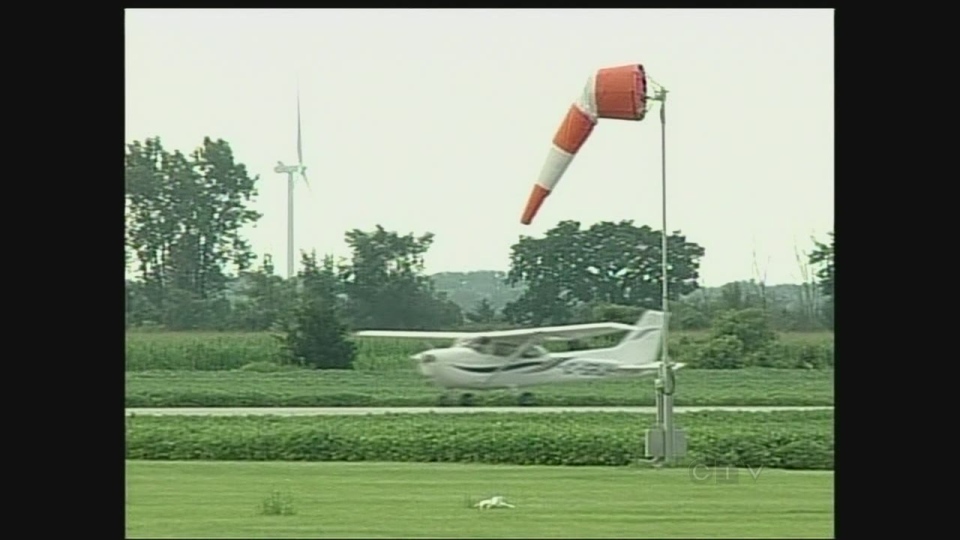
Transport Canada has issued an order requiring the eight wind turbines near Cedar Springs be removed by the end of this year.

The organization originally issued a letter requesting “voluntary compliance” last year.

In a release sent out by the municipality, Chatham-Kent mayor Randy Hope, says,“there is no safety issue so we need to change the regulation rather than force the removal of the turbines.”

RELATED STORIES

  • Questions surround wind turbine removal near Chatham airport
  • Angry pilot speaks out at Chatham airport ceremony
  • Fuel siphoned from planes at Chatham airport

PHOTOS

CTV Windsor: Pilot voices Chatham airport concerns

The municipality had been waiting for a reply from Transport Canada on this proposal and was surprised this week to learn that Transport Canada had taken this new step of issuing letters demanding that the turbines be removed by Dec. 31.

The affected wind turbines are in a “no fly zone” south of the airport.

It is expected that GDF SUEZ, the owner of the affected turbines, will formally object to the order from Transport Canada and seek a hearing before the Minister of Transport through the process laid out in the Aeronautics Act.

Read more: http://windsor.ctvnews.ca/transport-canada-demanding-wind-turbines-be-removed-near-chatham-airport-1.1901446#ixzz36n9X6XXM

Read the full story and see photos here.

The Toronto wind turbine: green energy symbol

05 Saturday Jul 2014

Posted by Ottawa Wind Concerns in Renewable energy, Wind power

≈ Leave a comment

Tags

Exhibition Place, Exhibition Place turbine, Exhibition Place wind mill, green energy, investment wind power, Parker Gallant, Toronto, Toronto windmill, wind energy, wind power, wind turbine

Not as advertised?

It’s hard to visit Toronto and NOT see the single wind turbine at Exhibition Place. Today, at about 600 kW and 90 meters tall, that turbine is very small compared to what is being built and approved all over Ontario—and yet, the people of Toronto and visitors to that city, believe it is a symbol of all that is good about “green” power developed from wind energy.

The truth is a little more complicated.

Former bank vice-president Parker Gallant has written an examination of the Exhibition Place turbine: all is not what it seems. His article is in two parts.

Part 1: http://www.windconcernsontario.ca/torontos-ex-place-wind-turbine-icon-or-mirage/

Part 2: http://www.windconcernsontario.ca/the-ex-place-toronto-turbine-disappointing-investment/

A note: whenever wind power developer executives are asked by small town residents whether THEY live anywhere near a turbine, many of them (including Prowind’s president for 5 minutes, Jeffrey Segal, speaking in South Dundas) respond, yes. They mean they live in downtown Toronto, and can see the Ex Place turbine. Not quite the same thing, is it?

Email us at ottawawindconcerns@gmail.com


← Older posts
Newer posts →

Recent Posts

  • Open letter to CAFES Ottawa
  • Ottawa Wind Concerns supports West Carleton residents
  • What does wind ‘farm’ construction really look like?
  • Unwilling Host communities surround Ottawa
  • How many birds do wind turbines kill?

Follow me on Twitter

My Tweets

Enter your email address to follow this blog and receive notifications of new posts by email.

Tags

Bob Chiarelli Green Energy Act IESO Ontario Ottawa Ottawa wind concerns wind energy wind farm wind power wind turbines

Contact us

PO Box 3 North Gower ON K0A 2T0

Create a free website or blog at WordPress.com.

Privacy & Cookies: This site uses cookies. By continuing to use this website, you agree to their use.
To find out more, including how to control cookies, see here: Cookie Policy
  • Subscribe Subscribed
    • Ottawa Wind Concerns
    • Join 379 other subscribers
    • Already have a WordPress.com account? Log in now.
    • Ottawa Wind Concerns
    • Subscribe Subscribed
    • Sign up
    • Log in
    • Report this content
    • View site in Reader
    • Manage subscriptions
    • Collapse this bar
 

Loading Comments...