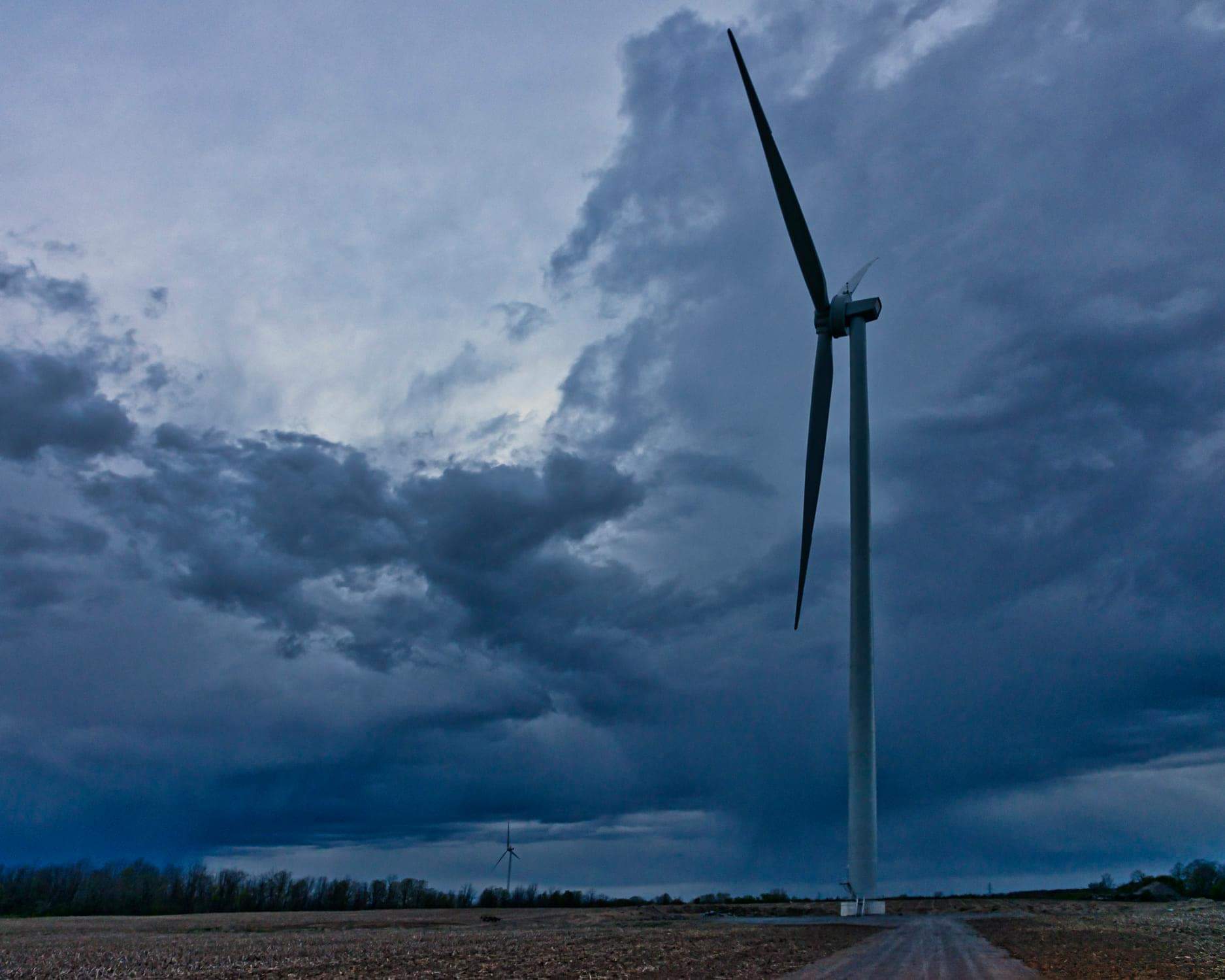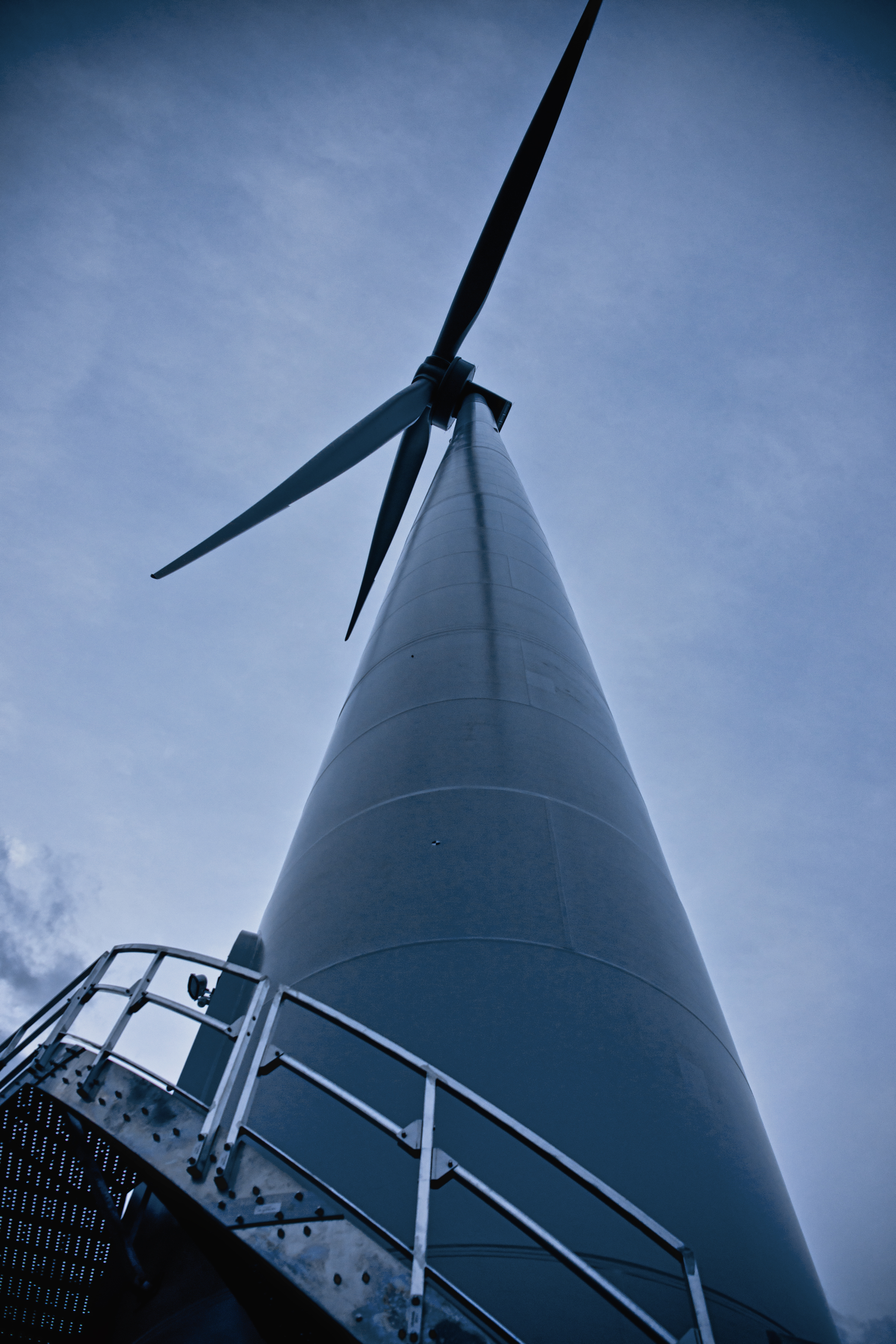
Just two of the 29 turbines in the Nation Rise power project Finch-Berwick-Crysler [Photo: D. Larsen for Wind Concerns Ontario]
October 7, 2021
With Ottawa discussing encouraging wind power development in the City’s rural areas, it’s important to know exactly what they’re talking about when it comes to wind turbines.
First, they are not “windmills,” they are Wind Turbine Generators or Industrial Wind Turbines (IWTs).
They are not “wind farms,” they are power generation facilities.
And, they are BIG. Very very big.
Here’s a suggested driving tour of the nearby Nation Rise wind power project
Embrun South to Cannamore via St Marie Street/County Rd 32
County road 13 into Crysler,
County road 12 to Berwick,
west on County road 9 to Goldfield road,
south to County road 43, turn west then south on the Stormont-Dundas Boundary to Concession 1-2.
East toward County road 12 (south of Finch), then back north on County road 12 into Finch, through Berwick, then Crysler north on County road 12 (to the 417) or turn west at (Harvex), concession 10-11 to Cannamore.
This route should give people an idea of the industrialization impact and the number of homes involved. You may not hear any noise, especially in this season when the turbines are not turning, or barely moving. You really have to stay in one of the homes over a period to experience the noise, sound pressure and vibration.
OK, so they’re big and unsightly, what else is wrong with wind power? It doesn’t work. Wind turbines are weather-dependent and thus, intermittent and unreliable. Today, Ontario’s power demand is over 15,000 megawatts while wind has produced 250-300 megawatts of power.
That’s not good enough.
ottawawindconcerns@gmail.com

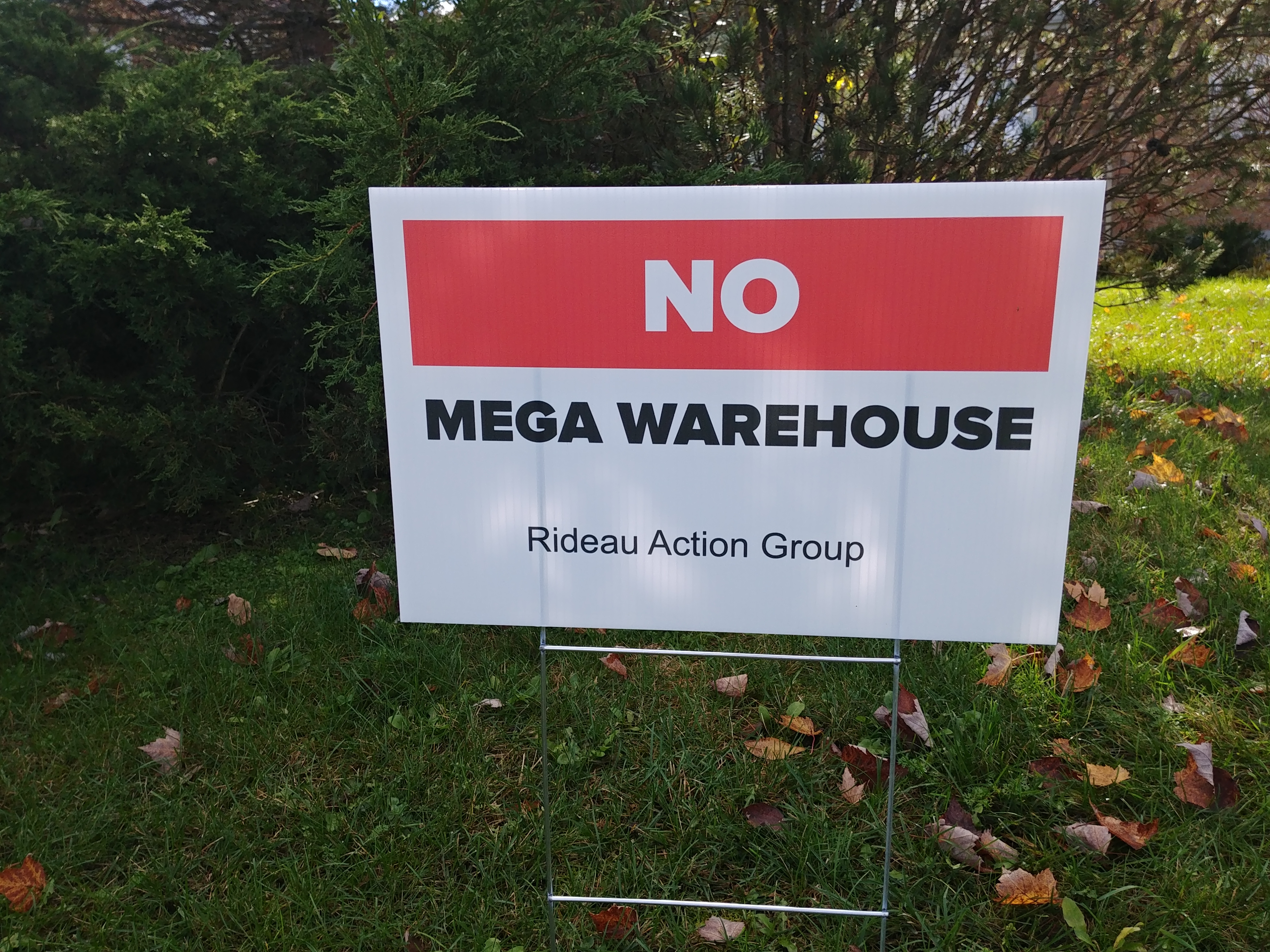
Want a sign? Email us. Contributions to the cost welcome.
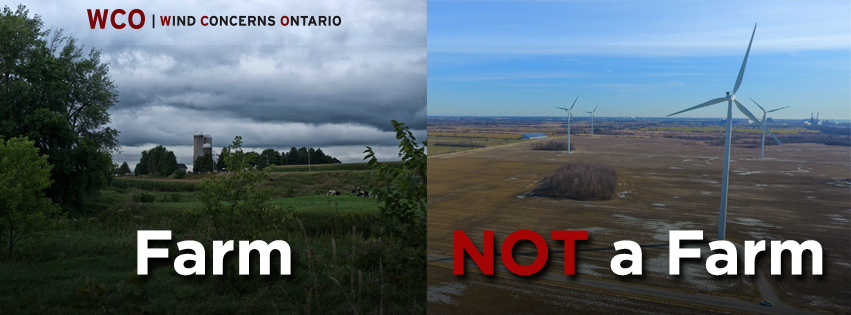
Produce stand in North Gower: a REAL “on-farm” activity, not industrial wind turbines [OWC photo]
October 5, 2021
The City of Ottawa is strangely devoted to the idea that industrial-scale or grid-scale wind turbines are just an ordinary on-farm activity.
When the final draft of the new Official Plan was presented at last week’s public meeting, City staff maintained their position that the large wind power generators were an activity just like any other in the countryside, like corn mazes and produce stands.
“We know there are concerns,” said planning staff member Melissa Jort-Conway, adding that the City will be conducting consultations and that the community will have input when the situation gets to the zoning bylaw stage.
That’s not very reassuring when you consider that the process for new bylaws allows for ONE comment period.
That’s it.
Ward 21 Councillor Scott Moffatt said at the recent Environmental Protection, Water and Waste Management committee meeting, which he chairs, that decisions aren’t always seen as fair by rural residents who are in the minority. They feel like they don’t get any say, he noted.
That is what happened south of Ottawa when the Ontario government under Kathleen Wynne approved one last wind power project, the 100-megawatt Nation Rise or Crysler project that encompasses hundreds of acres of land in North Stormont including the communities of Finch, Berwick and Crysler
Although the Wynne government had cancelled further wind power procurement in 2016, saying Ontario had enough power and it was more than 90-percent emissions-free, Nation Rise was approved in the Liberals’ last days. The community fought hard through an appeal which pointed out the risk of environmental noise, wildlife deaths and potential harm to the fragile aquifer. The communities remain divided after the bitter conflict.
In the recent heat wave in Ontario, wind power throughout the province failed to provide any significant amount of power during the days when demand was high to power air conditioning.
Now Ottawa is calling for as much as 3,200 megawatts of wind or more than 700 turbines by 2050.
Most Ottawa residents have never seen a modern wind turbine; their experience might be to see the turbines on Wolfe Island near Kingston which are some 18 km from highway 401–those are under 2 megawatts while turbines today are well over 3 megawatts in power rating, and stand 600 feet or more. The ExPlace turbine is downtown Toronto is less than one megawatt but works well as a backdrop for political and industry photos.
The facts: wind turbines do not fulfill any of the promises made for them by their promoters. They do not produce reliable power, they are highly invasive to the environment, the produce environmental noise pollution, and they do not contribute much toward any environmental action. They will use up valuable prime agricultural land, and they are most definitely NOT an on-farm activity, contributing to agriculture.
Yet Ottawa City Council seems to want them as highly visible “climate action” beacons.
Have your say by submitting a comment to the joint Planning and Agricultural and Rural Affairs Committee meeting on October 14. Deadline October 13. Details here: https://engage.ottawa.ca/the-new-official-plan
Not an “on-farm” agricultural activity [Photo: D. Larsen for Wind Concerns Ontario]
Huge turbines would be 60-storeys high, and produce noise and vibration—but not industrial?
Ottawa’s rosy and completely unrealisticvision of wind turbines in the countryside [Shutterstock image]
September 30, 2021
Ottawa’s planning department had its one and only “legally mandated” Public Open House on the new Official Plan via Zoom last evening.
Manager of Planning Policy Alain Miguelez was the prime presenter, assuring participants that “We the planners care very much about our city.”
The team covered the “five big moves” featured in the new Official Plan or OP, specifically growth management, mobility, urban and community design, climate, energy and public health, and economic development.
The city is focusing on intensification to accommodate their forecast of growth of almost a half million people, while at the same time protecting “our cherished neighbourhoods.” The City is all in on the :”15-minute neighbourhood” concept which holds that everyone should be able to walk to essential services such as food shopping, pharmacy services, parks, etc.
The rural areas of Ottawa are “prized, sensitive areas,” Miguelez said.”We have a beautiful countryside in Ottawa.”
Any development would be in keeping with goal to “keep things away from homes such as noise and dust.”
REALITY: giant steel noisy industrial power generators [Wind Concerns Ontario photo by D. Larsen, Nation Rise, North Stormont]
The City wants to transition from fossil fuels to renewable energy sources to meet energy needs locally, staff said. Large-scale projects such as solar would be employed.
When it came time for Question & Answer, our question on how Ottawa could justify allowing industrial-scale wind turbines in the rural areas when this contradicts provincial policy, planning staff responded that wind turbines “shouldn’t be in the category of industrial use.”
“We recognize there are concerns, and there will be opportunities for input,” said Melissa Jort-Conway. “We want to get it right.”
A question was asked about small-scale nuclear power, but no Ottawa staff was able to respond.
Another staff person commented on development in rural communities and said that development would be restricted to 300 square metres, maximum, within a boundary of 1 km.
The City’s statement about wind turbines being an “on-farm diversified use” contradicts the Provincial Policy Statement which says: “uses that are secondary to the principal agricultural use of the property and are limited in area. On-farm uses include but are not limited to, home occupations, home industries, agritourism uses and uses that produce value-added agricultural products. Ground-mounted solar facilities are permitted in prime agricultural areas…”
That is not grid-scale or industrial-scale wind turbines.
The City’s stance also appears to contradict policy from the Ontario Federation of Agriculture (OFA).
While City staff appears to have worked hard on the Official Plan, their knowledge of rural communities
is scant and their perception of industrial-scale renewable energy facilities is completely uninformed.
Today’s turbines are 60-storey noise and vibration-producing behemoths that completely alter the character of a community and do produce adverse effects for some people. There also seems to be no provision whatsoever for any kind of cost-benefit analysis for wind power. Wind is high impact on the environment and communities for very little benefit. It is a major factor in increasing electricity prices which can result in energy poverty and negative impacts on business and agriculture.
We will continue to try to provide information to the City at every opportunity but we remain disappointed that Ottawa has not chosen to be a leader and use innovative technology for reliable and affordable local energy generation.
Wind turbines are an industrial use of the land, says Ottawa Wind Concerns
The City of Ottawa’s planning department will present the changes to Ottawa’s new Official Plan at 6:30 p.m. today, in a virtual presentation.
At issue for rural residents is Section 4.11 which allows for “renewable energy facilities” in “agricultural resource areas.”
In an earlier draft, the renewable energy facilities were described as “Large-scale wind” and solar, and the placement included “prime agricultural land.”
The Current draft reads:
Renewable Energy Generation
3) Renewable energy generation facilities that are subject to Provincial approvals will be permitted as a principal use within the following designations:
a) Rural Countryside;
b) Greenbelt Rural and Greenbelt Facility; and
c) Natural Environment Area sub-designation, subject to the policies of Subsection 7 .3.
4) Renewable energy generation facilities that are subject to provincial approvals and are subordinate to a principal use will be permitted within the following designations:
a) Agricultural Resource Area, only as an on-farm diversified use; and
b) Rural Industrial and Logistics.
5) The following considerations will be used to establish zoning by-law provisions for such renewable energy generation facilities:
a) Limiting nuisance impacts. such as through siting and screening requirements;
b) Limiting impacts on significant natural heritage features and agricultural resource area lands; and
c) The ability to access the electricity transmission network and arterial roadways.
You must register to attend the event; you may also submit a question or comment in advance. Go to the City of Ottawa Engage site here: The New Official Plan | Engage Ottawa
Ottawa Wind Concerns has submitted several comments related to the apparent acceptance of industrial-scale or grid-scale wind power projects as an “on-farm diversified use.” Wind turbines are an industrial use of the land and not related to agriculture as is required in Ontario’s Provincial Policy Statement.
While City staff have denied that there will be wind turbines in Ottawa’s rural areas, the statements in the Official Plan are clear, as were statements made by the Manager of Planning Policy as a presentation in June. In the city’s Energy Evolution document, it is stated that a “project metric” is to have 20 megawatts of wind power installed by 2025. (See the link below for the Energy Evolution strategy.)
One of the hottest stocks these days is a company called Generac, which makes whole-home power generators, fueled by natural gas.
After the power failures in Texas and the current crisis in the UK (the latter a desperate situation due to poor energy planning and reliance on wind power), people are worried about the reliability of the power grid.
It’s happening here too and will escalate if cities like Ottawa engage in planning based on intermittent “unreliables” like wind and solar.
Here’s a comment from one of our readers, a long-time experienced power worker:
Breaking news!!!! I just got off the phone with another contractor from Rockland Ontario asking me to help them get caught up with residential generator installs. Most new construction includes a gas fired backup generator along with an 80 amp electric vehicle charging plug legislated by government code. Yup, the same people that are discussing phasing out gas fired generation. Oh, and by the way, for anyone interested, the 3 baseload gas plants that do operate daily are right across the river from Detroit and are privately owned by international consortiums supplying industrial operations that employ thousands. Most of the other gas fired electrical generating stations are on standby as backup to the Ontario windfarms which drop out of production many times a day, except for the Milton station which provides peaking power usually twice a day for the local industries. Get rid of that one, no big deal, BUT, you get rid of more Ontario industries and you get rid of more Ontario jobs. Move in Industrial Wind Turbines and move out industry, hey, it has been proven, the data is everywhere, Ontario windmills don’t work plus they are built using gas fired and coal fired power generation, just not in Ontario. Lucky for us China has gone in the opposite direction. Ok, enough new old news for today, gotta go hook up another generator.
The Environmental Protection, Water and Waste Management committee for the City of Ottawa has just approved a motion calling for Ontario to phase out its natural gas power plants by 2030.
Speakers at the meeting supported the phase out and a move to “alternate” or renewable forms of power generation. A speaker for the Ontario Clean Air Alliance erroneously said that Ontario has too much power which is why the province sells it to other jurisdictions at a loss—this is not correct. Often the surplus power comes from wind power which is generated in Ontario out of phase with demand. He also said that wind turbines in the Great Lakes could produce 80% of Ontario’s power, which is also not supported by the facts.
Speakers also referred to extreme weather events as a reason to phase out the natural gas power generation; in fact, at present, natural gas provides peaking capacity so in times of high demand due to weather extremes, gas is there to provide power whereas renewables like weather-dependent wind and solar cannot.
A spokesperson for Canadians for Nuclear Energy, Al Scott, commented that if the City of Ottawa wants to proceed with decarbonization, the choice is nuclear. Wind and solar cannot meet demand, he said, adding that wind power in Ontario had been an “unmitigated disaster.”
One councillor asked if there was any information on exactly what the impact would be on Ottawa’s power supply should the gas plants be phased out. This was not available.
Committee Chair Scott Moffatt commented that the City does not have plans to develop wind power itself and it would deal appropriately with any proposals; a staff member confirmed that the Energy Evolution document does mention the use of wind power to get to its Net Zero goal.*
Staff also commented on the detailed information received from Ottawa Wind Concerns.
The Committee voted and the motion carried.
OWC made a submission to the Committee as well as a copy of the Ontario Society for Professional Engineers comment on natural gas phase-out.
Councillor calls for alternative power sources including wind and solar
September 18, 2021
Image: IESO—looking at cost-benefit and impacts of phasing out gas
The City of Ottawa’s Committee for Environment, Water and Waste Management will hear a motion from Councillor Shawn Menard at its meeting on Tuesday, September 21, calling for the Ontario government to completely phase out power generation from natural gas by the year 2030.
In specific the motion says:
1. That the City of Ottawa request the Government of Ontario develop and implement a plan to phase-out gas-fired electricity generation by 2030 to help the City of Ottawa, the Province of Ontario and the Government of Canada meet their climate targets; 2. That the City of Ottawa call on the Independent Electricity System Operator (IESO) to give full consideration to wind and solar, demand response, Quebec Hydro, conservation and other models
Councillor Menard based his motion on a brief report which claims the Ontario government will increase “electricity generation and greenhouse gas pollution from Ontario’s gas-fired power plants by more than 300 % by 2030…due to the closing of the Pickering nuclear station and a forecast rise in the demand for electricity”.
The Ontario Independent Electricity System Operator of IESO is already undertaking an impact assessment of a gas phaseout but notes in its summary presentation that natural gas plays a significant role in providing reliable power to Ontario, and by providing a flexible supply of power to respond quickly if needed. As well, gas generators provide power locally.
Challenges, according to the IESO, include the fact that a number of natural gas plants are under contract and will have a useful life well beyond 2030, so cancelling them would not be cost-effective. Any “new resources” such as wind or solar would have to compete with equivalent characteristics such as reliability.
A recent court case in Minnesota, U.S., saw a wind power plant proposal turned down in favour of a natural gas facility precisely because the wind power plant could not compete on reliability or affordability; the court ruled that electricity prices would rise and the grid would be less stable if the choice were wind power.
The Ontario Society of Professional Engineers or OSPE has weighed in on the phase-out issue, saying that long-term energy planning in Ontario should be to “ensure reliable, cost-effective, affordable and sustainable energy systems. The OSPE recommended the IESO assessment be extended to 2040 to allow for the installation of clean technology including Small Modular Reactors and hydrogen technology.
The word “nuclear” does not appear anywhere in Mr. Menard’s motion except to note the closing of Pickering (which doesn’t have to happen).
The OSPE pointed out the role that gas plants play in Ontario winters: “Distributed gas plants are well suited to offset risks of a severe winter storm.”
This motion is premature, without factual support, and appears to be undertaken under pressure from special interest groups such as the Ontario Clean Air Alliance.
Some may dismiss it as “political theatre” but it is unfortunate that the City of Ottawa, Canada’s capital and the second largest city in Ontario, cannot find itself playing a leadership role and instead repeats tired tropes about wind and solar replacing reliable forms of power generation.
They can’t.
Readers are invited to email their City Councillor or file a comment with the environment
It’s time to see what the City is proposing in terms of renewable energy projects and Ottawa’s rural communities
Resident photo of turbines two kilometres from the village of Crysler, south of Ottawa
The people of Ottawa need to turn their attention to the City’s new Official Plan, says Ottawa Wind Concerns in an article published in the current edition of West Carleton Online.
“Back in June when we talked about Ottawa’s plans to put large-scale wind power projects in the city’s rural areas, some councillors were quick to deny that the city had any such plans,” Ottawa Wind Concerns said.
However, at that time, the city’s Energy Evolution document clearly stated on page 17 that the “Electricity Resource Strategy” is “to develop local or regional renewable energy supplies”. The “Project Metric” is to “Install” 20 megawatts of wind power, along with solar, hydro and electricity storage.
The City is now completing a revision of the Official Plan. “This also signals the intent to install wind turbines. An earlier draft mentioned both large-scale and small-scale wind turbines but has since been revised,” Ottawa Wind Concerns said.
Next step in the process is finalizing the Official Plan, and presenting it at an open public meeting on September 29, said Ottawa Wind Concerns chairperson Jane Wilson.
After the Plan is approved, staff will work on protective zoning regulations pertaining to setbacks and noise limits. The public will have one chance and one chance only to review and comment. Currently the Ontario setback for wind turbines is 550 metres—that is unchanged from 2009, when turbines were smaller and less powerful. Other jurisdictions are choosing longer setbacks such as 2 kilometres and more, and lower noise limits than Ontario has right now.
‘It is understandable that the people of Ottawa have had other things to think about with the COVID pandemic, and a federal election,’ Wilson said, ‘but now is the time to engage in plans being made for the future of Ottawa, its rural communities, and your home.’
The current draft Official Plan can be read here and citizens can also register to attend the September 29th event. The section relevant to renewable energy facilities is 4.11.
Comments on the West Carleton Online story follow:
Where are the proposed areas of these wind turbines? Solar is by far more efficient and cost effective. Large turbines are expensive to maintain and have large carbon footprints due to maintenance. Another white elephant city council will be spending our tax base on. Where are the proposed areas exactly Eli?
Jane Wilson is bang on. Ottawa needs to rethink their energy strategy. Wind turbines are neither environmentally friendly, cost-effective, or in the best interests of the citizens of Ottawa, especially those living in rural Ottawa where the large industrial wind turbines will be placed. How many acres of farmland will be lost to these unreliable, intermittent monsters?
Wind power: not in the public interest, judge says [Photo D Larsen/WCO]
September 13, 2021
A decision rendered by the Minnesota Court of Appeals recently determined that a natural gas power plant would better serve the public interest than a simultaneously proposed wind and solar power project.
In her decision, Judge Louise Dovre Borkman relied on information from the state’s public utilities analyst coordinator, who said that “wind and solar capacity does not always translate into available energy because those resources are unpredictable and uncontrollable—the wind is not always blowing and the sun is not always shining.”
A critical factor in the decision was a statement in Minnesota Statute §216B.2422, subsection 4(3) saying that due to the “intermittent nature of renewable energy facilities” there could be an impact on the cost of energy.
“In fact,” the Judge wrote, “as Minnesota Power illustrated in its EnergyForward , the output from those resources can ebb significantly even over the course of a single day.
“When that happens, or customer demand increases, Minnesota Power must increase output from more reliable resources, like coal or natural gas generators, or purchase power on the regional market.”
The Judge noted testimony from a consulting expert on energy who said that adding more wind instead of natural gas would leave the power company “doubly vulnerable to market pricing, both to sell surplus energy into the market when prices are low and to buy energy when prices are high.”
The final conclusion was that a “wind or solar alternative is not in the public interest” because the costs are higher.
The reasoning didn’t mention Ontario’s disastrous experience with wind power but it might have: two Auditors General said Ontario’s electricity customers had lost billions. And unlike Minnesota which appears to have approached this with care and consideration, there was never any cost-benefit analysis.
The City of Ottawa is about to make the same mistake, with its Energy Evolution plan, putting forward wind, solar and battery storage as the sole solutions to producing energy for the future.
[Reprinted with permission from Windconcernsontario.ca ]
Turbine mast and blades cover the ground in the Bow Lake wind power facility. Photo: Sault Online.
Meanwhile, Ottawa plans to allow industrial-scale turbines in rural areas as early as 2025
September 2, 2021
The failure of a wind turbine at the Bow Lake wind power facility near Sault Ste. Marie is raising questions about safety around the giant industrial structures and current Ontario regulations.
The collapse of the Bow Lake turbine is being investigated by the power facility operator, BluEarth Renewables, and there were no injuries associated with the event. However, as can be seen from the photo of the debris field, it is worth questioning what might have happened if the collapse had occurred on a farm property in southern Ontario.
Interviewed for the story in Sault Online , engineer Bill Palmer said “this incident is the 10th wind turbine failure in Ontario that has put the blades (and in this case all three of the 50 metre long blades for the failed turbine) onto the ground… this is the second collapse of a very similar GE wind turbine and the 6th case in Ontario in which GE turbines have put blades on the ground”.
Palmer has published numerous academic papers and appeared at international conferences on wind turbines and health and safety. He was also a witness in the citizen appeal of the Nation Rise project south of Ottawa. He noted that his personal experience with a turbine failure showed debris was flung more than 500 metres.
The Ontario regulation for setback between a wind turbine and a roadway or right of way is currently blade length plus 10 metres. In the case of the Nation Rise power project for example, that would be 79 metres or just 259 feet.
Just two months ago, a turbine failed in Southgate, just west of Toronto. The roadway nearby was closed for a week. No conclusions of the investigation into the event have been published to date.
The City of Ottawa plans to allow wind turbines in rural areas, according to its “Energy Evolution” document. The City states that one of its projects is changes to the electricity sector, which includes a plan “to develop local or regional renewable electricity supplies”. The “project metric” to “be undertaken 2020-2025” is for 20 megawatts of wind, or possibly six to seven industrial-scale wind turbines.
In a Tweet to Ottawa Wind Concerns today, Ward 21 Councillor Scott Moffatt, chair of the environment committee and co-chair of planning, said the City plans to regulate the turbines “within Ottawa.” He added that Ottawa does not “have any ability to say no to wind turbines in perpetuity.”
(In fact, other municipalities have made large-scale turbines a “not permitted” use [Dutton Dunwich] and others have strict rules about the size of turbines allowed [Prince Edward County]. The difference? Those communities are near active wind turbine projects and know what the issues are.)
“People who have never seen an actual modern wind turbine and who are familiar only with images from the wind power developers’ lobby group may not understand that these are industrial structures,” says Jane Wilson, president of Wind Concerns Ontario. “We are calling for an update to Ontario’s regulations for these power generators, for both safety and health. The current regulations are unchanged from 2009 and the McGuinty government, despite the fact turbines are growing more massive every year.
With the City of Ottawa calling for the installation of wind turbines as part of a Net Zero emissions strategy, more turbines could be on the way for Ontario.
“Government needs to act, now,” Wilson says.
Source: William Palmer PEng. Published in Sault Online