Rural Ottawa residents waiting to be “educated” by downtown Ottawa “environmental” group [Photo Pexels Canada]
April 2, 2026
Local “environmental” coalition CAFES or Community Associations for Environmental Sustainability and OREC, the Ottawa Renewable Energy Cooperative, are teaming up this year to “educate” Ottawa’s rural residents on the positive benefits of accepting renewable energy projects.
In its most recent email newsletter, CAFES announces “Thumbs Up for Renewable Energy” program which “will focus particularly on rural areas of Ottawa, where many projects may be proposed.”
The timing is linked to the next Independent Electricity System Operator (IESO) Request For Proposals, which may include large industrial wind power installations.
CAFES says it will host “workshops, site visits, community events, and accessible information resources, the project will help residents better understand the electricity system, engage in discussions about local energy project planning with proper safeguards, and position us to maximize local benefits.”
CAFES claims that Ontario needs a “more resilient grid” without mentioning that industrial-scale or grid-scale wind power projects actually destabilize the grid, require fossil-fuel backup, and in Ontario at least, are completely out of phase with demand. Last year saw weeks when there was no wind, and wind power in Ontario was dramatically below capacity.
Hardly “resilient.”
Although not a charity because of its political bent, CAFES nonetheless receives grants from unnamed sources.
Unaudited financial statements filed for the organization for 2024 show that CAFES received $86,848 in “grant revenue” and a further $28,799 from “donations and fundraising for a total of $138,055 in revenues that year.
As written in this space before, CAFES is all about saving trees and birds and frogs but at the same time quite OK with deforestation of landscapes and the use of productive farmland for wind turbines, which are an industrial land use.
Acknowledging that municipalities have an important role in renewable energy installations (the Ontario government made municipal support a mandatory requirement for successful project applications), CAFES also says their goal is to get projects approved faster and with fewer regulations: “CAFES will be advocating for a more enabling provincial regulatory environment for renewable energy and energy storage.”
In an Open Letter to CAFES written last year following their appearance at Ottawa’s Agricultural and Rural Affairs Committee (ARAC), Ottawa Wind Concerns criticized the group for their stance to reduce regulation and simply approve projects. CAFES had told ARAC that the City of Ottawa needed to “minimize delays” and simply approve renewable energy projects.
Translation: get out of the way and approve big projects.
No matter what citizen concerns exist for the environment, loss of farmland, and money spent on an unreliable, weather-dependent power source. Or that the energy minister himself, Stephen Lecce, has said renewables, i.e., industrial wind, are not the affordable reliable solution Ontario needs.
CAFES and its partner OREC that seeks investment in power projects certainly have the money to put on workshops and events (even free lunches as they did to promote battery storage) to promote their agenda, but we’ve already seen the enthusiasm rural communities will bring to opposing industrial projects in quiet rural areas. In Ontario, 159 municipalities are now Unwilling Hosts to new wind power project, a decision they made out of experience with industrial wind, not fear of the unknown.
The patronizing nature of this campaign to “educate” rural residents on their electricity system will not go unnoticed.
Just “another form of farming” investor group claims, says it will bid in next IESO round
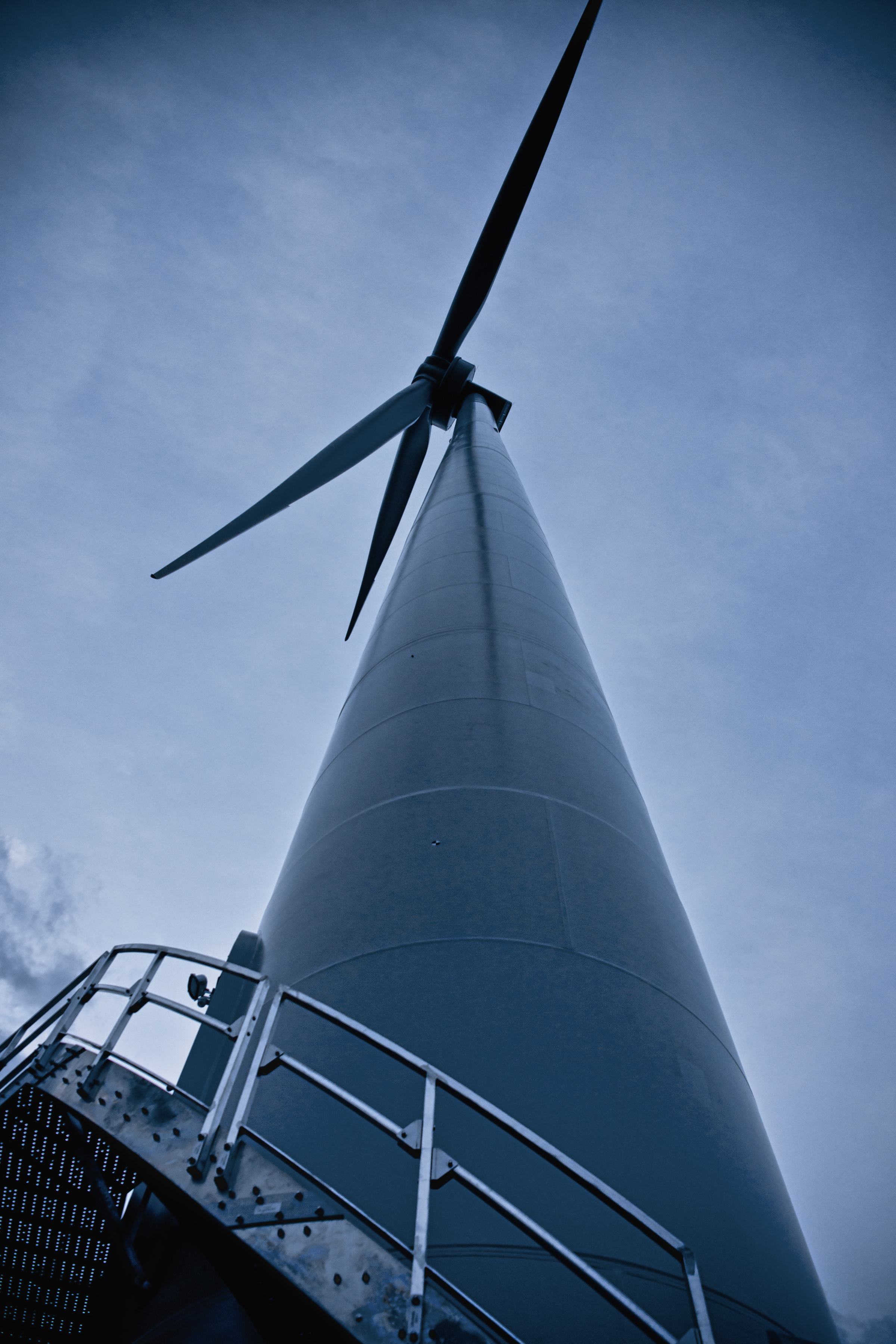
Industrial wind turbine just south of Ottawa: industrial land use
Following a web event held by the Independent Electricity System Operator or IESO a few weeks ago, Ottawa-based investor consortium Ottawa Renewable Energy Cooperative filed a comment in which it stated the group plans to bid for renewable energy projects, when the IESO releases its next Request For Proposals.
OREC already has invested in 24 renewable energy projects in Ontario, mostly solar, but also two small wind turbines, in the Kincardine and Bluewater areas of western Ontario (Huron County).
OREC’s comments to the IESO include the claim that it intends to bid for contracts. It acknowledges community opposition to some types of renewable energy development but claims it can avoid that by building smaller projects that will not attract opposition. The group correctly states that opposition to the Battery Energy Storage Systems or BESS was aided by the inability of developers to provide answers to citizen concerns.
OREC’s comments follow. Emphasis in italics is ours.
Concern 1: We previously noted a qualification bias in LT2 material in favour of indigenous engagement, including indigenous participation as co-proponents. We wish again to request that community-based investment entities such as OREC will be granted equivalency to indigenous participation in terms of rated criteria points as well as set-asides, particularly if such set-asides will be structured to incentivise partnership with indigenous communities. Our question is, “why not community groups too?”
Concern 2: Rural Ottawa is still reverberating from the process of approving large BESS contracts in LT1. Much negative feeling has grown since November 2023 when a plethora of Open House events were held in Ottawa’s rural areas and developers were not ready with adequate answers about appropriate project scale and risks to communities. OREC is monitoring continuing conversations among opponents and their municipal representatives, and we anticipate greater opposition to LT2 projects. OREC believes a development model involving multiple small projects on distribution lines, funded by community investors, will attract significant interest within municipalities. This approach will attract municipal councils to the benefits of local economic activity, and the virtuous loop of generating energy locally, thereby relying less on large energy sources from outside community boundaries. OREC believes that scaling generation and BESS units such as OREC is proposing, meaning smaller, more widely distributed locally owned projects will attract positive attitudes, especially within rural areas, to what is effectively another form of farming. OREC recommends to the IESO that future energy procurements accommodate smaller scale projects, particularly clusters of small projects that have commonality of ownership and regional proximity. Clustered projects on different but proximate distribution feeder lines could be considered as single projects. OREC further recommends that the IESO include rating criteria that reward developers who partner with community-based organizations, similar to indigenous engagement criteria.
Our comments:
Community support: OREC is requesting that community groups supposedly representing local residents should get the same consideration as Indigenous peoples. First, although OREC claims to be “local” its membership is unknown, and in fact the consortium actively reached out to residents in Huron County to invest, as well as Ottawa area residents. So, what is “local”? But more important, OREC misses the point of the IESO’s initiatives regarding Indigenous communities. The goal is to assist these communities with a “clean, reliable and affordable” energy, such as, for example, reducing communities’ reliance of diesel generators for power supply.
Community opposition: After acknowledging the problems of the BESS proposals in the fall of 2023 (a rushed process with little information available), OREC says it anticipates more community opposition. Instead of acknowledging citizen concerns about loss of farmland, industrialization of rural communities, and the significant environmental impact that industrial wind turbines can have, OREC says it has the answer — “multiple small projects.”
OREC has demonstrated grid illiteracy in the past and this is more of the same. Former energy minister Todd Smith commented in February of this year that the addition of renewables (wind and solar) under the McGuinty-Wynne governments created “a lot of instability” on the power grid. The answer, Minister Smith said, was to build a supply of “clean, reliable, baseload power” and the best way to do that was to use Canada’s proven nuclear technology to build large power sites.
Creating multiple small sources of intermittent power generation will not provide reliable power for Ottawa, and it may add to grid instability. That’s not good for anyone.
Citing a “virtuous loop” of local power generation, OREC seems to imply that cute little windmills operating in the area will be like locally grown food. It is not.
Local benefits: OREC claims there are “local benefits” to renewable energy projects. What are they? There are no jobs after the construction phase (and few of those unless you drive trucks), and few if any jobs afterward. Wind turbine maintenance and monitoring is done from remote centres, with a few highly trained technicians on the ground. As the president of Canadians for Nuclear Energy Dr Chris Keefer commented, There are no employee parking lots for wind farms. There are plenty of problems with wind turbines, which is why in Ontario there are currently 157 municipalities that have passed resolutions declaring themselves to be Unwilling Hosts to industrial wind power sites. Most of the Unwilling Hosts either have wind turbines already or are nearby jurisdictions that dothey know the problems, such as noise pollution, risk to wildlife, and irreversible damage to aquifers.
Farming: While possibly drawing analogies to local food production OREC purposely ignores a very big question about wind and solar power development—they use up a lot of land. Good land. Wind and solar are both “low density” forms of power generation because they require so much land for very little power generation. Ottawa’s Official Plan states that renewables cannot be sited on prime farmland, but in truth, all classes of farmland have value. This goes against the public’s wish to encourage local food production. OREC counters with the preposterous claim that operating industrial wind and solar power sites is ”another form of farming.” No, it isn’t. It’s industrialization.*
While OREC promotes itself as a “green” organization, interested in “sustainability,” the fact is, it is an investor group, interested in making money. They have shown little concern, even disdain for citizen concerns (see note below) about the environment and community well-being.
While OREC presents dreamy ideas about “local” power generation as if it were sweet corn, we are ready with the facts: wind power is ineffective, intermittent, unreliable, and expensive —it doesn’t make sense for Ottawa.
OTTAWA WIND CONCERNS
ottawawindconcerns@gmail.com
*OREC founder and Board member Dick Bakker spoke at an Ottawa IESO web event several years ago and when citizen concerns about the environment were raised, he angrily snapped that people who objected to industrialization of their communities were just “NIMBYs.” Industrialization. Acknowledged.

 Ottawa Wind Concerns