• About
  • Donate!
  • EVENTS
  • Ottawa’s “Energy Evolution”: wind turbines coming to rural communities
  • Thinking of signing a wind turbine lease?
  • Wind Concerns Ontario
  • Wind turbines: what you need to know

Ottawa Wind Concerns

~ A safe environment for everyone

Ottawa Wind Concerns

Tag Archives: Ontario

What does wind ‘farm’ construction really look like?

10 Friday Jan 2025

Posted by Ottawa Wind Concerns in Health, Ottawa, Renewable energy, Rural issues, Wind power

≈ 1 Comment

Tags

climate change, energy, IESO, noise, Ontario, Ottawa, Renewable energy, Wind power, wind turbines

Destruction of woodlands, loss of farmland, disruption of rural community life for an unsupportable, intermittent source of power

View of trucks and oversize turbine parts from Green Madness

A documentary film made in Upper New York State provides much needed insight into what really happens during construction of an industrial wind power site.

Green Madness: the waste and destruction of one wind turbine project follows the two-year period during which 37 gigantic industrial-scale or grid-scale wind turbines were erected at the Cassadaga wind power project.

It’s one thing to read about the environmental destruction that results from the construction of these industrial sites, but it’s another to actually see see the horrific damage day by day, as filmed by the crew.

A well written voice over details the reality of wind power: it is supported by subsidies, it is intermittent and out of phase with demand in New York as in Ontario (in fact, Ontario energy economist Edgardo Sepulveda says Ontario is bad for unreliable wind power—New York is worse), and it is simply a tool to make money for investors.

“Wind power is a charade sponsored by investment banks,” is one comment. “Somebody’s making money but it’s not the little guy.”

Promises of jobs are also false, as the film makers demonstrate by filming the license plates on cars and trucks owned by workers on the project: Texas, Arizona, California…anywhere but upper New York State.

Likewise, promises of increased revenues for the municipality are not accurate—expenses incurred outweigh any pittance revenues from the huge multi-national wind power developers.

It’s important for the people of Ottawa to see this film and to understand the reality of wind power construction and development.

Local “environmental” or “climate” groups promote tree planting and wildflower gardens while also hypocritically pushing for industrial wind power in rural Ottawa. The loss of good farmland and woodlands, plus the danger to wildlife and the environment will be horrendous.

The IESO will be launching its Long Term 2 Request For Proposals early in 2025. Wind power is included in the RFP.

If wind power proposals come forward, everyone needs to know what is really involved: it’s not “clean” “green” innocent “windmills,” it’s industrialization of our rural communities and farmland.

To join our mailing list, email ottawawindconcerns@gmail.com and be sure to subscribe to this page.

A documentary film follows the construction of a 37-turbine industrial wind power project in upper New York State, and is a chilling portrayal of the destruction that comes with these industrial power projects.

Wind power lobbyist opposes protection of prime agricultural land

12 Friday Apr 2024

Posted by Ottawa Wind Concerns in Ottawa, Renewable energy, Rural issues, Wind power

≈ 4 Comments

Tags

agriculture, climate change, environment, farming, IESO, Ontario, Ontario Ministry of Energy, prime agricultural, Renewable energy, Todd Smith, wind energy, wind farm, wind turbines

Farmland Trust warns that current use of prime agricultural land is “unsustainable” while wind power developers make threats if they don’t get access to it for power generation. And money. (Don’t forget the money.)

Berwick area farm: 29 huge industrial wind turbines now operate, despite community opposition [Photo D. Larsen]

The Independent Electricity System Operator or IESO is preparing to launch a new Request for Proposals in 2025, and is gearing up now with consultations for municipalities and stakeholders, prior to releasing final documents.

At issue is the policy of the Ontario government —and the City of Ottawa —that prime agricultural land must be protected.

The wind power industry sees this policy as an obstacle and is fighting back. With some success. In a recent IESO web event, a spokesperson said the question of protecting prime ag land is a topic of “active discussion” in government.

Meanwhile, the Canadian Renewable Energy Association, which is not an environmental organization but a trade association and lobbyist, had this to say in a comment to the IESO. (The emphasis is ours.)

“CanREA recommends that Ontario consider orienting agricultural land use policy in a manner similar
to Alberta’s recently announced ‘agriculture first’ approach for renewable energy project approvals.
This approach allows wind and solar generation on Class 1 and 2 lands if they can demonstrate that
they can co-exist with agriculture
.


“We believe that this is a sensible approach. CanREA’s law firm members who represent Ontario
farmers in negotiations with renewable energy developers describe numerous cases where siting of
renewable energy projects on agricultural lands has provided additional income to allow farmers to
stay on the land – making farming careers sustainable for them and their families.


“Should additional restrictions be imposed, renewable energy development would be forced into less
desirable areas with lower wind and solar potential, located further away from load centres. This
would result in system inefficiency, reduced levels of project investment and higher cost solutions for
Ontario ratepayers.”

Very clever wording on their part and not without active threats to the Ontario government, even going so far as to mention the association’s “law firm members.” Phrases like “additional restrictions” are meant to foreshadow legal action if CanREA doesn’t get what it wants, which is unfettered access to Ontario’s farmland for profit.

People want farm land protected

The lobbyist is out of step with Ontario’s citizens and the primacy of protecting our food supply. At a time when “eat local” echoes throughout the province, and the COVID experience of interrupted food supply is fresh in everyone’s mind, the protection of Ontario’s cropland is important.

The Ontario Farmland Trust has this warning for us:

“Every day in Ontario, we lose 319 acres of farmland to non-agricultural land uses like urban development and aggregate extraction; this rate of farmland loss is unsustainable and cannot be allowed to continue. Everyone in Ontario relies on agriculture, from the food we eat, to the jobs in our communities.Without strong protections in place for our farmland, we may not be able to provide enough food to feed our growing population.”

Wind power developers: we want the money

Several wind power developers lined up to file comments with the IESO too—any resemblance to the comments from CanREA are not accidental. Here is Capital Power.

“Broad, overarching limitations or restrictions for specific classifications of agricultural land or
technology types will likely limit the development of cost-effective projects in locations near existing
energy infrastructure. It will also result in a loss of potential non-agricultural income for farmers.
Capital Power submits that the appropriate use of land and potential impacts on agricultural use is
most effectively determined between landowners, developers, and through current project approval
processes. No further limitations, rated criteria, or other considerations needs to be considered for
LT-2 or potential projects.”

Translation: hands off our negotiations with farm owners.

Similarly, U.S.-based Invenergy commented:

“We would work with the landowners to minimize impact to
the land and form an agreement to return land to its
original state. Some projects may be able to allow for the
same productivity levels of the agricultural land like a wind
facility.”

Invenergy also said restricting prime agricultural land mean that municipalities would lose out on tax revenues from wind power projects. That is true but with the tax rates currently capped, the amount paid is a pittance in comparison to wind power operator profits, and would need to be assessed along with municipal costs such as the need for fire services, inspections, etc. It is not possible to return land fully to its “original state”—wind turbines require massive concrete and rebar foundations that cannot be removed.

Wind power developers also under-represent the amount of land used for wind turbines. At least one developer currently claims a turbine uses only 0.2 of an acre but obviously, this does not take into account access roads and other infrastructure.

You can read more industry comments here but make no mistake: they want that prime farm land and will do anything, and say anything to get it.

Ontario to launch request for new power projects next week

01 Thursday Dec 2022

Posted by Ottawa Wind Concerns in Ottawa, Renewable energy, Wind power

≈ 3 Comments

Tags

Ford government, IESO, LT-RFP Ontario, Ontario, Ottawa, Ottawa wind concerns, wind turbines

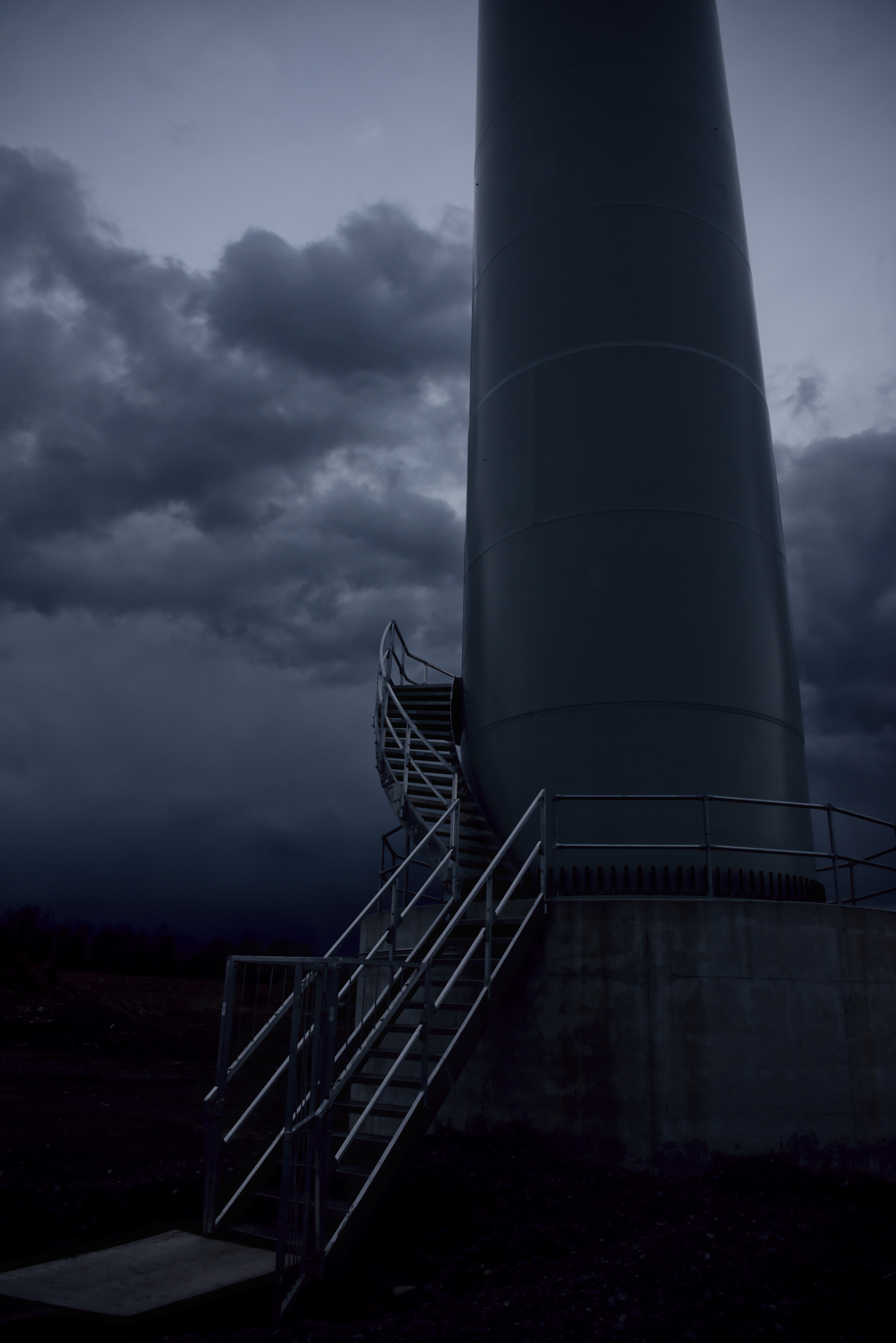
turbinemaststairsdark

Is Ottawa ready? NO.

December 1, 2022

Ontario’s Independent Electricity System Operator or IESO will launch its Long Term-Request for Proposals (LT-RFP) next Tuesday, December 6th.

The aim of the LT-RFP according to the IESO is to: “seek resources that can be in service between 2026 and 2028 to address global and regional needs.”

Energy Minister Todd Smith issued a directive on October 7th:

11. The Expedited Process, Upgrades Solicitation, and L T1 RFP shall be open to all resource types that meet the mandatory criteria established by the IESO, which may include renewable energy, energy storage, hybrid renewable energy with storage, biofuels and natural gas-fired generation.

The RFP has been in development for many months, despite the continued assertion by former Ward 21 Councillor Scott Moffatt who insisted that there is no procurement process in Ontario. When he wrote to members of Ottawa’s Planning and Agricultural and Rural Affairs committees that there was no plans for new power procurement (to head off a presentation by Ottawa Wind Concerns), the IESO was in the final phases of implementing the RFP.

Now, Ottawa could see proposals for new power projects.

The process will be very quick: announcement of successful bidders will come in March of 2023, according to IESO documents dated mid-November.

But we’re not ready.

Ottawa has no new zoning bylaws in place to deal with new power proposals and in fact, the zoning bylaw process following the new Official Plan is stalled due to concerns about new provincial legislation.

As well, we know from the experience with wind turbines since 2009 and the Green Energy Act, there are lots of problems with these industrial-scale projects. Noise, damage to aquifers, and risk to wildlife including endangered species are impacts seen all over Ontario. But regulations for noise and setbacks have not changed.

When the Green Energy Act was revoked by the Ford government in 2018, planning powers were returned to municipalities, who are now able to set their own regulations for noise limits and setback distances.

But Ottawa hasn’t done that.

The solution? Recommended to us by our planning consultant, and as already done by several other Ontario municipalities, Ottawa could pass a motion that is a simple statement of policy intent, to the effect that until new zoning bylaws are approved, the City of Ottawa will not review or approve any proposals for power generation, including wind power.

City staff have already expressed concern about the speed of the LT-RFP process and the fact that municipal approval doesn’t seem to be mandatory, though the Ford government promised that it would be. Other municipalities are worried about this IESO process which, they say, doesn’t give enough time for proper public consultation, or for a full assessment of new power development proposals such as analysis of the effectiveness of the technology being proposed, and what impacts the project could have on the environment.

We met today with new Ward 21 Councillor David Brown, who shares our concerns about the IESO RFP. He is already taking action on it.

We hope that the new Council will act quickly to ensure that the City is not sandbagged by new power generation proposals that are not appropriate to our area, and specifically that Ottawa’s rural communities will be protected from industrialization by unreliable and noisy grid-scale wind turbines. We hope that any new power generation would be for power that is reliable and affordable, and actually does something for the environment and climate change. That’s not expensive, invasive, out-of-phase with demand wind power.


Ottawa Wind Concerns

ottawawindconcerns@gmail.com


directive-from-the-minister-of-energy-20221007-resource-eligibility-1Download

Ontario government lags on wind turbine regulations: Ottawa business newspaper

25 Friday Mar 2022

Posted by Ottawa Wind Concerns in Uncategorized

≈ 1 Comment

Tags

Ford government, noise, Ontario, Ottawa, Ottawa BUsiness JOurnal, Wind ConcernsOntario, wind farm, wind turbines

Other jurisdictions choosing greater setbacks between homes and industrial wind turbines; Ontario has not changed since 2009. New setback of 2 km recommended

Turbines more than 600 feet or 60 storeys high in South Dundas [Photo: Tom Van Dusen for OBJ]

March 25, 2022

Complaints about wind turbine noise and environmental damage have never wound down in Ontario yet regulations to protect people and the environment have not changed since 2009, according to a story in this week’s Ottawa Business Journal.

While some landowners in the area signed up for “easy cash” by leasing land for wind turbines, they admit that the machines are noisy and may bother some people.

The need for wind power must be balanced with concern for health and safety, which is why greater setbacks have been recommended by Wind Concerns Ontario. The community group coalition recommends setbacks for any new wind turbines should be a minimum of 2 kilometres.

The Ontario setback currently is just 550 metres.

Other jurisdictions around the world and in the U.S. are now moving to greater setback distances.

Another issue of concern noted in the story was brought forward by Ontario’s MUlti-Municipal Wind Turbine Working Group, a collection of municipalities with operating wind power projects and experience with impacts of the turbines.

The group is worried about the increasing number of wind turbine failures and says that setbacks from public roadways and property lines are inadequate to protect safety. The municipalities also say there is no process for alerting municipalities of a failure event, nor are the results of any engineering investigations shared.

After completion of its Official Plan, the City of Ottawa is now working on developing new zoning bylaws. Ottawa Wind Concerns has been sharing information with city staff, and hopes that new setbacks for wind turbines in the Ottawa area will reflect the trends to greater distances.

Ottawa’s rural politicians claim there are no plans for industrial-scale or grid-scale wind turbines, but city staff say the Energy Evolution calls for wind and solar to provide electricity for Net Zero goals.

ottawawindconcerns@gmail.com

https://www.obj.ca/article/regional/turbine-issues-are-still-blowing-wind-across-province

Who’s boss in city planning? Ottawa’s new Official Plan? Or the energy strategy document, community group asks

24 Thursday Feb 2022

Posted by Ottawa Wind Concerns in Uncategorized

≈ 1 Comment

Tags

electricity bills, Official Plan, Ontario, Ottawa, Randall Denley, wind farm, wind turbines

Community group files request for review with Municipal Affairs ministry


Official Plan says no industrial wind turbines permitted on valuable agricultural land but it also says its Energy Evolution document drives city actions. That document calls for hundreds of turbines. [Illustration: City of Ottawa Climate Change newsletter]

February 24, 2022

Community group Ottawa Wind Concerns has filed a comment on the city’s Official Plan with the Ministry of Municipal Affairs over concerns about where the document ranks in Ottawa’s planning structure.

“Our worry is that Ottawa’s expressed view that the Energy Evolution document and climate change plan overrides all policies and action means statements in the Official Plan could be subject to amendment at any time,” chairperson Jane Wilson wrote in the group’s submission, filed yesterday.

“What we have is an Official Plan that looks like an Official Plan, but it also appears to have a back door through which the City can make changes and take action by using another plan—one that did not go through any public engagement process.”

The intent of an Official Plan in Ontario is that it is the single document which outlines the direction for the city, Wilson says. In the case of the City of Ottawa, this direction may actually be subordinate to the Climate Change Strategy and the Energy Evolution document.

The community group comment referred to page 23 of Ottawa’s new Official Plan where the city asserts: “The policies of this [Official] Plan should be read as supportive of the Climate Change Master Plan.”

And, on page 26, the City states, “The Climate Change Master Plan and associated Energy Evolution and Climate Resiliency strategies provide the analysis and action plans for City-wide action.”

Ottawa Wind Concerns said the group is worried about how this affects policy on renewable power generation facilities, specifically large or industrial-scale wind turbines.

The Energy Evolution document calls for the possibility of hundreds of wind turbines in the city’s rural areas in a model of how Net Zero might be achieved, while the Official Plan makes statements about industrial-scale wind turbines not being permitted on valuable agricultural land.

“Essentially, it looks like the City is saying, its Energy Evolution document trumps everything. We’re saying, that’s not how a municipality is supposed to use an Official Plan.”

The contents of the Energy Evolution document, approved by Council in 2020 with no public input, are not widely known among Ottawa’s citizens.

There has been criticism from media and analysts who have read it.

Local media branded the strategy document “an expensive pipe dream,” with its $57B (estimated) price tag. Political commentator Randall Denley said the Energy Evolution report was “only the beginning,” and promoted “unachievable goals.”

“How high are they prepared to raise taxes,” he asked, “and what existing services will they cut to fund their quixotic effort to save the planet?”

The City of Ottawa has a history of passing zoning amendments that result in public concern. For example, a zoning amendment was passed without the knowledge of even the local councillor for a large warehouse and truck depot in Barrhaven. That move caused newspaper columnist Kelly Egan to remark, “You know who doesn’t get what they want at city hall anymore? Ordinary people.”

Ordinary people in Ottawa’s rural communities sent emails and made telephone calls to councillors when the wind turbine model in Energy Evolution became known, and STOP THE OTTAWA WIND TURBINES signs went up from Kinburn to Navan, and south to North Gower and Manotick.

City councillors maintained that the Energy Evolution statements were just a “model” but the motion of wind power is present in many City documents and wind turbines are prominent in City banners and graphics. A recent submission to the Ontario Energy Board dated January 17th contained the whole Energy Evolution document, including the wind turbine model, as supporting evidence for the City’s objection to replacement of a natural gas pipeline.

“Everyone wants what’s best for the environment,” says Ottawa Wind Concerns Chair Wilson, “but the fact is, we should be making choices about what is shown to be effective and successful. Ontario is an example of how intermittent weather-dependent wind power doesn’t do anything for the environment, but it does have a huge impact on electricity bills and on communities. Giving the Energy Evolution strategy importance over the Official Plan means decisions can be made on what looks good, not what really is good.”

The community group has asked the Ministry of Municipal Affairs to look at both the Energy Evolution document and the draft Official Plan together, to make sure provincial directives are being followed.

Ottawa Wind Concerns filed its comment with the Ministry and was advised Thursday that the comments were accepted and reviewed, and will be posted publicly.

More analysis on the Energy Evolution document, coming soon.


ottawawindconcerns@gmail.com


Ontario definition of an Official Plan

An official plan describes your upper, lower or single tier municipal council or planning board’s policies on how land in your community should be used. It is prepared with input from your community and helps to ensure that future planning and development will meet the specific needs of your community.

An official plan deals mainly with issues such as:

where new housing, industry, offices and shops will be located

what services like roads, watermains, sewers, parks and schools will be needed

when, and in what order, parts of your community will grow

community improvement initiatives

Source: Government of Ontario: Citizen’s guide to land use planning: Official plans | Ontario.ca


Boom in home generator sales a sign of the times

23 Thursday Sep 2021

Posted by Ottawa Wind Concerns in Uncategorized

≈ 1 Comment

Tags

electricity, generators, Ontario, Ottawa, Ottawa wind concerns, wind power, wind turbines

Reliable: what’s not to like?

September 24, 2021

One of the hottest stocks these days is a company called Generac, which makes whole-home power generators, fueled by natural gas.

After the power failures in Texas and the current crisis in the UK (the latter a desperate situation due to poor energy planning and reliance on wind power), people are worried about the reliability of the power grid.

It’s happening here too and will escalate if cities like Ottawa engage in planning based on intermittent “unreliables” like wind and solar.

Here’s a comment from one of our readers, a long-time experienced power worker:

Breaking news!!!!
I just got off the phone with another contractor from Rockland Ontario asking me to help them get caught up with residential generator installs. Most new construction includes a gas fired backup generator along with an 80 amp electric vehicle charging plug legislated by government code.
Yup, the same people that are discussing phasing out gas fired generation.
Oh, and by the way, for anyone interested, the 3 baseload gas plants that do operate daily are right across the river from Detroit and are privately owned by international consortiums supplying industrial operations that employ thousands.
Most of the other gas fired electrical generating stations are on standby as backup to the Ontario windfarms which drop out of production many times a day, except for the Milton station which provides peaking power usually twice a day for the local industries.
Get rid of that one, no big deal, BUT, you get rid of more Ontario industries and you get rid of more Ontario jobs.
Move in Industrial Wind Turbines and move out industry, hey, it has been proven, the data is everywhere, Ontario windmills don’t work plus they are built using gas fired and coal fired power generation, just not in Ontario.
Lucky for us China has gone in the opposite direction.
Ok, enough new old news for today, gotta go hook up another generator.

Stan the power man

ottawawindconcerns@gmail.com

Nation Rise wind turbines change rural communities

06 Tuesday Apr 2021

Posted by Ottawa Wind Concerns in Uncategorized

≈ 1 Comment

Tags

noise, North Stormont, Ontario, wind energy, wind farm, wind turbines

FB_IMG_1617736030798

April 6, 2021

Huge grid-scale wind turbines are changing the landscape in North Stormont as the Nation Rise wind power project approaches commercial operation in June.

The photo above shows a view of the village of Crysler with two of the wind turbines visible. The Nation Rise turbines are 131 metres to the hub height, or 429 feet. The height to the blade tip is more than 600 feet.

There are 29 turbines in total in the industrial power project.

Wind Concerns Ontario reports that some residents have already experienced excessive noise and vibration from the turbines; they have been advised to call the Ministry of Environment, Conservation and Parks Cornwall Office at 1-800-860-2760. If the call is outside of business hours, residents should call the 24/7 Spills Action Centre at 1-866-MOE-TIPS.

In both cases, caller should be given an Incident Report number, and should also keep a record of their call.

You may also email nationrise@edpr.com to report problems; the company is required to pass along your complaint to the environment ministry.

ottawawindconcerns@gmail.com

How wind turbines scarred a landscape and harmed a community

04 Thursday Mar 2021

Posted by Ottawa Wind Concerns in Ottawa, Renewable energy, Uncategorized, Wind power

≈ 1 Comment

Tags

Kathleen Wynne, North Stormont, Ontario, wind energy, wind farm, wind turbines

March 4, 2021 

An editorial in the Eastern Ontario edition of Farmers Forum says “Toronto” should never have imposed the 100-megawatt Nation Rise wind power facility on the communities of North Stormont. 

In his editorial titled “How wind turbines scarred a landscape and a community,” editor Patrick Meagher notes that the township conducted a survey of residents and found most didn’t want the wind turbine development, and then unanimously voted to declare North Stormont an “Unwilling Host”. 

“But things didn’t go that way,” Meagher writes.  

Weeks before the provincial election in 2018, the Liberal government “greenlighted the project. This was in spite of a longstanding agreement not to approve major projects when another government could take over. Wynne got a two-for-one deal, sticking it to the next government and the locals at Crysler, Berwick and Finch.” (The riding went Conservative.) 

The wind power project caused strong feelings, Meagher says. “The project was so acrimonious that in this small community friendships broke up, family members stopped talking to each other, and more than 10 property owners sold their houses and moved away.” 

Now the community is “stuck” with 29 huge turbines that are “large, inefficient, taxpayer-subsidized generators of intermittent power…not even a good business decision.”

“This ugly event is testimony to why governments should listen to the people they work for…Toronto should never have decided what should happen in this small farming community 400 kilometres away.” 

The editorial also quoted former mayor Dennis Fife who said the community now has to try to move on. 

ottawawindconcerns@gmail.com

Pro-wind court decision shocks North Stormont communities

15 Friday May 2020

Posted by Ottawa Wind Concerns in Ottawa, Uncategorized, Wind power

≈ 1 Comment

Tags

bats, endangered species, environment, ERT, Ford government, Jeff Yurek, MECP, North Stormont, Ontario, water, wildlife, wind farm, wind power

Tremendous step backwards for environmental protection, citizens group says

Water supply, wildlife and noise pollution were concerns in the community fight against an unwanted wind power project [Photo: Pexels]

May 15, 2020

The decision released Wednesday by the Ontario Superior Court which overturned the Ontario environment minister’s move to revoke approval of a large wind power project has shocked the communities that have been fighting for five years to stop the wind “farm” due to concerns about the environment and wildlife.

While the urban media, at the urging of the wind power lobby, power developer, the NDP and Green political parties and so-called environmental organizations are happy about the court decision, those familiar with the power project and the evidence presented against it are not.

The court decision does not merely overturn the minister’s revocation of the project approval, it declares the minister had no authority to act and in essence, writes new public policy over development decisions and the environment. Referencing the “Ford government” with obvious distaste and a transparently one-dimensional view of the government’s approach to environmental issues, columnists failed to recognize what the court has really done.

Concerned Citizens of North Stormont chair Margaret Benke said the decision leaves the “entire Province highly vulnerable. The Minister and Ministry of the Environment with all their resources can’t protect our natural resources and species at risk. The only protection against these kinds of mistakes by the ERT [the quasi-judicial body that hears appeals of approvals] is now in the hands of private citizens,” Benke said.

“We will be asking the Court of Appeal to reconsider what seems to be a tremendous step backwards for environmental protection in Ontario.”

The community group appealed the approval for the project on the grounds of risk of harm to wildlife, the environment specifically the aquifer which is noted as “highly vulnerable” by the Ontario government, and the risk to human health from the wind turbines. The appeal was dismissed; the group then filed a direct appeal with the minister, noting errors in the Environmental Review Tribunal decision. The minister revoked the approval last December saying the risk to endangered bats was significant, he wanted to “exercise precaution” and in any event, Ontario does not need the electrical power from the wind project.

While media reports claim the Ford government dislikes renewable energy projects, the truth is, the Wynne government halted all procurement in 2016 saying the province had enough electricity, and 90 percent of the power suppl was emissions-free. The Wynne government actually cancelled several wind power projects, but gave contracts to five that year, including Nation Rise.

The power developer insists the community did not bring forward bats in their appeal, which is not correct: written submissions were presented to the Tribunal but then, the wind power developer filed a last-minute report which gave the community group’s expert witness no time to review it, so little of his evidence was presented.

The Concerned Citizens group has spent over $100,000 on legal fees; in Wednesday’s decision they were punished for their work to protect the community and environment by having to pay the power developer $60,000 in costs.

The office of the Attorney General or the Minister of the Environment, Conservation and Parks have not made a comment on whether they will appeal the decision, which clearly has an impact on ministerial authority.

ottawawindconcerns@gmail.com


Nation Rise wind power project in court next month

15 Wednesday Jan 2020

Posted by Ottawa Wind Concerns in Renewable energy, Wind power

≈ 1 Comment

Tags

EDPR, Ford government, Kathleen Wynne, Nation Rise, North Stormont, Ontario, wind farm cancelled, wind power

January 15, 2020

EDPR, the Portugal-based power developer for the Nation Rise wind power facility planned for, and partially constructed, in North Stormont, south of Ottawa, will appear in court in Toronto February 14th, with an application to “render without legal effect” or quash the recent revocation of the Renewable Energy Approval by environment minister Jeff Yurek.

Minister Yurek issued his decision in response to a direct application to his office by the local community group, filed early in 2019.

Minister Yurek revoked the Renewable Energy Approval on the grounds that there was a significant risk to endangered bat species, which are critical to the eco-system, citing the fact that Ontario also does not need the power from the proposed 100-megawatt project.

The wind power lobbyist Can WEA, the Canadian Wind Energy Association, is seeking status in the legal proceedings as an intervenor, which would mean their lawyers could cross-examine witnesses.

Community group the Concerned Citizens of North Stormont (CCNS), which filed the direct application, may also participate. CCNS had appealed the original approval before the Environmental Review Tribunal but the appeal was dismissed.

While statements have been made that the cancellation is unprecedented, the fact is, several power projects have been cancelled in Ontario historically. The Ostrander Point project in Prince Edward County was also revoked due to danger to the Blandings Turtle, and the White Pines power project, also in Prince Edward County, was reduced from 29 to 27 and eventually 9 turbines over multiple environmental concerns. That project was ultimately cancelled by the Ford government.

Statements have been made that the Nation Rise project was mostly constructed when the approval was revoked. In fact, of 29 turbines, only eight were approaching completion. The company’s target date for completion and providing power to the grid in Ontario was near the end of March or this year. That deadline has now been extended because of legal actions.

The power developer has also claimed that the community will suffer because of the cancellation, because the project would have brought jobs to the area. The usual case, however, is that there is one technical job per 10 turbines in operation; other jobs are short-term, construction-related positions that end with the construction phase.

North Stormont was one of the original unwilling host communities in Ontario, and was also one of 116 municipalities that demanded a return of local land-use planning powers removed by the Green Energy Act.

The Wynne government did not respond.

The Ford government returned planning powers to municipalities last year.

Almost every wind power project has been appealed on the basis of environmental concerns in Ontario since 2009; prior to that date, communities appealed to the Ontario Municipal Board.

← Older posts

Recent Posts

  • Open letter to CAFES Ottawa
  • Ottawa Wind Concerns supports West Carleton residents
  • What does wind ‘farm’ construction really look like?
  • Unwilling Host communities surround Ottawa
  • How many birds do wind turbines kill?

Follow me on Twitter

My Tweets

Enter your email address to follow this blog and receive notifications of new posts by email.

Tags

Bob Chiarelli Green Energy Act IESO Ontario Ottawa Ottawa wind concerns wind energy wind farm wind power wind turbines

Contact us

PO Box 3 North Gower ON K0A 2T0

Create a free website or blog at WordPress.com.

Privacy & Cookies: This site uses cookies. By continuing to use this website, you agree to their use.
To find out more, including how to control cookies, see here: Cookie Policy
  • Subscribe Subscribed
    • Ottawa Wind Concerns
    • Join 379 other subscribers
    • Already have a WordPress.com account? Log in now.
    • Ottawa Wind Concerns
    • Subscribe Subscribed
    • Sign up
    • Log in
    • Report this content
    • View site in Reader
    • Manage subscriptions
    • Collapse this bar
 

Loading Comments...