Law firm alleges “threats to personal security”

Ottawa Wind Concerns's avatarWIND CONCERNS ONTARIO: On WordPress

In a letter to Environmental and Lands Tribunal Ontario, a lawyer at Torys LLP, representing wind power developer NextEra in the appeal of the Adelaide wind power project, objects to the appellant’s request to videorecord the proceedings.

Justin Necpal writes “There is evidence that anti-wind groups [sic] have used the Internet and social media to criticize REA appeal participants, creating the potential for a threatening environment for wind developers and the governmental agencies that are involved in issuing approvals for wind energy projects. In one recent REA appeal, audio recordings of the hearing were made and photos of legal counsel were taken, and both were posted to the Internet. There are other examples of activities by wind opponents that give rise to personal security concerns for those participating in REA appeals…” See the full letter, copied to appellant Esther Wrightman, here.

Mr Necpal, who is a litgation lawyer…

View original post 233 more words

Electricity bills going up again!

Tags

, , ,

The Ontario Energy Board has announced another rate hike, effective November 1st. Here from energy economist Robert Lyman, is a view of what is going on (madness!).

In 2002, the residential electricity rate in Ontario was 4.3 cents per kWh. There was only one tier that applied at all times and levels of residential use. This is the rate for the power alone, and does not include the charges for transmission, distribution, regulatory charges, debt retirement and taxes.

In 2004, the two-tier system was introduced. The lower-tier rate was 4.7 cents per kWh and the upper-tier rate was 5.8 cents per kWh.

By 2011, the lower-tier rate had increased to 6.8 cents per kWh and the upper-tier rate had increased to 7.9 cents per kWh.

In 2011 and 2012, Ontario introduced time-of-use (TOU) rates based upon the use of “smart” meters. The rates were set at 6.3 cents per kWh for the off-peak and 11.8 cents per kWh for the peak periods.

Today (October 17, 2013), the Ontario Energy Board authorized an off-peak rate increase to 7.2 cents and a peak period rate increase to 12.9 cents, effective November 1, 2013.

Since 2002, therefore, off-peak rates have increased by 67%, and peak period rates have increased by 200%. Transmission and distribution costs have increased as well, of course, but not as much in percentage terms. The addition of the HST has added about $1.2 billion to ratepayers’ bills every year.

There are many conflicting projections as to where rates will go in future. The province projected in 2010 that rates would rise by about 50% by 2015. Parker Gallant, the well-known critic of provincial electricity policies, has estimated that costs could rise by $7.3 billion per year by 2016, or almost 100%.

Incidentally, Ontario consumes about the same amount of electrical energy today as it did in 2004.

This is the Liberal legacy.

North Gower plans to be “Not a Willing Host”

Tags

, , , ,

When Ontario Premier Kathleen Wynne held her first interviews after being elected the Ontario Liberal Party leader, and thus, Premier, she was asked about the controversy over wind power projects in Ontario. She said, her government would not be forcing the power projects on communities that were not “willing hosts.”

Today, 72 Ontario municipalities have declared themselves to be “Not a Willing Host” ( see windconcernsontario.ca Not a Willing Host tab for the list of communities).

North Gower is not a legal municipality since amalgamation with the City of Ottawa, but residents plan to be declared Not a Willing Host by using a legal petition to the City of Ottawa.

“This petition is a legal document, signed and witnessed by members of our community,” says Ottawa Wind Concerns chair Jane Wilson. “We will take this petition to the City of Ottawa and make sure the City overall knows that there is no support here for a wind power generation utility so close to homes, and our school.”

Wilson notes that Ontario often has a surplus of power and has sold excess for a loss to neighbouring jurisdictions such as Michigan or New York State, and that the Ontario government recently announced it is paying wind power companies NOT to add power to the grid. “So why build another one?” she asks. “Why subject yet another Ontario community to the dramatic impact of a wind power project it it’s not even needed?”

The proposed 20-megawatt wind power project will be within 3.5 km of more than 1,000 homes, Wilson explained. A conservative estimate of the average property value loss is over $130 million.

MPP Lisa MacLeod, now energy critic for the opposition has often spoken against the wind power project; MP Pierre Poilievre has said it makes no sense financially, and commissioned a Library of Parliament study to show that subsidies for the project from Ontario taxpayers would be about $4.8 million per year.

The petition-signing debut for North Gower residents is Saturday October 26th at 10 a.m. at the Alfred Taylor Centre on Community Way. Special guest Parker Gallant, frequent contributor to the Financial Post series “Ontario’s Power Trip,” will deliver a presentation “What’s in your electricity bill?” by videolink at the event.

Residents who are unable to attend will be able to sign the petition when volunteer canvassers come to their door, or on a special “voting day” at the Alfred Taylor Centre on Saturday November 9 from 11 a.m. until 1 p.m.

For more information, email Ottawa Wind Concerns at ottawawindconcerns@gmail.com

South Branch wind project footprint visible

Tags

, , , , , , , , , ,

From the October edition of The AgriNews, an update on the South branch wind power project. You recall that Prowind, the same developer as for the Marlborough project in North Gower, began this project by leasing land from local farm owners, and then sold it to Portuguese energy giant EDP. Construction is ongoing now.

Here is an excerpt of the story by Lois Ann Baker.

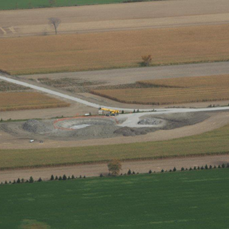
BRINSTON–Now that the wet weather is out of the way, construction on the South Branch Wind Farm* is well underway. The sites of the 10 turbines that will be scattered throughout the Brinston area have been excavated and access roads have been created to allow the many trucks and equipment to access the sites.

Within the next week or two the foundations for the turbines will be poured, paving the way for installation of the turbines.

The main site located on Brinston Road just south of the hamlet, will also be home to the substation that will be used to maintain the turbines. A building consisting of meeting rooms and storage space will also be located on that site.

Project manager Ken Little said … the turbines [will] be installed in November and they should be producing power for Hydro One by the new year.

The controversial wind farm has sparked interest among the locals, said Little and EDP Renewables has tried to keep up “fairly regular communication” with both supporters of the project and those that oppose the turbines.

Ralph Butler of Williamsburg expressed his concerns over the wind farm by saying that the area of farm land being wasted is unbelievable.

BrinstonAerialSB“I think it’s the biggest waste of money since the gas plant,” said Butler. “I’ve been complaining about this ever since it started.”

Butler added that with new regulations brought in by the Ontario government stopping the turbines from producing power when there is an abundance of power on the grid, it’s possible these turbines will never turn a blade to produce power. He also added that the municipal government should have done something to stop the project.

[EDP’s] Little didn’t seem overly concerned with the regulations saying that…they will be compensated. “If we are asked to shut them down, after a certain amount of time we will be paid,” said Little.

In light of these new regulations, South Dundas council passed a resolution at the first regular council meeting held after the groundbreaking of the turbine sites to not support any future proposals until the supply and demand for electricity demonstrates a need. Council had previously turned down a resolution by Councillor Evonne Delagarde requesting that the municipality become known as “Not a Willing Host” to industrial wind turbines.

At the same council meeting, council felt the need to defend themselves when long-time Brinston resident Robbie Giles gave a presentation on how he felt council had no been open and acted in the best interests of residents of South Dundas, with regards to the South Branch project. Giles claimed too many informal meetings with a lack of follow-up was a big issue.

Giles said he felt the biggest lesson learned from the South Branch project was that revealed a lack of public contact or consultation and urged council to take responsibility for “access, transparency, honesty, respect for all voices, and courage to change position and challenge authority, if it is the right thing to do.”

Mayor Steven Byvelds** responded with “I think we are an open council. We do not have informal meetings and do not discuss council issues away from the council table.” ***


*They are not “farms”

**Remember that name, especially in the next municipal election, October 2014

***Because that would be ILLEGAL under the Municipal Act, wouldn’t it?

Aerial photo of South Branch wind power plant by Ralph Butler

New map shows potential impact of North Gower wind power project

Tags

, , , ,

turbine and houseCloseWith new research on both health impacts and property value loss surfacing, we decided to update our maps on the sphere of influence of the proposed wind power generation project in North Gower and Richmond.

It is staggering. With health problems due to the environmental noise being reported as far away as 5 km in other jurisdictions (10 km reported in Australia) and property value loss substantial within 2 miles (US study from Clarkson University), our map depicts the influence on residents living within 3.5 km.

See the map HERE NG wind turbines – 3500m- 20131012

Where is YOUR home?

And what can you do? Tell the City of Ottawa that the residents of the North Gower area are NOT a “willing host” to this wind power project.

Come sign the legal petition Saturday October 26th at 10 AM at the Alfred Taylor Centre, and help get the word out to your North Gower friends and neighbours.

Alternate signing day will be Saturday November 9th from 11 AM to 1 PM. Volunteers will also be going door-to-door in the weeks after the petition launch; you may also email us at ottawawindconcerns@gmail.com to have a copy brought to you.

Each signature will be witnessed: this is a LEGAL DOCUMENT that will go to Ottawa City Council.

Donations welcome: PO Box 3, North Gower ON  K0A 2T0

Ottawa Wind Concerns

ottawawindconcerns@gmail.com

Algoma residents consider action on wind power plant approval

Tags

, , , , ,

The Goulais Bay wind power generation plant was approved October 4th, despite objections from all over Canada about placing an industrial power generation project in the landscape celebrated by Canada’s Group of Seven painters.

From SooToday:

Goulais wind farm approved, opponents consider next steps

Saturday, October 12, 2013   by: Darren Taylor


The Save Ontario’s Algoma Region (SOAR) group is clearly disappointed with the Ontario Ministry of the Environment (MOE) October 4, 2013 decision to approve construction of the Goulais Wind Farm project.

A Renewable Energy Approval (REA) has been given to SP Development Limited Partnership to build, install, operate and eventually retire a renewable energy facility, consisting of 11 wind turbines , with a total capacity of 25 MW, in the unorganized Townships of Pennefather and Aweres.

The wind facility will be connected to Great Lakes Power’s distribution system.

The REA comes with a long list of conditions, which include requiring SP Development Limited to construct and install the facility within three years of the date of approval, compliance with the MOE’s noise emission limits,  keep an eye on storm water management, sediment and erosion during and after construction, the effect of the project on wildlife (such as birds and bats), establish a community liaison committee with members of the public, and properly decommissioning of the facility upon its retirement.

SOAR’s Executive Member and spokesperson Gillan Richards, in an e-mail to SooToday.com, stated: “SOAR and Wind Concerns Ontario (WCO) will now consider what action to take in response to the Goulais Project Approval.”

The group, if it decides to file an application to appeal the MOE’s Goulais Wind Farm project approval, must do so within 15 days.

SOAR has long been opposed to the project, and has maintained that the whirring of wind turbines, for example, is detrimental to human health, and that the presence of more wind farms in Algoma would be an all-round disruption to the environment and wildlife in the area.

Also ranking high among the group’s concerns is that, in its view, the project will create an eyesore on the area’s famous Group of Seven landscape, disturbing “the natural beauty of Algoma from industrial intrusion.”

SOAR states the public in general has never been keen on wind turbine developments, claiming  “Algoma residents and visitors are already annoyed and dismayed by the intrusion of the Prince Wind Farm turbines.”

SOAR has also long insisted not enough public input has been gathered from the province and the developer regarding the Goulais Wind Farm project (along with other wind projects, proposed by other developers, for the Algoma region).

The group agrees with criticism from The Fraser Institute (a Canadian think tank based in Vancouver) that forecasts Ontario’s energy prices will increase dramatically (40 to 50 percent) in coming years, putting the blame for that on the use of wind and solar farms, and insisting that wind turbines are simply inefficient in producing electricity.

SOAR agrees with critics who state Ontario could have gone with cheaper alternatives, such as natural gas or nuclear power, when it sought to move away from coal-fired plants and brought in the Green Energy Act in 2009.

The Ontario government has said the Green Energy Act, despite higher costs for electricity, will ensure “cleaner” electricity for future generations.

Rex Murphy on “duplicitous Dalton”

Tags

, , , ,

From the weekend edition of The National Post, Rex Murphy‘s summary of Duplicitous Dalton and the havoc wreaked up Ontario taxpayers. Who pays for all this “venality” Murphy asks: “the honest pockets of carpenters in North bay and teaching assistants and snow plow operators and store clerks and seniors…”
The horrible truth is, Ontarians are continuing to pay for the disastrous McGuinty energy policies as approvals of giant wind power projects continues, and subsidies are doled out by the million each week.

Wonder how Ottawa South voters are feeling about John Fraser this week…

Rex Murphy: Duplicitous Dalton, Inc.

Rex Murphy | 12/10/13 | Last Updated: 11/10/13 1:58 PM ET
More from Rex Murphy
Where is McGuinty now that the full cost of his expediency is known? Harvard, of course, disappeared like a member of some witness protection program for the well-connected.

Peter J. Thompson/National Post Where is McGuinty now that the full cost of his expediency is known? Harvard, of course, disappeared like a member of some witness protection program for the well-connected.
 

The Auditor-General of Ontario has released her report on the provincial Liberal government’s brazenly political decision to cancel two gas-fired power plants. Her estimate of the ultimate cost: about $1.1-billion, potentially reaching $1.5-billion. This obscenity of mismanagement and prevarication came out of Duplicitous Dalton, Inc., a.k.a. the McGuinty government, an administration we now know was, politically, so venal as to toss perhaps as much as a billion and a half taxpayer dollars into the devouring — but politically favourable — wind.

Kelly McParland: Here lies the wreckage of Dalton McGuinty’s self-serving gas plant decisions

In contemplating the disastrous consequences of the Ontario government’s two arbitrary gas plant closures, it does well to remember the performance put on by then-premier Dalton McGuinty before his abrupt resignation.
Never hesitant to play the Boy Scout, the premier prorogued the legislature rather than face questions about the gas plants, and then piously sought to blame the opposition for his troubles.
“I prorogued because the place was becoming overheated,” Mr. McGuinty insisted, citing a “spurious, phoney” suggestion that his energy minister had been in contempt of the legislature for failing to produce documents related to the scandal.

D.D., Inc. even had the brass to insist, originally, that the cost to cancel just the Oakville, Ont., plant was only $40-million. The Auditor-General this week, after a cautionary distribution of Gravol tablets to the assembled press, offered a more altitudinous range of $675-million to $810-million — 15 to 20 times as much! And from the very beginning of the noxious affair, to any question the Liberal response was delay, obfuscate, stone-wall, delete emails, deny said deletions, miraculously locate the not-so-deleted emails, and, of course, insult and hector any and all critics.
Let there be no more “used car salesmen” jokes about political leaders. Used car salesmen are pillars of candour and conscience compared to this lot.
They knew $40-million was a joke estimate from the moment they scrambled to “buy” the votes by scrapping the plant — in other words, from the moment they chose to buy a couple of ridings by ripping up contracts, costs be damned.

Read the whole article here.

Highlights from St Columban ERT: infrasound is real (we knew that)

Ottawa Wind Concerns's avatarWIND CONCERNS ONTARIO: On WordPress

Dr. David Michaud at the St. Columban ERT Hearing

“Knowledge gaps on noise, infrasound”


   Dr. Michaud testified that there was a ‘knowledge gap’ in respect to low frequency noise emitted by wind turbines.  International standard used to assess noise do not consider low frequency noise as they do not deal with sound 31.5Hz.


  Dr. Michaud also stated that the knowledge gaps relative to both audible and low frequency noise from wind turbines were sufficient to qualify for Health Canada funding. He stated that to receive funding, a project…

View original post 163 more words

Tom Adams on wind and solar: not working

Ottawa Wind Concerns's avatarWIND CONCERNS ONTARIO: On WordPress

From today’s Financial Post, Tom Adams and Kathy Hamilton on the latest Big Ideas for renewable power in Ontario.

Ontario’s latest electricity scheme: Pumped energy storage

For ratepayers, none of this is working. Wind and solar are not just unreliable. Ratepayers pay unaffordable prices for their chaotic output. Adding the cost of storage puts ratepayers in double jeopardy.
Daniel Acker/Bloomberg

As the Ontario government’s $1-billion gas plant relocation scandal slips into history, the province’s electricity ratepayers should not assume that the era of big-ticket rate-boosting power projects of questionable value is a thing of the past. Now comes the “Smart Grid” and a host of other projects.

Smart Grid is the new fad taking over power industry policy everywhere — it’s a flexible concept that gives utilities, contractors and governments room to justify ratepayer spending on “Smart Meters,” electric cars, power line automation and the new hot idea of electricity storage.

None of these ideas comes cheap, including pumped electricity storage, a plan making its way through…

View original post 211 more words

The Auditor General’s report on gas plants: a summary

Tags

, , , , ,

Here from Ottawa economist Bob Lyman, who specializes in energy issues, is what you need to know about the Auditor General’s report, and why the losses mounted up to over $1 billion for both the Oakville and Mississauga gas plants.

ONTARIO AUDITOR GENERAL’S REPORT  ON OAKVILLE POWER PLANT CANCELLATION COSTS:  SUMMARY AND BRIEF COMMENTARY

Introduction

On October 8, 2013, Bonnie Lysyk, Auditor General of Ontario, released a Special Report on the costs that have been incurred and are likely to be incurred by the public as a result of the cancellation of a natural gas-fired electricity generation plant in Oakville Ontario. In the period leading up to a provincial election, the Liberal government announced the cancellation of this plant on October 7, 2010. As a result of the cancellation, the Ontario Power Authority (OPA) was required to negotiate arrangements for the construction of alternative power generation facilities in Napanee, Ontario. Thus, the objective of the Auditor General Office’s review was to determine the costs of both the cancellation of the Oakville plant and the relocation of the power generation facilities to Napanee.

Background

The need for a natural gas electricity generation plant in the Southwest Greater Toronto Area was first identified by the OPA in its 2007 Integrated Power System Plan. In response to the plan, the Minister of Energy and Infrastructure directed the OPA in 2008 to procure a combined–cycle natural gas generation facility in the area with a capacity of up to 850 megawatts (MWs), to begin operating no later than December 31, 2013.

In September, 2009, the OPA awarded a contract to TransCanada Energy Ltd. (TCE) to build the facility in Oakville. There followed significant local opposition from groups in the Oakville area, including the Town of Oakville. The government cancelled the project. Soon after, OPA and TCE began to negotiate a settlement on a replacement project. TCE had already incurred significant costs and was facing the loss of revenues it would have received if the original contract had been honoured. The negotiations were difficult. The Premier’s Office intervened, without consulting OPA, to assure TCE that it would be compensated for the financial value of its contract for the Oakville plant. The Minister of Energy instructed OPA to contract with TCE to build a new plant in Napanee. Finally, the Province and OPA agreed to an arbitration framework (for determining damages to be paid to TCE if no settlement was reached) that favoured TCE and waived the protections that OPA had under the original Oakville contract. In December, a deal was reached to relocate the plant to Napanee.

Cancellation Costs

 The Special Report lists two types of costs that resulted from the plant cancellation -the costs already incurred and the estimated future costs.

The costs already incurred include reimbursing TCE for its initial purchases of gas turbines for the Oakville plant and the modifications made to them ($210 million), sunk operating costs relating to the Oakville plant ($40 million) and legal fees ($3 million).

The estimated future costs essentially relate to the cost of constructing the Napanee plant, of increased gas connections to get natural gas to the Napanee plant, the costs of new gas pipelines to move gas to Napanee and new electricity lines to move electricity from Napanee to the GTA, the penalty associated with the use of less efficient gas turbines, and the cost of replacement power to make up for the non-availability of the Oakville plant’s power for some time. The Auditor General’s Office estimates these costs to be $859 million.

The total costs incurred plus estimated future costs are thus $1,112 million (i.e. $1.1 billion).

Estimated Future Savings

 In return for taking on a portion of the costs that TCE would have incurred, OPA was able to negotiate a lower price for the power from the Napanee plant than it would have had to pay for the power from the Oakville plant. This results in an expected savings of $275 million. There is also a delay in the commencement of payments to TCE compared to what would have occurred under the Oakville contract because the Napanee plant will come into operation later. The OPA and Auditor General disagree on both the dates when the Oakville plant would have come into operation and when the Napanee plant will come into production. As a result of these disagreements, the Auditor General estimates the present value of the savings to be $162 million, and OPA estimates it to be $539 million.

Using the Auditor General’s figures, the net cost to the public will be $675 million.

Impact of Potential Toll Increase

 TCE’s parent company will also benefit from the fact that under the Napanee agreement a section of the pipeline route owned by TransCanada Pipelines Limited (TCPL) effectively must be used to transport gas to Napanee. This section does not now have the capacity to transport the amount of gas that will be needed by the Napanee plant. Accordingly, TCPL will need to make additional capital investments and recover these costs through increased toll charges, which will get passed on to electricity ratepayers. Tolls could increase by up to 50% in the first three years; if so, over the 20-year term of the contract for the Napanee plant, the cost of gas delivery would increase by $140 million.

Special Observations

The Special Report makes some observations that raise concerns about the way the Ontario government managed this issue.

  • Throughout the initial procurement process for the Oakville plant, including prior to the awarding the contract to TCE in September 2009, OPA provided the government with “off ramps” not to proceed. Despite the public controversy and the firm opposition of the Town of Oakville, the government declined to take any of these off ramps.
  • The contract for the Oakville plant contained protection to relieve both TCE and OPA of any financial obligation if events beyond their control (force majeure events) caused the plant’s commercial operation date to be delayed by more than 24 months. Given Oakville’s strong opposition to the plant, including Oakville’s stated intention to fight the matter all the way to the Supreme Court of necessary, it may well have been possible for the OPA to wait it out, with no penalty and at no cost. In other words, if the Premier’s Office had not intervened to guarantee TCE compensation, there might have been no cost to the Crown.
  • The Minister of Energy agreed to locate the new plant in Napanee, hundreds of miles from the market for the power, and with no consideration of the potential opposition of people in Napanee.

I would also observe that the need for additional natural gas generating plants is closely linked with the Ontario government’s commitment to add significant additional generating capacity from “green” energy sources, mainly wind turbines and solar power equipment. These intermittent sources of power require much more conventional energy sources to back them up for periods when they produce little or no electricity.

In reality, Ontario already has significant surplus electrical generating capacity, a situation that seems likely to continue until 2018 at the earliest. The problem seems to be one that is entirely of the government’s own making.

Robert Lyman

Ottawa