We’ve added an online petition to our campaign to ask the City of Ottawa to create safe, protective setbacks between industrial wind turbines and homes in Ottawa’s “rural countryside.”
Sign today.
Share the link with friends, neighbours and family!
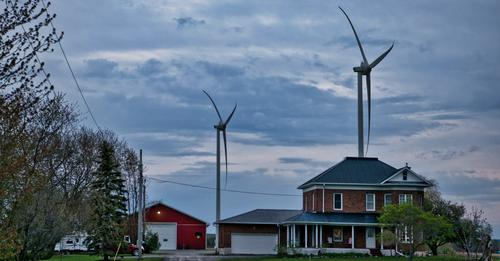
Wind turbines near Crysler, Ontario, 40 minutes south of Ottawa: protective bylaws needed [Photo: D. Larsen for Wind Concerns Ontario(C)]
April 22, 2023
“Earth Day”
A petition asking the City of Ottawa to develop new, protective bylaws that include a setback between industrial-scale or grid-scale wind turbines was launched at an event held in North Gower Last Thursday.
Dozens of people attended, coming from West Carleton, Carlsbad Springs, Navan, Greely, Richmond and North Gower to learn more about the City’s background documents for the new zoning bylaw process, and to see maps depicting where renewable energy projects—including wind turbines—could be located according to Ottawa’s new RuralMapOttawa.
People attending were concerned about the environmental impacts of large wind turbines including the introduction of noise and vibration (low frequency noise), the impacts on wildlife and aquifers, loss of land used to produce food, and the effect on property values.
Ward 21 Rideau-Jock councillor David Brown dropped in to hear resident concerns.
The petition asks for a 2-km setback which, as community group Ottawa Wind Concerns chair Jane Wilson explains, is in line with many countries in Europe and follows the trend in the United States to longer setback distances. “Just recently, a jurisdiction in Nebraska, which has plenty of experience with wind turbines, installed a setback of two miles,” she says.
The group consulted U.S. acoustics expert Robert Rand who said the setback distance was “a reasonable compromise.”
The City of Ottawa has acknowledged that there could be significant environmental impacts on rural residents should wind turbines be erected, and staff has said in public meetings and correspondence that they want to “do the right thing.”
Many people attending Thursday’s launch event said they were eager to see protective setbacks but they were not persuaded that the City should be open to expensive, intermittent wind power to support widespread electrification. The City’s $57-B Energy Evolution climate action plan proposes 3200 megawatts of wind power, which the report translates as 700 wind turbines.
Environmental impacts are high for little return with grid-scale wind turbines.
Another drop-in information event will be held in Kinburn at the Community Centre on April 26th between 5-7 PM. (Locally made butter tarts will be served again!)
Anyone wishing to sign the petition can download the document here petition-1
Signed copies can be picked up, just email ottawawindconcerns@gmail.com , or mailed to:
Photo of Nation Rise turbines: equal to 60-storey office towers. Wind turbines are an industrial use of the land
March 10, 2022
Last November, after STOP THE OTTAWA WIND TURBINES signs dotted rural Ottawa from Navan to Dunrobin, and south to North Gower and Manotick, Ward 21 councillor Scott Moffatt said that Ottawa was not planning industrial-scale wind turbines. He also suggested in one of his podcasts that the signs, put up by Ottawa Wind Concerns and Carleton Landowners,were just frightening people.
Where did the idea come from? The city’s Energy Evolution document contains a model for 3,200 megawatts of renewable power generation, which could mean 710 wind turbines. The document was passed by Council in the fall of 2020 to very little fanfare.
As to a coming rush of huge, noisy wind turbines, Mr. Moffatt wrote in the Manotick Messenger on November 5: “That could not be farther from the truth.”
He went on to say that wind turbines built in other areas would count toward Ottawa’s Net Zero goal. Councillors El-Chantiry and Darouzeagreed, stating during the last meeting for the City’s Official Plan that people were confused about wind turbines.
The fact is, there is a conflict between what City staff are saying, and councillors’ public statements.
On March 7, a hearing was held before the Ontario Energy Board, with regard to the City of Ottawa objecting to a proposal by Enbridge Gas to replace a pipeline for natural gas along St. Laurent Blvd in order to serve its customers.
The City’s objection, they say, is based on the idea that we won’t need natural gas in the coming years because we will rely on power from renewable sources instead.
In answering a question from Energy Probe at the hearing as to whether and where wind turbines might go, Climate Change manager Mike Fletcher answered:
“The city’s plan does not propose to install 710 large scale wind turbines in the City of Ottawa.”
But…
“Any Ottawa wind turbines of any size that were built would be located in appropriately zoned areas of community respecting required setbacks.”
So, no, or…yes?
Mr. Fletcher then went on to say that the city has consulted with a planner with regard to setbacks to determine siting for wind turbines. From the transcript, Mr. Fletcher said:
So a land use planner was involved in looking at this issue and considered guidance on setbacks and a setback is — as I recall it being described, a setback is the distance from mostly from buildings where people are living or working.
And there are zoning considerations as to where — where turbines could be located. So prime agricultural land would not be a non-associated use for a wind turbine.
So, the city is involved in developing setbacks “as to where turbines could be located”. That’s reasonable; it is good to be prepared, but are they actually planning for wind power?
Later, answering a question put from Enbridge Gas’ lawyer, Mr. Fletcher confirmed the sources of renewable energy:
[Enbridge Gas lawyer] And the next line is 4.3 gigawatts of other planned renewable capacity. And is that roughly the accurate figure?
MR. FLETCHER: That’s correct.
MR. ELSON: And I understand that that renewable capacity includes some wind and some solar?
MR. FLETCHER: Well, it is predominantly those two, actually.
Again, we ask the City of Ottawa to be transparent with the residents of our rural communities.
It is worth noting that counsel for the parties objecting to the pipeline replacement would not allow the city staff to answer a more definitive question on wind turbines:
ENERGY PROBE: I am trying to understand what will be considered. It is appropriate uses — okay. So if the farm is not using power from the wind turbine, then the turbine cannot be located there. I asked couldn’t it be located in a farm that is not in that category, but is — in fact there is opposition from the farmer?
[COUNSEL FOR OBJECTORS]: We are objecting to the question; we will not answer it. I am instructing the witness not to answer it.
Everyone wants the best for our environment, and to take action that will be effective against climate change, but we also know that industrial-scale wind turbines are inefficient and unreliable, and cannot be used as baseload power.
Moreover, they use up a lot of land and are considered a “low-density” power source.
Because of the subsidies required, electricity bills will increase as will “energy poverty.” That will harm people and businesses. Industrial-scale wind turbines emit noise which can be pollution at certain levels; stringent setbacks are required to protect health and safety. Ontario’s current setbacks are only 550 meters and have not been changed since 2009.
Ottawa Wind Concerns is an incorporated, not-for-profit group, with a membership list of several hundred residents of rural Ottawa communities and other stakeholders. We are a community group member of the Wind Concerns Ontario coalition.



 Ottawa Wind Concerns