• About
  • Donate!
  • EVENTS
  • Ottawa’s “Energy Evolution”: wind turbines coming to rural communities
  • Thinking of signing a wind turbine lease?
  • Wind Concerns Ontario
  • Wind turbines: what you need to know

Ottawa Wind Concerns

~ A safe environment for everyone

Ottawa Wind Concerns

Tag Archives: Ontario economy

The truth about ‘saving’ electricity

12 Sunday Jul 2015

Posted by Ottawa Wind Concerns in Ottawa, Renewable energy

≈ 4 Comments

Tags

conservation electricity, conservation power, electricity bills, hydro bills, IESO, Ontario, Ontario economy, Ontario Energy Board, Robert Lyman, smartmeters, surplus power Ontario

Ottawa-based energy economist Robert Lyman has taken a critical eye to advertisements on energy conservation

This week, people living in Ottawa are being bombarded with radio and newspaper advertisements proclaiming that the electrical energy they “saved” over the past six years was enough to “power our arenas”.

How about some “truth in advertising”?

There is a big difference between reducing your energy use and “saving” money. When a residential householder in Ontario reduces electricity use, that may temporarily reduce his or her electricity bill, but it does not reduce the costs that are incurred by the various companies that are involved in generating, transmitting and distributing electricity. All of those companies are government-owned and regulated utilities. Unlike private companies that, faced with reduced demand for their services, have to cut back production and costs, the electrical utilities are completely protected by their regulated rate structures. When sales go down, they simply apply to the regulator (the Ontario Energy Board) to raise their rates per unit of sale, denominated in kilowatts per hour (kWh). So, the price for the consumer just goes up after the next rate hearing.

But it gets worse, far worse.

When the Ontario government advertises about “saving energy,” it is not talking about saving consumers money. It is talking about— in theory— reducing the costs associated with generating and transporting electrical energy to consumers. Reducing demand usually refers to two things: reducing the overall average use of electricity and switching the use of electricity from the peak periods of day and season to other times. Reducing the average use over time reduces the amount of generating capacity of all kinds that the electrical utilities need to build. Reducing the peak uses can, in theory, cut the amount of peaking capacity (electrical energy generation capacity that stands idle to be used when needed) that has to be built.

So, in theory, Ontario wants us all to use less electricity so that its utilities won’t have to build more expensive generating plants and transmissions lines. This is where things start to get bizarre. You see, back in 2002, people were justifiably worried that Ontario would not have enough generating capacity. So the province started to add more, and more, and more. In fact, Ontario has added more than 12,400 megawatts (MW) of generating capacity since 2002. As of March 2015, the Independent Electricity Systems Operator (IESO) had 18,458 MW of in-service generating capacity, not counting the significant amount of solar powered capacity that is contracted by the several distribution utilities in the province. The Ontario Auditor General, in his December, 2014 report, found that, while IESO is required to maintain an operating reserve of between 1,300 and 1,600 MW for contingencies, since 2009 the available surplus has been between 4,000 and 5,900 MW.

Meanwhile, IESO is busily contracting for immense amounts of additional capacity, mostly to meet the dictates of the 2009 Green Energy and Green Economy Act. In 2015 alone, newly contracted supply of renewable energy sources (wind, solar and biomass) totaled 1,700 MW, raising the amount of IESO contracted (but not necessarily built) supply to 21,000 MW. This contracted supply is on a path to reach 23,000 MW by the 2018–2022 period. Demand continues to fall every year.

With massive and costly oversupply and a legislated mandate to continue contracting for more, what does IESO do? Does it cut back on its “conserve, conserve, conserve” campaign? Why no, it ramps it up. The present focus is on two strategies — programs and pricing. The programs include plenty of advertising and financial inducements to get people to use less electricity, programs that cost hundreds of millions of dollars and are charged to — you guessed it — Ontario electricity ratepayers.

The pricing strategy is delivered though the use of “smart meters” and time-of-use pricing is to gouge ratepayers until they yell “uncle.” The rate for on-peak service went up on May 1, 2015 to 16.1 cents per kWh.

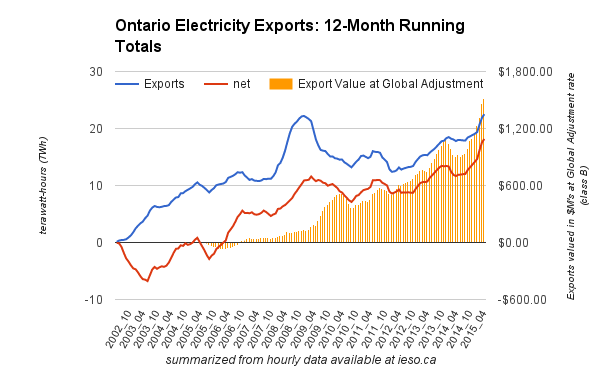
Despite all this activity, the surplus continues to grow. So the power is exported. In 2014, Ontario’s exports totaled 19.1 terawatt hours (TWh), sold at a loss of $1.4 billion. If current trends this year continue, export sales will reach an all-time high and an all-time maximum loss of about $2 billion. You already know who will pay for that.

In effect, every kWh saved is another kWh exported and more money lost. Keep that in mind when you hear the ads.

Robert Lyman

Ottawa

Bob Chiarelli cost you $135–and it’s going to get worse

27 Wednesday May 2015

Posted by Ottawa Wind Concerns in Renewable energy, Wind power

≈ 1 Comment

Tags

Bob Chiarelli, electricity exports, Ontario, Ontario economy, Ontario electricity bills, Ontario hydro bills, Parker Gallant, wind farms, wind power


April 2015: surplus wind power costs Ontario millions

Energy Minister hiding his head over consumer losses due to surplus power, lots of it windEnergy Minister hiding his head over consumer losses due to surplus power, lots of it wind

Electricity exports cost heading for $2 billion in 2015

The continued costs to Ontario’s ratepayers for the oversupply of electricity generation in Ontario continued in April 2015; we exported another 2 terawatts (TWh) of power to our neighbours.  April’s exported TWh brings exports for the first four months of 2015 to 8.65 TWh — that’s enough to supply 900,000 average Ontario ratepayers with power for a full year.

Surplus exports represented over 19% of Ontario’s total demand for the month; that figure doesn’t include curtailed wind, steamed-off nuclear or spilled hydro.

The cost (Hourly Ontario Electricity Price + Global Adjustment) to ratepayers for exported power in April was $223 million. We sold it for 1.57 cents per kilowatt hour, thereby generating only $32 million. Ontario’s electricity ratepayers had to eat $191 million in losses that will find their way to the Global Adjustment pot and the “electricity” line on our bills.

As noted in a prior article, the first quarter of the current year generated losses (costs to ratepayers) of $437 million. So now, with the April figures, those costs to date are $608 million or $135 per ratepayer.

We still have eight months left in the year: at the current pace, our bill to support surplus exports will amount to over $400 for the average ratepayer.

Wind power generation for April represented 39% of the exported volume as it produced about 850,000 MWh (megawatt hours) at an average of $123.50 per/MWh, meaning its cost of $104 million represented almost 50% of total export costs.

Energy Minister Bob Chiarelli doesn’t seem to notice our growing surplus*; however, he has directed the IESO to acquire another 500 MW of renewable energy from wind and solar in 2015, and mandated conservation of another 7 TWh by 2020.

Time to stop digging the hole.

© Parker Gallant

May 27, 2015

The views expressed are those of the author and do not represent Wind Concerns Ontario policy.

 Editor’s note: speaking at a wind power information evening in Finch, Ontario, on May 6th, Ontario Federation of Agriculture president Don McCabe said there is no surplus of power in Ontario. This is a lot of lost power and a lot of losses to electricity consumers—including farmers—to deny.

Ontario Q1 electricity losses: selling our power off cheap

30 Thursday Apr 2015

Posted by Ottawa Wind Concerns in Renewable energy, Wind power

≈ 4 Comments

Tags

CFRA, electricity bills Ontario, hydro bills Ontario, Ontario economy, Parker Gallant, Rob Snow, surplus electricity Ontario, Wind Concerns Ontario, wind farms, wind power

Q1 ratepayer pain: electricity export costs skyrocket

Ontario's electricity customers pay and pay and pay while neighbours get our power cheap
Ontario’s electricity customers pay and pay and pay while neighbours get our power cheap

Wind almost 40% of exported power; cost of surplus export $437 million in just 3 months

The first quarter of the current year indicates Ontario is exporting record quantities of surplus electricity.

It appears to be part of the Liberal government plan as this excerpt from Finance Minister Sousa’s budget “Building Ontario Up” claims:  “Through our four-part economic plan, we are supporting greater investment in productivity and innovation, providing a renewed focus on international exports, encouraging the transition to a low-carbon economy and creating more jobs for Ontarians.”

It would be better if our surplus electricity was exported profitably, instead of a cost to ratepayers, but alas, that is not the way the Liberal Energy Ministers past and present have structured the portfolio.

The first quarter of the current year saw Ontario export a record 6.65 TWh (terawatts) — that’s enough to power 690,000 average households for a full year.

Export costs up 75% in first quarter

The 6.65 TWh sold to our neighbours was up 75% from 3.81 TWh in 2014′s first quarter. We sold that surplus at prices well below what we received.  Exports represented 17.5 % of Ontario’s demand in 2015 versus 10% in the same period in 2014. Wind (generated and curtailed) in 2014 was 2.05 TWh and 53.7% of Ontario’s exports; in 2015, wind grew to 2.61 TWh and was 39.2 % of our exports.

The concept of exporting is one that economists encourage; however, they expect it will be profitable, create jobs, and not burden the rest of the economy though subsidization.  Subsidizing exports is often referred to as “dumping” and frequently challenged under the WTO (World Trade Organization) rules.

Cost to ratepayers is shocking

Examining the cost to Ontario ratepayers for the 3.81 TWh exported in 2014 and the 6.65 TWh exported in 2015 using data from the Independent Electricity System Operator’s (IESO) “Market Summaries” is shocking.

The 2014 first Quarter exports cost (average of $102.6 million/TWh) ratepayers $391 million to produce and was sold via the HOEP (hourly Ontario electricity price) market at an average of $75.54 million/TWh. That cost Ontario’s ratepayers $103 million.  In 2015, the 6.65 TWh exported cost Ontario’s ratepayers $672 million (average cost of $101 million/TWh), and sold at an average of $35.4 million/TWh, costing Ontario ratepayers $437 million.

To put some context to the latter, the money lost exporting the 6.65 TWh  was equal to 6.6 cents per kilowatt hour.   The foregoing subsidy does not include other costs Ontario’s ratepayers pick up including: spilled hydro, steamed-off nuclear or payments to idling gas plants. The subsidies supporting exports is double what Energy Minister Bob Chiarelli suggests is needed to assist almost 600,000 “low-income” households to pay their hydro bills. Ontario’s ratepayers will start paying the latter January 1, 2015.

This analysis would not be complete without noting the cost of wind generation (two quarters) in 2014 was $252.7 million (average cost of $123.5 million per/TWh) and $322.5 million for 2015!

Perhaps our Finance Minister should “focus” on the harm to Ontario’s ratepayers instead of dumping our surplus electricity on our neighbours who are happy to take it and not raise the issue with the WTO.  If the first quarter of 2015 is indicative of the full year, ratepayers will pick up $1.8 billion in subsidies to supply our neighbours with cheap electricity, while Ontario’s citizens struggle.

Parker Gallant, April 28, 2015

The views expressed here are those of the author and do not necessarily represent Wind Concerns Ontario policy.

Chart courtesy Scott Luft of Cold Air Online

EDITOR’S NOTE: Parker Gallant will be on the Rob Snow show on radio CFRA, Friday May 1st, to discuss this. Listen in an AM 580 or online at cfra.com


Ontario budget: ratepayers will pay and pay and pay

28 Tuesday Apr 2015

Posted by Ottawa Wind Concerns in Renewable energy, Wind power

≈ 2 Comments

Tags

Charles Sousa, electricity bills Ontario, hydro bills Ontario, Kathleen Wynne, Ontario, Ontario budget, Ontario budget 2015, Ontario deficit, Ontario economy

Reposted from Wind Concerns Ontario

Ontario ratepayers on the hook for Ontario deficit

Ontario on the brink of the financial abyss--with electricity ratepayers on the hook for millions
Ontario on the brink of the financial abyss–with electricity ratepayers on the hook for millions [Photo: the whirlpool in Niagara Gorge]

“Building Ontario Up”…to a huge disappointment

A letter directed to Energy Minister Bob Chiarelli, dated April 1, 2015, suggesting how he might stop the climb in electricity prices remains unanswered.

The budget preview posted on the WCO site April 19, 2015, however, has been verified.  The Ontario Budget, “Building Ontario Up,” released by Finance Minister Sousa April 23, 2015 has lots of bad news for Ontario ratepayers.

Prior to the release of the budget, Sousa released a 191-page report: “Ontario’s Long-Term Report on the Economy,” which got no media attention.  The report speaks to the wonders of how the current government plans for Ontario’s future will look, but with a caveat:  “It is beyond the scope of projections of this nature to quantify the risks of global political disruptions, extreme weather due to climate change, major health emergencies such as pandemics, disruptive technologies or an increase in international conflicts. Any of these factors, in addition to other unforeseen risks, could significantly impact the long-term outlook for the Ontario economy.”

With respect to electricity, it had this to say: “This will mean pursuing lower-cost options to meet energy needs when and where they are needed and other initiatives to reduce the cost increases in electricity now and in the future. Compared to the previous plan, the 2013 LTEP is expected to reduce projected cost increases by a cumulative $16 billion in the near term (2013–17), and $70 billion by 2030.”

The take-away from the lack of a response from Energy Minister, Bob Chiarelli is that the Liberal agenda, as it relates to the electricity sector, is written in stone and ratepayers are now regarded as a “revenue tool.”  Ratepayers are needed to pay for the agenda, to help balance the budget, and eliminate the deficit, despite the dishonest comment in the preceding quote.

The budget confirmed most of the preview forecast and included areas that extracts after-tax ratepayer dollars, despite the rhetoric in the “Long-Term Report on the Economy.” Non-budget Items, Reduced Spending and Increased Revenue from Ratepayers are three categories reviewed as follows.

►Non-budget Items affecting ratepayers

The budget claims the province is making “investments” falsely by extracting monies from ratepayers as the following quote about the “Northern Industrial Electricity Rate Program” (NIER) notes: “the government is committing to ongoing support for northern industrial facilities beyond March 2016, with continued investment of up to $120 million annually.”

The $120 million referenced will be paid by ratepayers, not taxpayers. It’s just one example.  The rest include: the newly announced Ontario Electricity Support Program (OESP) for “low-income” households of $225 million (see below under “Reduced Spending”); the Class A to Class B shift for industrial consumers with peak demand of 3 Megawatts costing an estimated $200 million; the recently approved rate increase by the Ontario Energy Board for the OPG which increased electricity costs $600 million; and the anticipated increases in delivery charges for LDC (local distribution companies) of $600 million.  Collectively the foregoing represent over $1.7 billion. This additional cost to ratepayers attracts the Ontario Portion of the HST (see below under “Increased Revenue”).

►Reduced Spending

The Ontario Clean Energy Benefit will officially end December 31, 2015 meaning the forecast in the budget reduces this cost by $220 million; it will be followed in the next budget by a further reduction of $900 million.  This reduced spending will than be paid fully by ratepayers and include the HST, raising costs another $145 million putting $90 million into Ontario’s sales tax revenue slot. The budget also shows a cut of $243 million in “Social Service” spending reflecting the advent of the OESP.  Total reduced spending next year will be $450 million and in two years, will be reduced by $1.4 billion!

►Increased Revenue from ratepayers

The budget anticipates increased Payments in Lieu of Taxes (PIL) of $315 million. That means the province is anticipating huge profits being generated by LDC that will be directly taken from ratepayers’ pockets.   In addition, the province’s portion of “sales tax” (forecast to increase $1.2 billion) on HST revenues will produce another $160 million for the 2015/16 year and in excess of $230 million in 2016/17.  Increased Revenue will be $550 million.

Eliminating the double counting on LDC revenue (PIL of $315 versus forecast “Non-budget Item” of $600 million) and “Social Service” spending ($243 million) will saddle ratepayers with costs in excess of $2.1 billion for budget year 2015/16 and $3.1 billion the following year—that’s without including the costs of the additional industrial wind and solar generation now in the contracting process!

In short

The ratepayers in Ontario should be grateful the reduction in those “projected cost increases by a cumulative $16 billion in the near term (2013–17), and $70 billion by 2030” have been tackled by our incumbent government, or the excesses we have seen, past, present and future from the proliferation of industrial wind turbines and solar panels, would have driven all industry from Ontario and have us freezing in the dark and unable to buy groceries.

As it is, the budget claims:  “Ontario remains the leading destination in North America for FDI” (Foreign Direct Investment). That particular claim fails to mention that as much as $25 billion of the “FDI” came from foreign companies rushing to Ontario to sign those lucrative ratepayer-backed wind and solar contracts, guaranteeing them 20 years of subsidies!

The current Liberal government has brought Ontario to the brink of the whirlpool. Unless they change their push for more wind and solar generation “Athens-on-the-lake” (a.k.a. Queen’s Park) and  Ontario will be sucked into the abyss.

©Parker Gallant

April 25, 2015

The views expressed are those of the author and do not necessarily represent Wind Concerns Ontario policy

Economist: top 10 reasons why Ontario carbon tax is a bad idea

16 Thursday Apr 2015

Posted by Ottawa Wind Concerns in Renewable energy, Wind power

≈ 3 Comments

Tags

air pollution, cap and trade, environment, fossil fuel use, Ontario, Ontario economy, renewable energy, renewable power, Robert Lyman

Here, from energy economist Robert Lyman, a discussion of the recent announcement of a “cap and trade” arrangement for Ontario.

Various politicians and academics in Canada have recently called for the introduction of a carbon tax as a means of stimulating a reduction in greenhouses gas emissions. This is welcome news to provincial governments like that of Kathleen Wynne in Ontario that are desperate for new sources of funds. The central arguments for a carbon tax, in terms of economic theory, are that such a tax would create a price disincentive affecting the use of all fossil fuels sources of energy (i.e., oil products, coal, and natural gas) and that it would be more even-handed and economically efficient than the current complex system of subsidies, incentives, and regulatory mandates that are now used in almost every sector of the economy to discourage fossil fuel consumption and emissions. 

British Columbia, it is claimed, has already found success with a carbon tax of about seven cents per liter on gasoline. Allegedly, this caused gasoline consumption in the province to drop from 2008 to 2012, even as British Columbia economic performance overall was one of the best in Canada. 

Such arguments, in my view, are based on wishful thinking and poor understanding of the institutional context within which carbon taxes have been implemented. Here are ten reasons why imposition of a carbon tax in Ontario would be a very bad idea.


Read the full article here: THE TOP TEN REASONS WHY A CARBON TAX IS A BAD IDEA (long version)


Ontario needs to learn from Europe’s green energy debacle, says policy advisor

16 Thursday Apr 2015

Posted by Ottawa Wind Concerns in Renewable energy, Wind power

≈ 3 Comments

Tags

climate change, electricity bills, EU climate policy, Europe, forms of energy, hydro bills, Ontario, Ontario economy, renewable energy, subsidies renewables, wind farms, wind power

Financial Post, April 14

Ontario will follow the EU at its peril — power rates will soar while industries depart

As the Ontario government announces new unilateral climate policies, Canadian policymakers would be well advised to heed the lessons of Europe’s self-defeating green energy debacle.

The European Union has long been committed to unilateral efforts to tackle climate change. For the last 20 years, Europe has felt a duty to set an example through radical climate policy-making at home. Political leaders were convinced that the development of a low-carbon economy based on renewables would give Europe a competitive advantage.

European governments have advanced the most expensive forms of energy generation at the expense of the least expensive kinds. No other major emitter has followed the EU’s aggressive climate policy and targets. As a result, electricity prices in Europe are now more than double those in North America and Europe’s remaining and struggling manufacturers are rapidly losing ground to international competition. European companies and investors are pouring money into the U.S., where energy prices have fallen to less than half those in the EU, thanks to the shale gas revolution.

Although EU policy has managed to reduce CO2 emissions domestically, this was only achieved by shifting energy-intensive industries to overseas locations without stringent emission limits, where energy and labour is cheap and which are now growing much faster than the EU.

Most products consumed in the EU today are imported from countries without binding CO2 targets. While the EU’s domestic CO2 emissions have fallen, if you factor in CO2 emissions embedded in goods imported into EU, the figure remains substantially higher.

Of all the unintended consequences of EU climate policy perhaps the most bizarre is the detrimental effect of wind and solar schemes on the price of electricity generated by natural gas. Many gas power plants can no longer operate enough hours. They incur big costs as they have to be switched on and off to back-up renewables.

Most products consumed in the EU today are imported from countries without binding CO2 targets

This week, Germany’s energy industry association warned that more than half of all power plants in planning are about to fold: Even the most efficient gas-fired power plants can no longer be operated profitably.

Every 10 new units worth of wind power installation has to be backed up with some eight units worth of fossil fuel generation. This is because fossil fuel plants have to power up suddenly to meet the deficiencies of intermittent renewables. In short, renewables do not provide an escape route from fossil fuel use without which they are unsustainable.

Read more here: http://business.financialpost.com/fp-comment/eus-green-energy-debacle-shows-the-futility-of-climate-change-policies

Surplus power in Ontario: $4 billion lost

13 Monday Apr 2015

Posted by Ottawa Wind Concerns in Renewable energy, Wind power

≈ 2 Comments

Tags

electricity bills Ontario, George Smitherman, Green Energy Act, hydro bills Ontario, Ontario economy, Parker Gallant, surplus power Ontario, wind farm, wind power

From Wind Concerns Ontario:

Wind output up, exports up, cost of electricity up— no coincidence

Five years ago, in 2009, George Smitherman, Minister of Energy during the McGuinty reign, rammed through the Ontario Legislature the Green Energy and Green Economy Act.  The Act ushered in the FIT (Feed In Tariff) and MicroFIT programs, attracting corporations from around the world who wanted the lucrative power contracts being let by the government-mandated Ontario Power Authority.

The result of the Act is now evident with huge chunks of rural Ontario covered with solar panels and spiked by 500-foot industrial wind turbines cranking out intermittent electricity, surplus to our demand, 99.9% of the time.

Early in 2010, the Independent Electricity System Operator (IESO) advised us of electricity generation    for Ontario by fuel type for 2009.  The headline in their press release stated: “Wind Power in Ontario Generates a New Record in 2009.” Wind produced 2.3 terawatt hours (TWh) or 1.6% of Ontario’s total demand of 139 TWh.   The same press release noted Ontario exported 15.1 TWh, and wind’s percentage of those exports was 15.2%.  The release also disclosed the average HOEP (hourly Ontario electricity price) for 2009 was $31.6 million per TWh, and the Global Adjustment (GA) $30.6 million/TWh.

That means, the costs of power generation (on average) were $60.2 million per/TWh.

Wind significant share of the loss

In 2009, Ontario exported 15.1 TWh generating revenue of $477.2 million (15.1 TWh x $31.6 million), but the TWh exported cost Ontario ratepayers $909 million (15.1 TWh X $60.2) — that means Ontario lost $432 million.  The cost of power production from wind was $283 million (2.3 TWh X $123 million/TWh), representing 65.5% of the losses on the exported TWh.

Fast forward five years to January 2015: IESO’s announcement indicated Ontario’s demand in 2014 was 139.8 TWh. Wind was 6.8 TWh, or 4% of all generation.  Exports grew to 19.1 TWh and wind’s percentage of exports shot up to 35.6%.   HOEP was $36 million/TWh and the GA jumped to $54.6 million/TWh, making the all-in-cost to Ontario’s ratepayers $90.6 million/TWh.   The cost to produce 19.1 TWh was $1,730 million (19.1 TWh X $90.6 million), and revenue generated from the sale was $688 million (19.1 TWh X $36 million). That left Ontario’s electricity ratepayers to pick up the $1.042 billion shortfall.  The cost for 6.8 TWh of wind was $836 million plus another $42 million1. for curtailed wind bringing its cost to $878 million, representing 84 % of export losses.

$4 billion

The all-in-cost of Ontario’s electricity generation jumped from 6.2 cents/kWh in 2009 to 9.06 cents/kWh in 2014, an increase of 46%. Ratepayers picked up an additional burden of $4,048 million for 139.8 TWh.

The extra .8 TWh (800 million kWh) Ontario ratepayers consumed in 2014 versus 2009 cost us over $4 billion or $5.06 per/kWh, much of it was caused by the push for renewable energy and the need to have back-up power plants for when the wind is not blowing or the sun isn’t shining.

Imagine how many subway stations or hospitals $4 billion might have built.

©Parker Gallant

April 13, 2015

What the Easter Bunny brought you (losses)

10 Friday Apr 2015

Posted by Ottawa Wind Concerns in Renewable energy, Wind power

≈ 2 Comments

Tags

electricity bills Ontario, hydro bills Ontario, Ontario, Ontario economy, Parker Gallant, power demand Ontario, surplus power Ontario, wind power Ontario

What the Easter Bunny brought Ontario’s neighbours

Ontario goodies for somebody...just not you
Ontario goodies for somebody…just not you

Ontario’s ratepayers won’t care much for what the Easter Bunny delivered over the long weekend.

Over Friday, Saturday and Sunday on the weekend of April 3, 2015, the Independent Electricity System Operator (IESO) reported we exported 250,500 megawatt hours (MWh) of electricity to our friends and neighbours, but they gave us only $6.21 per/MWh for power that cost us at least $90 per/MWh to produce.

The exported power over those three days was equivalent to almost 24% of total Ontario Demand of 1,009,700 MWh.

On top of that, IESO indicated via their Planned Outage Report they constrained, spilled, idled or steamed-off another 238,000 MWh from a variety of generators which represented 23% of total Ontario Demand.  Between exports and the outage requirements, ratepayers picked up the tab for 488,000 MWh or 51% of power we didn’t have a demand for.

So, why are we all told to conserve more?

Wind over that weekend generated about 58,000 MWh and represented 23% of exports. The cost of production was $7.1 million ($123 per/MWh) for which we were paid $360K ($6.21 per/MWh) — that’s a loss of $6.7 million.

Ratepayers also picked up the cost of the other 192,500 MWh exported at a cost of $17.5 million and the constrained production at a cost of about $12 million.

$36 million in losses

In those three days, Ontario’s electricity customers paid for all this and saw no benefit. Yet we are obligated to pick up almost $36 million in losses.  Doing this every day would results in annual costs of $3 billion, with no benefit!

We need the Liberal government to tell the Easter Bunny to stay home next time and dole out the Easter treats to Ontario’s ratepayers and taxpayers, instead of our neighbours.

©Parker Gallant,

Toronto, April 7, 2015

Take the poll on CFRA today

02 Thursday Apr 2015

Posted by Ottawa Wind Concerns in Ottawa, Renewable energy, Wind power

≈ 2 Comments

Tags

CFRA, cost of renewables, cost of wind power, online poll, Ontario, Ontario economy, poll, wind power

Radio station CFRA is holding an online poll on the economics of renewable power–wind and solar–take the poll here

How to get those power bills down: Parker Gallant to Bob Chiarelli

02 Thursday Apr 2015

Posted by Ottawa Wind Concerns in Renewable energy, Wind power

≈ 3 Comments

Tags

Bob Chiarelli, electricity bills Ontario, electricity prices, Energy Minister Bob Chiarelli, energy poverty, Feed In Tariff program, HOEP, Ontario, Ontario deficit, Ontario economy, Ontario hydro bills, Parker Gallant, wind farms, wind power, wind power contracts

Financial Post, 2015

Parker Gallant, the former banker who several years ago launched FP Comment’s prophetic Ontario’s Power Trip campaign against the province’s expensive and pointless electricity industry reforms, has some new advice for the government. As the price of electricity soars, Ontario industries and consumers are being hammered by rate increases that seem never-ending. In an open letter today to Energy Minister Bob Chiarelli, Mr. Gallant lists a few easy initiatives the government could undertake to stop some of the madness and save consumers billions of dollars.  Terence Corcoran

LETTER FROM PARKER GALLANT

April 1, 2015

The Honourable Bob Chiarelli, Minister of Energy,

Legislative Building, Queen’s Park, Toronto ON, M7A 1A1

Dear Minister Chiarelli:

Re: Dropping Ontario’s Price for Electricity

I have noted the difficulty you have experienced over the past several months trying to convince the media and the general population of Ontario they should simply bite the bullet and accept the fact that electricity prices will continue their above inflation climb. Having studied the situation I believe I have come up with some suggestions that would allow you to move things in the opposite direction.

First I suspect that Premier Wynne and Finance Minister Sousa exerted considerable pressure on you to come up with a scheme to help out the 500,000 to 700,000 “low-income” households in the province experiencing what is generally referred to as “energy poverty.” While the plan recommended came from the Ontario Energy Board and was altered somewhat by yourself I believe I have a better plan.

More on that later in this letter.

I also suspect that the Premier and Finance Minister told you unequivocally the OCEB was finished at the end of the year as they wish to wave better deficit numbers in front of those pesky credit rating agencies. The $1.2 billion that went to keep electricity rates down, a little bit, would no longer be available and they made that clear to you.

While you did your best to dance around the issue associated with the upcoming big jump in our electricity bills I could see the criticism was troublesome for you. As a result I believe my suggestions on what you should do will put some spring back in your step.

Here they are:

Recommendations to reduce future ratepayer bills

Conservation spending for the period 2015 to 2020 is forecast and budgeted at $1,835 million so drop it and that will provide close to $400 million annually that can go to reduce electricity prices.

Next, cancel the acquisition of the 500 MW of renewable wind and solar that you instructed IESO to acquire. That will save an estimated $200 million annually in future costs that would increase our rates.

I note there are 510 MW of wind generation contracts awarded that have not yet obtained their REA from the MoE and I recommend you also cancel those. I estimate that would provide relief from future increases of another $200 million per annum. I would suspect the costs of exiting these will be nominal.

Needless to say the cancellation of the above 1,010 MW of renewable energy will reduce future power surpluses meaning the HOEP might show some upward movement. That would allow all the dispatched wind and solar, spilled hydro, steamed off nuclear and idled gas to be sold via the market place to our neighbours. I estimate we could sell anywhere from 10/15 TWh annually at a price of somewhere around $40 million per TWh which would earn revenue of $400/600 million annually.

I would also cancel the new OESP plan which is estimated to cost $200 million (including a new administrative bureaucracy costing $20 million) annually.

Now if you do the math on the above the amount of money your portfolio would save in the future and also generate new income it totals $1.7 billion.

You could than use some of that $1.7 billion to both decrease electricity prices and provide relief for those suffering from “energy poverty.”

My recommendations on those two issues follow:

Recommendations to relieve “energy poverty”

First you should instruct the OEB that the .12% allocated to the LEAP program be increased immediately (providing you have completed the other recommendations) to 1% which will immediately make over $30 million available to the social agencies for relief purposes. You should also increase the maximums per household to $1,000 and instruct the OEB that the Return on Equity and/or Return on Assets for the LDC are to reflect a reduction to accommodate this.

Second you should drop the TOU off-peak rate from 7.7 cents per kWh to 5 cents per kWh. The cost of this would be about $350 million. It would also benefit many of those “low-income” households meaning they would no longer suffer from “energy poverty.” The other benefit is that the ratio of offpeak to on-peak would be much closer to the 3 : 1 ratio that the Auditor General suggested it should be and get more people to shift their use. It would also benefit our business community.

The cost of the two above recommendations are less than $400 million meaning ratepayers will be better off by avoiding future rate hikes and seeing some relief on existing rates. At the same time the TOU pricing will provide a clear signal that usage should shift preserving the “conservation” theme.

I certainly hope you will give my suggestions some serious thought and I do look forward to your response.

Yours truly,

Parker Gallant

← Older posts
Newer posts →

Recent Posts

  • Open letter to CAFES Ottawa
  • Ottawa Wind Concerns supports West Carleton residents
  • What does wind ‘farm’ construction really look like?
  • Unwilling Host communities surround Ottawa
  • How many birds do wind turbines kill?

Follow me on Twitter

My Tweets

Enter your email address to follow this blog and receive notifications of new posts by email.

Tags

Bob Chiarelli Green Energy Act IESO Ontario Ottawa Ottawa wind concerns wind energy wind farm wind power wind turbines

Contact us

PO Box 3 North Gower ON K0A 2T0

Create a free website or blog at WordPress.com.

Privacy & Cookies: This site uses cookies. By continuing to use this website, you agree to their use.
To find out more, including how to control cookies, see here: Cookie Policy
  • Subscribe Subscribed
    • Ottawa Wind Concerns
    • Join 379 other subscribers
    • Already have a WordPress.com account? Log in now.
    • Ottawa Wind Concerns
    • Subscribe Subscribed
    • Sign up
    • Log in
    • Report this content
    • View site in Reader
    • Manage subscriptions
    • Collapse this bar
 

Loading Comments...