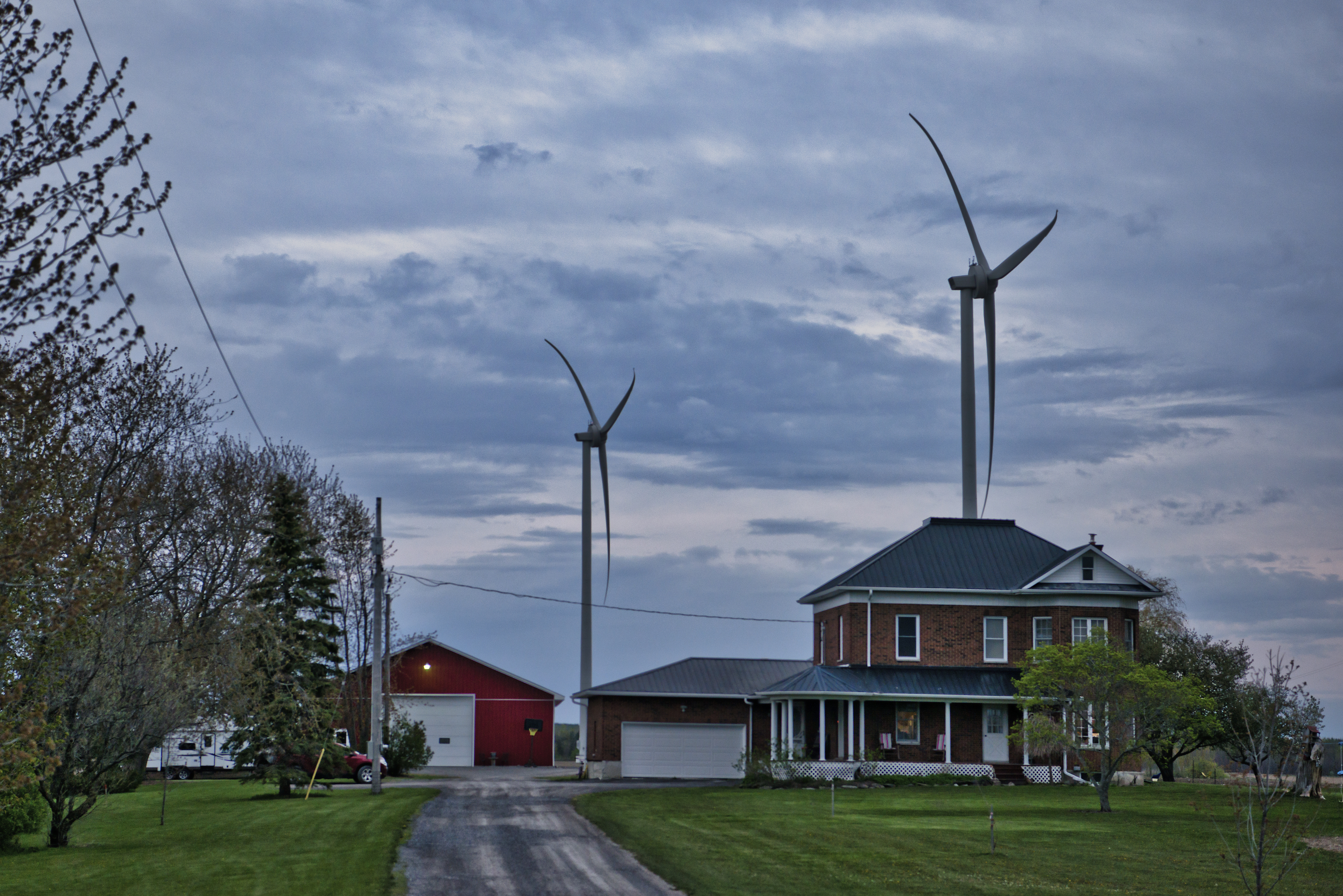
Wind turbines are an industrial land use that affects property owners, neighbours and the wider community. The decision to lease land for these structures is deadly serious. [Photo: D. Larsen]
April, 2026
With the IESO soon to launch its Long-Term 2-Request For Proposals window 2 which will include industrial wind power, it’s likely that rural Ottawa could see some proposals.
If you, or someone you know, has been approached by a wind power developer to sign a lease, it is important to learn all the facts about this transaction. It will affect you, your family, the future of your farm, your neighbours and your community for a very long time.
The best advice we’ve seen comes from the Ontario Federation of Agriculture (OFA) which has prepared a fact sheet on what to consider. Prepared by a farm owner with experience in wind turbine leases, it is a valuable document.
Your neighbours and your community at large will be affected, too. To learn more about the impacts of wind power installations, check out Wind Concerns Ontario’s Impacts page, here: https://www.windconcernsontario.ca/impacts-of-wind-energy/
Wind power developers can be very persuasive, telling you this power is desperately needed (it isn’t, it’s expensive and unreliable), you’ll make lots of money (you’ll lose a lot too), while helping the environment and climate change (false, wind power does nothing for either of these things).
The IESO is an independent agency, that is responsible for contracting for new power sources. They don’t care about agriculture, the environment or health or in fact YOU. It is your duty to be responsible in making any decisions that will result in impacts for 20, 40 even 50-60 years.
It’s not just about money.
For more information contact us at ottawawindconcerns@gmail.com
Farmland Trust warns that current use of prime agricultural land is “unsustainable” while wind power developers make threats if they don’t get access to it for power generation.And money.(Don’t forget the money.)
Berwick area farm: 29 huge industrial wind turbines now operate, despite community opposition [Photo D. Larsen]
The Independent Electricity System Operator or IESO is preparing to launch a new Request for Proposals in 2025, and is gearing up now with consultations for municipalities and stakeholders, prior to releasing final documents.
At issue is the policy of the Ontario government —and the City of Ottawa —that prime agricultural land must be protected.
The wind power industry sees this policy as an obstacle and is fighting back. With some success. In a recent IESO web event, a spokesperson said the question of protecting prime ag land is a topic of “active discussion” in government.
Meanwhile, the Canadian Renewable Energy Association, which is not an environmental organization but a trade association and lobbyist, had this to say in a comment to the IESO. (The emphasis is ours.)
“CanREA recommends that Ontario consider orienting agricultural land use policy in a manner similar to Alberta’s recently announced ‘agriculture first’ approach for renewable energy project approvals. This approach allows wind and solar generation on Class 1 and 2 lands if they can demonstrate that they can co-exist with agriculture.
“We believe that this is a sensible approach. CanREA’s law firm members who represent Ontario farmers in negotiations with renewable energy developers describe numerous cases where siting of renewable energy projects on agricultural lands has provided additional income to allow farmers to stay on the land – making farming careers sustainable for them and their families.
“Should additional restrictions be imposed, renewable energy development would be forced into less desirable areas with lower wind and solar potential, located further away from load centres. This would result in system inefficiency, reduced levels of project investment and higher cost solutions for Ontario ratepayers.”
Very clever wording on their part and not without active threats to the Ontario government, even going so far as to mention the association’s “law firm members.” Phrases like “additional restrictions” are meant to foreshadow legal action if CanREA doesn’t get what it wants, which is unfettered access to Ontario’s farmland for profit.
People want farm land protected
The lobbyist is out of step with Ontario’s citizens and the primacy of protecting our food supply. At a time when “eat local” echoes throughout the province, and the COVID experience of interrupted food supply is fresh in everyone’s mind, the protection of Ontario’s cropland is important.
“Every day in Ontario, we lose 319 acres of farmland to non-agricultural land uses like urban development and aggregate extraction; this rate of farmland loss is unsustainable and cannot be allowed to continue. Everyone in Ontario relies on agriculture, from the food we eat, to the jobs in our communities.Without strong protections in place for our farmland, we may not be able to provide enough food to feed our growing population.”
Wind power developers: we want the money
Several wind power developers lined up to file comments with the IESO too—any resemblance to the comments from CanREA are not accidental. Here is Capital Power.
“Broad, overarching limitations or restrictions for specific classifications of agricultural land or technology types will likely limit the development of cost-effective projects in locations near existing energy infrastructure. It will also result in a loss of potential non-agricultural income for farmers. Capital Power submits that the appropriate use of land and potential impacts on agricultural use is most effectively determined between landowners, developers, and through current project approval processes. No further limitations, rated criteria, or other considerations needs to be considered for LT-2 or potential projects.”
Translation: hands off our negotiations with farm owners.
Similarly, U.S.-based Invenergy commented:
“We would work with the landowners to minimize impact to the land and form an agreement to return land to its original state. Some projects may be able to allow for the same productivity levels of the agricultural land like a wind facility.”
Invenergy also said restricting prime agricultural land mean that municipalities would lose out on tax revenues from wind power projects. That is true but with the tax rates currently capped, the amount paid is a pittance in comparison to wind power operator profits, and would need to be assessed along with municipal costs such as the need for fire services, inspections, etc. It is not possible to return land fully to its “original state”—wind turbines require massive concrete and rebar foundations that cannot be removed.
Wind power developers also under-represent the amount of land used for wind turbines. At least one developer currently claims a turbine uses only 0.2 of an acre but obviously, this does not take into account access roads and other infrastructure.
You can read more industry comments here but make no mistake: they want that prime farm land and will do anything, and say anything to get it.


 Ottawa Wind Concerns