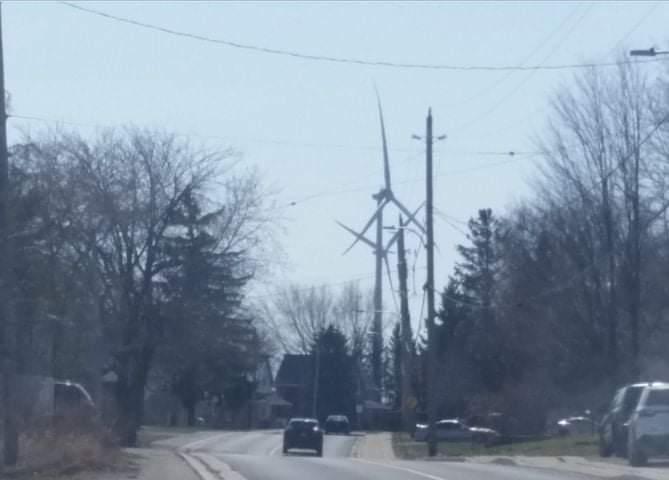
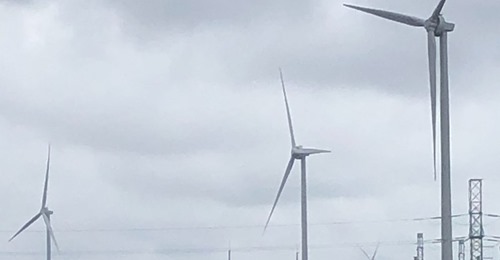
Huge grid-scale wind turbines are changing the landscape in North Stormont as the Nation Rise wind power project approaches commercial operation in June.
The photo above shows a view of the village of Crysler with two of the wind turbines visible. The Nation Rise turbines are 131 metres to the hub height, or 429 feet. The height to the blade tip is more than 600 feet.
There are 29 turbines in total in the industrial power project.
Wind Concerns Ontario reports that some residents have already experienced excessive noise and vibration from the turbines; they have been advised to call the Ministry of Environment, Conservation and Parks Cornwall Office at 1-800-860-2760. If the call is outside of business hours, residents should call the 24/7 Spills Action Centre at 1-866-MOE-TIPS.
In both cases, caller should be given an Incident Report number, and should also keep a record of their call.
You may also email nationrise@edpr.com to report problems; the company is required to pass along your complaint to the environment ministry.
An editorial in the Eastern Ontario edition of Farmers Forum says “Toronto” should never have imposed the 100-megawatt Nation Rise wind power facility on the communities of North Stormont.
In his editorial titled “How wind turbines scarred a landscape and a community,” editor Patrick Meagher notes that the township conducted a survey of residents and found most didn’t want the wind turbine development, and then unanimously voted to declare North Stormont an “Unwilling Host”.
“But things didn’t go that way,” Meagher writes.
Weeks before the provincial election in 2018, the Liberal government “greenlighted the project. This was in spite of a longstanding agreement not to approve major projects when another government could take over. Wynne got a two-for-one deal, sticking it to the next government and the locals at Crysler, Berwick and Finch.” (The riding went Conservative.)
The wind power project caused strong feelings, Meagher says. “The project was so acrimonious that in this small community friendships broke up, family members stopped talking to each other, and more than 10 property owners sold their houses and moved away.”
Now the community is “stuck” with 29 huge turbines that are “large, inefficient, taxpayer-subsidized generators of intermittent power…not even a good business decision.”
“This ugly event is testimony to why governments should listen to the people they work for…Toronto should never have decided what should happen in this small farming community 400 kilometres away.”
The editorial also quoted former mayor Dennis Fife who said the community now has to try to move on.
The 100-megawatt “Nation Rise” wind power project, being constructed in North Stormont in the communities of Finch, Crysler and Berwick, will be finished and operating by June, the developer EDPR told a community liaison meeting last week.
The project will provide power to more than 25,000 homes —sometimes. Wind power is weather-dependent, intermittent, and produced out of phase with demand in Ontario, at night, and in the warmer seasons of spring and fall.
A news story with more details was published in the Cornwall Standard-Freeholder. Read it here. Note the concerns the community still has about this project, and questions asked (without satisfactory answers) by Councillor Steve Densham.
The community filed multiple appeals of the approval of this project, which was done in the dying days of the Wynne Liberal government. Concerns were about environmental noise pollution, harm to wildlife including migratory birds and endangered species of bats, and the risk of harm to the local aquifer, which is designated as “highly vulnerable” by the provincial government.
Testing of the wind turbine operations should begin soon, and full operation is planned for June.
Anyone experiencing problems with noise, vibration or sound pressure, and/or problems with their water wells, should call the Ontario Spills Action Centre at 1-866-MOE-TIPS. The call centre is available 24 hours a day.
Be sure to get an Incident Report number if you call, and keep a record of your call for yourself.
Tremendous step backwards for environmental protection, citizens group says
Water supply, wildlife and noise pollution were concerns in the community fight against an unwanted wind power project [Photo: Pexels]
May 15, 2020
The decision released Wednesday by the Ontario Superior Court which overturned the Ontario environment minister’s move to revoke approval of a large wind power project has shocked the communities that have been fighting for five years to stop the wind “farm” due to concerns about the environment and wildlife.
While the urban media, at the urging of the wind power lobby, power developer, the NDP and Green political parties and so-called environmental organizations are happy about the court decision, those familiar with the power project and the evidence presented against it are not.
The court decision does not merely overturn the minister’s revocation of the project approval, it declares the minister had no authority to act and in essence, writes new public policy over development decisions and the environment. Referencing the “Ford government” with obvious distaste and a transparently one-dimensional view of the government’s approach to environmental issues, columnists failed to recognize what the court has really done.
Concerned Citizens of North Stormont chair Margaret Benke said the decision leaves the “entire Province highly vulnerable. The Minister and Ministry of the Environment with all their resources can’t protect our natural resources and species at risk. The only protection against these kinds of mistakes by the ERT [the quasi-judicial body that hears appeals of approvals] is now in the hands of private citizens,” Benke said.
“We will be asking the Court of Appeal to reconsider what seems to be a tremendous step backwards for environmental protection in Ontario.”
The community group appealed the approval for the project on the grounds of risk of harm to wildlife, the environment specifically the aquifer which is noted as “highly vulnerable” by the Ontario government, and the risk to human health from the wind turbines. The appeal was dismissed; the group then filed a direct appeal with the minister, noting errors in the Environmental Review Tribunal decision. The minister revoked the approval last December saying the risk to endangered bats was significant, he wanted to “exercise precaution” and in any event, Ontario does not need the electrical power from the wind project.
While media reports claim the Ford government dislikes renewable energy projects, the truth is, the Wynne government halted all procurement in 2016 saying the province had enough electricity, and 90 percent of the power suppl was emissions-free. The Wynne government actually cancelled several wind power projects, but gave contracts to five that year, including Nation Rise.
The power developer insists the community did not bring forward bats in their appeal, which is not correct: written submissions were presented to the Tribunal but then, the wind power developer filed a last-minute report which gave the community group’s expert witness no time to review it, so little of his evidence was presented.
The Concerned Citizens group has spent over $100,000 on legal fees; in Wednesday’s decision they were punished for their work to protect the community and environment by having to pay the power developer $60,000 in costs.
The office of the Attorney General or the Minister of the Environment, Conservation and Parks have not made a comment on whether they will appeal the decision, which clearly has an impact on ministerial authority.
Turbine components waiting for delivery to Nation Rise wind power project. Another $450 million to go on your hydro bill. [Photo: Leanne Baldwin]*
October 24, 2019
Ontario Premier Doug Ford gave his first interview after the federal election today, with host Bill Carroll on Ottawa talk radio CFRA.
The topic was how Ford could work with Prime Minister Justin Trudeau after an acrimonious election campaign in which Ford was repeatedly used as an example of Conservative government dedicated to budget cuts, but the conversation included the cost of electricity in Ontario, and why hydro bills are set to go up next week, when the Ford government had promised to get them down.
“[The electricity file] has been very frustrating,” Ford told Bill Carroll. He put some of the blame on the McGuinty-Wynne governments which cut lucrative deals for wind and solar with “cronies” Ford said, and Ontarians are now stuck paying above-market rates for electricity.
“We’re trying to get a handle on it,” he said.
Meanwhile, despite a citizen appeal that cost the people of North Stormont, south of Ottawa, about $100,000 in legal fees as they brought forward numerous, serious concerns about the impact of grid-scale wind turbines on people and the environment, the 100-megawatt Nation Rise wind power project is under construction.
It will cost Ontario electricity customers more than $450 million over its 20-year contract.
And, in Chatham-Kent, another wind power project is being built: Romney Wind is being built by EDF of France. That will add over $250 million to electricity bills.
“If you set out to destroy the electricity file in Ontario, you could not have done a better job than they[McGuinty and Wynne] did,” Ford said.
ottawawindconcerns@gmail.com
*Note the pickup truck in the lower left corner of the photo—an idea of the scale of the wind turbines
Despite a full appeal of the Nation Rise wind power project by community group Concerned Citizens of North Stormont, which raised serious issues of concern about human health and the environment, and despite a final appeal and request for a Stay of construction, the 100-megawatt wind power project is under construction in the Finch, Berwick, and Crysler areas.
Construction updates are to be provided by the developer EDPR on its website here
There have already been citizen complaints about dust and noise during construction, as well as a couple of mishaps with trucks and trailers delivering turbine components, and citizens have reported concerns about road safety.
EDPR at its construction update meeting in Finch last week said anyone concerned about safety, or who notices a worksite where there are no flagmen, should contact the company at: Email: nationrise@edpr.com Phone: (613) 240-0348
The Ottawa Citizen recently ran an article by Kelly Egan which outlined community concerns. Ontario does not need more intermittent or variable wind power, which is produced out of phase with demand (source Auditor General Ontario). The Nation Rise project will cost Ontario electricity customers $450 million over its 20-year contract.
How the wind power industry made a fool out of Ontario
Noise complaints unanswered, wells contaminated, a huge job ahead to unwind the damage
Home in Huron County surrounded by turbines: no laughing matter [Photo Gary Moon]
April 1, 2019
It’s now almost a decade since Ontario passed the Green Energy and Green Economy Act, which opened the door to industrial-scale wind power developments throughout the province, and heralded ten years of environmental impact … for nothing.
In fact, the province had already approved a gigantic wind power project in Melancthon, and racked up hundreds of noise complaints before the Green Energy Act was passed — the government went ahead anyway.
Today, we have high electricity bills which are harming ordinary families and discouraging business investment; the government has records of thousands of complaints about wind turbine noise and vibration (mostly unresolved); there are 40 or more families in Chatham-Kent who trace the failure of their water wells to construction and operation of wind turbines on a fragile aquifer there; and, we are seeing the environmental impacts that were brought forward in citizen appeals of Renewable Energy Approvals now becoming reality.
Ontario citizens spent close to $10 million in after-tax dollars to protect their communities from the onslaught of large-scale wind power, according to a survey Wind Concerns Ontario did of our coalition members.
The Ontario wind power disaster should not have been a surprise.
Auditor General Jim McCarty chastised the McGuinty government for never having done a cost-benefit or impact study on the wind power program; subsequently, current Auditor General Bonnie Lysyk estimated that Ontario electricity customers overpaid for renewable energy by $9.2 billion.
Guaranteed to fail
The program to encourage large-scale wind power (the province had a choice back in 2004 onwards to go for small-scale power generation–that’s not what they chose, guided by wind lobbyists) was based on ideology and was criticized by such informed analysts as Michael Trebilcock, who said “This combination of irresponsibility and venality has produced a lethal brew of policies.”
Economics professor Ross McKitrick predicted, “If the goal [of the Green Energy Act] was to promote industry and create jobs, it is guaranteed to fail.”
And Tom Adams, who said, “Urban Ontario, including city-bound journalists, are largely unaware of the corrosive effects some wind developments are having on communities, neighbourhoods, even families. This is expropriation without compensation.”
The jobs never materialized, electricity bills went up, a new phrase “energy poverty” was coined, businesses closed or left, and families were forced to leave their homes because of unbearable noise.
Noise complaints are so prevalent in Huron County that the health unit launched a follow-up study (results will be published later this year). Preliminary data showed that 60% of the people participating in the follow-up were experiencing problems because of wind turbine noise.
Wind Concerns Ontario presented the government’s own noise complaint data as evidence at the appeal of the Nation Rise power project last summer; the approval was upheld regardless of citizen concerns about noise, and damage to a provincially designated “highly vulnerable aquifer.”
Meanwhile, reports of noise are investigated on behalf of the wind power operators by the same companies who prepared the original noise impact assessments for them; one such acoustics firm even boasts that it created the government’s noise assessment protocol.
The fox is not only in the hen house, he built it to ensure easy access.
As Ontario’s new government struggles with all this (Energy Minister Greg Rickford told the Legislature last week that this is a “very difficult” file), there is little to laugh about in Ontario today as the spring winds blow, and families face more sleepless nights.
Berwick area farm: 33 huge industrial wind turbines planned could mean a loss of $37 million for nearby property owners [Photo Dorothea Larsen, Kemptville]
Homeowners in North Stormont will have to make a big sacrifice to “green” energy if the proposed “Nation Rise” wind power project is constructed, says Wind Concerns Ontario, a coalition of community groups and Ontario families.
Using research completed recently by a land economist with the University of Guelph and published in Land Economics, Wind Concerns calculates that overall, the property loss for houses within 5 km of the 33 planned turbines could be $87.8 million. Using other research that is less conservative, however, the property value loss could be more than $140 million.
Research done in 2016 by the partnership of Clarkson University and Nanos Research on U.S properties with a view of Wolfe Island wind turbines showed an overall property value loss of 15 per cent for homes “with a view” of the turbines. Older research done by Ontario real estate appraiser Ben Lansink in 2012 found a more dramatic reduction for properties closest to turbines, an average loss of 37 per cent.
University of Guelph associate professor Richard Vyn found a property value loss in communities opposed to wind power projects of 8.98 percent for houses within 2 km of turbines, and 8.62 per cent for properties within 4 km, post-construction of turbines.
For the Nation Rise power project, there are 828 properties within 1,500 metres of turbines according to the wind power developer, Portugal-based EDP, and approximately 2,500 residences within 2 to 5 km of the turbines, according to community group Concerned Citizens of North Stormont.
The houses within 1,500 metres of a turbine in the “Nation Rise” project could see a loss of $21.8 million using professor Vyn’s estimate, $37 million according to Clarkson-Nanos, or as much as $91 million in losses using Mr. Lansink’s calculations.
The community group has appealed the project approval on the basis of environmental, safety and health concerns, and is worried about the effect of turbine construction on the water supply, which could be an additional factor in property value loss.
Wind power proponents and Ontario’s municipal assessment agency have maintained that there is no appreciable property value loss, but an energy commentator wrote in Forbes magazine in 2015 that “there’s a heavily funded public relations machine to make Americans think that wind power doesn’t impact property values.”
“Renewable energy and the ‘environment’ are big businesses and they include not just energy producing companies but also various agencies, interest groups, and even university researchers,” Jude Clemente wrote. “Their grant money and careers are at stake.”
Clemente added that “Many members of the Real Estate and Appraisal businesses, however, have been clear that wind power DOES impact property values … it would seem to me that these groups have no vested interest in supporting wind power or not supporting it.”
A decision is expected on the Nation Rise project appeal in the first week of January, 2019.
Ontario’s Independent Electricity System Operator (IESO) says Ontario has an adequate supply of power until 2035. The 20-year contract for the Nation Rise project will cost Ontario more than $450 million.
The citizen-funded appeal of the 100-megawatt, 30+ industrial-scale wind turbine power project in North Stormont (between Ottawa and Cornwall) resumes Monday with expert testimony from a hydrogeologist. Testimony will centre on the danger to area water supply as a result of vibration from construction and operation of the turbines.
Residents in the Chatham-Kent area of Ontario have already experienced problems connected to wind turbine construction, with dozens of families and farms now without water when turbines were constructed on a highly vulnerable aquifer.
The aquifer in the “Nation Rise” wind power project is also designated “highly vulnerable” and residents are concerned.
One of the conditions of the Renewable Energy Approval given to the project by the Wynne government in its last days before election defeat requires that wells within a prescribed distance of turbines must be identified and the water tested prior to construction. That hasn’t happened, say residents, who note that as far as they can tell, the Spain-based power developer EDP has identified less than half the wells that could be affected.
Now, residents whose wells have not been noted by the developer are posting signs.
“We do not want EDP to be able to say that they did not know that we have wells,” Margaret Benke of Concerned Citizens of North Stormont explains. “They counted only 444 domestic wells within 2 km of a turbine/infrastructure, although there are 816 residences in the same area. As long as this project continues to proceed, we want our wells taken into consideration for health and safety.”
That count does not include wells used by local farm operations for livestock, which could also be affected by the vibration from construction and turbine operation.
The danger to water supply was one of the principal issues noted in the appeal launched against the project, and appears also to be a concern to the provincial environment ministry, reflected in the conditions in the project approval. In fact, even though the appeal had already begun, the power developer actually filed notice that it was changing the construction method for the wind turbines, which have huge concrete foundations. This material change to the project has never been subjected to public scrutiny and was not part of the company’s documentation on the project.
“It’s not good enough,” says Benke. “We’ve seen what happened to the people in North Kent, some of whom still don’t have any water, not even to take a bath or shower—any damage to the aquifer could be serious and irreversible harm to the environment, and a risk to human health.”
The appeal resumes in Finch at the community centre and arena on Monday morning.